Boeser Trade: Will Canucks Move Their Last Star? 2026
The Boeser trade question lingers after Brock Boeser survived the March 6 deadline despite interest from the Bruins and Islanders. With a $7.25M NMC, 16 goals in 58 games, and a Canucks rebuild accelerating around him, Vancouver faces a summer decision on their longest-tenured star.
Live updates
No updates yet. Refreshing automatically.
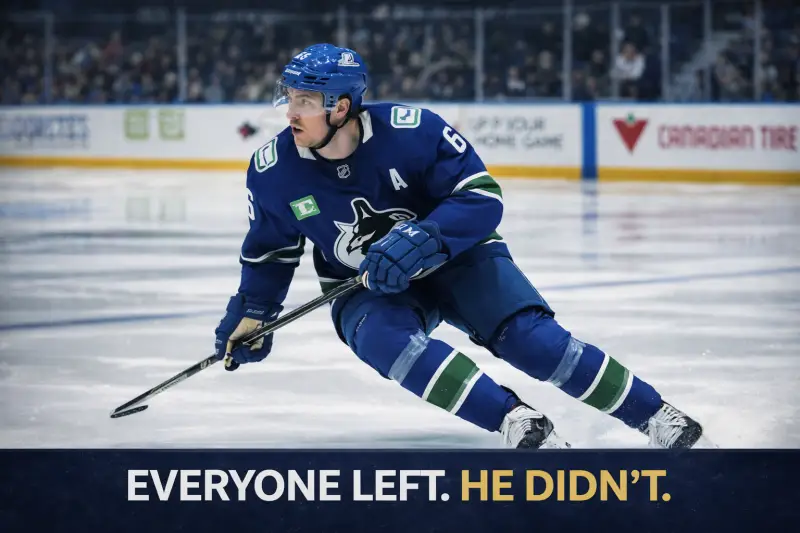
The Boeser trade question won't go away. Brock Boeser survived the March 6 deadline without being moved, but the fact that his name was on every insider's board tells you everything about where Vancouver stands right now. The Canucks are 20-37-8 and sitting in the wreckage of a season that started with playoff hopes and ended with a full-scale teardown. Quinn Hughes is gone. Tyler Myers is gone. Conor Garland is gone. And yet Boeser — the longest-tenured Canuck on the roster — is still here.
So what happens next? Is the Boeser trade speculation justified, or is his $7.25 million cap hit a price worth paying for stability during a rebuild?
Why the Boeser Trade Talk Won't Die
Let's start with the obvious. Vancouver isn't just bad — they're historically bad. A 20-37-8 record puts them 31st in goals for (164) and dead last in goals against (239). Head coach Adam Foote has benched Elias Pettersson in the third period during a game in Seattle. The vibes are not good.
The Canucks' front office pulled the trigger on five trades at the deadline, shipping out Garland to Columbus, Myers to Dallas, Lukas Reichel to Boston, and David Kampf to Washington. They collected a haul of draft picks — two seconds, a third, a fourth, and two sixths. But the one name everyone expected to see moved? Boeser. And he stayed put.
Multiple reports linked the Bruins and Islanders to a potential Boeser trade before the deadline. TSN's Darren Dreger reported that Boeser would consider waiving his no-movement clause for "the right fit." But that fit never materialized — or the price wasn't right — and here we are.
The Contract That Makes a Boeser Trade So Complicated
Boeser signed a seven-year, $50.75 million extension last July 1st. That's $7.25 million AAV through 2031-32. The deal includes a full no-movement clause for the first four years, meaning the Canucks can't move him without his explicit permission through 2028-29. After that, it shifts to a 15-team no-trade list.
Here's the fundamental Boeser trade dilemma: you're asking a contender to take on $7.25 million for a winger who has 16 goals and 31 points in 58 games this season. Those aren't numbers that scream franchise wing. Boeser has shown he can score 30-plus — he's done it before — but at 29, with limited elite speed and a cap hit that's already above market value for his current production, the return was always going to disappoint.
And that's before you factor in the NMC. Boeser controls his destiny. He decides if and when he goes. "I committed to signing here for that long, and I'm not just going to bail on the guys," he told Sportsnet. "I'm not going to go ask for a trade."
Key Takeaways
- Boeser survived the March 6 trade deadline despite interest from the Bruins and Islanders, with his full NMC giving him veto power over any deal
- His 2025-26 stats (16 G, 15 A, 31 P in 58 GP) represent a down year that suppressed his Boeser trade value at the worst possible time for the Canucks
- The $7.25M AAV through 2031-32 makes a Boeser trade difficult unless Vancouver retains salary, which defeats the purpose of a rebuild
- The Rossi-Ohgren-Boeser line has shown real chemistry since the Olympic break, giving Vancouver a reason to keep him as the veteran anchor
- Vancouver's rebuild haul so far: Marco Rossi, Liam Ohgren, Zeev Buium, a 2026 first-round pick (from Hughes), plus six additional picks from deadline deals
The Case for Keeping Boeser
Not every rebuild requires scorching the earth completely. And opponents of a Boeser trade point to a legitimate argument: he's more valuable in Vancouver than whatever draft capital he'd return on the open market.
Since the Olympic break, the Rossi-Ohgren-Boeser line has been one of the few bright spots in an otherwise miserable season. Ohgren brings the speed, Rossi has the playmaking instincts, and Boeser provides the finishing touch and the veteran presence that young players desperately need. Rossi has been particularly impressive, posting a goal and two assists in a 4-3 shootout win over Nashville — exactly the kind of development the Canucks need to see.
Boeser isn't just a name on the roster. He's the longest-tenured Canuck, he's respected in the room, and he's publicly committed to mentoring the young core through what could be a multi-year rebuild. "I feel like I can be a leader and show the guys the right way," he said. In an organization that just traded its captain, that kind of stability matters.
The Case for Moving Him
But here's the counterargument, and it's not a weak one. Boeser turns 30 next year. His speed limitations are getting more pronounced. And the Canucks' rebuild timeline — with a roster that's going to lean heavily on prospects like Tom Willander, Buium, and potentially a top-five pick from the 2026 draft — doesn't really align with Boeser's remaining prime years.
If Vancouver waits another year, the Boeser trade conversation gets harder. He'll be 30 with five years left on a deal that includes a 15-team no-trade list. The return drops. The leverage shifts entirely to the player. And the Canucks might end up stuck carrying a $7.25 million cap hit for a winger on a team that won't be competitive until 2028 at the earliest.
From my perspective, the window to maximize a Boeser trade is this offseason. Not the draft floor — too rushed. But a July deal where Patrik Allvin can negotiate from a position of knowing exactly what the draft produced and which contenders have cap space to absorb the full hit. The longer they wait, the worse it gets.
Boeser's Stats: A Tale of Three Seasons in One
| Stretch | GP | G | A | P | Context |
|---|---|---|---|---|---|
| Oct-Nov (Hot Start) | 20 | 8 | 7 | 15 | Top-line minutes with Pettersson |
| Dec-Feb (Goal Drought) | 22 | 3 | 5 | 8 | Longest drought of career, Hughes traded |
| Post-Olympic Break | 16 | 5 | 3 | 8 | Chemistry with Rossi-Ohgren |
| Full Season | 58 | 16 | 15 | 31 | On pace for ~45 pts |
The numbers tell a clear story. The Boeser trade value peaked in November when he was scoring at a 30-goal pace. By the time the deadline arrived, his production had cratered through the mid-season drought, and the return simply wasn't there. The post-Olympic resurgence is encouraging, but 16 games of chemistry with new linemates isn't enough to rebuild a trade market that evaporated in December.
What Happens This Summer?
The Boeser trade debate isn't over — it's just on pause. Jim Rutherford and Allvin have made it clear they're willing to make uncomfortable decisions. Trading your captain (Hughes) in December proved that. But Boeser's NMC means this isn't entirely their call.
If the Canucks land a top-three pick and add another elite prospect, the pressure to clear cap space intensifies. Boeser's $7.25 million could fund two or three roster spots for the kind of depth pieces a rebuilding team actually needs. The Boeser trade market will look very different in July when contenders have cap space and time to integrate a new winger before training camp.
The answer probably lands somewhere in the middle. The Canucks will quietly shop a Boeser trade through the summer, and if a contender offers a first-round pick plus a solid prospect, they pull the trigger. If not, Boeser stays, mentors the kids, and they revisit the conversation next March.
Frequently Asked Questions
Will Brock Boeser be traded by the Canucks?
A Boeser trade remains possible this offseason, but his full no-movement clause through 2028-29 gives him veto power. He survived the March 2026 deadline and has publicly committed to staying, but Vancouver's rebuild timeline may force the issue if the right offer emerges this summer.
What is Boeser's contract with the Canucks?
Boeser signed a seven-year, $50.75 million extension on July 1, 2025. The deal carries a $7.25 million AAV through 2031-32, with a full no-movement clause for the first four years and a 15-team no-trade list after that.
What are Boeser's stats in 2025-26?
Boeser has 16 goals and 15 assists for 31 points in 58 games during the 2025-26 season. His production dipped significantly during a mid-season goal drought but has picked up since the Olympic break on a line with Marco Rossi and Liam Ohgren.
Who did the Canucks trade at the 2026 deadline?
Vancouver moved Conor Garland (to Columbus), Tyler Myers (to Dallas), Lukas Reichel (to Boston), and David Kampf (to Washington). The Canucks also traded captain Quinn Hughes to Minnesota in December for Marco Rossi, Liam Ohgren, Zeev Buium, and a 2026 first-round pick.
Frequently Asked Questions
Will Brock Boeser be traded by the Canucks?
A Boeser trade remains possible this offseason, but his full no-movement clause through 2028-29 gives him veto power. He survived the March 2026 deadline and has publicly committed to staying, but Vancouver's rebuild timeline may force the issue if the right offer emerges this summer.
What is Boeser's contract with the Canucks?
Boeser signed a seven-year, $50.75 million extension on July 1, 2025. The deal carries a $7.25 million AAV through 2031-32, with a full no-movement clause for the first four years and a 15-team no-trade list after that.
What are Boeser's stats in 2025-26?
Boeser has 16 goals and 15 assists for 31 points in 58 games during the 2025-26 season. His production dipped significantly during a mid-season goal drought but has picked up since the Olympic break on a line with Marco Rossi and Liam Ohgren.
Who did the Canucks trade at the 2026 deadline?
Vancouver moved Conor Garland (to Columbus), Tyler Myers (to Dallas), Lukas Reichel (to Boston), and David Kampf (to Washington). The Canucks also traded captain Quinn Hughes to Minnesota in December for Marco Rossi, Liam Ohgren, Zeev Buium, and a 2026 first-round pick.
Related Stories
McDavid Gudas Suspension: NHL Audit Call After 5-Game Ban
McDavid Gudas suspension fallout deepens as the Oilers captain calls for a full NHL disciplinary audit. Gudas got 5 games for a season-endin...
By Mike Johnson · 6 min read

Andersson Golden Knights Extension: Why No Deal Yet
The Andersson Golden Knights extension hasn't happened yet — but it's a CBA and cap issue, not a willingness problem. Friedman says both sid...
By Mike Johnson · 5 min read
McTavish Healthy Scratch: What's Gone Wrong in Anaheim
McTavish healthy scratch rocks Anaheim as the $42M center sits while Troy Terry returns with 3 points and Carlson debuts. Full breakdown of...
By Mike Johnson · 6 min read

Carlson Ducks Extension: 2-Year Deal Worth $8-9M Projected
The Carlson Ducks extension is projected at 2 years, $8M-$9M AAV per Pierre LeBrun. Anaheim has the cap room, the rising ceiling, and the mo...
By Mike Johnson · 6 min read
Comments
Be the first to share your take.
Get NHL trade rumors in your inbox
One email per week. Zero spam. Verified rumors only.