Bobrovsky Panthers Extension: The 50% Pay Cut Coming
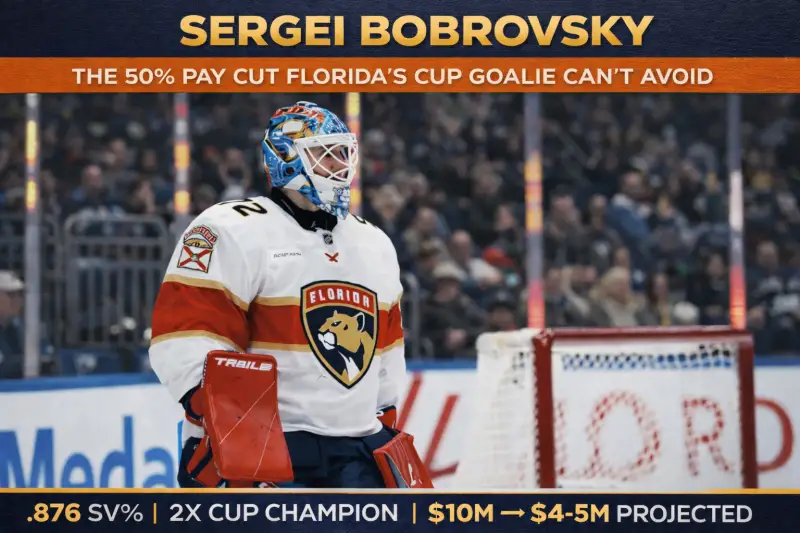
Bobrovsky's Panthers extension will be a 2-3 year deal at $4-5M AAV — a 50% pay cut from his $10M. The worst season of his career meets the Knight trade aftermath.
Live updates
No updates yet. Refreshing automatically.
The Bobrovsky Panthers extension is going to happen. Both sides have said it publicly. GM Bill Zito calls him "a part of our core." Bobrovsky himself said he loves everything about the organization. Insider David Pagnotta expects a two-year deal signed after the season. None of that is in question. What IS in question is the number — because a two-time Stanley Cup champion with a .876 save percentage is walking into the most awkward contract negotiation in the NHL this summer.
Call it The Bobrovsky Discount. The gap between what a franchise goalie with two rings and two Vezinas believes he's earned and what a 37-year-old with the worst statistical season of his career actually commands on the open market. That gap is going to be uncomfortable for everyone involved.
Key Takeaways
- The numbers are brutal: Bobrovsky's .876 save percentage and 3.07 GAA are the worst marks of his 16-year career — a significant drop from his .906 career average
- The pay cut is unavoidable: His $10M AAV expires in July. Realistic extension range is $4-5M on a 2-3 year deal — a 50%+ reduction that no amount of Cup rings can avoid
- Florida has no backup plan: The Spencer Knight trade to Chicago in March 2025 eliminated the Panthers' goalie succession plan, making Bobrovsky's return a necessity rather than a preference
- The Marchand comp is dead: Bobrovsky's camp reportedly pitched a Brad Marchand-style deal (6yr/$5.25M at age 37) and the Panthers rejected it outright — different position, different decline curve
- Pagnotta's prediction: The Fourth Period's David Pagnotta expects a two-year extension signed after the season ends, which tracks with how Florida typically handles these negotiations
A .876 Save Percentage From a Two-Time Cup Champion
I've watched Bobrovsky win two Cups. Watched him steal the 2024 playoffs almost single-handedly with a .909 postseason save percentage that climbed to .925 in the Final. Watched him do it again in 2025. The man's postseason resume is bulletproof.
His regular season this year tells a completely different story.
Through 46 games, Bobrovsky has posted a .876 save percentage and a 3.07 GAA with a 24-20-1 record. For context, his career save percentage is .914. That's a 38-point drop. In goaltending terms, that's not a slump — that's a different player.
| Season | GP | SV% | GAA |
|---|---|---|---|
| 2022-23 | 55 | .913 | 2.83 |
| 2023-24 (Cup) | 55 | .915 | 2.59 |
| 2024-25 (Cup) | 47 | .904 | 2.82 |
| 2025-26 | 46 | .876 | 3.07 |
Here's what the advanced numbers say: Bobrovsky's goals saved above expected (GSAx) has cratered into negative territory this season. He's allowing more goals than a league-average goalie would on the same shots. That's a brutal metric for a guy who was elite by this measure as recently as 2024. The decline isn't gradual — it fell off a cliff this year, which could mean either a temporary blip or the start of the age-related regression curve that hits every goalie eventually.
The trend line is ugly. Three straight years of decline — .915 to .904 to .876. Even the Cup-winning seasons showed cracks if you looked at the regular season numbers. The difference is that in 2024 and 2025, playoff Bobrovsky showed up and erased every concern. At 37, betting on that switch flipping again is getting harder to justify.
"I want to be here. I love the team. I love the fans. I love the organization. I love the guys. I love everything. Yeah, I want to stay here."
— Sergei Bobrovsky, postgame (via Florida Hockey Now)I don't doubt that he means it. But wanting to stay and being worth $10 million to stay are two very different conversations.
Why Florida Holds All the Cards (And Has No Alternative)
The Panthers are negotiating from a position of strength on price — and a position of desperation on need. That contradiction is the entire story of this extension.
Zito's bargaining power on the dollar amount is obvious. Bobrovsky is 37 with career-worst numbers. The UFA goalie market this summer is thin, which means Bob won't get a bidding war. No team is offering a 37-year-old with a sub-.880 save percentage more than $5 million per year. The Panthers know this. Bobrovsky's agent knows this.
But here's the part that gives Bobrovsky bargaining power back: Florida traded Spencer Knight to Chicago in March 2025 for Seth Jones and a pick. That trade eliminated the Panthers' goalie succession plan. Knight was supposed to be the future. He's gone. The current backup is Chris Driedger, called up from AHL Charlotte. There is no prospect in the pipeline ready to take over.
If Bobrovsky walks in free agency, the Panthers are starting next season with Driedger or whoever they can find on the UFA market — behind a core of Barkov ($10M), Tkachuk ($9.5M), and Reinhart ($8.75M). That's a Cup-contending roster with an AHL goalie. You don't do that.
The result: both sides know a deal gets done. The only fight is over term and AAV.
The Bobrovsky Discount — What the Numbers Say
Bobrovsky's camp reportedly used the Brad Marchand deal as a comparable — six years at $5.25 million AAV, signed at age 37. The Panthers rejected that comparison immediately. I'd have done the same. Marchand is a forward. Forwards age differently than goalies. A 37-year-old winger can adjust his game, take fewer minutes, move to the power play. A 37-year-old goalie either stops pucks or he doesn't. There's no part-time option.
The real comparables are goalies specifically. And the data isn't encouraging:
| Goalie | Age | AAV | Term |
|---|---|---|---|
| Marc-Andre Fleury (MIN) | 39 | $2.5M | 1 yr |
| Jonathan Quick (NYR) | 38-39 | $1.55M | 1 yr |
| Craig Anderson (BUF) | 41 | $1.5M | 1 yr |
| Bobrovsky (proj.) | 37 | $4-5M | 2-3 yrs |
Fleury took $2.5 million at 39. Quick is making $1.55 million at 39. Those are backup-money deals for Hall-of-Fame-level goalies. Bobrovsky is younger (37) and has a stronger recent postseason track record than either of them did at the time of signing. That's worth a premium — but not a $10 million premium.
The historical pattern is clear: elite goalies take massive pay cuts after 36. Fleury went from $7 million to $2.5 million. Quick went from $5.8 million to $1.55 million. Luongo retired rather than play out his final year at a reduced role. The only goalie who bucked this trend in the modern cap era was Lundqvist, and that's because the Rangers bought him out rather than let him decline on their dime.
Bobrovsky's camp will argue the Cup rings should bump his value above Fleury and Quick's deals. I'd agree — partially. Two championships in the last three years is unprecedented for a goalie entering free agency at 37. But the regular season numbers are the numbers. An .876 save percentage doesn't become .910 because you won a Cup two years ago. The Panthers are paying for what Bobrovsky WILL be, not what he WAS.
My projection: 2 years at $4.5 million AAV. Maybe 3 years at $4 million if Bobrovsky's camp pushes for term. Anything above $5 million per year would be an overpay given the statistical decline. Anything below $3.5 million would be insulting to a two-time champion. The sweet spot is the $4-5M range that Pagnotta and other insiders have been floating.
"Sergei is a part of our franchise, a part of our core. We want to try and keep him."
— Bill Zito, Panthers GM (via ESPN)The Cap Math Florida Can't Ignore
The Panthers have an estimated $17 million in projected cap space for 2026-27 with the ceiling rising to $104 million. That sounds like plenty until you count the bodies.
Barkov is locked in at $10 million. Tkachuk at $9.5 million. Reinhart at $8.75 million. Those three eat $28.25 million before you add a single depth player. Factor in the trade deadline additions and expiring deals, and that $17 million in space has to cover a starting goalie, a backup, and half a dozen roster spots.
If Bobrovsky signs at $4.5M, that leaves $12.5 million for everything else. A backup goalie ($1-2M), two bottom-six forwards ($1.5-2M each), a depth defenseman ($1-2M) — and suddenly you're at the ceiling with zero flexibility. This is why term matters as much as AAV. A two-year deal keeps the Panthers nimble. A three-year deal at $4M saves $500K annually but locks them in through Bobrovsky's age-40 season — and history says goalies don't age gracefully past 39.
There's also the Tkachuk factor that nobody's discussing. He's been on LTIR, and when he returns, the Panthers are right against the ceiling. Every dollar of Bobrovsky's extension has to be calculated against Tkachuk's $9.5 million tax-advantaged cap structure returning in full. Zito is playing Tetris with a $104 million ceiling and $90+ million in existing commitments. The Bobrovsky Discount isn't just about what Bob deserves — it's about what the roster can physically absorb.
What kills me is that the Knight trade is the reason this math is so tight. If Knight were still in the system, the Panthers could let Bobrovsky walk, save the $4-5 million, and have a young starter ready. Instead, they traded their insurance policy for a defenseman and now have to pay the premium.
What If He Walks? The UFA Nightmare Scenario
I don't think Bobrovsky leaves. Neither does Pagnotta. Neither does anyone who's actually covering this team. But the Panthers have to game-plan for it.
The 2026 UFA goalie market is remarkably thin. There is no elite option available. Devon Levi is a trade target, not a free agent. The Panthers' backup options would be journeymen — guys making $2-3 million who might give you an .895 save percentage on a good night.
That's not good enough for a team paying $28.25 million to three forwards who expect to compete for a Cup. Florida without Bobrovsky is a team with a $100 million roster and a $2 million goalie. That's how dynasties end — not with a bang, but with a bad goaltending decision.
Edmonton and Montreal both kicked tires on Bobrovsky before the deadline. The Oilers are desperate for goaltending stability and would have offered a first-round pick. The Canadiens need a veteran presence behind their young core. If Bobrovsky hits the open market, those two teams — plus Vegas and maybe Buffalo — would be the realistic suitors. But at 37, none of them are paying more than $5 million per year either.
The UFA market actually strengthens Florida's negotiating position. If Bobrovsky's best offer from another team is 2 years at $4 million, the Panthers can match that without breaking a sweat. The only scenario where Florida loses is if someone panics and offers 4+ years — and in the current cap environment, I'd bet anything that doesn't happen.
Sources and Reporting
- ESPN — Bobrovsky 2025-26 season statistics and game log
- ESPN — Panthers keep Bobrovsky at deadline, pivot to contract extension
- PuckPedia — Contract details, cap hit, UFA status verification
- Florida Hockey Now — Bobrovsky "I want to be here" quote and extension reporting
- ClutchPoints — Marchand comparable rejected by Panthers
- Hockey-Reference — Career statistics and save percentage history
- PuckPedia — Panthers 2026-27 cap space projections
- The Fourth Period — David Pagnotta's two-year extension prediction
The Bobrovsky Discount is coming. My read: 2 years, $4.5 million AAV, signed sometime between the end of the season and draft week in late June. Florida gets their Cup goalie at half price. Bobrovsky gets to chase a third ring in the building where he became a legend. Both sides take something off the table — and that's exactly how it should work when a 37-year-old franchise icon meets a salary cap that doesn't care about Vezina trophies.
Frequently Asked Questions
What is Sergei Bobrovsky's current contract status?
Bobrovsky's 7-year, $70 million contract ($10M AAV) expires in July 2026, making him an unrestricted free agent. The Panthers chose not to trade him at the deadline and are actively negotiating a new deal. At 37, he won't command anywhere near his current $10 million — expect a 50%+ pay cut.
How bad has Bobrovsky been this season?
His .876 save percentage and 3.07 GAA are both career worsts across 16 NHL seasons. For perspective, his career average is .914. He's still gone 24-20-1 with 3 shutouts, but the Panthers have been winning despite his numbers, not because of them.
What will Bobrovsky's extension look like?
Insider David Pagnotta projects a two-year deal after the season. The AAV will likely land between $4 million and $5 million. Bobrovsky's camp pushed for a Marchand-style deal (6yr/$5.25M), but the Panthers shut that down. Fleury took $2.5M at 39 and Quick $1.55M at 38 — Bob's Cup pedigree gets him more, but not much more.
Why didn't the Panthers trade Bobrovsky at the deadline?
Four teams — Edmonton, Montreal, Vegas, and Buffalo — showed interest. But Florida's problem is they traded Spencer Knight to Chicago last March, eliminating their succession plan. Without a replacement ready, trading Bob meant starting next season with an AHL backup behind a $28 million forward core. The math didn't work.
Frequently Asked Questions
What is Sergei Bobrovsky's current contract status?
Bobrovsky's 7-year, $70 million contract ($10M AAV) expires in July 2026, making him an unrestricted free agent. The Panthers chose not to trade him at the deadline and are actively negotiating a new deal. At 37, he won't command anywhere near his current $10 million — expect a 50%+ pay cut.
How bad has Bobrovsky been this season?
His .876 save percentage and 3.07 GAA are both career worsts across 16 NHL seasons. For perspective, his career average is .914. He's still gone 24-20-1 with 3 shutouts, but the Panthers have been winning despite his numbers, not because of them.
What will Bobrovsky's extension look like?
Insider David Pagnotta projects a two-year deal after the season. The AAV will likely land between $4 million and $5 million. Bobrovsky's camp pushed for a Marchand-style deal (6yr/$5.25M), but the Panthers shut that down. Fleury took $2.5M at 39 and Quick $1.55M at 38 — Bob's Cup pedigree gets him more, but not much more.
Why didn't the Panthers trade Bobrovsky at the deadline?
Four teams — Edmonton, Montreal, Vegas, and Buffalo — showed interest. But Florida's problem is they traded Spencer Knight to Chicago last March, eliminating their succession plan. Without a replacement ready, trading Bob meant starting next season with an AHL backup behind a $28 million forward core. The math didn't work.
Related Stories

How Do Line Changes Work in Hockey?
A line change is hockey's strangest routine: you swap players while the puck is live, but only inside a five-foot pocket beside your own ben...
By Mike Johnson · 10 min read

What Is the Long Change in Hockey?
The long change is not jargon, it is bench geography. Teams switch ends each period but keep the same bench, so in the second period a tired...
By Mike Johnson · 9 min read
What Is a Delayed Penalty in Hockey?
A delayed penalty is not a penalty yet. It is the referee holding the whistle after a foul until the penalized team touches the puck, which...
By Mike Johnson · 9 min read
What Is a One-Timer in Hockey?
A one-timer reaches the net just 42% of the time, the worst of any shot, yet it is the most dangerous weapon in hockey and the shot Ovechkin...
By Mike Johnson · 11 min read
Comments
Be the first to share your take.
Get NHL trade rumors in your inbox
One email per week, zero spam, verified rumors only.