How Does NHL Salary Cap Work? Complete 2026 Guide
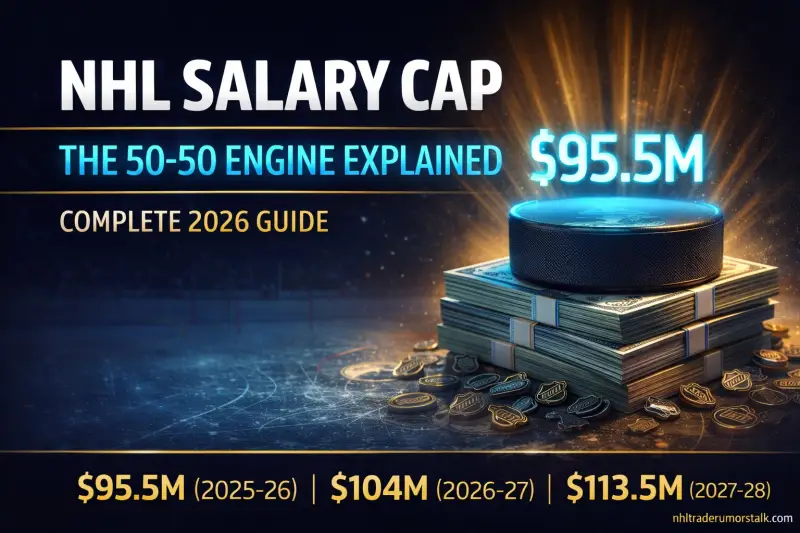
The 2025-26 NHL salary cap is $95.5 million, rising to $104 million in 2026-27. This complete guide explains the 50-50 Engine formula, LTIR loopholes, the new playoff cap rule, NMC/NTC power, ELC value, and every cap mechanic that drives NHL trades and free agency.
Live updates
No updates yet. Refreshing automatically.
$95.5 million — that is the 2025-26 NHL salary cap ceiling, the hard spending limit that every general manager in the league must build a roster around. The NHL salary cap works by splitting Hockey Related Revenue (HRR) 50-50 between players and owners, dividing the players' share across 32 teams, and adding a 15% band above and below that midpoint to set the ceiling and floor. Understanding how this system works in 2026 is essential for following trades, free agency, and contract negotiations — this guide explains every mechanic from the revenue formula to the loopholes teams exploit.
Unlike the NBA's soft cap or the NFL's tag-and-franchise system, the NHL operates a hard salary cap with no luxury tax escape valve. Every team must stay at or below the ceiling and at or above the floor. There are no exceptions for homegrown players, no mid-level exceptions, and no amnesty provisions. When a GM like Kyle Dubas or Kevin Cheveldayoff says "we don't have cap space," they mean it literally — the NHL's system leaves zero room for creative accounting that ignores the number.
NHL Salary Cap 2025-26 — Quick Reference
| Cap Ceiling (2025-26) | $95.5 million |
| Cap Floor (2025-26) | $70.6 million |
| 2026-27 Projection | $104.0 million |
| 2027-28 Projection | $113.5 million |
| Max LTIR Relief (returning player) | $3.82 million |
| Max Salary Retention per Trade | 50% (3 teams max) |
| Max Contract Length (re-sign / new team) | 8 years / 7 years |
| Min Player Salary | $775,000 |
Sources: NHL.com, PuckPedia, CapWages — verified April 2026
Key Takeaways
- The 50-50 Engine: The NHL salary cap is calculated by splitting Hockey Related Revenue (HRR) equally between players and owners, then dividing the players' share across 32 teams — this formula is why the cap rises when the league makes more money
- 2025-26 cap ceiling: $95.5 million per team, with a floor of $70.6 million — an increase of $7.5 million from the previous season's $88 million
- 2026-27 projection: The cap jumps to $104 million with a $76.9 million floor, representing the largest single-year increase since the flat-cap era ended
- New playoff cap rule: Starting with the 2026 postseason, teams must be cap-compliant for every playoff game — closing the LTIR loophole Tampa Bay and Vegas exploited
- LTIR relief change: Teams can now only receive up to $3.82 million in cap relief for a player expected to return that season, down from the full cap hit under the old rules
How the NHL Salary Cap Is Calculated: The 50-50 Engine in 2026
Every dollar of the salary cap traces back to a single source: Hockey Related Revenue. HRR includes ticket sales, national and local broadcast deals, merchandise, sponsorships, and arena revenue across all 32 teams. Under the current collective bargaining agreement between the NHL and NHLPA, players receive 50% of adjusted HRR as their total compensation pool.
The 50-50 Engine
The revenue-sharing mechanism at the heart of the NHL's salary cap system. Players and owners split Hockey Related Revenue equally — 50% each — and the players' half is divided by 32 teams to produce the midpoint. The cap ceiling sits 15% above that midpoint; the floor sits 15% below. Every trade rumor, free agency signing, and contract negotiation on this site flows directly from this formula.
Here's how the math works in practice. Per the CBA formula confirmed by PuckPedia and CapWages, if adjusted HRR totals $6.3 billion, the players' 50% share equals $3.15 billion. Divide that by 32 teams, and the per-team midpoint lands at approximately $98.4 million. Apply the 15% band: the cap ceiling becomes roughly $113.2 million, and the floor drops to approximately $83.7 million.
The actual 2025-26 numbers — $95.5 million ceiling, $70.6 million floor — reflect HRR from the previous season plus adjustments for escrow repayments and prior-year reconciliations. An escrow system withholds approximately 6% of every player's paycheck during the season to ensure the 50-50 split balances out. If players collectively earn more than their 50% share, the escrow funds cover the difference. If they earn less, the withheld money gets returned.
NHL Salary Cap History: From $39 Million to $104 Million in 2026
When the salary cap debuted after the 2004-05 lockout, the ceiling was $39 million. Twenty-one years later, it has nearly tripled — and the growth hasn't been linear. Here is the complete year-by-year history, verified through PuckPedia and NHL.com:
| Season | Cap Ceiling | Change |
|---|---|---|
| 2005-06 | $39.0M | First cap year |
| 2008-09 | $56.7M | +$17.7M in 3 yrs |
| 2013-14 | $64.3M | Post-lockout reset |
| 2018-19 | $79.5M | +$15.2M in 5 yrs |
| 2019-20 to 2021-22 | $81.5M | Flat cap (COVID) |
| 2022-23 | $82.5M | +$1M (cap thaws) |
| 2023-24 | $83.5M | +$1M |
| 2024-25 | $88.0M | +$4.5M |
| 2025-26 | $95.5M | +$7.5M |
| 2026-27 (projected) | $104.0M | +$8.5M |
| 2027-28 (projected) | $113.5M | +$9.5M |
What stands out to me is the three-year flat-cap era from 2019-20 through 2021-22. The COVID-19 pandemic froze HRR growth, and the cap stayed locked at $81.5 million for three consecutive seasons — the longest stagnation in cap history. That freeze compressed the market, forced teams into cap gymnastics with no-movement clauses and buyouts, and created a pent-up demand for spending that is now exploding. The projected $8.5 million jump to $104 million in 2026-27 is the largest single-season increase since 2007-08, and NHL revenue projections around $6.8 billion suggest even further acceleration through 2028.
Cap Hit, AAV, and Dead Cap: How NHL Contracts Count Against the Salary Cap
Not every dollar a player earns counts the same against the cap. The most important number to understand is cap hit — also called AAV (average annual value). It's calculated by dividing the total contract value by the number of years. When Auston Matthews signed a four-year, $53 million deal with the Maple Leafs, his cap hit became $13.25 million per year, regardless of whether he actually earns $15 million in year one and $9 million in year four.
How to Calculate a Player's Cap Hit: Step-by-Step
Let's walk through Connor McDavid's contract as a real example. He signed a two-year extension with Edmonton at a total value of $25 million. Here's the math:
- Total contract value: $25,000,000
- Divide by term: $25,000,000 / 2 years = $12,500,000
- Cap hit (AAV): $12.5 million per season — this number counts against Edmonton's $95.5 million ceiling every single day of the contract, regardless of how the actual payments are structured
It doesn't matter if McDavid earns $15 million in year one and $10 million in year two. The cap hit stays flat at $12.5 million both seasons. This is why front-loading or back-diving contracts exists — GMs manipulate cash flow while keeping the cap hit constant. Honestly, once you understand this one calculation, you understand 80% of how NHL trades get structured.
That gap between cap hit and actual cash paid creates one of hockey's sneakiest competitive edges. Matthews' deal pays $15.925 million in signing bonuses in year one but only $775,000 in base salary. Why structure it that way? Because teams in states without income tax — Florida, Texas, Nevada — can offer players more take-home pay on the same cap hit.
The Sergei Bobrovsky extension with the Panthers is the textbook example: Florida's zero state income tax makes a $10 million AAV deal worth roughly $500,000 more per year compared to the same deal in Toronto or New York.
Then there's dead cap space — the ghost of roster mistakes past. When a team buys out a player's contract, the remaining cost is spread over twice the remaining term at a reduced rate. A player with one year and $4 million left would cost approximately $1.33 million against the cap for each of the next two years after buyout. My read: the teams that mismanaged the flat-cap era are still paying for it through buyout penalties in 2026.
NMC, NTC, and Trade Clauses: The Salary Cap's Hidden Power Brokers
Trade clauses don't show up in the cap number, but they control everything about how a GM can manage that number. Three types dominate NHL contracts, and the differences between them matter enormously when trade season arrives:
| Clause Type | Blocks Trades? | Blocks Waivers/Minors? | Blocks Expansion Draft? |
|---|---|---|---|
| Full NMC | Yes — all 32 teams | Yes | Yes |
| Full NTC | Yes — all 32 teams | No | No |
| Modified NTC | Partial — player submits 10-15 team list | No | No |
The full NMC is the nuclear option. Stars like Connor McDavid, Auston Matthews, and Nathan MacKinnon all carry one, giving them effective veto power over every form of player movement. When we covered Cale Makar's $18 million AAV shutdown, the NMC was the reason Colorado couldn't move him even if they wanted to.
I've watched this play out the same way for a decade now: a GM hands out an NMC to keep a star happy, then three years later that same clause prevents the roster flexibility needed to stay competitive. A $10 million player with a full NMC is essentially unmovable — that locks $10 million of cap space in place regardless of performance. Smart GMs like Steve Yzerman in Detroit build rosters with trade flexibility in mind. Others, like the Nashville Predators with their NMC-heavy contracts, end up trapped when a rebuild becomes necessary.
To be eligible for any trade clause, a player must have seven NHL seasons or be at least 27 years old.
LTIR, the Playoff Cap, and the Loopholes Teams Exploit in 2026
Long-Term Injured Reserve (LTIR) is the salary cap's most misunderstood mechanism — and the one teams have historically abused most aggressively. Here's how it works and what changed in 2025-26.
When a player is expected to miss at least 10 games and 24 days, the team can place them on LTIR. This provides cap relief roughly equal to the player's cap hit, allowing the team to spend over the ceiling by that amount. The key word is "roughly" — the actual relief depends on the team's cap position at the moment the player goes on LTIR, a calculation called the "LTIR pool."
"It's a big rule change, and like a lot of big rule changes, there will be some things we can foresee and some things we don't foresee as far as how it'll impact our decision-making process and how we approach the trade deadline."
— Chris Patrick, Washington Capitals GM (via RMNB / Pierre LeBrun)Patrick's candor is rare for an NHL GM — most executives avoid commenting on CBA mechanics publicly. But his point captures the uncertainty perfectly: every contender's front office is recalculating how they approach the trade deadline now that LTIR relief is capped at $3.82 million (the previous season's average league salary) for any player expected to return that season. Under the old rules, a team received full relief on the injured player's entire cap hit. That era is over.
This rule change is massive. Under the old system, Tampa Bay placed Nikita Kucherov on LTIR for the entire 2020-21 regular season, received full cap relief on his $9.5 million hit, added players at the deadline, and then activated Kucherov for the playoffs — where there was no salary cap. They won the Stanley Cup. The new CBA directly targets this strategy by capping LTIR relief at $3.82 million (the previous season's average league salary) for any player who plans to return.
Starting with the 2026 playoffs, the loophole closes entirely. For the first time in NHL history, teams must be cap-compliant during the postseason. The 20 players dressed for each playoff game must fit under the regular-season ceiling, and all dead cap charges (buyouts, retained salary) count against that number.
Real Example: Florida's Tkachuk LTIR Strategy (2024-25)
The clearest demonstration of how the old LTIR rules worked came from the 2024-25 Florida Panthers. Matthew Tkachuk suffered a lower-body injury at the 4 Nations Face-Off in February 2025, and Florida placed him on LTIR. His $9.5 million cap hit moved off the books, and the Panthers used that relief to acquire defenseman Seth Jones from Chicago at the trade deadline — taking on $7 million in cap hit after the Blackhawks retained $2.5 million.
When the 2025 playoffs arrived, Tkachuk returned to the lineup and Florida iced a roster valued well above the $88 million regular-season ceiling. Under the new rules taking effect this season, Florida would have received only $3.82 million in relief on Tkachuk's $9.5 million hit — a $5.68 million difference that likely kills the Jones trade entirely. This is why the new CBA changes matter beyond theory: they directly target the championship-building strategy that Tampa Bay (Kucherov 2021), Vegas (Stone 2023), and Florida (Tkachuk 2025) all used.
"Starting this spring, the lineup for each game must fit under the salary cap."
— NHL.com official announcement (via NHL.com)I'd bet this changes how contenders approach the trade deadline permanently. Teams like the Blues dealing Robert Thomas or the Stamkos trade destinations discussion take on new dimensions when the acquiring team must account for playoff cap compliance months in advance.
Entry-Level Contracts, RFAs, and UFAs: How the NHL Salary Cap Shapes Player Movement
Every NHL career follows the same contractual progression, and each stage interacts with the salary cap differently:
It starts with the entry-level contract (ELC). Drafted players sign one-to-three-year deals with a maximum AAV based on draft position — first-round picks typically max out around $925,000 in base salary plus performance bonuses. This is where smart teams extract enormous value: players like Cole Eiserman with the Islanders deliver first-line production at a tenth of the cost. Every dynasty in modern hockey was built on the back of ELC production.
What happens when that cheap deal expires? If the player is under 27 with fewer than seven NHL seasons, he becomes a restricted free agent (RFA). His current team holds matching rights, so even if another franchise offers him a contract, the original team can match it and keep the player.
The wrinkle that makes RFA negotiations so tense is the offer sheet — a rival team signs the player and surrenders draft picks as compensation, scaled to the AAV. It rarely happens, but the threat alone gives agents enormous bargaining power.
The final stage is unrestricted free agency (UFA), triggered at age 27 or after seven NHL seasons. No matching rights, no compensation — pure open-market bidding where the salary cap ceiling becomes the only constraint. This is where bidding wars like the TJ Hughes situation erupt, and where GMs either build contenders or cripple their rosters with overpays.
One final guardrail: maximum contract length is eight years for a player re-signing with his current team and seven years for a new team, preventing franchise-crippling mega-deals from dominating the cap for a full decade.
Sources and Reporting
- NHL.com — Official salary cap projections for 2025-26 through 2027-28
- CapWages — Salary cap formula explanation, HRR calculation, and escrow mechanics
- PuckPedia — LTIR rules, cap relief mechanics, and 2025-26 changes
- CapWages — Top 10 CBA changes for 2026 including playoff cap and contract rules
- ESPN — League revenue growth analysis and salary cap spike context
- NHL.com — Official playoff salary cap compliance rules announcement
- Wikipedia — Historical salary cap figures from 2005-06 to present
- Elite Prospects — Contract structure rules, ELC details, and UFA/RFA eligibility
The Verdict: The 50-50 Engine
Every trade rumor, every contract breakdown, and every free agency prediction on this site traces back to one number: the salary cap ceiling. At $95.5 million in 2025-26 and $104 million projected for 2026-27, the 50-50 Engine is accelerating after three years of pandemic-induced stagnation. My projection: the cap surpasses $110 million by 2027-28 as NHL revenue pushes past $7 billion, fundamentally reshaping the market for franchise players.
The teams that understand this system — the LTIR mechanics, the NMC implications, the ELC value, the playoff cap — will build dynasties. The teams that don't will spend $95.5 million and still miss the playoffs.
Frequently Asked Questions
What is the NHL salary cap for 2025-26?
The 2025-26 NHL salary cap ceiling is $95.5 million per team, with a salary floor of $70.6 million — a $7.5 million increase from 2024-25. The cap is projected to rise to $104 million in 2026-27 and $113.5 million in 2027-28 per the NHL-NHLPA agreement. The midpoint between ceiling and floor sits at approximately $83.05 million.
What happens if an NHL team goes over the salary cap?
An NHL team cannot exceed the salary cap — it is a hard cap with no luxury tax option. If a team's total cap hit exceeds the ceiling at any point during the season, the NHL will not approve the transaction that caused the violation. Teams found in violation face fines, loss of draft picks, and potential voiding of contracts. The only legal way to exceed the cap is through LTIR, which provides temporary relief equal to an injured player's cap hit under specific conditions.
How does salary retention work in NHL trades?
When a team trades a player, it can agree to retain a portion of that player's salary — up to 50% of the remaining cap hit. The retaining team continues to carry that retained amount against its own cap for the duration of the contract. A maximum of three teams can retain salary on a single contract simultaneously. Salary retention has become a critical trade deadline tool, allowing cash-strapped contenders to acquire players they otherwise could not fit under their cap.
What is the difference between a no-trade clause and a no-movement clause?
A no-trade clause (NTC) prevents a team from trading a player without consent, but the team can still waive, assign to the minors, or buy out the player. A no-movement clause (NMC) is stronger — it blocks all forms of player movement including trades, waivers, minor league assignments, and expansion draft exposure. Only players with seven NHL seasons or who are at least 27 years old are eligible for either clause.
Why was the NHL salary cap flat for three years?
The cap was frozen at $81.5 million from 2019-20 through 2021-22 because the COVID-19 pandemic slashed Hockey Related Revenue when arenas closed or operated at reduced capacity. Since the cap is tied to HRR via the 50-50 Engine formula, reduced revenue meant no growth. The NHL and NHLPA agreed to escrow adjustments and deferred payments to manage the shortfall, and the cap finally began rising again in 2022-23 at $82.5 million.
How do performance bonuses affect the salary cap?
Performance bonuses on entry-level contracts and certain one-year veteran deals do not count against the cap during the season unless they push the team past the ceiling. If achieved bonuses cause a cap overage after the season ends, the excess is charged to the following season's cap as a penalty. Eleven teams carried bonus overage penalties into the 2025-26 season. Only ELC players, players aged 35-plus on one-year deals, and long-term injury veterans on one-year contracts are eligible for performance bonuses.
Frequently Asked Questions
What is the NHL salary cap for 2025-26?
The 2025-26 NHL salary cap ceiling is $95.5 million per team, with a salary floor of $70.6 million. This represents a $7.5 million increase from the 2024-25 cap of $88 million. The midpoint between the ceiling and floor is approximately $83.05 million. The cap is expected to rise further to $104 million for 2026-27 and $113.5 million for 2027-28 per the NHL-NHLPA agreement announced in January 2025.
What happens if an NHL team goes over the salary cap?
An NHL team cannot exceed the salary cap -- it is a hard cap with no luxury tax option. If a team's total cap hit exceeds the ceiling at any point during the season, the NHL will not approve the transaction that caused the violation. Teams found in violation face fines, loss of draft picks, and potential voiding of contracts. The only legal way to exceed the cap is through LTIR, which provides temporary relief equal to an injured player's cap hit under specific conditions.
How does salary retention work in NHL trades?
When a team trades a player, it can agree to retain a portion of that player's salary -- up to 50% of the remaining cap hit. The retaining team continues to carry that retained amount against its own cap for the duration of the contract. A maximum of three teams can retain salary on a single contract simultaneously. Salary retention has become a critical trade deadline tool, allowing cash-strapped contenders to acquire players they otherwise could not fit under their cap.
What is the difference between a no-trade clause and a no-movement clause?
A no-trade clause (NTC) prevents a team from trading a player without consent, but the team can still waive, assign to the minors, or buy out the player. A no-movement clause (NMC) is stronger -- it blocks all forms of player movement including trades, waivers, minor league assignments, and expansion draft exposure. Only players with seven NHL seasons or who are at least 27 years old are eligible for either clause.
Why was the NHL salary cap flat for three years?
The cap was frozen at $81.5 million from 2019-20 through 2021-22 because the COVID-19 pandemic slashed Hockey Related Revenue when arenas closed or operated at reduced capacity. Since the cap is tied to HRR via the 50-50 Engine formula, reduced revenue meant no growth. The NHL and NHLPA agreed to escrow adjustments and deferred payments to manage the shortfall, and the cap finally began rising again in 2022-23 at $82.5 million.
How do performance bonuses affect the salary cap?
Performance bonuses on entry-level contracts and certain one-year veteran deals do not count against the cap during the season unless they push the team past the ceiling. If achieved bonuses cause a cap overage after the season ends, the excess is charged to the following season's cap as a penalty. Only ELC players, players aged 35-plus on one-year deals, and long-term injury veterans on one-year contracts are eligible.
Related Stories

NHL Buyout Candidates 2026
The NHL buyout window opens June 15. Rielly, Gallagher, Kotkaniemi, and Frederic are the names in play, but the Dead-Cap Tail means most buy...
By Mike Johnson · 10 min read

Bill Guerin Wild Window Paradox: $17M Meets $1.18M
Wild GM Bill Guerin said 'we're in a window now' and 'you can't trade your way out of problems' five days after a Game 5 collapse. Then Kapr...
By Mike Johnson · 11 min read

Brady Tkachuk Checked Out: The Belief Gap | Senators 2026
Per Frank Seravalli, Brady Tkachuk has been 'checked out in Ottawa.' 3 Olympic goals to 0 playoff points in 60 days. Inside The Belief Gap o...
By Mike Johnson · 9 min read

Kris Knoblauch Oilers Fired? The Cup Final Tax 2026
Per Frank Seravalli, Kris Knoblauch is 'absolutely in the crosshairs' if Oilers lose to Ducks. Two Cup Finals reached. Two wins from termina...
By Mike Johnson · 11 min read
Get NHL trade rumors in your inbox
One email per week. Zero spam. Verified rumors only.