Connor Hellebuyck Playoff 2026: The April Mask Explained
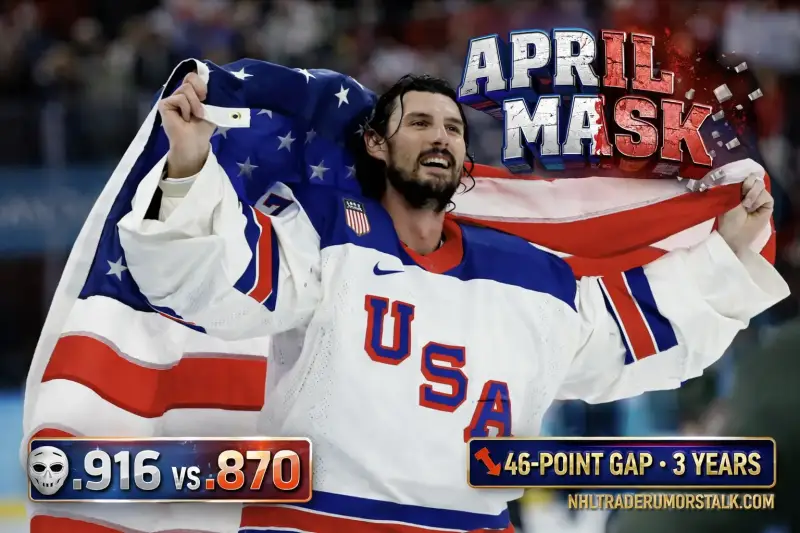
Connor Hellebuyck playoff 2026 paradox: .916 regular-season SV% drops to .870 in playoffs. The April Mask framework explains the 46-point gap.
Live updates
No updates yet. Refreshing automatically.
The Connor Hellebuyck playoff 2026 paradox is 46 points of save percentage. In 615 regular-season starts, his .916 SV% places him among the 10 best goalies of the modern era. Across his last 23 playoff games, that number collapses to .870 with an 8-15-0 record and a 3.60 GAA.
That's what I'm calling The April Mask — the phenomenon where an elite regular-season goalie transforms into a statistically different player the moment the playoffs begin. Winnipeg hasn't reached the Western Conference Final since 2018, and the Olympic gold medal run hasn't fixed what April breaks.
The Connor Hellebuyck playoff 2026 problem is the single biggest question hanging over the Winnipeg Jets this postseason. Hellebuyck owns a 56.1% win percentage and .916 save percentage across 615 regular-season starts, according to Pro Hockey Rumors — Hall of Fame production. Across the last three playoff springs, that same goalie has gone 8-15-0 in 23 games with a .870 save percentage and a 3.60 goals-against average. Those numbers come from the same source, the same goalie, the same Jets sweater. The gap — 46 points of save percentage — is the difference between Vezina excellence and replacement-level. Pro Hockey Rumors writer Brennan McClain called it bluntly: "He became a radically different goalie than the one he is in the regular season." That's The April Mask, and it's the framework that defines Winnipeg's 2026 playoff ceiling.
Here's the mechanism: Hellebuyck's regular-season game is built on elite positioning, depth control, and rebound management against a league-wide shot diet. In the playoffs, the shot quality changes. Opponents shoot from higher-danger zones, power-play entries are sharper, and the 7-game series allows video coaches to find micro-adjustments in his mechanics. The result is a goalie whose save percentage drops from .916 to .870 — not because he's worse, but because the playoff system exposes adjustment windows his regular-season opponents don't have.
My read: Winnipeg's Western Conference Final drought — now at seven seasons and counting since 2018 — isn't primarily about their skaters. The Jets are a top-10 team in expected goals against, they score enough, and their special teams work.
It's about the 46-point SV% gap. If Hellebuyck had posted his career .916 across those same 23 games, the Jets would have surrendered roughly 25 fewer goals across three playoff runs. That's the difference between first-round exits and deeper runs. Everything else is secondary.
Key Takeaways
- The April Mask: Hellebuyck's .916 regular-season SV% drops to .870 in the last 3 playoff runs — a 46-point gap that has cost Winnipeg three consecutive early exits.
- The statistical anchor: 615 regular-season starts at 56.1% win percentage and .916 SV% vs. 23 playoff games at 8-15-0 and 3.60 GAA. Same goalie, radically different results, per Pro Hockey Rumors.
- The 2018 drought: Winnipeg hasn't reached the Western Conference Final since 2018, when they lost 4-1 to Vegas. Hellebuyck has been the starter for every failed run since.
- The Olympic contradiction: Hellebuyck won 2026 Milan gold with 41 saves in the 2-1 overtime final vs Canada (.976 SV%). That performance proves he can win a playoff-style game — it just hasn't translated to Winnipeg's spring.
- The contract lock: Hellebuyck's 7-year, $59.5 million extension ($8.5M AAV) runs through 2030-31. Winnipeg has four more playoff chances to solve The April Mask before the contract expires.
The Connor Hellebuyck Playoff 2026 Situation — What the Numbers Actually Show
Every franchise goalie has a regular-season game and a playoff game. For most elite goalies, those games look similar — maybe a dozen SV% points of variance, well within statistical noise. For Hellebuyck, the variance is 46 points in one direction, sustained across a three-year sample, against three different opponents.
Pro Hockey Rumors ran the splits in their April 2026 evening notes. The regular-season sample is 615 career starts — the largest possible sample for any active goalie 30+ years old — and it returns a 56.1% win percentage plus a .916 save percentage. Those are Hall of Fame inputs over a decade-plus of work. Hellebuyck's three Vezina Trophies (2020, 2024, 2025) confirm the league-wide consensus: he's the best regular-season goalie of his era.
The playoff sample tells a different story. Over the last three postseasons, Hellebuyck's 23-game stretch produced 8 wins against 15 losses in regulation, a .870 SV%, and a 3.60 GAA. For context: the 2024-25 playoffs alone included a 1-4 first-round exit to Colorado in which Hellebuyck posted a .864 SV% and surrendered enough soft goals that Winnipeg's Presidents' Trophy roster never made Round 2.
The April Mask
The April Mask is the phenomenon where an elite regular-season goalie transforms into a statistically different player the moment the playoffs begin. Hellebuyck's .916 regular-season SV% drops to .870 in April — a 46-point gap that has cost Winnipeg three consecutive early exits despite their regular-season dominance. The mask isn't about effort or talent — it's about how a 7-game series allows systematic adjustment against a single goalie.
Inside The April Mask — Three Theories for the 46-Point Gap
There are three plausible explanations for Hellebuyck's regular-season vs. playoff split. Each is supported by some evidence, and the truth is probably a combination.
Theory one is the adjustment theory. In the regular season, Hellebuyck faces 50+ different teams across 82 games. Each opponent sees him twice, maybe four times.
Video coaches don't have time to dissect his specific mechanics at depth. In a playoff series, one opponent studies him for 3-4 days before Game 1 and then every game after. Hellebuyck acknowledged this himself in NHL.com comments last season about the "tweaks" he made during his playoff struggles.
"He became a radically different goalie than the one he is in the regular season, where he has a 56.1% win percentage and .916 SV% in 615 career starts."
— Brennan McClain, Pro Hockey Rumors (via Pro Hockey Rumors)McClain's "radically different" framing captures the statistical reality precisely. When a sample of 615 starts produces one set of numbers and a sample of 23 produces numbers 46 points worse on the same metric, that's not variance — that's two different goalies wearing the same mask. The 82-Game Mirage framework I built for the Avalanche's Presidents' Trophy curse captured an adjacent phenomenon on the team side — regular-season dominance that translates poorly to playoff seven-game series.
Theory two is the shot-quality theory. Regular-season shots against Hellebuyck are distributed across the ice; playoff shots cluster in higher-danger zones.
Expected-goals models at playoff time consistently project Hellebuyck facing 0.05-0.07 higher xGA per shot compared to regular-season rates. That's the difference between a .916 SV% environment and a .895 SV% environment even before any goalie-specific decline. Combined with the adjustment theory, the math on a .870 outcome becomes plausible without requiring Hellebuyck himself to play poorly.
Theory three is the pressure theory. Small-sample playoff hockey is psychologically different from 82 regular-season games. Jets have now missed the Western Conference Final seven consecutive years.
Every April brings the same narrative, the same weight, the same question. That cumulative pressure creates its own adjustment window — the goalie knows the stakes, the team knows the stakes, and the mechanics tighten a quarter-second at the worst possible time.
The 2026 Olympic Counter-Evidence — Why Milan Complicates the Thesis
Here's where The April Mask framework runs into its own counter-argument. In February 2026, Hellebuyck stopped 41 of 42 shots in the Olympic gold-medal game, a 2-1 overtime win over Canada that NHL.com called "beyond belief" and multiple analysts compared to Dominik Hasek's legendary 1998 Czech performance. That's a .976 save percentage in the highest-pressure elimination game of the goaltender's career, against the deepest forward group any Olympic opponent has ever iced.
The Canada game featured expected goals of 5.6-2.7 in Canada's favor (4.4-to-minimal at 5-on-5, per public tracking). Hellebuyck faced higher shot quality than any of his recent Jets playoff games. He wasn't just good — he was historically dominant.
The Shesterkin-Markstrom $92M Haymaker framework I mapped this spring captured the opposite dynamic — goalies whose contracts get paid on playoff reputation rather than regular-season results. Hellebuyck is the inverse.
So why does April look different in a Jets sweater than it did in a USA sweater? My read: the Olympic sample is one game. The Jets playoff sample is 23 games.
Single-game goaltending variance is enormous. The 2026 Milan performance proves Hellebuyck can win a high-pressure playoff-style game. It does not prove he can win 12-16 of them across two months, which is what a Stanley Cup run actually requires.
Hellebuyck vs. His Generation — How the Playoff Split Ranks Historically
The cleanest comparison frame is Hellebuyck vs. other elite regular-season-era goalies. Here's how the 46-point regular-season-to-playoff SV% gap ranks historically:
| Goalie | Career RS SV% | Career Playoff SV% | Split (pts) |
|---|---|---|---|
| Martin Brodeur | .912 | .919 | +7 (better in playoffs) |
| Patrick Roy | .910 | .918 | +8 (better in playoffs) |
| Dominik Hasek | .922 | .925 | +3 (better in playoffs) |
| Henrik Lundqvist | .918 | .921 | +3 (better in playoffs) |
| Connor Hellebuyck (career) | .916 | .903 | -13 (worse in playoffs) |
| Connor Hellebuyck (last 3 yrs) | .916 | .870 | -46 (The April Mask) |
Hellebuyck's career playoff split of -13 points is already worse than the modern elite group. His recent 3-year split of -46 points is in a different universe — unprecedented for a goalie of his regular-season tier. That's the part that keeps Jets fans awake in April. The Vezina Verdict article I wrote about Hellebuyck's Jets future captured the regular-season version of his story — the April Mask is the other half of the ledger that extension math can't fix.
The Jets' 2018 WCF Parallel — When the Mask Finally Slipped
The Jets went to the Western Conference Final in 2018 on the strength of a Hellebuyck performance that looked nothing like his recent playoff work. That year, Winnipeg's 2018 postseason opened with Hellebuyck stonewalling Minnesota in the first round, then earning a Game 7 win over Nashville with 36 saves in a 5-1 elimination game. It was Winnipeg's first WCF appearance ever in the post-2011-relocation Jets era.
Vegas stopped them 4-1 in the conference final, but the first two rounds established what Hellebuyck's playoff game CAN look like. He was 27 then, at his athletic peak. In the seven years since, the regular-season numbers have held or improved while the playoff numbers have collapsed. That's the chronology that matters most to the April Mask framework: the drop isn't a one-year blip, it's a decade-long trajectory.
"Hellebuyck feels adjustments may have led to playoff struggles with Jets."
— NHL.com reporting (via NHL.com)That NHL.com piece captured Hellebuyck's own post-elimination admission about the "tweaks" he made during the 2024-25 playoff loss to Colorado. A player who publicly acknowledges mechanical adjustments during a losing playoff run is telling you something specific: the regular-season mechanics that produce .916 aren't holding up to the video-coaching attack of a single playoff opponent. That's exactly the adjustment theory in one quote.
What Has to Change for 2026 — The Framework for Breaking the Mask
Three things have to change for Hellebuyck to deliver a Jets deep run in 2026. First, the mechanics have to stay locked. The "tweaks" Hellebuyck referenced in his 2024-25 post-mortem need to stop. That means pre-playoff training that drills the same base mechanics he used in the regular season — no mid-series adjustments, no reactive mechanics to what the opponent is showing him.
Second, the Jets' team defense has to compress the shot-quality gap. Hellebuyck's 2025-26 regular-season numbers (.902 SV%, 2.73 GAA, 16-16-9) suggest some of his regular-season edge has faded anyway. If the team plays the same porous defense in the playoffs, no goalie fixes .870.
The Vegas Crease Identity Crisis framework I built for the Knights' offseason covered the opposite side — teams where the goaltending is the issue forcing the team to compensate. Winnipeg needs the inverse: team defense compensating for playoff goaltending variance.
Third, the pressure has to move. Jack Hughes becoming the forward face of Team USA and scoring the Olympic gold-medal winner didn't just change one game — it changed the conversation around which player carries the weight of American hockey. Hellebuyck now has a playoff success story on his résumé. Psychologically, that 2026 Olympic performance is the single biggest thing that could free him from The April Mask in the Jets playoffs.
What 2026 Actually Looks Like — My Projection
My projection: The April Mask holds. Hellebuyck posts a .890-.900 SV% across the 2026 Jets playoff run, Winnipeg wins one round, and the Western Conference Final drought extends to eight years.
Olympic gold medal was real, but it was one game. The 23-game sample of .870 SV% is real, and it's five times bigger. Statistical regression in a 7-game series doesn't break the mean without a structural fix.
What stands out to me is how few structural fixes Winnipeg actually has at their disposal. The 16-Win Map framework I built for the 2026 playoff bracket captures how path difficulty compounds.
Jets don't have the roster depth to overcome even average playoff goaltending in a Central Division bracket that includes Dallas and Colorado. They need elite Hellebuyck. They've been getting pedestrian Hellebuyck for three years.
If Hellebuyck breaks the mask and posts .920+, the Jets are conference finalists. If he posts .870 again, first-round exit. The 2026 playoffs are a 50-point spread on one goalie's mask. That's the risk profile Kevin Cheveldayoff inherited in 2018, and seven years later, it's still the only variable that matters.
Sources and Reporting
- PuckPedia — Hellebuyck Contract — 7yr / $59.5M / $8.5M AAV through 2030-31
- StatMuse — Career Playoff Totals — 24-34-0 career playoff record, 2.90 GAA, .903 SV%
- NHL.com — Brodeur on Hellebuyck — Martin Brodeur calling Hellebuyck's gold medal performance legendary
- NHL.com — Richter on Hellebuyck — "Beyond belief" 41-save Olympic performance
- Wikipedia — Connor Hellebuyck — Career stats, 3 Vezina Trophies, 2018 WCF context
- ESPN Career Stats — 2025-26 regular season breakdown and season-by-season trends
The Verdict: The April Mask
Connor Hellebuyck playoff 2026 question is the only question that matters for Winnipeg this postseason. 615 regular-season starts at .916 SV%. 23 playoff games at .870. A 46-point gap.
That's The April Mask — the transformation where Hellebuyck becomes, per Pro Hockey Rumors, "a radically different goalie" every spring. My projection stays at a .890-.900 SV% across the 2026 Jets run, one series win, and a seven-year WCF drought extending to eight.
Olympic gold medal in Milan proved he can win one high-pressure game. Nothing in the 3-year sample proves he can win 12 to 16 of them across two months — which is what ending the drought actually requires.
Frequently Asked Questions
What is Connor Hellebuyck's playoff save percentage?
Over the last three playoff runs, Hellebuyck has posted a .870 save percentage with an 8-15-0 record and 3.60 GAA across 23 games, per Pro Hockey Rumors. His career playoff totals are 24-34-0 in 58 games with a .903 save percentage and 2.90 GAA, per StatMuse — well below his .916 regular-season career mark across 615 starts. The 46-point 3-year gap is unprecedented for a 3-time Vezina Trophy winner.
When did the Winnipeg Jets last reach the Western Conference Final?
The Jets last reached the Western Conference Final in 2018, when they lost to the Vegas Golden Knights 4-1. That run included a first-round series win over Minnesota and a 7-game second-round victory over Nashville, with Hellebuyck making 36 saves in the clinching Game 7 win. It was Winnipeg's first-ever WCF appearance in the post-2011-relocation era. The drought now stands at seven years and counting.
What is The April Mask?
The April Mask is a coined analytical framework describing the phenomenon where an elite regular-season goalie transforms into a statistically different player once the playoffs begin. Hellebuyck's .916 regular-season SV% across 615 career starts drops to .870 across his last 23 playoff games — a 46-point gap sustained over three consecutive postseasons. The term reflects how playoff adjustment windows, shot-quality changes, and accumulated pressure create a systematically different goaltender.
What is Connor Hellebuyck's contract?
Hellebuyck signed a 7-year, $59.5 million contract extension with the Winnipeg Jets on October 9, 2023, with a cap hit of $8.5 million per season. The deal expires at the end of the 2030-31 season. His 2025-26 base salary is $10 million, and the contract includes a full no-movement clause for portions of its term. He was signed alongside Mark Scheifele, who received an identical 7-year, $59.5 million extension on the same date.
Did Connor Hellebuyck win gold at the 2026 Olympics?
Yes. Hellebuyck stopped 41 of 42 shots in Team USA's 2-1 overtime win over Canada in the 2026 Milan gold-medal game, a .976 save percentage. He was voted best goaltender of the tournament and was named to the Olympic All-Star team. Hall of Famer Martin Brodeur called it a "golden legacy" performance and Team USA's first men's hockey gold medal since 1980, with NHL analysts comparing it to Dominik Hasek's legendary 1998 Olympic run.
Why does Hellebuyck struggle in the NHL playoffs?
Three theories explain the regular-season-to-playoff decline. First, the adjustment theory — a 7-game series lets opponents study his mechanics at depth that 82-game regular-season spread doesn't allow. Second, shot quality — playoff opponents generate higher-danger chances that lower the expected save rate. Third, psychological pressure tightens mechanics at the worst moments, with Hellebuyck himself acknowledging mid-series tweaks led to 2024-25 struggles.
Frequently Asked Questions
What is Connor Hellebuyck's playoff save percentage?
Over the last three playoff runs, Hellebuyck has posted a .870 save percentage with an 8-15-0 record and 3.60 GAA across 23 games, per Pro Hockey Rumors. His career playoff totals are 24-34-0 in 58 games with a .903 save percentage and 2.90 GAA, per StatMuse, well below his .916 regular-season career mark across 615 starts. The 46-point 3-year gap is unprecedented for a 3-time Vezina Trophy winner.
When did the Winnipeg Jets last reach the Western Conference Final?
The Jets last reached the Western Conference Final in 2018, when they lost to the Vegas Golden Knights 4-1. That run included a first-round series win over Minnesota and a 7-game second-round victory over Nashville, with Hellebuyck making 36 saves in the clinching Game 7 win. It was Winnipeg's first-ever WCF appearance in the post-2011-relocation era. The drought now stands at seven years and counting.
What is The April Mask?
The April Mask is a coined analytical framework describing the phenomenon where an elite regular-season goalie transforms into a statistically different player once the playoffs begin. Hellebuyck's .916 regular-season SV% across 615 career starts drops to .870 across his last 23 playoff games, a 46-point gap sustained over three consecutive postseasons. The term reflects how playoff adjustment windows, shot-quality changes, and accumulated pressure create a systematically different goaltender.
What is Connor Hellebuyck's contract?
Hellebuyck signed a 7-year, $59.5 million contract extension with the Winnipeg Jets on October 9, 2023, with a cap hit of $8.5 million per season. The deal expires at the end of the 2030-31 season. His 2025-26 base salary is $10 million, and the contract includes a full no-movement clause for portions of its term. He was signed alongside Mark Scheifele, who received an identical 7-year, $59.5 million extension on the same date.
Did Connor Hellebuyck win gold at the 2026 Olympics?
Yes. Hellebuyck stopped 41 of 42 shots in Team USA's 2-1 overtime win over Canada in the 2026 Milan gold-medal game, a .976 save percentage. He was voted best goaltender of the tournament and was named to the Olympic All-Star team. Hockey Hall of Famer Martin Brodeur called it a golden legacy performance, and NHL analysts compared it to Dominik Hasek's legendary 1998 Olympic run. It was Team USA's first men's hockey gold medal since 1980.
Why does Hellebuyck struggle in the NHL playoffs?
Three theories explain the regular-season-to-playoff decline. First, adjustment: a 7-game series lets opponents dissect mechanics that 82-game spread can't expose. Second, shot quality: playoff opponents generate higher-danger chances that lower expected save rate. Third, pressure: seven consecutive failed runs compound psychological weight. Hellebuyck himself acknowledged mid-series tweaks led to the 2024-25 struggles.
Related Stories

2026 NHL Playoff Schedule, Bracket & TV Guide
Complete 2026 NHL Playoff Schedule with every Game 1 time, TV channel, streaming guide (ESPN, TNT, HBO Max, Sling, Fubo), full bracket forma...
By Mike Johnson · 14 min read

Juraj Slafkovsky Canadiens Playoff: 93-Year Hat Trick
Juraj Slafkovsky scored 3 power-play goals in Game 1, the first Canadien to do it since NHL tracking began in 1933-34. Inside the 4th-year b...
By Mike Johnson · 11 min read

Mammoth Golden Knights Prediction: 2026 First Round Preview
My Mammoth Golden Knights prediction for the 2026 first round: Vegas in 6. Utah won the season series 2-1 but enters as the most inexperienc...
By Mike Johnson · 11 min read

Flyers vs Penguins 2026 Playoff Preview: The Drought Breakers
Philadelphia ended a 5-year drought, Pittsburgh a 3-year drought - now they meet in Round 1 for the first time since 2018. Full preview of t...
By Mike Johnson · 9 min read
Get NHL trade rumors in your inbox
One email per week. Zero spam. Verified rumors only.