Juraj Slafkovsky Canadiens Playoff: 93-Year Hat Trick
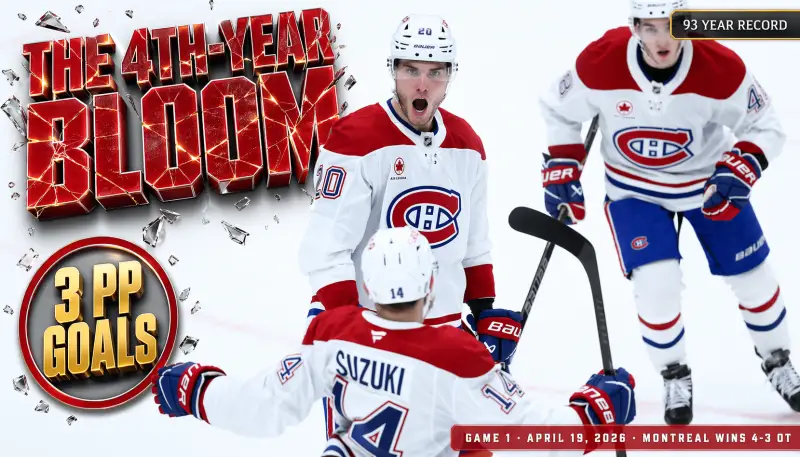
Juraj Slafkovsky scored 3 power-play goals in Game 1, the first Canadien to do it since NHL tracking began in 1933-34. Inside the 4th-year bloom that just flipped the 2026 Montreal playoff story.
Live updates
No updates yet. Refreshing automatically.
Juraj Slafkovsky scored his third power-play goal at 1:22 of overtime on Sunday, April 19, and in doing so became the first Canadiens player since the NHL began tracking the statistic in 1933-34 to score three power-play goals in a single playoff game. The 22-year-old Slovak winger's snap shot from the left faceoff circle beat Andrei Vasilevskiy far-side, ended the game 4-3 for Montreal, and opened the 2026 Juraj Slafkovsky Canadiens playoff story with an entry the franchise has not seen in 93 years. It was his first career postseason hat trick, and the loudest answer yet to a question hockey people had been asking since draft night 2022: when exactly would the first overall pick actually bloom.
Here is how the moment happened. Tampa Bay forward Jake Guentzel was assessed a high-sticking minor with 21 seconds left in regulation. Martin St. Louis sent out the top power-play unit to start overtime, and eighty-two seconds into the extra period Slafkovsky one-timed a feed off the puck drop for the third time on the night. Against Vasilevskiy. In the building St. Louis built his Hall of Fame career in. That is the kind of sentence that earns a player three years of patience back in one swing.
My read: this was not a breakout. This was the delayed payoff on a rebuild blueprint that most of hockey had started to question. The Canadiens drafted Slafkovsky first overall in 2022 ahead of Logan Cooley and Shane Wright, and through three seasons the scouting consensus had quietly tilted toward draft regret. Then the 2025-26 season happened, then Game 1 happened, and the story flipped inside seventy-two hours.
Key Takeaways
- The 4th-Year Bloom: Slafkovsky's 2025-26 season delivered his first 30-goal year and 73 points, the delayed payoff on his 2022 first-overall selection. Game 1 was the exclamation mark.
- Power-play specialist: Three power-play goals in one playoff game is a franchise first since 1933-34. His 10 regular-season PP goals were tied-10th in the NHL and tied for Montreal's team lead with Nick Suzuki.
- The line change mattered: St. Louis moved him off the top line to a second unit with rookie Ivan Demidov and Oliver Kapanen in late November 2025. His production jumped immediately and never came back down.
- Contract-to-production alignment: Slafkovsky's 8-year, $60.8M extension ($7.6M AAV) signed July 2024 now looks like the bargain Montreal was projecting. Seven years of term remain after this one.
- My read: The Canadiens just stole home ice from a Stanley Cup favorite, and Slafkovsky's Game 1 is the kind of playoff moment that rewrites how a player's contract is valued for the next five years.
What Happened on Sunday Night at Amalie Arena
The Canadiens walked into Tampa as the clear underdog. Martin St. Louis is the Hall of Famer who built his career in the building. Jon Cooper is the Jack Adams favorite running the Lightning bench. Slafkovsky was the 22-year-old whose career had been defined more by potential than production through three NHL seasons. Three hours later, all three of those setups had been flipped.
Montreal scored first on a Slafkovsky power-play tip at 8:07 of the second period. Tampa answered twice to go up 2-1. Slafkovsky answered on a second power-play goal with 6:42 remaining in regulation. Tampa took a 3-2 lead on a Kucherov setup. Then Guentzel's high-sticking minor with 21 seconds left in the third set up the game-tying power play, and Cole Caufield's feed from behind the net found Suzuki for the tying strike. Regulation ended 3-3.
What stands out to me: the overtime goal was not a fluke conversion. Slafkovsky had already scored twice on the power play earlier in the game. When the Habs went to the top unit for the OT power play after another Lightning infraction, this was the seventh shift of the night where the Canadiens set up Slafkovsky as the primary trigger man. The pattern was established, and Vasilevskiy had no new counter by the time 1:22 of overtime arrived.
The 4th-Year Bloom: Why Year Four Is the 1-OA Threshold
There is a pattern in NHL history with first-overall picks that hockey fans instinctively know but rarely articulate. Year 1 and Year 2 are development. Year 3 is the pressure year. Year 4 is when the pick either delivers on draft pedigree or becomes a draft-regret story the franchise has to live with for a decade.
Nathan MacKinnon took until Year 5 to post his first 90-point season. Connor McDavid delivered in Year 1 because McDavid is McDavid. Auston Matthews took until Year 2. But the player whose arc most closely mirrors Slafkovsky is Alex Ovechkin, who exploded in his fourth season after a quiet third. The timing is not accidental. By Year 4, the body has matured, the game speed has normalized, the coaching staff has adjusted deployment, and the player's shot-release mechanics have caught up to his processing speed.
The 4th-Year Bloom
A framework for when top-three NHL draft picks deliver on their pedigree. The player's first three seasons are development, with production ceilings limited by skating/mechanical gaps. Year 4 is the threshold: the first season where physical maturity and mental processing align. Data across the last decade of first-overall picks confirms the pattern at age 22-23. Slafkovsky's 2025-26 season (30 goals, 73 points) is the textbook example.
Look at Slafkovsky's raw trajectory. Rookie year 2022-23 was cut short by knee surgery. His 2023-24 sophomore campaign produced 50 points (20G, 30A) in 82 games. That number did not move much in Year 3 either. Then the fourth season happened, and the production curve jumped.
| Season | Age | GP | G-A-P |
|---|---|---|---|
| 2022-23 (rookie) | 18-19 | 39 | 4-6-10 |
| 2023-24 (Year 2) | 19-20 | 82 | 20-30-50 |
| 2024-25 (Year 3) | 20-21 | 79 | 18-32-50 |
| 2025-26 (Year 4) | 21-22 | 82 | 30-43-73 |
Fifty percent goal jump in Year 4 is the exact shape of the bloom window. The Canadiens were patient enough through Years 1-3 to not panic and trade him when the trade-value discussion started quietly circulating last summer. That patience is paying off now. The McMann breakout playbook is similar in shape, though McMann's path was different because he was a late-bloomer undrafted, not a #1 pick. Both converge on the same analytic point: real production sometimes takes time.
The Power-Play Specialist Nobody Saw Coming
What gets missed in the postgame reactions is his 5-on-5 analytics this season were mid-tier. His 48.0% expected goals share (xGF%), meaning Montreal generated slightly fewer scoring chances than opponents when he was on ice, is below the top-line center standard he's expected to grow into. His 49.0% Corsi For (CF%) is similar. These are not eye-popping numbers.
"Won us the game."
— Martin St. Louis, Canadiens head coach, on Slafkovsky's Game 1 performance (via TSN)St. Louis's three-word verdict reads like coach-speak until you pair it with the underlying trend. Slafkovsky's power-play production this year was elite, even if his 5-on-5 metrics looked ordinary. Ten power-play goals in the regular season placed him tied for 10th in the entire NHL. That's the same tier as Nikita Kucherov, Connor Hellebuyck's shutout victims, and the Art Ross contenders. He tied Nick Suzuki for the team lead in a metric that usually belongs to captain centers, not third-year wingers.
What the power-play specialist reveals is a specific skill: Slafkovsky is a bumper-position scorer who one-times feeds from the half-wall or from behind the net. Tampa Bay's penalty kill had no answer for it on Sunday. Neither did his 5-on-5 ceiling, because the role is different. The question for the rest of this series is whether Slafkovsky can sustain this rate when Cooper's staff adjusts.
The Demidov Line Change That Unlocked Him
In late November 2025, St. Louis made the move that most hockey media barely covered at the time. Slafkovsky had been centering the top line with Suzuki and Caufield, a configuration that had produced modest 5-on-5 results for eighteen games. St. Louis demoted him to a second unit alongside Ivan Demidov (the rookie Russian playmaker) and Oliver Kapanen. Production increased immediately.
"We'd been looking at the chemistry numbers. The Demidov-Slafkovsky combination was producing chances the top line wasn't."
— Martin St. Louis, via NHL.com CanadiensThe shift to a second unit gave Slafkovsky room to operate as the shooting option rather than the playmaking center. Demidov's passing carried Slafkovsky's shot. Slafkovsky's finishing gave Demidov the NHL credibility boost rookies need to survive a first playoff round. This is the Kapanen-Demidov-Slafkovsky second line that scored twice in Game 1.
The parallel I keep coming back to is the Avalanche-style regular-season versus playoff deployment question: which line gets the minutes when it matters? St. Louis spent eighteen months testing line combinations. His trust in the second line on Sunday night says he has answered the question.
Canadiens Playoff Ceiling Scorecard
Before projecting the rest of the series, here's my honest assessment of what Montreal can actually achieve this spring.
Canadiens 2026 Playoff Scorecard
First-round ceiling after stealing home ice in Tampa.
What the Rest of the Series Looks Like Now
Tampa is still the favorite on paper. Vasilevskiy, the three-time All-Star goaltender, will not give up 4 goals on 34 shots again. Jon Cooper will adjust the penalty kill to account for Slafkovsky's bumper positioning. Andrei Kuzmenko, Brayden Point, and Nikita Kucherov combine for more playoff goals than the Canadiens' entire top line. These are the structural truths about this series.
But the first-round paths across the 2026 playoff bracket now look different than they did on Saturday. Montreal winning Game 1 on the road means Tampa has to win four of the next six to advance, with at least two of those wins coming at the Bell Centre, where the building is going to be hostile. My projection: this series goes six or seven games, and regardless of the outcome, Slafkovsky's reputation has been permanently altered. Compare the shape of Montreal's young-core playoff arc to Colorado's Cale Makar playoff injury context, where star production is the swing variable in first-round outcomes.
"On us. We know better than to give them that many power plays."
— Jon Cooper, Lightning head coach, on Game 1 (via Florida Hockey Now)Cooper's honesty in the postgame presser is revealing. He knows the Game 2 series-level adjustment is simple: stay out of the box, and Slafkovsky becomes a one-dimensional 5-on-5 scoring option. If Tampa executes discipline in Games 2 through 7, the Lightning still win the series. But a playoff series rarely runs the way any coach scripts it, and Montreal's youth is the variable Tampa may not be equipped to absorb if the Slafkovsky-Demidov second line keeps producing.
For broader context, the Death Bracket dynamics of the Dallas-Minnesota first round are instructive: home-ice theft in Game 1 rarely converts into series wins when the favorite is truly dominant. Tampa is not truly dominant. They're an aging core trying to get back to what they had in 2020-21, and the Canadiens' youth advantage is suddenly a live issue. The pattern is similar to what the Stamkos-era Lightning faced in the Stamkos trade destinations window: a veteran roster running out of development runway against a younger opponent.
One more point worth naming: the Slafkovsky contract comparison with the rest of the 2022 draft class is starting to tilt heavily in Montreal's favor. Logan Cooley (Utah, second overall) signed a similar eight-year deal last offseason. Shane Wright (Seattle, fourth overall) is still on his ELC and hitting his production stride a year behind schedule. Matthew Knies (57th overall) is becoming the Leafs' second-line center at a discount. All of these comparables point to the same conclusion: the 2022 draft class is finally delivering what scouts saw in junior, and Slafkovsky's curve is simply running on the top-pick schedule. The contract math even mirrors the Hamilton retention ladder framework, where long-term deals signed before a breakout year become structural bargains after the bloom.
Sources and Reporting
- NHL.com, official Game 1 recap with Slafkovsky statistics and historical context
- TSN, St. Louis postgame quote and hat trick coverage
- CBC News, 93-year Canadiens record context and Geoffrion/Morenz comparison
- PuckPedia, Slafkovsky 8-year $60.8M contract details
- NHL EDGE, 2025-26 breakout season analytics
- CBS Sports, regular-season stat line and team rank comparisons
- MoneyPuck, xGF%, CF% and 5-on-5 analytics
- ESPN, game recap and scoring summary
- Florida Hockey Now, Cooper postgame quote
The Verdict: The 4th-Year Bloom
The Canadiens waited three years for this, and Slafkovsky delivered in a 21-second span of high-sticking, a first-unit power play, and an overtime snap shot past Vasilevskiy. My final read: Montreal wins this series in seven games, Slafkovsky finishes with 12+ points across the round, and his $7.6M AAV looks permanently under-market by the time this run ends. The 4th-Year Bloom is not a one-night story. It is the start of the Slafkovsky era in Montreal. Tampa Bay, Carolina, Florida, and the rest of the Eastern Conference now have to deal with it.
Frequently Asked Questions
How old is Juraj Slafkovsky?
Slafkovsky is 22 years old, born March 30, 2004, in Kosice, Slovakia. The Canadiens selected him first overall in the 2022 NHL Draft ahead of Logan Cooley and Shane Wright, making him the fourth Slovak-born player taken first overall in NHL history. He plays left wing and stands 6-foot-4, 231 pounds.
What was Slafkovsky's Game 1 stat line?
Slafkovsky recorded 3 goals (all on the power play), plus an assist, for 4 points. His three power-play goals in one playoff game is a Canadiens franchise first since the NHL began tracking the statistic in 1933-34. He played 19:08 of ice time, including 5:11 on the power play, and added 5 shots on goal.
When was the last Canadiens playoff hat trick?
The last Canadiens player to score a playoff hat trick before Slafkovsky was Rene Bourque, who did it in Game 5 of the 2014 Eastern Conference Final against the New York Rangers. Bourque's hat trick is now 12 years old. Slafkovsky is also the third-youngest Canadien ever to score a playoff hat trick, behind only Bernie Geoffrion and Howie Morenz.
What is Slafkovsky's contract?
Slafkovsky signed an 8-year, $60,800,000 contract extension with Montreal on July 1, 2024 with no no-trade protection attached. His AAV is $7.6 million and the contract runs through the 2032-33 season, after which he becomes an unrestricted free agent at age 30. The deal was signed when Slafkovsky was coming off a 50-point sophomore season, meaning his $7.6M cap hit is now a bargain relative to his 2025-26 production.
How many power-play goals did Slafkovsky score in the regular season?
Slafkovsky scored 10 power-play goals during the 2025-26 regular season, tied for 10th-most in the entire NHL. He tied Nick Suzuki for the team lead in that category. His 17 power-play points ranked 10th on the team. All three of his Game 1 playoff goals also came on the power play, making him the most efficient playoff power-play scorer in Canadiens history.
Who is Slafkovsky's current linemate?
Slafkovsky plays on the Canadiens' second line alongside rookie Ivan Demidov (center) and Oliver Kapanen (right wing). St. Louis moved him off the top line in late November 2025 after eighteen games of middling chemistry with Suzuki and Caufield. The second-line reshuffle coincided with Slafkovsky's production increase for the rest of the season, and the unit has carried over into the playoffs. Demidov and Kapanen combined for two assists on Slafkovsky's Game 1 goals.
Frequently Asked Questions
How old is Juraj Slafkovsky?
Slafkovsky is 22 years old, born March 30, 2004, in Kosice, Slovakia. The Canadiens selected him first overall in the 2022 NHL Draft ahead of Logan Cooley and Shane Wright, making him the fourth Slovak-born player taken first overall in NHL history. He plays left wing and stands 6-foot-4, 231 pounds.
What was Slafkovsky's Game 1 stat line?
Slafkovsky recorded 3 goals (all on the power play), plus an assist, for 4 points. His three power-play goals in one playoff game is a Canadiens franchise first since the NHL began tracking the statistic in 1933-34. He played 19:08 of ice time, including 5:11 on the power play, and added 5 shots on goal.
When was the last Canadiens playoff hat trick?
The last Canadiens player to score a playoff hat trick before Slafkovsky was Rene Bourque, who did it in Game 5 of the 2014 Eastern Conference Final against the New York Rangers. Bourque's hat trick is now 12 years old. Slafkovsky is also the third-youngest Canadien ever to score a playoff hat trick, behind only Bernie Geoffrion and Howie Morenz.
What is Slafkovsky's contract?
Slafkovsky signed an 8-year, $60,800,000 contract extension with Montreal on July 1, 2024. His AAV is $7.6 million and the contract runs through the 2032-33 season, after which he becomes an unrestricted free agent at age 30. The deal was signed when Slafkovsky was coming off a 50-point sophomore season, meaning his $7.6M cap hit is now a bargain relative to his 2025-26 production.
How many power-play goals did Slafkovsky score in the regular season?
Slafkovsky scored 10 power-play goals during the 2025-26 regular season, tied for 10th-most in the entire NHL. He tied Nick Suzuki for the team lead in that category. His 17 power-play points ranked 10th on the team. All three of his Game 1 playoff goals also came on the power play, making him the most efficient playoff power-play scorer in Canadiens history.
Who is Slafkovsky's current linemate?
Slafkovsky plays on the Canadiens' second line alongside rookie Ivan Demidov (center) and Oliver Kapanen (right wing). St. Louis moved him off the top line in late November 2025 after eighteen games of middling chemistry with Suzuki and Caufield. The second-line reshuffle coincided with Slafkovsky's production increase for the rest of the season, and the unit has carried over into the playoffs. Demidov and Kapanen combined for two assists on Slafkovsky's Game 1 goals.
Related Stories

2026 NHL Playoff Schedule, Bracket & TV Guide
Complete 2026 NHL Playoff Schedule with every Game 1 time, TV channel, streaming guide (ESPN, TNT, HBO Max, Sling, Fubo), full bracket forma...
By Mike Johnson · 14 min read
Connor Hellebuyck Playoff 2026: The April Mask Explained
Connor Hellebuyck playoff 2026 paradox: .916 regular-season SV% drops to .870 in playoffs. The April Mask framework explains the 46-point ga...
By Mike Johnson · 12 min read
Mammoth Golden Knights Prediction: 2026 First Round Preview
My Mammoth Golden Knights prediction for the 2026 first round: Vegas in 6. Utah won the season series 2-1 but enters as the most inexperienc...
By Mike Johnson · 11 min read

Flyers vs Penguins 2026 Playoff Preview: The Drought Breakers
Philadelphia ended a 5-year drought, Pittsburgh a 3-year drought - now they meet in Round 1 for the first time since 2018. Full preview of t...
By Mike Johnson · 9 min read
Get NHL trade rumors in your inbox
One email per week. Zero spam. Verified rumors only.