Hurricanes Not Expected Back: The Contender's Tax
Three Hurricanes not expected back next season. At 96 points and first in the Metro, Carolina must shed cap to keep its championship core intact.

Live updates
No updates yet. Refreshing automatically.
Most "not expected back" articles are about losing. Bad teams shedding dead weight. Rebuilders clearing cap for a draft pick they'll probably waste. The Hurricanes not expected back story is the opposite — Carolina is first in the Metropolitan Division with 96 points, and the players leaving aren't failures. They're casualties of success.
Call it the Contender's Tax. When you're paying Sebastian Aho $9.75 million, Nikolaj Ehlers $8.5 million, K'Andre Miller $7.5 million, and Seth Jarvis $7.42 million, the math eventually eats the margins. Frederik Andersen, Jordan Staal, and at least one depth roster spot are the price Carolina pays to keep its championship core intact through 2026-27 and beyond.
Key Takeaways
- Andersen is already replaced: Brandon Bussi's 3-year, $1.9M AAV extension in February was the exit signal — he's 26-6-1 with a 2.47 GAA across 33 games, the fastest goaltender in NHL history to reach 10, 15, and 20 wins
- Staal's farewell is coming: The captain turns 38 next September with one year left at $2.9M — retirement after 2026-27 is the likeliest outcome, freeing cap for the next generation
- This isn't a teardown — it's triage: Carolina has $16M in projected 2026-27 cap room, but Kochetkov needs a raise, depth forwards need replacing, and the Hurricanes want deadline flexibility
- The Contender's Tax is real: Every Cup-caliber team loses useful players to keep its core — Chicago lost Saad, Byfuglien, and Ladd after 2010. Carolina's version is cleaner but no less painful
- 96 points changes the calculus: You don't make emotional roster decisions when you're winning. You make ruthless ones. That's what this offseason requires
Frederik Andersen: The Exit Nobody's Pretending to Fight
Andersen's numbers this season tell a story the Hurricanes already read months ago. A .872 save percentage and 3.19 GAA across 28 appearances — both career worsts for a goaltender who once posted a .927 in Anaheim and carried Toronto through three first-round exits.
He's 36. His contract expires in July. And the Hurricanes already signed his replacement.
Brandon Bussi's three-year, $5.7 million extension ($1.9M AAV) in February wasn't subtle. The 27-year-old is 26-6-1 with a 2.47 GAA and .895 save percentage across 33 games — the fastest goaltender in NHL history to reach 10, 15, and 20 wins, needing just 24 games for the 20-win mark. His post-Olympic stretch has been rough — 3-3-0 with an .844 save percentage in his last six starts — but the body of work still makes the case. Every rookie hits a wall. What matters is whether the organization panics. Carolina hasn't. Pair him with Pyotr Kochetkov (entering the final year of his $2M deal), and Carolina has a tandem that costs $3.9 million combined. Andersen alone costs $2.75 million for significantly worse results.
"It's a great day to say the least. This is where I want to be. The guys in here, the coaching staff, the organization — it just feels right."
— Brandon Bussi, on signing his extension (via Yahoo Sports)BRANDON BUSSI WITH THE SAVE OF THE YEAR?!?!
— NHL (@NHL) March 10, 2026
Even Andersen's late-season uptick in starts — a product of Bussi's post-Olympic struggles — doesn't change the financial calculus. At 36 with a sub-.880 season save percentage, no team is offering term. A backup role somewhere — maybe Toronto for the nostalgia, maybe a Western Conference team desperate for a veteran presence — is possible. But his days as a 1A are over, and the Hurricanes identified that reality before anyone else did.
What's quietly impressive is how Carolina managed this transition. They didn't panic-trade for a goalie at the deadline. They didn't overpay for a rental. They identified Bussi on the waiver wire, claimed him from Florida, gave him the opportunity nobody else would, let Andersen's contract expire naturally, and locked up the replacement before the UFA even hit the market. That's how contenders handle goaltending transitions — not by developing from scratch, but by recognizing value others missed.
Jordan Staal: The Hardest Conversation in Raleigh
This is the one that hurts.
Staal has one year left at $2.9 million through 2026-27. He'll turn 38 next September. And his production has been sliding for three straight seasons — from 15 goals in 2023-24 to 13 in 2024-25 to what's tracking as single digits this year.
He's still an elite penalty killer. Still wins faceoffs at a 54% clip. Still sets the tone in the room every single night. Rod Brind'Amour won't cut him and shouldn't — captains earn a different kind of exit.
My read: Staal plays 2026-27 as his farewell season. Gets the ceremony, the video tribute, the standing ovation in the final home game. Then the $2.9 million comes off the books naturally, and Carolina redirects it toward a younger third-line center who can keep up with the pace Aho and the league's next generation of forwards are setting.
What kills me is the timing. Staal has been a Hurricane for 14 seasons. He's the longest-tenured player on the roster by half a decade. The man has given everything to this franchise — and his reward is becoming a cap casualty for a team that's finally good enough to win without him carrying the third line.
That's the Contender's Tax in its cruelest form. The veterans who built the culture become the ones the culture can't afford.
The Third Spot: Depth Gets Expensive When Stars Get Paid
The third departure is less about a specific name and more about a structural reality. Carolina's forward depth — the Tyson Josts, the Jordan Martinooks of the roster — costs more than a contender can justify when the top six eats $45 million.
Martinook is signed through 2026-27 at $3.05 million. He's a beloved locker room presence with 9 goals in 63 games. I'd bet he plays out his deal. But behind him, at least one depth forward currently on the roster won't survive the offseason roster crunch.
The Blackhawks-style teardown this is not. Carolina's depth losses are surgical — one or two fourth-line players replaced by cheaper ELC options or minimum-salary veterans. But those decisions still matter. Playoff depth wins championships. Ask any team that's been one forward short in June.
The Contender's Tax: What $9M in Departures Actually Buys
Here's where the math gets interesting. Between Andersen's expiring $2.75M, Staal's $2.9M (freed after 2026-27), and one depth forward slot (~$1-2M), Carolina is looking at roughly $7-9 million in cap flexibility over the next two summers.
| Departing Player | AAV Freed | Projected Use |
|---|---|---|
| Frederik Andersen | $2.75M (July 2026) | Kochetkov raise ($2M → $3.5-4M) |
| Jordan Staal | $2.9M (July 2027) | Third-line center upgrade |
| Depth forward spot | $1-2M (July 2026) | ELC/minimum replacement + deadline flexibility |
Kochetkov's extension is the big one. He's making $2 million in the final year of his deal. After what Bussi signed for ($1.9M), Kochetkov's camp will push for $3.5-4 million. That raise gets funded almost entirely by Andersen's departure. Clean swap — declining 36-year-old out, ascending 27-year-old waiver claim in, net cap impact near zero.
The Staal money is a 2027 problem, not a 2026 one. But smart organizations plan two summers ahead, and Carolina's front office has earned that reputation. When that $2.9 million opens up, contenders like Florida will have demonstrated exactly how much a third-line center upgrade matters in a playoff run.
Historical Precedent: The 2010 Blackhawks Paid This Tax Too
The comparison isn't exact, but it's instructive. After winning the 2010 Stanley Cup, Chicago lost Andrew Ladd, Dustin Byfuglien, Kris Versteeg, and Andrew Bickell in a single offseason. The salary cap forced their hand. The core — Toews, Kane, Keith, Seabrook — stayed. Everyone else was expendable.
Chicago won two more Cups in the next five years.
Carolina's situation is less dramatic — they're losing a backup goalie and a declining captain, not prime-age contributors. But the principle is identical: contenders shed the margins to protect the core. The Hurricanes' core is Aho ($9.75M), Svechnikov ($7.75M), Ehlers ($8.5M), Jarvis ($7.42M), Slavin ($6.72M through 2032-33), and Miller ($7.5M through 2032-33). That group costs $47.64 million. Everyone else is a supporting actor — and supporting actors get replaced.
The difference between Carolina and most teams paying the Contender's Tax? The Hurricanes have internal replacements ready. Bussi for Andersen. Jack Drury or a trade acquisition for Staal's eventual vacancy. AHL call-ups for the depth spots. When the cost of winning forces roster turnover, having a pipeline is the difference between a blip and a collapse.
Sources and Reporting
- ESPN — Andersen 2025-26 stats (.872 SV%, 3.19 GAA, 12-11-5 record)
- Sports Illustrated — Bussi 3-year extension details ($1.9M AAV, fastest to 10/15/20 wins in NHL history)
- Yahoo Sports — Bussi "great day" extension quote
- Hockey-Reference — Staal career stats and contract history
- NC Sports Network — Full 2025-26 roster and salary cap snapshot
- The Hockey Writers — Bussi extension analysis and Kochetkov 1A/1B tandem projection
- ESPN Standings — Carolina 96 points, 1st in Metropolitan Division
The Contender's Tax is real, and Carolina is about to pay it. My projection: Andersen signs a one-year backup deal elsewhere by August. Staal plays his farewell 2026-27 season. Bussi and Kochetkov split starts as a tandem that costs less than Andersen did alone. And the Hurricanes — with $16 million in cap flexibility and a core locked through 2030 — enter October as a legitimate Cup favorite. The tax hurts. The alternative — being too cheap to win — hurts more.
The Counter-Arguments (And Why They Don't Hold Up)
But Andersen is still playing — doesn't that mean Bussi isn't ready?
Bussi's post-Olympic slump (3-3-0, .844 SV% in six starts) earned Andersen more reps. Fair enough. But zoom out: 26-6-1 with a 2.47 GAA across 33 games. Every rookie hits a wall. Andersen hit one at 24 and recovered. Bussi will too — and the 3-year extension says Carolina agrees. The timeshare is temporary. The direction isn't.
Can't Carolina just keep Staal at $2.9M? That's cheap!
Cheap relative to what? That $2.9M buys you a legitimate third-line center on the open market — someone who can skate, score 15 goals, and play 16 minutes. Staal scored 13 last year and is tracking single digits this season. The emotional value is real. The hockey value is declining. And in a cap league, sentiment is a luxury contenders can't afford.
This sounds like a normal offseason, not a "tax."
Normal offseasons don't involve losing your captain and your starting goalie in the same summer while your franchise sits first in the division. The 2010 Blackhawks didn't lose Byfuglien and Ladd because they were bad — they lost them because the cap forced a choice between role players and the core. Carolina is making the same choice. The Contender's Tax isn't about losing — it's about what winning costs.
Frequently Asked Questions
Key Takeaways Andersen is already replaced: Brandon Bussi's 3-year, $1.9M AAV extension in February was the exit signal — he's 26-6-1 with a 2.47 GAA across 33 games, the fastest goaltender in NHL history to reach 10, 15, and 20 wins Staal's farewell is coming: The captain turns 38 next September with one year left at $2.9M — retirement after 2026-27 is the likeliest outcome, freeing cap for the next generation This isn't a teardown — it's triage: Carolina has $16M in projected 2026-27 cap room, but Kochetkov needs a raise, depth forwards need replacing, and the Hurricanes want deadline flexibility The Contender's Tax is real: Every Cup-caliber team loses useful players to keep its core — Chicago lost Saad, Byfuglien, and Ladd after 2010. Carolina's version is cleaner but no less painful 96 points changes the calculus: You don't make emotional roster decisions when you're winning. You make ruthless ones. That's what this offseason requires Frederik Andersen: The Exit Nobody's Pretending to Fight Andersen's numbers this season tell a story the Hurricanes already read months ago. A .872 save percentage and 3.19 GAA across 28 appearances — both career worsts for a goaltender who once posted a .927 in Anaheim and carried Toronto through three first-round exits. He's 36. His contract expires in July. And the Hurricanes already signed his replacement. Brandon Bussi's three-year, $5.7 million extension ($1.9M AAV) in February wasn't subtle. The 27-year-old is 26-6-1 with a 2.47 GAA and .895 save percentage across 33 games — the fastest goaltender in NHL history to reach 10, 15, and 20 wins, needing just 24 games for the 20-win mark. His post-Olympic stretch has been rough — 3-3-0 with an .844 save percentage in his last six starts — but the body of work still makes the case. Every rookie hits a wall. What matters is whether the organization panics. Carolina hasn't. Pair him with Pyotr Kochetkov (entering the final year of his $2M deal), and Carolina has a tandem that costs $3.9 million combined. Andersen alone costs $2.75 million for significantly worse results. "It's a great day to say the least. This is where I want to be. The guys in here, the coaching staff, the organization — it just feels right." — Brandon Bussi, on signing his extension (via Yahoo Sports) BRANDON BUSSI WITH THE SAVE OF THE YEAR?!?!— NHL (@NHL) March 10, 2026 Bussi's save-of-the-year candidate against Tage Thompson — the play that convinced Carolina to lock him up long-term — via X (formerly Twitter) Even Andersen's late-season uptick in starts — a product of Bussi's post-Olympic struggles — doesn't change the financial calculus. At 36 with a sub-.880 season save percentage, no team is offering term. A backup role somewhere — maybe Toronto for the nostalgia, maybe a Western Conference team desperate for a veteran presence — is possible. But his days as a 1A are over, and the Hurricanes identified that reality before anyone else did. What's quietly impressive is how Carolina managed this transition. They didn't panic-trade for a goalie at the deadline. They didn't overpay for a rental. They identified Bussi on the waiver wire, claimed him from Florida, gave him the opportunity nobody else would, let Andersen's contract expire naturally, and locked up the replacement before the UFA even hit the market. That's how contenders handle goaltending transitions — not by developing from scratch, but by recognizing value others missed. Video: Bussi's sprawling save against Stutzle — the kind of play that makes Andersen's departure painless — via NHL.com Jordan Staal: The Hardest Conversation in Raleigh This is the one that hurts. Staal has one year left at $2.9 million through 2026-27. He'll turn 38 next September. And his production has been sliding for three straight seasons — from 15 goals in 2023-24 to 13 in 2024-25 to what's tracking as single digits this year. He's still an elite penalty killer. Still wins faceoffs at a 54% clip. Still sets the tone in the room every single night. Rod Brind'Amour won't cut him and shouldn't — captains earn a different kind of exit. My read: Staal plays 2026-27 as his farewell season. Gets the ceremony, the video tribute, the standing ovation in the final home game. Then the $2.9 million comes off the books naturally, and Carolina redirects it toward a younger third-line center who can keep up with the pace Aho and the league's next generation of forwards are setting. What kills me is the timing. Staal has been a Hurricane for 14 seasons. He's the longest-tenured player on the roster by half a decade. The man has given everything to this franchise — and his reward is becoming a cap casualty for a team that's finally good enough to win without him carrying the third line. That's the Contender's Tax in its cruelest form. The veterans who built the culture become the ones the culture can't afford. The Third Spot: Depth Gets Expensive When Stars Get Paid The third departure is less about a specific name and more about a structural reality. Carolina's forward depth — the Tyson Josts, the Jordan Martinooks of the roster — costs more than a contender can justify when the top six eats $45 million. Martinook is signed through 2026-27 at $3.05 million. He's a beloved locker room presence with 9 goals in 63 games. I'd bet he plays out his deal. But behind him, at least one depth forward currently on the roster won't survive the offseason roster crunch. The Blackhawks-style teardown this is not. Carolina's depth losses are surgical — one or two fourth-line players replaced by cheaper ELC options or minimum-salary veterans. But those decisions still matter. Playoff depth wins championships. Ask any team that's been one forward short in June. The Contender's Tax: What $9M in Departures Actually Buys Here's where the math gets interesting. Between Andersen's expiring $2.75M, Staal's $2.9M (freed after 2026-27), and one depth forward slot (~$1-2M), Carolina is looking at roughly $7-9 million in cap flexibility over the next two summers. Where the Departing Cap Space Gets Redirected Departing PlayerAAV FreedProjected Use Frederik Andersen$2.75M (July 2026)Kochetkov raise ($2M → $3.5-4M) Jordan Staal$2.9M (July 2027)Third-line center upgrade Depth forward spot$1-2M (July 2026)ELC/minimum replacement + deadline flexibility Kochetkov's extension is the big one. He's making $2 million in the final year of his deal. After what Bussi signed for ($1.9M), Kochetkov's camp will push for $3.5-4 million. That raise gets funded almost entirely by Andersen's departure. Clean swap — declining 36-year-old out, ascending 27-year-old waiver claim in, net cap impact near zero. The Staal money is a 2027 problem, not a 2026 one. But smart organizations plan two summers ahead, and Carolina's front office has earned that reputation. When that $2.9 million opens up, contenders like Florida will have demonstrated exactly how much a third-line center upgrade matters in a playoff run. Historical Precedent: The 2010 Blackhawks Paid This Tax Too The comparison isn't exact, but it's instructive. After winning the 2010 Stanley Cup, Chicago lost Andrew Ladd, Dustin Byfuglien, Kris Versteeg, and Andrew Bickell in a single offseason. The salary cap forced their hand. The core — Toews, Kane, Keith, Seabrook — stayed. Everyone else was expendable. Chicago won two more Cups in the next five years. Carolina's situation is less dramatic — they're losing a backup goalie and a declining captain, not prime-age contributors. But the principle is identical: contenders shed the margins to protect the core. The Hurricanes' core is Aho ($9.75M), Svechnikov ($7.75M), Ehlers ($8.5M), Jarvis ($7.42M), Slavin ($6.72M through 2032-33), and Miller ($7.5M through 2032-33). That group costs $47.64 million. Everyone else is a supporting actor — and supporting actors get replaced. The difference between Carolina and most teams paying the Contender's Tax? The Hurricanes have internal replacements ready. Bussi for Andersen. Jack Drury or a trade acquisition for Staal's eventual vacancy. AHL call-ups for the depth spots. When the cost of winning forces roster turnover, having a pipeline is the difference between a blip and a collapse. Sources and Reporting ESPN — Andersen 2025-26 stats (.872 SV%, 3.19 GAA, 12-11-5 record) Sports Illustrated — Bussi 3-year extension details ($1.9M AAV, fastest to 10/15/20 wins in NHL history) Yahoo Sports — Bussi "great day" extension quote Hockey-Reference — Staal career stats and contract history NC Sports Network — Full 2025-26 roster and salary cap snapshot The Hockey Writers — Bussi extension analysis and Kochetkov 1A/1B tandem projection ESPN Standings — Carolina 96 points, 1st in Metropolitan Division The Contender's Tax is real, and Carolina is about to pay it. My projection: Andersen signs a one-year backup deal elsewhere by August. Staal plays his farewell 2026-27 season. Bussi and Kochetkov split starts as a tandem that costs less than Andersen did alone. And the Hurricanes — with $16 million in cap flexibility and a core locked through 2030 — enter October as a legitimate Cup favorite. The tax hurts. The alternative — being too cheap to win — hurts more. The Counter-Arguments (And Why They Don't Hold Up) But Andersen is still playing — doesn't that mean Bussi isn't ready?
Bussi's post-Olympic slump (3-3-0, .844 SV% in six starts) earned Andersen more reps. Fair enough. But zoom out: 26-6-1 with a 2.47 GAA across 33 games. Every rookie hits a wall. Andersen hit one at 24 and recovered. Bussi will too — and the 3-year extension says Carolina agrees. The timeshare is temporary. The direction isn't.
Who is the Carolina Hurricanes general manager?
Eric Tulsky serves as the Hurricanes general manager, having been promoted from assistant GM in 2024. He took over day-to-day operations from Don Waddell following Waddell's departure to the Columbus Blue Jackets.
What is the Contender's Tax framework?
The Contender's Tax is the compounding cost teams pay after sustained deep playoff runs — exhausted depth, rising cap commitments to star players, and prospect pipeline erosion from traded picks. Carolina shows classic symptoms after five straight playoff appearances.
Related Stories

How Do Line Changes Work in Hockey?
A line change is hockey's strangest routine: you swap players while the puck is live, but only inside a five-foot pocket beside your own ben...
By Mike Johnson · 10 min read

What Is the Long Change in Hockey?
The long change is not jargon, it is bench geography. Teams switch ends each period but keep the same bench, so in the second period a tired...
By Mike Johnson · 9 min read

What Is a Delayed Penalty in Hockey?
A delayed penalty is not a penalty yet. It is the referee holding the whistle after a foul until the penalized team touches the puck, which...
By Mike Johnson · 9 min read
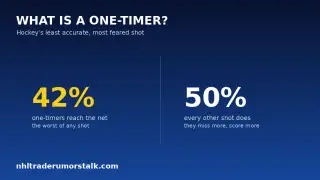
What Is a One-Timer in Hockey?
A one-timer reaches the net just 42% of the time, the worst of any shot, yet it is the most dangerous weapon in hockey and the shot Ovechkin...
By Mike Johnson · 11 min read
Comments
Be the first to share your take.
Get NHL trade rumors in your inbox
One email per week, zero spam, verified rumors only.