Cole Eiserman Islanders Contract: The 3-Year Rebuild Window
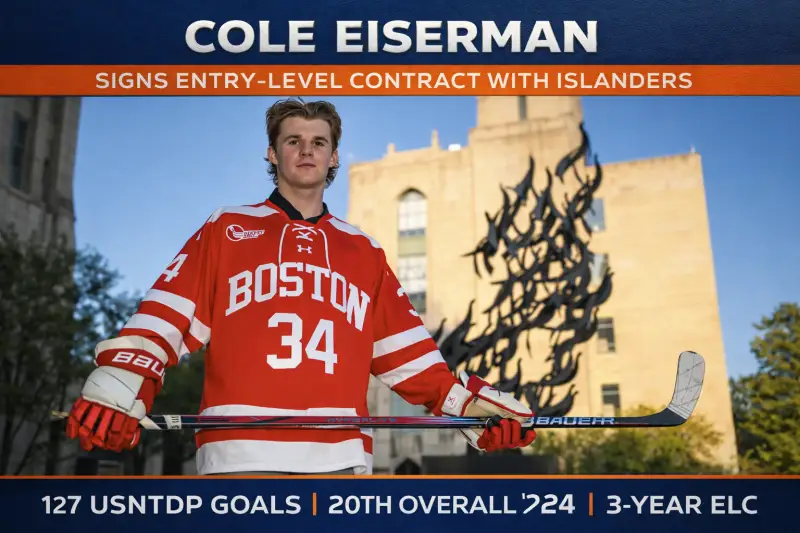
Cole Eiserman signed a 3-year entry-level contract with the Islanders on March 18. His ELC window overlaps with Schaefer's cheap deal and the Barzal-Horvat prime — giving New York a narrow rebuild window that closes by 2029.
Live updates
No updates yet. Refreshing automatically.
The Cole Eiserman Islanders contract is a three-year entry-level deal signed March 18, running from 2026-27 through 2028-29. Cap hit: $1.075 million per season. Pocket change.
#Isles News: The New York Islanders announced today that the club has signed forward Cole Eiserman to a three-year, entry-level contract rules.
— New York Islanders (@NYIslanders) March 18, 2026
In a league where top-six wingers command $7-9 million, that number barely registers. But the story here isn't what the Islanders are paying Eiserman. It's what they're already paying everyone else.
Mathew Barzal at $9.15 million through 2030-31. Bo Horvat at $8.5 million through the same year. Ilya Sorokin at $8.25 million through 2031-32. Matthew Schaefer on his own ELC through 2027-28, putting up a historic rookie season from the blue line. Roughly $50 million in projected cap space for next season, with the ceiling jumping to $104 million. And now Cole Eiserman — a 19-year-old with the best shot release in the 2024 draft class — making next to nothing for three years.
That window — both ELCs cheap, the veteran core in their prime, $50 million to fill the gaps — is the entire Islanders rebuild compressed into a single bet. Long Island has a contender by 2028, or Barzal and Horvat are on the wrong side of 30 and the window slams shut. No middle ground.
The Rebuild Clock the Cole Eiserman Contract Sets in Motion
The Islanders have until 2029. That's the math.
Eiserman's ELC and Schaefer's ELC create a two-to-three-year stretch with two potential top-six talents on entry-level money. Cap advantages like that build contenders — but only if the front office moves fast enough.
| Player | AAV | Expires | Age at ELC End (2029) |
|---|---|---|---|
| Cole Eiserman | ELC ($1.075M) | 2028-29 | 22 |
| Matthew Schaefer | ELC (~$950K) | 2027-28 | 21 |
| Mathew Barzal | $9.15M (M-NTC) | 2030-31 | 31 |
| Bo Horvat | $8.5M (NTC) | 2030-31 | 34 |
| Ilya Sorokin | $8.25M (NMC) | 2031-32 | 33 |
By the time Eiserman needs a real contract, Horvat will be 34. Barzal hits 31 — still productive, probably, but not the electric playmaker who carried this franchise for five years. Sorokin's deal running through 2031-32 gives them goaltending stability. Every roster decision between now and 2028 should reflect that urgency.
So why did they acquire Brayden Schenn from St. Louis at the trade deadline instead of stockpiling futures? They traded Dobson to Montreal on draft day 2025 and got a solid return — Emil Heineman plus picks 16 and 17, one of which became part of the Schaefer package. Good trade. But the Schenn move tells you this team is still caught between timelines. Eiserman's signing should clarify which one they're on.
GM Mathieu Darche — who replaced Lou Lamoriello last spring — reportedly shut down both Vancouver's offer for Conor Garland and St. Louis's inquiry about Jordan Kyrou when those teams asked about Eiserman in return. That tells you everything. (And honestly, good for Darche.)
127 Goals and a 14-Spot Draft Slide
One hundred and twenty-seven USNTDP goals.
Cole Eiserman broke Cole Caufield's all-time record in May 2024, netting his 127th in the gold medal game at the U18 World Championship. Caufield had 126. Phil Kessel had 104. Kane, Matthews, Hughes — all below him. He also finished second in all-time USNTDP points with 193, trailing only Hughes's 228.
And he still fell to 20th overall.
The draft slide tells you everything about the gap between his elite finishing and the rest of his game. Scouting reports describe the shot release as "automatic" and "NHL-ready" — off the rush, on the power play, from the slot, off a one-timer. The kid has more ways to beat a goaltender than some NHLers who've been cashing checks for a decade. That part of his game is undeniable.
But the skating. Scouts flag the edgework. The explosiveness. The inability to create separation. He can't drive a cycle alone, can't generate offense carrying the puck against tight coverage, and there are shifts where he straight-up puck-watches instead of tracking his man. His hockey sense hasn't convinced evaluators he's anything more than a pure goal scorer who needs the right linemates.
The lazy take is that 20th overall was a steal. I think that's wrong — it was an accurate read of risk. But here's the flip side: his specific skill set — that shot, that release, that finishing ability — is the hardest thing in hockey to teach. You can coach skating. You can coach positioning. You can't coach whatever lets him pick corners from impossible angles. The Islanders drafted the ceiling.
What Cole Eiserman's Two Years at BU Actually Fixed
So what did two years of college hockey actually change?
Cole Eiserman's freshman campaign was impressive: 25 goals, 11 assists, 36 points in 39 games — leading all NCAA freshmen in goals. His two-year BU totals: 43 goals across all competitions (38 in regular-season NCAA play). Sophomore year told a different story. Eighteen goals and 10 assists in 32 games. Same player, fewer results.
That drop isn't as simple as the box score makes it look. A lower-body injury cost him several weeks early in the season. Then he lost his primary linemate Cole Hutson to a mid-year ELC signing with Washington — losing a playmaker like that, especially on the power play, would dent anyone's numbers. He still closed strong. Five goals in his final five.
The development that happened at BU won't show up on a stat sheet. Scouts noted improved willingness to battle at the net-front, take and dish hits for rebounds, engage physically in puck battles — the kinds of details NHL evaluators track obsessively and casual fans never notice.
What didn't improve enough: the skating. Two years of NCAA competition and Cole Eiserman's foot speed is still flagged as below average for an NHL prospect. That's a problem. Pro-level defenders are faster, heavier, and more disciplined than anything he faced in Hockey East. If the skating doesn't take a serious leap, his ceiling drops from "top-six sniper" to "power-play specialist who plays 14 minutes a night." That's a massive gap.
Leaving was the right call. With Hutson gone and BU running a different system, a third year would have been playing it safe. The ELC clock starts in October.
Bridgeport First, Then September
"We know Cole...he's a goal scorer. That's something you can't teach. Like any player, there are things everybody needs to work on, but he's got a skill that's tough to teach, and that's scoring goals. So we're excited to have him."
— Mathieu Darche, Islanders GM (via The Hockey News)Darche isn't just talking. He's putting Eiserman in a position to prove it.
The former first-rounder practiced with the Bridgeport Islanders on Thursday — one day after signing — and could make his AHL debut Saturday against the Hershey Bears. He's on an amateur tryout, so the entry-level contract doesn't burn a year until 2026-27 begins.
Most coverage is treating this as a meaningless development stint. It's not. Bridgeport is tied for the sixth and final AHL playoff seed with Springfield, 13 games left. Cole Eiserman is walking into a team fighting for its postseason life. Those reps either accelerate development or expose players who aren't ready.
September is the real audition. Training camp determines whether he cracks the opening night roster or starts in Bridgeport. Given the forward group — Barzal, Horvat, Schenn, Holmstrom, Tsyplakov — there's no rush. Schaefer made the roster at 18 because he was a generational talent at a position of need. Eiserman's path doesn't demand that urgency.
My projection: Bridgeport to start 2026-27. Called up by December when someone inevitably gets hurt. Sticks by the All-Star break if the shot translates at NHL speed. If the skating remains a problem at the pro level, he could spend most of the year in the minors. That's not a failure — that's the normal timeline for a player with his profile.
The Caufield Comparison — And Where It Falls Apart
Everyone's going to compare him to Cole Caufield. The parallels are right there: both broke USNTDP goal records, both undersized first-round shooters, both left college after sophomore year.
Caufield's timeline is the optimistic blueprint. Wisconsin for two NCAA seasons, 2 games in the AHL, called up to Montreal, scored in the 2021 playoffs at 20 years old. By 24, he'd crossed the 30-goal threshold — and this season he's pushing 40. If Cole Eiserman follows that path, the Islanders have a real top-six winger by 2028. Right in the middle of their window.
But the comparison breaks in two places. Caufield was a better skater at the same age — not elite, but functional enough to create space for his shot against NHL defenders. Eiserman can't do that yet. And Caufield walked into a Montreal lineup that desperately needed scoring, giving him every opportunity. Eiserman will be competing for ice time behind established forwards on a team with cap space to add more.
You know what comparison nobody's making? Alex DeBrincat. Another undersized pure scorer who needed the right system and the right linemates. DeBrincat put up 41 goals with the Blackhawks when paired with Dylan Strome, then his production dropped when Chicago shipped him to Ottawa without a complementary playmaker. If the Islanders are smart, they're already thinking about which center — Barzal or someone new — feeds the BU product the puck in the spots where that release does damage.
What This Means for the Islanders' Direction
The Cole Eiserman Islanders contract locks in the final piece of a prospect core that didn't exist two years ago.
Before the Dobson trade, this pipeline was among the weakest in the league. Now? Schaefer is producing at a historic rate — 20 goals as a rookie defenseman, Calder Trophy favorite. Cole Eiserman owns the USNTDP's all-time goal-scoring record. Calum Ritchie, a 2023 first-rounder, is developing in Bridgeport. Emil Heineman is already showing flashes at the NHL level. Entirely different foundation than what the previous regime left behind.
Whether the Islanders actually commit to the timeline this core demands — that's the question nobody can answer yet. Signing the kid was the easy part. The hard part is resisting the urge to trade futures for another 32-year-old rental, or handing Eiserman 18 minutes a night before his skating can handle it, or panicking if October starts slow.
Three years. That's it. Three years of a potential 30-goal scorer at a fraction of his market value, overlapping with a generational rookie defenseman on a similar deal, behind a veteran core still in their prime. The Islanders haven't had this kind of alignment since the Tavares era — and we all know how that ended. The Cole Eiserman Islanders contract is the starting gun. What they do in the next 36 months determines whether it ends with a parade or another decade of rebuilding.
Frequently Asked Questions
What are the financial details of Cole Eiserman's ELC?
The three-year deal carries a $1.075 million AAV, with performance bonuses available on top. It runs from 2026-27 through 2028-29, after which he becomes a restricted free agent. His current amateur tryout with Bridgeport does not count against the ELC's three-year term — that clock starts in October.
When will Cole Eiserman make his NHL debut?
He could make his AHL debut as early as March 22 against the Hershey Bears. The NHL timeline depends on September training camp — most likely scenario is AHL to start 2026-27, then a midseason callup. The Islanders have enough forward depth that rushing him isn't necessary.
How does Cole Eiserman compare to Cole Caufield?
Both hold USNTDP goal-scoring records (Eiserman: 127, Caufield: 126), and both turned pro after two NCAA seasons. The key difference is skating — Caufield had better foot speed at the same stage, helping him produce 30+ goal NHL seasons by age 24. Eiserman's shot release may be even better, but his skating and two-way game lag behind. A closer comp is Alex DeBrincat, who needed the right center to unlock his production.
Why did the Islanders refuse to trade Cole Eiserman at the deadline?
Both Vancouver (in Conor Garland discussions) and St. Louis (in Jordan Kyrou discussions) reportedly asked about him, and GM Mathieu Darche shut those conversations down immediately. The Islanders view him as a core piece of the rebuild, not a trade chip — a clear signal about how the front office values his ceiling.
What are Cole Eiserman's biggest strengths and weaknesses?
The shot is his calling card — scouts describe his release as the best in the 2024 draft class. He scored 127 career USNTDP goals, surpassing Phil Kessel (104), Patrick Kane, and Auston Matthews. His weaknesses are serious: below-average skating, inconsistent defensive awareness, and difficulty creating offense against tight coverage. The bet is that pro development closes those gaps before the ELC expires.
Frequently Asked Questions
What are the financial details of Cole Eiserman's ELC?
The three-year deal carries a $1.075 million AAV, with performance bonuses available on top. It runs from 2026-27 through 2028-29, after which he becomes a restricted free agent. His current amateur tryout with Bridgeport does not count against the ELC's three-year term — that clock starts in October.
When will Cole Eiserman make his NHL debut?
He could make his AHL debut as early as March 22 against the Hershey Bears. The NHL timeline depends on September training camp — most likely scenario is AHL to start 2026-27, then a midseason callup. The Islanders have enough forward depth that rushing him isn't necessary.
How does Cole Eiserman compare to Cole Caufield?
Both hold USNTDP goal-scoring records (Eiserman: 127, Caufield: 126), and both turned pro after two NCAA seasons. The key difference is skating — Caufield had better foot speed at the same stage, helping him produce 30+ goal NHL seasons by age 24. Eiserman's shot release may be even better, but his skating and two-way game lag behind. A closer comp is Alex DeBrincat, who needed the right center to unlock his production.
Why did the Islanders refuse to trade Cole Eiserman at the deadline?
Both Vancouver (in Conor Garland discussions) and St. Louis (in Jordan Kyrou discussions) reportedly asked about him, and GM Mathieu Darche shut those conversations down immediately. The Islanders view him as a core piece of the rebuild, not a trade chip — a clear signal about how the front office values his ceiling.
What are Cole Eiserman's biggest strengths and weaknesses?
The shot is his calling card — scouts describe his release as the best in the 2024 draft class. He scored 127 career USNTDP goals, surpassing Phil Kessel (104), Patrick Kane, and Auston Matthews. His weaknesses are serious: below-average skating, inconsistent defensive awareness, and difficulty creating offense against tight coverage. The bet is that pro development closes those gaps before the ELC expires.
Related Stories

How Do Line Changes Work in Hockey?
A line change is hockey's strangest routine: you swap players while the puck is live, but only inside a five-foot pocket beside your own ben...
By Mike Johnson · 10 min read
What Is the Long Change in Hockey?
The long change is not jargon, it is bench geography. Teams switch ends each period but keep the same bench, so in the second period a tired...
By Mike Johnson · 9 min read
What Is a Delayed Penalty in Hockey?
A delayed penalty is not a penalty yet. It is the referee holding the whistle after a foul until the penalized team touches the puck, which...
By Mike Johnson · 9 min read
What Is a One-Timer in Hockey?
A one-timer reaches the net just 42% of the time, the worst of any shot, yet it is the most dangerous weapon in hockey and the shot Ovechkin...
By Mike Johnson · 11 min read
Comments
Be the first to share your take.
Get NHL trade rumors in your inbox
One email per week, zero spam, verified rumors only.