MacKinnon Ejection Controversy: NHL Admits Mistake | 2026
The NHL rescinded Nathan MacKinnon game misconduct for goaltender interference two days after the Avalanche 4-3 loss to the Oilers. Full breakdown of the MacKinnon ejection controversy and Rule 23.6 implications.
Live updates
No updates yet. Refreshing automatically.
The NHL just admitted what everyone with functioning eyes already knew — Nathan MacKinnon shouldn't have been thrown out of Tuesday night's game against the Edmonton Oilers. The league officially rescinded MacKinnon's game misconduct for goaltender interference on Thursday morning, two days after the Avalanche lost 4-3 in a game that turned on one of the worst officiating decisions of the 2025-26 season. The MacKinnon ejection controversy didn't just cost Colorado two points in the standings — it reignited a firestorm about the NHL's inability to get goaltender interference calls right.
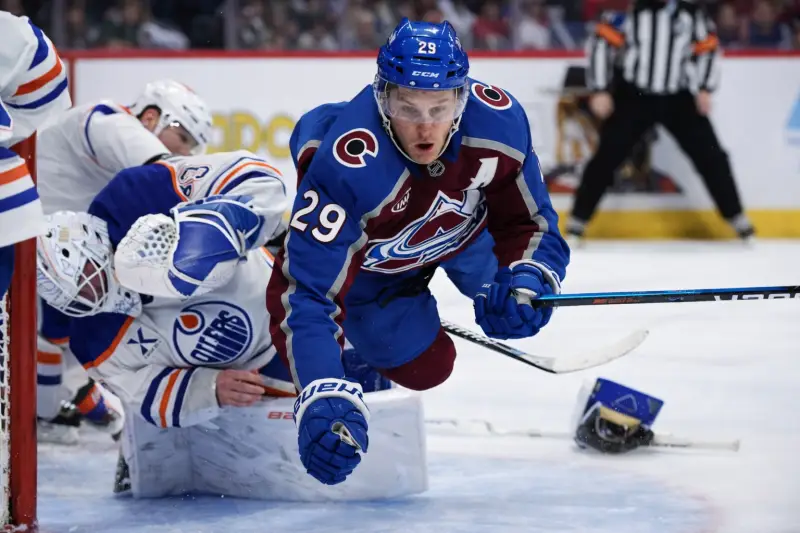
MacKinnon, who was driving the net on a power play with 37 seconds left in the second period, got shoved into Edmonton goalie Connor Ingram by Oilers defenseman Darnell Nurse. The officials hit MacKinnon with a five-minute major and an automatic game misconduct. And even after a video review that dragged on for roughly ten minutes, they stuck with it. Colorado killed the penalty. They still lost. And MacKinnon — a Hart Trophy-caliber center having a 100-point season — watched the third period from the locker room.
"Mistakes happen," MacKinnon told the Denver Post on Thursday. "They know they made a mistake and that's why they took away the five."
That quote is about as diplomatic as it gets for a guy who had a game stolen from him.
What Happened — The MacKinnon Ejection Controversy, Play by Play
Here's the sequence. Late in the second period, Colorado on the power play, Brock Nelson fired a cross-ice pass to MacKinnon, who was doing what he's done his entire career — attacking the net at full speed. MacKinnon tipped the puck wide and tried to pull up. That's when Nurse dove across and collided with him, Nurse's head catching MacKinnon's hip. The contact redirected MacKinnon directly into Ingram.
The goaltender went down hard. Blood from a cut on his forehead. The arena went quiet. Ingram eventually skated off under his own power but was immediately placed into the NHL's concussion protocol.
The officials assessed MacKinnon a five-minute major for goaltender interference at 19:25 of the second period. Because Ingram was injured on the play, the major carried an automatic game misconduct under NHL rules. MacKinnon was done for the night.
But here's what makes this call indefensible: the officials reviewed it. They had every angle. They spent close to ten minutes looking at the footage. And they still got it wrong.
"There's no chance that he hits the goalie if Nurse doesn't run into him," Avalanche head coach Jared Bednar said after the game. "If you put guys in your own goalie, it's not a penalty."
Bednar wasn't wrong. The video is clear — MacKinnon's skates were oriented east-west before Nurse's contact. He was trying to avoid Ingram, not barrel through him. Nurse created the collision, and MacKinnon paid for it.
The Avalanche Locker Room Wasn't Having It
The postgame scene in the Colorado dressing room was tense. Bednar, normally measured in his pressers, didn't hold back. When asked about Ingram's injury, he dropped the now-viral line: "I don't give a crap" — his point being that the injury was a direct result of Nurse shoving MacKinnon, not of anything MacKinnon did intentionally.
Cale Makar backed his linemate. "Nate's got some of the best spatial awareness in the league," Makar said. "Explanation we got was that [Nurse] didn't nudge him enough."
Read that again. The officials acknowledged Nurse made contact with MacKinnon — but decided the push wasn't forceful enough to excuse the collision. That's an absurd standard. You either caused the contact or you didn't. There's no threshold of "enough" force that flips responsibility from the defenseman to the attacking forward.
Nazem Kadri, fresh off his return to Colorado via trade deadline acquisition, was equally frustrated. "He's diving across the top of the crease to try to get out of the way," Kadri said. "There was clear contact."
On the Edmonton side, coach Kris Knoblauch kept it diplomatic. "Obviously, you have to protect your goalies," Knoblauch said. "Obviously, they lost a good player." Not exactly a ringing endorsement of the call, either.
NHL Rescinds the Major — An Unprecedented Admission
Two days later, the league quietly did something it almost never does. The NHL rescinded MacKinnon's game misconduct.
According to MacKinnon, Avalanche GM Chris MacFarland formally requested a review from the league office. The NHL agreed the call was wrong and wiped it from MacKinnon's record.
"I think [MacFarland] asked them to review it, from what I know, and they took it," MacKinnon said. "I just assumed they wanted to review it and that's why they gave the five, and then I thought I'd be back on the ice for a power play. I knew I got hit... There was nothing I could do."
This matters beyond optics. Under NHL Rule 23.6, any player who accumulates two game misconducts in the "Physical Infractions Category" within 41 consecutive games faces an automatic suspension. By rescinding this one, MacKinnon's counter resets to zero. Had it stood, one more bad call — or one more borderline play — could have triggered a suspension for a player who did nothing wrong.
Multiple analysts noted just how rare this reversal is. The league doesn't like admitting its officials blew a call. The fact that they did here tells you everything about how egregious this was.
Key Takeaways
- The NHL admitted the call was wrong — rescinding the game misconduct is an extraordinary step the league almost never takes.
- Darnell Nurse caused the collision — video clearly shows Nurse's contact redirected MacKinnon into Ingram. MacKinnon was trying to avoid the goaltender.
- MacKinnon's Rule 23.6 counter resets — he no longer faces automatic suspension risk from this incident.
- Connor Ingram cleared concussion protocol within 48 hours — he was back on the ice for Thursday's practice and dressed as backup vs. Dallas.
- The loss snapped Colorado's five-game winning streak — a critical two points lost in the Central Division race.
- NHL officiating consistency remains a league-wide problem — this is far from the first goaltender interference controversy this season, and it won't be the last.
MacKinnon's MVP-Caliber Season Rolls On
Lost in the controversy is the fact that MacKinnon is having one of the best seasons of his career. And for a guy with a Hart Trophy on his shelf, that's saying something.
| Stat | 2025-26 | 2023-24 (Hart) | Career Avg |
|---|---|---|---|
| GP | 59 | 82 | 74 |
| Goals | 41 | 51 | 33 |
| Assists | 59 | 89 | 55 |
| Points | 100 | 140 | 88 |
| +/- | +54 | +22 | +13 |
At his current pace, MacKinnon is tracking for roughly 130 points — not quite the 140 he hit during his Hart-winning 2023-24 campaign, but still a monstrous number. His 41 goals in 59 games put him in the Rocket Richard conversation, just five back of Cole Caufield's league-leading pace. His 100 points sit second only to Connor McDavid's 106.
The Avalanche sit atop the Central Division, and MacKinnon is the engine. Losing him for even a period and a half against Edmonton — on a bogus call, no less — is the kind of thing that can swing a playoff seeding. Colorado killed the five-minute major, sure. But without MacKinnon on the ice for the third period, the Oilers had more room to operate. McDavid scored the game-winning goal on a power play. That's a direct consequence.
The Bigger Picture — NHL's Goaltender Interference Problem
This isn't just about one call. The MacKinnon ejection controversy is a symptom of a deeper disease in NHL officiating.
Daily Faceoff analyst Steve Peters broke down the play frame by frame and concluded that "if not for Darnell Nurse, MacKinnon does not hit Ingram." Peters acknowledged the call was "technically defensible" under the current rulebook given the severity of Ingram's injury, but called it "contextually questionable."
Fellow analyst Tyler Yaremchuk expressed sympathy for the on-ice officials, who had to make a snap judgment on a violent collision involving a star player and an injured goaltender in a one-goal game. But sympathy doesn't change the outcome. The officials had ten minutes of video review to correct their mistake, and they didn't.
The fundamental problem is this: the current goaltender interference framework doesn't adequately account for defensive players pushing attackers into their own goalies. When a defenseman like Nurse initiates contact that sends a forward into the crease, the forward gets penalized. The defenseman gets nothing. That incentivizes exactly this kind of play — box out aggressively, create a collision, and let the refs sort it out in your favor.
From my perspective, the NHL needs a rule adjustment. If contact is initiated by the defending team, the resulting goaltender interference should be a no-call at minimum, or a penalty on the defenseman if it's egregious enough. Until that happens, we're going to keep seeing star players get tossed for plays they didn't cause.
Ingram Update and Oilers Implications
On the Edmonton side, the good news is that Connor Ingram is fine. The goaltender cleared the NHL's concussion protocol by Thursday morning and was back on the ice for practice in Dallas. Oilers coach Knoblauch confirmed Ingram would dress as the backup for Thursday's game against the Stars, with Tristan Jarry getting the start.
Ingram had allowed two goals on 17 shots before leaving Tuesday's game. Jarry came in cold and stopped 11 of 12 in relief — a solid performance that earned him the next start. The Oilers' goaltending situation remains fluid, but Ingram's quick recovery from the concussion protocol removes the worst-case scenario from the equation.
What's Next for the Avalanche
MacKinnon's misconduct is officially wiped clean. His Rule 23.6 counter sits at zero. There are no lingering disciplinary consequences — just the sting of a loss that didn't need to happen.
Colorado's focus now shifts to the final stretch of the regular season. The Avalanche remain the team to beat in the Central Division, and their playoff positioning is strong despite the loss. With Ross Colton now on IR, Colorado needs MacKinnon healthy, available, and — critically — on the ice for all 60 minutes. Bad officiating already cost them one game. The MacKinnon ejection controversy should serve as a wake-up call for the league to fix a broken system before it impacts something bigger than a regular-season game.
Frequently Asked Questions
Why was Nathan MacKinnon ejected against the Oilers?
MacKinnon was assessed a five-minute major and automatic game misconduct for goaltender interference after colliding with Edmonton goalie Connor Ingram at 19:25 of the second period on March 10, 2026. Oilers defenseman Darnell Nurse pushed MacKinnon into Ingram while MacKinnon was driving the net on a power play.
Did the NHL overturn MacKinnon's ejection?
Yes. On March 12, 2026, the NHL officially rescinded MacKinnon's game misconduct after Avalanche GM Chris MacFarland requested a formal review. MacKinnon confirmed the decision, stating the league acknowledged the call was a mistake. The 4-3 loss to Edmonton still stands.
What is Rule 23.6 and why does it matter for MacKinnon?
NHL Rule 23.6 states that any player who accumulates two game misconducts in the "Physical Infractions Category" within 41 consecutive games faces an automatic one-game suspension. By rescinding MacKinnon's misconduct, the NHL reset his counter to zero, removing the risk of future suspension from this incident.
Is Connor Ingram okay after the MacKinnon collision?
Ingram suffered a cut on his forehead and was placed in the NHL's concussion protocol immediately after the collision. He cleared protocol within 48 hours and was back on the ice for Thursday's practice in Dallas. He dressed as Tristan Jarry's backup for the Oilers' next game against the Stars.
How does the MacKinnon ejection controversy affect the Avalanche's playoff chances?
The loss cost Colorado two points in the standings and snapped a five-game winning streak. But the Avalanche remain atop the Central Division with a strong playoff position. The bigger concern is the precedent — losing a star player to a bad call in a tight playoff race is the kind of thing that can shift home-ice advantage.
Frequently Asked Questions
Why was Nathan MacKinnon ejected against the Oilers?
MacKinnon was assessed a five-minute major and automatic game misconduct for goaltender interference after colliding with Edmonton goalie Connor Ingram at 19:25 of the second period on March 10, 2026. Oilers defenseman Darnell Nurse pushed MacKinnon into Ingram while MacKinnon was driving the net on a power play.
Did the NHL overturn MacKinnon's ejection?
Yes. On March 12, 2026, the NHL officially rescinded MacKinnon's game misconduct after Avalanche GM Chris MacFarland requested a formal review. MacKinnon confirmed the decision, stating the league acknowledged the call was a mistake. The 4-3 loss to Edmonton still stands.
What is Rule 23.6 and why does it matter for MacKinnon?
NHL Rule 23.6 states that any player who accumulates two game misconducts in the "Physical Infractions Category" within 41 consecutive games faces an automatic one-game suspension. By rescinding MacKinnon's misconduct, the NHL reset his counter to zero, removing the risk of future suspension from this incident.
Is Connor Ingram okay after the MacKinnon collision?
Ingram suffered a cut on his forehead and was placed in the NHL's concussion protocol immediately after the collision. He cleared protocol within 48 hours and was back on the ice for Thursday's practice in Dallas. He dressed as Tristan Jarry's backup for the Oilers' next game against the Stars.
How does the MacKinnon ejection controversy affect the Avalanche's playoff chances?
The loss cost Colorado two points in the standings and snapped a five-game winning streak. But the Avalanche remain atop the Central Division with a strong playoff position. The bigger concern is the precedent — losing a star player to a bad call in a tight playoff race is the kind of thing that can shift home-ice advantage.
Related Stories
How to Watch the NHL: 2026-27
How to watch the NHL in 2026-27: every channel (ESPN, ABC, TNT, NHL Network), every streaming option, the free routes, blackout traps, and t...
By Mike Johnson · 9 min read
NHL 2026-27: The 84-Game Season
The NHL 2026-27 season expands to 84 games, the first since 1993-94. Both new games are divisional. Here is why it changed, when it starts,...
By Mike Johnson · 10 min read
How to Watch the 2026 NHL Draft
Round 1 is June 26 at 7 p.m. ET, Rounds 2-7 are June 27 — but the channel changes between days. The full how-to-watch guide for the 2026 NHL...
By Mike Johnson · 6 min read

Who Is Gavin McKenna? The No. 1 Pick
A Yukon kid who dominated two leagues two years apart, now the consensus No. 1 for 2026. Inside Gavin McKenna's game, his NHL comps, and the...
By Mike Johnson · 9 min read
Comments
Be the first to share your take.
Get NHL trade rumors in your inbox
One email per week. Zero spam. Verified rumors only.