McTavish Healthy Scratch: What's Gone Wrong in Anaheim
McTavish healthy scratch rocks Anaheim as the $42M center sits while Troy Terry returns with 3 points and Carlson debuts. Full breakdown of the slump, trade whispers, and what comes next.
Live updates
No updates yet. Refreshing automatically.
A $42 Million Benchwarmer — The McTavish Healthy Scratch Nobody Saw Coming
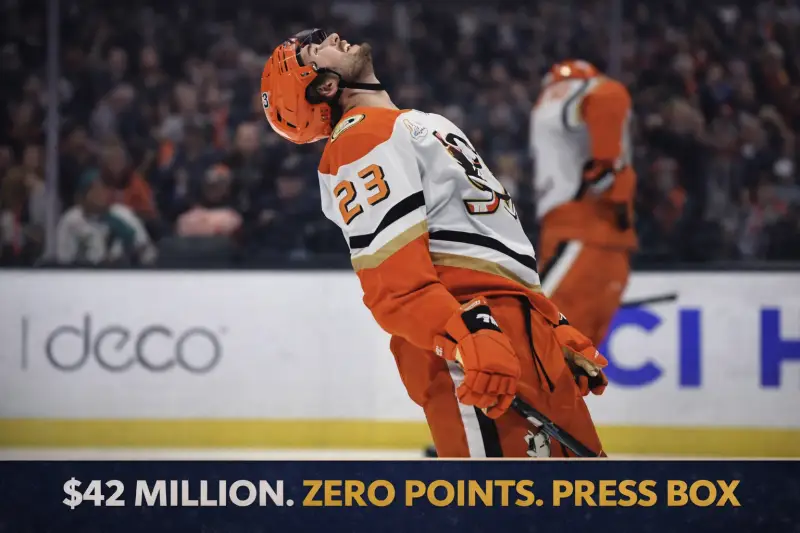
The McTavish healthy scratch landed like a grenade in Anaheim's locker room on March 15. Mason McTavish — third overall pick, franchise centerpiece, owner of a freshly signed six-year, $42 million contract — sat in the press box while the Ducks beat the Montreal Canadiens 4-3. First time all season. Nobody outside the coaching staff saw it coming. And yet, when you look at the numbers, the only surprise is that the McTavish healthy scratch didn't happen sooner.
The timing made it sting more. Troy Terry returned from a nine-game absence with an upper-body injury and immediately reminded everyone what a point-per-game forward looks like — three points in 14:23 of ice time. John Carlson made his Anaheim debut after the trade deadline acquisition from Washington and logged 22:59, the second-highest mark on the team. Leo Carlsson scored twice. The Ducks moved into first place in the Pacific Division with Vegas sitting idle.
Everyone contributed. Everyone except the guy making $7 million a year.
The McTavish Healthy Scratch in Context — A Statistical Freefall
Numbers don't lie, and McTavish's numbers have been screaming for weeks.
| Season | GP | G | A | PTS | P/GP | SOG | TOI/GP |
|---|---|---|---|---|---|---|---|
| 2024-25 | 76 | 22 | 30 | 52 | 0.68 | 180 | 17:30+ |
| 2025-26 | 61 | 13 | 19 | 32 | 0.52 | — | <16:00 |
Last season was supposed to be the launching pad. Twenty-two goals. Fifty-two points. Career highs across the board. The Ducks looked at those numbers, weathered a 10-day holdout, and committed $42 million because they believed the trajectory only pointed up. Instead it cratered.
Thirteen goals in 61 games. Two assists in his last 12. Zero goals in his final five before the scratch. His ice time has dipped below 16 minutes a night for the first time since the start of the season — a death sentence for a player who's supposed to be your second-line center. The possession metrics look respectable on paper — a career-best 52.2% Corsi — but dig one layer deeper and it falls apart. Nearly 59% of his shifts start in the offensive zone. That's not driving play. That's being sheltered.
The progression tells the real story. Center. Then wing. Then third line. Then the press box. Joel Quenneville doesn't bench $7 million players for fun. He benches them when he's out of options. The McTavish healthy scratch was inevitable the moment that 12-game slump became a trend instead of a blip.
Quenneville's System and Why the McTavish Healthy Scratch Was Coming
This is where it gets uncomfortable for McTavish.
Quenneville's system in Anaheim demands pace. Quick transitions. Aggressive forechecking. Forwards who can retrieve pucks and get back in defensive position without cheating. It's the system that turned the Ducks from an 80-point afterthought into a 75-point playoff contender through 66 games — a 15-point jump from where they stood on the same date last season.
McTavish doesn't fit. Not right now. Analyst Félix Sicard put it bluntly: “He's gone from center, to wing, to now healthy scratch. He's shown he can be more than this with his physicality and finishing, but the lack of footspeed in Q's system has stood out.”
Footspeed. That's the word that keeps surfacing in conversations around Anaheim's coaching staff. McTavish at 6-foot-1, 207 pounds has the frame and the hands. The shot is there. The compete level, on his best nights, is legitimate. But when the game opens up and the pace accelerates through the neutral zone, he's a half-step behind. And in Quenneville's system, a half-step is the difference between the top six and the press box.
Meanwhile, look at what walked back into the lineup. Troy Terry: 48 points in 47 games. Plus-10. Averaging 18:16 a night. Quenneville's postgame comments about Terry's return were practically a love letter. “He's got a point a game, he plays important minutes… He gives you a lot of options.” That's the standard. McTavish isn't close to meeting it. No wonder the McTavish healthy scratch felt less like a punishment and more like arithmetic.
Does the McTavish Healthy Scratch Change the Trade Conversation?
Short answer: not yet. But the whispers are getting louder.
During the summer of 2025 — before the holdout, before the extension — McTavish's name circulated in trade discussions. Detroit. Carolina. Vancouver. Calgary. Montreal. Philadelphia. Six teams were reportedly interested. An NHL executive told reporters that GM Pat Verbeek “hasn't sent out the bat signal yet” for McTavish offers, which is the kind of carefully worded non-denial that keeps phones ringing.
Then the Ducks signed him for six years and $7 million AAV. That was supposed to end the conversation. It didn't. It just made the conversation more expensive.
Here's the reality. Trading McTavish right now would be selling at the absolute floor of his value. He's 23 years old with 73 career goals and a contract that runs through 2030-31. Any GM picking up the phone would low-ball Verbeek into the ground, and Verbeek knows it. You don't move a former third overall pick after one bad stretch unless you've given up on the player entirely. Anaheim hasn't reached that point. Not even close.
McTavish hasn't asked for a trade, per reports. This isn't a disgruntled star forcing his way out. It's a young player hitting a wall — something the Blues are dealing with differently in their own goaltending situation. Those are different problems with different solutions. The McTavish healthy scratch is a message, not a farewell.
What Happens Next — Why This McTavish Healthy Scratch Is a Crossroads
The Ducks have 16 games left. They're sitting at 75 points, one behind Vegas for the Pacific Division lead, with a 98.2% probability of making the playoffs. This is the most meaningful stretch of hockey Anaheim has played since the 2017 postseason. The margin for passengers is zero.
McTavish has to earn his way back. That means showing Quenneville in practice what he hasn't shown in games — the pace, the engagement, the two-way commitment that a $7 million center owes a playoff team fighting for every point. The holdout last September was supposed to signal that McTavish believed in himself. The scratch signals that the belief alone isn't enough.
From my perspective, the McTavish healthy scratch is the best thing that could happen to him. Sometimes a 23-year-old with generational talent and a massive contract needs the press box to recalibrate. He watched Terry come back and put up three points. He watched Carlson log 23 minutes in his first game. He watched Leo Carlsson score twice. The message was clear: this team doesn't need you right now. Make it need you again.
If McTavish responds? This becomes a footnote — a one-game wake-up call in a season that ends with a deep playoff run. If he doesn't? The bat signal goes up this summer. And after this McTavish healthy scratch, nobody in Anaheim will be surprised when the phone calls start.
Frequently Asked Questions
Why was Mason McTavish a healthy scratch?
The McTavish healthy scratch came on March 15 against Montreal after he recorded just two assists in his previous 12 games. Coach Joel Quenneville had already demoted him from center to wing to the third line without improvement. With Troy Terry returning from injury and John Carlson making his Ducks debut, there simply wasn't room for a player producing at that rate.
What is Mason McTavish's contract with the Ducks?
McTavish signed a six-year, $42 million extension ($7 million AAV) on September 27, 2025, following a brief holdout from training camp. The deal runs through the 2030-31 season and includes a limited no-trade clause in the final two years.
Are the Ducks going to trade Mason McTavish?
Not imminently. An NHL executive said GM Pat Verbeek “hasn't sent out the bat signal yet” for trade offers, and McTavish has not requested a trade. However, if his production doesn't recover after the McTavish healthy scratch, the conversation could resurface this summer. Six teams expressed interest during the 2025 offseason.
How have the Ducks performed without McTavish in the lineup?
The Ducks won 4-3 over Montreal on the night of the McTavish healthy scratch, moving into first place in the Pacific Division. Troy Terry had three points in his return, John Carlson logged 22:59 in his debut, and Leo Carlsson scored twice. The team has 75 points through 66 games with a 98.2% playoff probability.
Frequently Asked Questions
Why was Mason McTavish a healthy scratch?
The McTavish healthy scratch came on March 15 against Montreal after he recorded just two assists in his previous 12 games. Coach Joel Quenneville had already demoted him from center to wing to the third line without improvement. With Troy Terry returning from injury and John Carlson making his Ducks debut, there simply wasn't room for a player producing at that rate.
What is Mason McTavish's contract with the Ducks?
McTavish signed a six-year, $42 million extension ($7 million AAV) on September 27, 2025, following a brief holdout from training camp. The deal runs through the 2030-31 season and includes a limited no-trade clause in the final two years.
Are the Ducks going to trade Mason McTavish?
Not imminently. An NHL executive said GM Pat Verbeek “hasn't sent out the bat signal yet” for trade offers, and McTavish has not requested a trade. However, if his production doesn't recover after the McTavish healthy scratch, the conversation could resurface this summer. Six teams expressed interest during the 2025 offseason.
How have the Ducks performed without McTavish in the lineup?
The Ducks won 4-3 over Montreal on the night of the McTavish healthy scratch, moving into first place in the Pacific Division. Troy Terry had three points in his return, John Carlson logged 22:59 in his debut, and Leo Carlsson scored twice. The team has 75 points through 66 games with a 98.2% playoff probability.
Related Stories
Binnington Blues Trade: Why St. Louis Will Deal Him (2026)
Binnington Blues trade called a "forgone conclusion" by Brian Lawton. Joel Hofer's .948 SV% since the break has sealed the starting job. Ful...
By Mike Johnson · 6 min read
McDavid Gudas Suspension: NHL Audit Call After 5-Game Ban
McDavid Gudas suspension fallout deepens as the Oilers captain calls for a full NHL disciplinary audit. Gudas got 5 games for a season-endin...
By Mike Johnson · 6 min read
Andersson Golden Knights Extension: Why No Deal Yet
The Andersson Golden Knights extension hasn't happened yet — but it's a CBA and cap issue, not a willingness problem. Friedman says both sid...
By Mike Johnson · 5 min read

Carlson Ducks Extension: 2-Year Deal Worth $8-9M Projected
The Carlson Ducks extension is projected at 2 years, $8M-$9M AAV per Pierre LeBrun. Anaheim has the cap room, the rising ceiling, and the mo...
By Mike Johnson · 6 min read
Comments
Be the first to share your take.
Get NHL trade rumors in your inbox
One email per week. Zero spam. Verified rumors only.