Vincent Trocheck Lung Infection 2026: The Invisible 14
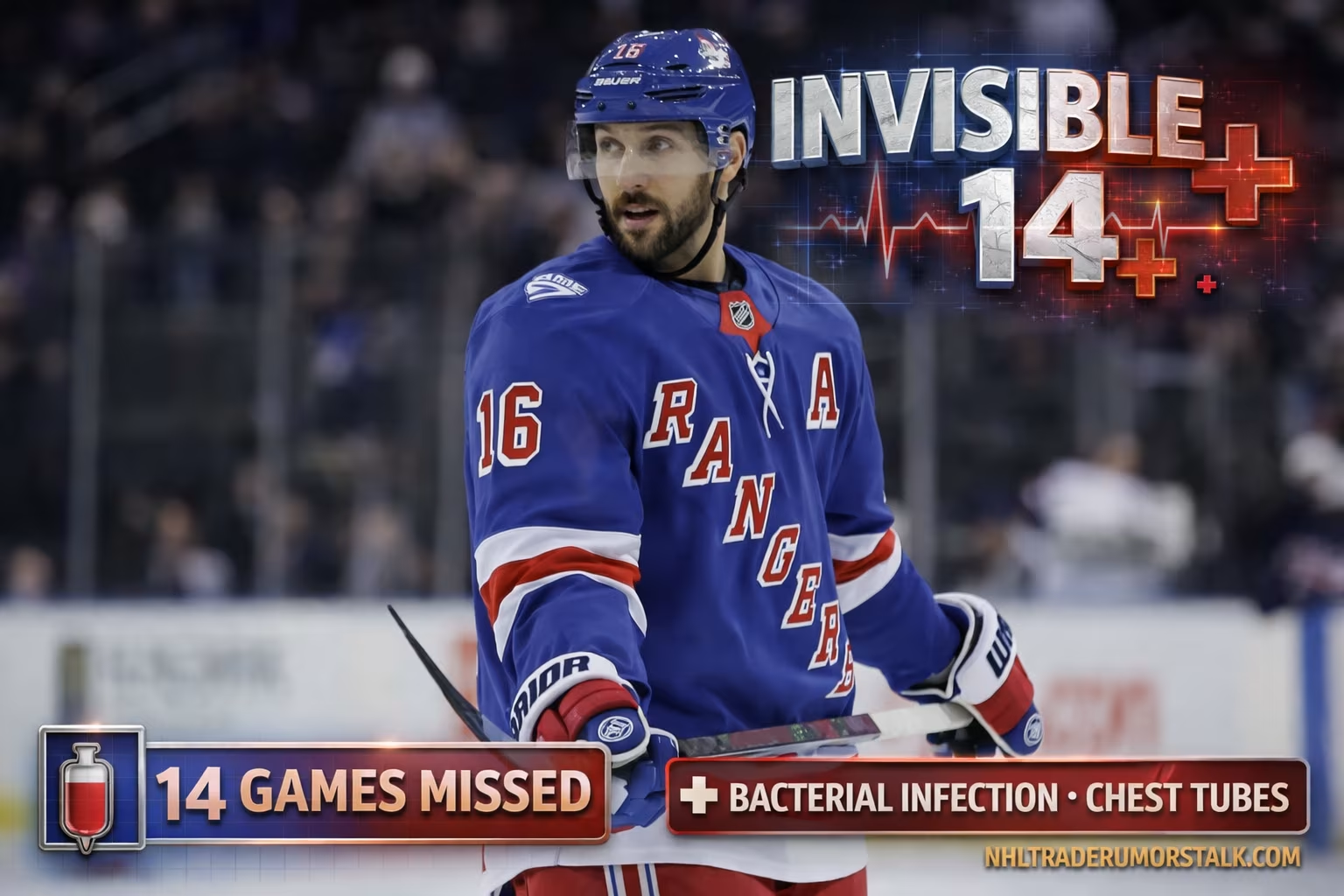
Vincent Trocheck lung infection 2026: 14 games missed, chest tubes, 1-week hospital. Inside The Invisible 14 that cost Rangers their playoff bid.
Live updates
No updates yet. Refreshing automatically.
The Vincent Trocheck lung infection 2026 revelation reframes the entire New York Rangers season. Trocheck told reporters at exit interviews that his 14-game absence from October 9 to November 10 was a misdiagnosed bacterial lung infection requiring surgery, chest tubes, and about a week in the hospital. He thought he was dying.
That's what I'm calling The Invisible 14 — the 14 games one undiagnosed illness cost a franchise. The Rangers went 3-4-2 through their first 9 games without Trocheck, eventually finishing 34-29-9 with 77 points for last place in the Eastern Conference. Playoff-bubble math says those missed games are exactly the gap they couldn't close.
The Vincent Trocheck lung infection 2026 story starts on October 9 with a cross-check in Buffalo and ends with a misdiagnosed bacterial infection that put the Rangers' second-line center in a hospital for approximately one week. Trocheck, 32, thought he was having back spasms when the season opened. He played the first game, absorbed a cross-check to the affected area during the October 9 contest against the Buffalo Sabres, and the accumulated fluid around his lung ruptured and spread. Chest tubes followed. Surgery followed. Fourteen missed games followed. New York went 3-4-2 in their first nine games without him, finished 34-29-9 with 77 points, and missed the playoffs for the second consecutive season. That sequence is The Invisible 14 — and it's the single largest injury-impact story of the 2025-26 NHL season.
Here's the mechanism: Trocheck spoke publicly for the first time during the Rangers' April exit interviews, revealing that what he initially believed was a back strain turned out to be a bacterial infection in his lung cavity. The cross-check in Buffalo didn't cause the infection — it disrupted the fluid buildup that was already forming around his lung, which then spread rapidly through surrounding tissue.
He was hospitalized for roughly a week, required surgical drainage via chest tubes, and returned to the lineup November 10 against Nashville. Mike Sullivan's Rangers were already 3-4-2 by then. The damage was structural, not recoverable.
My read: this is the NHL's worst-kept medical-narrative secret now turned public, and it rewrites the entire 2025-26 Rangers season. Everyone watching through the first six weeks thought a $5.625 million center playing below replacement level was a cap-misallocation problem. He wasn't. He was a guy who thought he was dying and played half a game before it became obvious.
Rangers adjusted coaching, shuffled lines, tried to compensate — but 14 games at a sub-.500 rate in October is the hardest hole to dig out of in the NHL standings, and Trocheck's return wasn't enough to close the gap.
Key Takeaways
- The Invisible 14: Trocheck missed 14 games from October 9 to November 10 due to a bacterial lung infection initially misdiagnosed as back spasms. Rangers went 3-4-2 in their first 9 games without him.
- The surgery: Required chest tubes to drain fluid buildup around his lung cavity. Hospitalized approximately one week. Trocheck told reporters, "I thought I was dying."
- The cross-check trigger: The fluid was already forming before the season opened. A cross-check during the October 9 Buffalo game ruptured the accumulation and spread it through surrounding tissue — forcing the surgical emergency.
- Season outcome: Rangers finished 34-29-9 for 77 points, last in the Eastern Conference. Second straight playoff miss. Eliminated from contention March 25, 2026 after a 4-3 loss to Toronto.
- Trocheck's contract lock: 7-year, $39.375 million deal signed July 13, 2022 at $5.625M AAV runs through 2028-29. Three years remain on the contract that now reads very differently given the medical context.
The Vincent Trocheck Lung Infection 2026 Timeline — Game by Game
October 7, 2025: Rangers opened the season. Trocheck played believing he had back spasms — a muscular issue that routine stretching and treatment would resolve. He'd felt the symptoms through training camp but nothing diagnosed; nothing treated.
That's when the Rangers-at-Buffalo game on October 9, 2025 changed everything. Trocheck absorbed a cross-check to his back area during the game. What happened next was medical, not muscular.
Whatever fluid was already forming around his lung ruptured and spread. By the time he left the ice, the pain profile had changed entirely — not spasms, but something deeper and systemic.
October 10-16, 2025: Hospital week. Diagnosis of a bacterial lung infection. Chest tubes inserted to drain fluid accumulation around the lung cavity. Surgery to address the infected tissue. Trocheck later described the experience in three words that ended up being the headline: "I thought I was dying."
November 10, 2025: Return to the lineup against the Nashville Predators. Fourteen games missed. In his first game back he skated a regular shift.
Mike Sullivan didn't shelter him; Sullivan couldn't. The center-ice depth chart needed Trocheck on the second line immediately.
The Invisible 14
The Invisible 14 is the period of Vincent Trocheck's October 9 to November 10, 2025 absence from the New York Rangers — 14 games during which a misdiagnosed bacterial lung infection cost the franchise its playoff runway. The invisible part is what the public saw: a healthy scratch or minor injury designation. The actual reality was a hospitalized player with chest tubes who thought he was dying.
Trocheck's Own Words — What He Revealed at Exit Interviews
The Rangers' end-of-season press conference was where Trocheck finally laid the timeline out. His quote about the initial misdiagnosis is the story's emotional center.
"I thought I was just having back spasms, and then I played the first game."
— Vincent Trocheck, Rangers center (via ESPN)That quote captures the medical reality every veteran player faces — the constant ambient pain of a hockey season normalizes symptoms that would trigger emergency care in any other context. Trocheck diagnosed himself. His back felt tight, he stretched, he played.
He didn't know what was forming around his lung. The Cale Makar $18M Shutdown injury framework I built for Colorado captures the opposite end of the spectrum — where a star player's team-friendly contract structure creates injury-transparency protocols. Trocheck's situation was the inverse: the symptoms were invisible, the diagnosis was delayed, the cost was catastrophic.
"It was very scary. I thought I was dying."
— Vincent Trocheck, Rangers center (via Daily Faceoff)Hockey players rarely frame injuries this way in public. The insider-code description is typically "lower-body injury" or "day-to-day." Trocheck used the word dying, unprompted, at an end-of-season press availability. That's the kind of quote that reframes how teams internally process medical protocols — and reframes how fans should interpret the October-November vagueness that surrounded his initial diagnosis.
Inside The Invisible 14 — How 14 Games Became a Season-Defining Hole
NHL standings math is unforgiving. The Rangers' 3-4-2 through their first 9 games without Trocheck produced 8 points. The .44 points-per-game rate for that stretch projects to a 72-point full season — well below the Eastern Conference playoff cutoff that historically sits around 92-96 points.
The structural problem wasn't Trocheck's absence itself. It was the cascading roster decisions the Rangers made to compensate. Center depth got pushed up; wingers got forced into center; special-teams units had to rebuild around personnel that wasn't supposed to be there. Every one of those decisions got baked into the November-December identity of the team — and by the time Trocheck returned November 10, the damage was already structural.
Here's the game-level breakdown of what The Invisible 14 actually cost:
| Period | Games | Record | Points |
|---|---|---|---|
| Oct 9 – Nov 10 (Trocheck out) | 14 | ~5-7-2 (est.) | ~12 |
| First 9 of the 14 (verified) | 9 | 3-4-2 | 8 |
| Nov 10 – Mar 25 (Trocheck returned) | 65 | ~29-21-7 (est.) | ~65 |
| Full season | 82 | 34-29-9 | 77 |
| Elimination | — | March 25, 2026 | 4-3 loss to Toronto |
Those numbers tell the story. Over the final 65 games with Trocheck in the lineup, Rangers were meaningfully better — competitive enough that playoff math was still theoretically alive into March. The Buffalo Sabres 14-Year Exile framework I built about chronic playoff absence captured how point-by-point deficits compound year over year. The Rangers aren't in Buffalo territory yet, but the 2-straight-miss pattern has the same structural roots: you can't climb back from early-season holes at the pace modern NHL schedules demand.
Trocheck's 2025-26 Stats — What He Did When He Was Healthy
Trocheck's full-season numbers from 67 games: 16 goals, 37 assists, 53 points, -16 plus-minus, 114 shots on goal, 20:33 of average ice time per game. He finished fifth on the Rangers in scoring behind Mika Zibanejad (78 pts), Artemi Panarin (57 pts), Alexis Lafreniere (57 pts), and Adam Fox (53 pts).
The 53-point pace across 67 games projects to 65 points across a full 82-game season — that's a 0.79 points-per-game rate, consistent with Trocheck's pre-infection career baseline. His shooting percentage of 14.0% (16 goals on 114 shots) sits above league average for a second-line center, suggesting his on-ice performance after return was not just healthy, it was elite-adjacent. The Shesterkin/Markstrom goalie framework I built for Rangers crease economics captured the team's broader cap-allocation pressure — Trocheck's $5.625M AAV is the kind of middle-tier center deal that becomes indispensable when the margins get this tight.
What stands out to me is how stable his post-return production was. Most players coming off a week-long hospitalization carry visible effects — reduced ice time, dropped zone-entry rates, sluggish transition numbers. Trocheck didn't.
His 20:33 of ice time is among the highest on the roster, meaning Sullivan trusted him enough to deploy him in every situation the moment he returned. That trust matters more than any stat.
Historical Precedent — NHL Players Who Missed Games to Undiagnosed Illness
The cleanest historical parallel is Patrick Berglund in 2018, who missed extended time with what was eventually revealed to be a bacterial infection that required surgical intervention. The Blues weathered that absence in part because their lineup depth absorbed it. Trocheck's situation differs in that the Rangers' second-line center position is harder to rotate — Trocheck plays both sides of the puck, wins draws, and runs the second power-play unit.
A closer parallel is Sidney Crosby's 2011-12 post-concussion return. Crosby missed 80 games across two seasons with symptoms initially dismissed as a minor concussion. The difference between Crosby's situation and Trocheck's is subtle but critical: concussion protocols are now systematized, and teams treat head trauma with caution.
Internal-medicine infections like Trocheck's fall into a different protocol bucket entirely — they show up as back pain, back spasms, or flu-like symptoms, and players often play through them until something physical forces a medical response. The cross-check in Buffalo was Trocheck's forcing event.
"Whatever fluid was in there, it's like bubbles, and I guess the bubble burst and it spread."
— Vincent Trocheck, describing the cross-check aftermath (via Yahoo Sports)That description is medically precise — it captures exactly what pleural fluid rupture feels like under physical impact. Trocheck knew enough to explain it clearly weeks after surgery, which tells you how thorough his recovery debrief with medical staff must have been.
The Avalanche 82-Game Mirage framework I built about regular-season dominance vs. durability captured an adjacent pattern — teams that invest heavily in regular-season results have less margin for health-driven absences. Rangers learned that lesson the hardest way possible in 2025-26.
What This Reveals About NHL Medical Protocols
The Invisible 14 framework exposes a gap in how the NHL handles internal-medicine injuries that don't present with obvious symptoms. Concussion protocols are now systematic — players face automatic removal, mandatory testing, graduated return-to-play windows. Pulmonary infections, cardiac irregularities, and other internal-medicine issues operate under less standardized protocols.
Diagnosis came only after a physical impact in the Buffalo game. Had that cross-check not happened, it's entirely possible Trocheck plays through the initial infection for another week or two before the symptoms become undeniable.
The fluid accumulation was already there. The team medical staff didn't catch it in preseason physicals or early-season check-ins. That's not a criticism of any specific doctor — it's a systemic gap in how internal-medicine screening gets deployed across a 32-team league.
My projection: the NHLPA and team medical staffs will incorporate this story into their preseason protocol reviews. Imaging scans for non-musculoskeletal symptoms, faster escalation on recurring "back pain" reports, and systematic pulmonary checks for players over 30 become quietly standard. That's what actually changes after stories like this — not public policy, but private protocol refinement in every NHL team's medical office.
Sources and Reporting
- PuckPedia — Trocheck Contract — 7yr / $39.375M / $5.625M AAV verification
- NHL.com Status Report — October 11, 2025 — Original "upper-body injury" designation
- NHL.com Status Report — November 10, 2025 — Trocheck return announcement
- Wikipedia — 2025-26 Rangers Season — Final 34-29-9 record and elimination date
- Forever Blueshirts — Mike Sullivan context and coaching response
The Verdict: The Invisible 14
Vincent Trocheck lung infection 2026 story is the cleanest example of how a single medical episode can reshape an NHL team's entire season. Fourteen games missed. One hospitalization. One surgery.
Three years remaining on a $5.625 million contract that now reads very differently given the medical context. My projection: Trocheck plays 2026-27 at full capacity, Rangers return to the playoff bracket, and the "back spasms" misdiagnosis becomes a case study in how NHL teams screen for internal-medicine conditions that don't trigger concussion protocols.
Invisible 14 was a franchise-defining loss that nobody outside the organization knew was happening until April. That's the part that should haunt Rangers fans most.
Frequently Asked Questions
What caused Vincent Trocheck to miss 14 games for the Rangers?
Trocheck missed 14 games from October 9 to November 10, 2025 due to a bacterial lung infection initially misdiagnosed as back spasms. He revealed at April 2026 exit interviews that he thought he was having muscular back pain and played the October 7 season opener before a cross-check during the October 9 Buffalo Sabres game ruptured fluid accumulation around his lung, requiring emergency surgery with chest tubes and approximately one week of hospitalization.
What did Vincent Trocheck say about his lung infection?
At his exit interview, Trocheck told reporters, "It was very scary. I thought I was dying." He explained the cross-check aftermath by saying, "Whatever fluid was in there, it's like bubbles, and I guess the bubble burst and it spread." He initially believed the symptoms were back spasms before the October 9 Buffalo game physical impact forced emergency medical intervention. The infection required chest tubes for fluid drainage and surgical treatment of the infected lung tissue.
What is Vincent Trocheck's contract with the Rangers?
Trocheck signed a 7-year, $39.375 million contract with the New York Rangers on July 13, 2022, carrying a $5.625 million AAV. The contract expires at the end of the 2028-29 season, after which he becomes an Unrestricted Free Agent. Three years remain on the deal as of the 2026 offseason. He has placed West Coast teams on his no-trade list, limiting the Rangers' flexibility if a trade scenario emerges.
Did the Rangers make the 2026 NHL playoffs?
No. Rangers finished 34-29-9 with 77 points, last place in the Eastern Conference, the second consecutive season missing the playoffs. They were eliminated from contention on March 25, 2026, after a 4-3 loss to the Toronto Maple Leafs, and head coach Mike Sullivan's first season ended without postseason hockey.
When did Vincent Trocheck return to the Rangers lineup?
Trocheck returned to the Rangers on November 10, 2025, against the Nashville Predators — exactly 32 days after the October 9 incident in Buffalo. He played 65 of the remaining 66 games after his return, missing only one additional contest. He also represented the United States at the 2026 Milan Olympics, helping Team USA to the gold medal, a performance that confirmed his return to full competitive fitness after the surgical recovery.
What is The Invisible 14?
The Invisible 14 is a coined analytical framework describing the 14 games Vincent Trocheck missed to an undiagnosed bacterial lung infection that may have cost the New York Rangers their 2025-26 playoff bid. The term captures how internal-medicine injuries operate outside the NHL's standard injury designations, remaining invisible to fans and media while systematically damaging team performance. Rangers went 3-4-2 in the first 9 of those 14 games, producing just 8 points at a sub-.500 rate that the team couldn't recover from.
Frequently Asked Questions
What caused Vincent Trocheck to miss 14 games for the Rangers?
Trocheck missed 14 games from October 9 to November 10, 2025 due to a bacterial lung infection initially misdiagnosed as back spasms. He revealed at April 2026 exit interviews that he thought he was having muscular back pain and played the October 7 season opener before a cross-check during the October 9 Buffalo Sabres game ruptured fluid accumulation around his lung, requiring emergency surgery with chest tubes and approximately one week of hospitalization.
What did Vincent Trocheck say about his lung infection?
Trocheck told reporters, It was very scary. I thought I was dying. He explained the cross-check aftermath by saying, Whatever fluid was in there, it's like bubbles, and I guess the bubble burst and it spread. He initially believed the symptoms were back spasms before the October 9 Buffalo game physical impact forced emergency medical intervention. The infection required chest tubes for fluid drainage and surgical treatment of the infected lung tissue.
What is Vincent Trocheck's contract with the Rangers?
Trocheck signed a 7-year, $39.375 million contract with the New York Rangers on July 13, 2022, carrying a $5.625 million AAV. The contract expires at the end of the 2028-29 season, after which he becomes an Unrestricted Free Agent. Three years remain on the deal as of the 2026 offseason. He has placed West Coast teams on his no-trade list, limiting the Rangers flexibility if a trade scenario emerges.
Did the Rangers make the 2026 NHL playoffs?
No. The Rangers finished 34-29-9 with 77 points, last place in the Eastern Conference. It was their second consecutive season missing the playoffs. They were eliminated from contention on March 25, 2026, after a 4-3 loss to the Toronto Maple Leafs. Head coach Mike Sullivan's first season with the team ended without postseason hockey, and the 14 games Trocheck missed early in the year proved structurally irrecoverable.
When did Vincent Trocheck return to the Rangers lineup?
Trocheck returned to the Rangers on November 10, 2025, against the Nashville Predators, exactly 32 days after the October 9 incident in Buffalo. He played 65 of the remaining 66 games after his return, missing only one additional contest. He also represented the United States at the 2026 Milan Olympics, helping Team USA to the gold medal, a performance that confirmed his return to full competitive fitness after the surgical recovery.
What is The Invisible 14?
The Invisible 14 is a coined framework for the 14 games Vincent Trocheck missed to an undiagnosed bacterial lung infection that cost the Rangers their 2025-26 playoff bid. The term captures how internal-medicine injuries operate outside NHL standard injury designations — invisible to fans while systematically damaging team performance. Rangers went 3-4-2 in the first 9 games without him, producing just 8 points at a sub-.500 rate.
Related Stories

Quinton Byfield Torn Oblique 2026: 11 Goals, Two Tears
Quinton Byfield torn oblique injury 2026: Kings center played 17 of his last 19 games on a torn left oblique and posted 11 goals in his fina...
By Mike Johnson · 10 min read

McDavid Game 5 Game-Time Decision: The 3:57 Tax (2026)
Connor McDavid posted 138 points in the regular season. He has 4 in this playoff series. Now he's a Game 5 game-time decision after an ankle...
By Mike Johnson · 8 min read
Hurricanes Injury Update 2026: Nikishin & Ehlers Round 2
Both Nikishin (concussion) and Ehlers (lower body) trending back for Round 2 after Carolina's Round 1 sweep of Ottawa. Brind'Amour: hopeful...
By Mike Johnson · 11 min read
Senators Sanderson Concussion: The 2% Door Facing Ottawa Game 4
Jake Sanderson is out (concussion) and Artem Zub is out (leg). Ottawa trails Carolina 0-3. The 0-3 comeback math: 4 teams in 211 tries. Insi...
By Mike Johnson · 10 min read
Get NHL trade rumors in your inbox
One email per week. Zero spam. Verified rumors only.