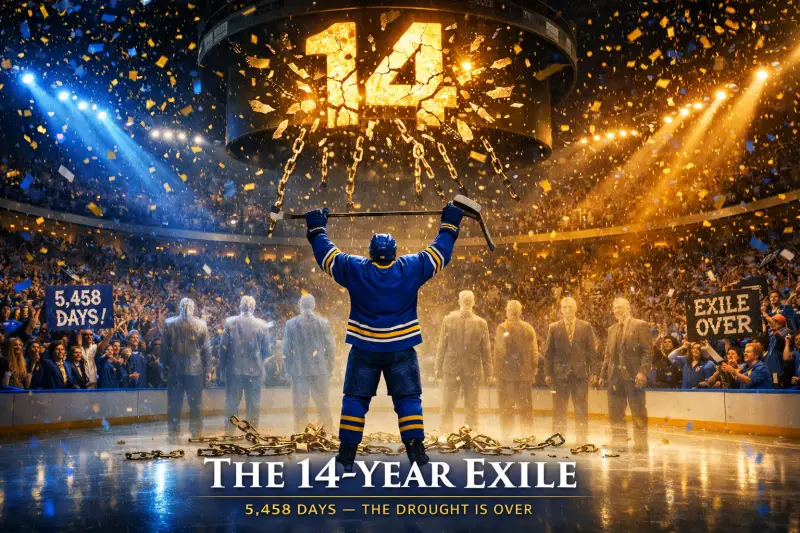
Buffalo Sabres Playoff Drought Over: The 14-Year Exile Ends
Buffalo clinched on April 4 after a 35-8-4 run, ending the longest playoff drought in NHL history at 14 seasons and 5,458 days. Seven coaches, four GMs, and the most dramatic single-season turnaround in franchise history.
Live updates
No updates yet. Refreshing automatically.
Every Buffalo Sabres playoffs 2026 headline this week leads with a number. 5,458 days. That's how long the franchise went without a postseason appearance — from Lindy Ruff's Game 7 loss to Philadelphia on April 26, 2011, to the scoreboard clinch on April 4 that ended the longest playoff drought in NHL history.
The clinch itself was perfectly imperfect. Buffalo was losing 6-2 to Washington when the Rangers beat Detroit in regulation and mathematically eliminated every remaining competitor. The Sabres found out they were a playoff team via the arena videoboard, in the middle of being outscored by four goals.
I'm calling this story The 14-Year Exile — and what makes it remarkable isn't that it ended. It's how fast it ended. Buffalo sat dead last in the Eastern Conference on December 15 and finished first in the Atlantic Division 111 days later. No franchise in modern NHL history has covered that distance in a single season.
Key Takeaways
- The exile in numbers: 14 consecutive seasons without a playoff berth, 5,458 days, 7 head coaches, and 4 general managers — the longest drought in NHL history ended April 4, 2026
- The Kekalainen pivot: Buffalo went 35-9-4 after Jarmo Kekalainen replaced Kevyn Adams as GM on December 15 — the best 40-game stretch by any NHL team since 1996, tied for 4th best in league history
- Thompson's historic season: Tage Thompson's 44 goals made him the first Sabre to reach 40 since Alexander Mogilny and Pat LaFontaine in 1992-93 — a 33-year gap
- The draft dividend: Three top-10 picks accumulated during the tank years — Dahlin (#1, 2018), Cozens (#7, 2020), and Power (#1, 2021) — now form the core of a 102-point playoff team
- The bracket reality: Buffalo's first-round matchup against Montreal opens a playoff path where no single round dips below 6/10 in difficulty, with Tampa Bay's Kucherov-Vasilevskiy combination lurking in Round 2
The @BuffaloSabres, @TBLightning, @Canes and @mnwild can all book their ticket to the 2026 #StanleyCup Playoffs tonight, but will they all do it? Three or more teams have clinched a postseason berth on the same day nine times since 2013-14. #NHLStats pic.twitter.com/nJNy8Dk2Kd
— NHL Public Relations (@NHLPR) April 4, 2026
5,458 Days: The Anatomy of The 14-Year Exile
The drought started with a coaching legend and ended with the same one. Ruff was fired midseason in February 2013 after 15 years behind the Buffalo bench — the longest tenure in franchise history. Fourteen years later, the organization brought him back to finish what the six coaches between his two stints couldn't.
Between those bookends, Buffalo cycled through Ron Rolston (interim, won 19 of 51 games), Ted Nolan, Dan Bylsma (a Cup winner with Pittsburgh who went 68-73-23 in Buffalo), Phil Housley, Ralph Krueger (fired 28 games into his second season), and Don Granato (122-125-27 across three full years). Seven coaches in 14 seasons. Not one lasted long enough to see a rebuild through.
The general manager carousel was equally damaging. Darcy Regier was fired in November 2013 after 16 years. Tim Murray lasted until 2017. Each new hire tried to fix what the predecessor broke, and each one created new problems in the process.
Building a contender requires patience, and Buffalo's ownership never gave anyone enough runway. Kevyn Adams inherited the job in 2020 and presided over five-plus seasons that included four last-place finishes. The Sabres spent those years picking in the top 10 almost annually, accumulating the draft capital that would build a 102-point roster. The problem wasn't the talent coming in — it was every decision surrounding it.
| Era | Coach | Points Peak | What Failed |
|---|---|---|---|
| 2011-13 | Ruff → Rolston | 89 pts | Aging core, no succession plan |
| 2013-15 | Nolan | 54 pts | Full tank, consecutive last-place finishes |
| 2015-17 | Bylsma | 81 pts | 68-73-23 record, no defensive identity |
| 2017-19 | Housley | 76 pts | 25-45-12 year one, Dahlin's rookie growing pains |
| 2019-21 | Krueger | 68 pts | COVID-shortened, system didn't fit roster |
| 2021-24 | Granato | 91 pts | Close but 0 playoff berths in 3 full seasons |
| 2024-25 | Ruff (2nd stint) | 78 pts | Adams fired mid-season, culture reset begins |
| 2025-26 | Ruff / Kekalainen | 102 pts | THE EXILE ENDS |
That 91-point peak under Granato in 2022-23 is the most painful number on the board. Buffalo missed the playoffs that year when 92 points would have clinched a wild-card spot. One point. The Exile survived by a single point.
Former Sabres broadcaster Rob Ray said he hopes the late Rick Jeanneret — the legendary voice of the franchise for 51 seasons — has a smile on his face watching this team play in April. Jeanneret called every season of the franchise's playoff years and retired before seeing the drought end. His voice is the one an entire generation of Buffalo fans hears when they imagine what postseason hockey in this city should sound like.
December 15: The Day Everything Changed
Buffalo fired Kevyn Adams on December 15, 2025, with the team sitting last in the Eastern Conference. His replacement: Jarmo Kekalainen, the first European-born general manager in NHL history, who had spent 11 years building Columbus into a perennial playoff contender before a front-office shakeup sent him packing.
What happened next defies historical comparison. The Sabres went 35-9-4 from December 15 through the end of the regular season — the best 40-game stretch by any NHL team since the 1995-96 Detroit Red Wings, tied for the fourth-best in league history. Within that run sat a 10-game winning streak and an 8-game winning streak, back-to-back surges that transformed the franchise from a punchline into the Atlantic Division champion.
I didn't expect the turnaround to be this sudden. Coaching changes usually take months to produce results. GM changes take years. Kekalainen's impact was almost immediate — and the simplest explanation is that he didn't overhaul the roster, he gave the existing one permission to play.
"All of the teams we've been playing are playing for their playoff lives and we've just been cruising."
— Tage Thompson, Buffalo Sabres (via NHL.com)That Thompson quote captures the cultural shift better than any metric can. A team that spent 14 years clenching through close games was suddenly cruising through the final month. Ruff's second-stint coaching — 1,165 career games and counting as the franchise's all-time leader — gave Buffalo the structure. Kekalainen's urgency gave them the belief.
My read: the roster was always playoff-caliber. What was missing wasn't talent — it was organizational conviction that winning mattered more than process. Adams built a roster full of skill forwards and puck-moving defensemen but never addressed the physicality gap that separated Buffalo from legitimate playoff teams. Kekalainen's first move was shifting that identity — trading for size on the blue line and grit in the bottom six — and the results were immediate.
The post-Olympic break numbers reinforce that conclusion. Buffalo went 14-3-2 after the February break — the best record in the league over that stretch. By March, the question had shifted from "can the Sabres make the playoffs?" to "can anyone in the Atlantic catch them?"
The Draft Dividend: How Losing Built This Roster
The drought produced exactly one silver lining: draft capital. Buffalo's sustained losing put them in the top 10 almost annually, and three of those picks now anchor the team that ended the exile.
Rasmus Dahlin went first overall in 2018 and is now Buffalo's captain, a Norris Trophy candidate, and the franchise's best defenseman since Phil Housley wore the jersey in the 1980s. His 2025-26 line — 18 goals, 51 assists, 69 points — sits near his career high of 73. At $11 million per year through 2031-32, he's the foundation piece every rebuilding franchise dreams about drafting.
Owen Power went first overall in 2021 and has developed into a top-pair presence alongside Bowen Byram. Injuries limited him to 61 games and 21 points this season — well off his 40-point breakout in 2024-25 — but his defensive presence stabilized the blue line during the historic surge. Dylan Cozens, the seventh pick in 2020, provides middle-six depth that no amount of free-agent spending can replicate.
Then there's Tage Thompson. He didn't come from the draft lottery — Buffalo acquired him in the Ryan O'Reilly trade with St. Louis in 2018 — but his 44-goal campaign is the single most important individual performance of the season.
Thompson became the first Sabre to score 40 since Alexander Mogilny and Pat LaFontaine both reached the mark in 1992-93 — a 33-year gap between 40-goal scorers in the same franchise. He hit the milestone on February 26 in a 7-4 win over Washington and never slowed down, finishing with the most goals by a Sabre since LaFontaine's 53 in that same 1992-93 campaign. Thompson was gutting out a nagging injury through the final stretch, and the fact that he scored 14 of his 44 goals after the All-Star break says more about his competitiveness than any advanced metric.
Thompson's shooting percentage this season sits at 15.8%, above his career average of 13.1%. That 2.7-point gap is within the range of legitimate breakout rather than unsustainable luck. If it regresses even slightly in the playoffs, Buffalo will need secondary scoring from Alex Tuch (30 goals) and Josh Doan, whose acquisition from Utah via the Peterka trade gave the Sabres a forward leading the team in 5-on-5 expected goals for percentage at 59.7%.
The Tuch situation deserves its own paragraph. He came to Buffalo in the Jack Eichel trade in November 2021 — one of the most consequential deals of the drought era — and has been the emotional heartbeat of this roster since day one. His expiring UFA contract and reported $10.5 million asking price mean the Sabres face an offseason decision that could define the next chapter.
The Deadline Bet: Kekalainen Goes All In
"They've earned all the help we can give them."
— Jarmo Kekalainen, Buffalo Sabres GM (via NHL.com)Kekalainen backed those words with four deadline acquisitions that reshaped Buffalo's physical identity. Logan Stanley (6-foot-7, 231 pounds) and Luke Schenn arrived from Winnipeg to add the bruising defense this roster had always lacked. Sam Carrick came from the Rangers specifically for his 53.9% faceoff win rate — a direct answer to a weakness that had haunted the team all season.
Tanner Pearson, acquired from Winnipeg for a seventh-round pick, brought something no stat sheet captures: a Stanley Cup ring from the 2014 Kings and 24 career playoff points in 59 postseason games. I'd argue Pearson is the most important addition of the four. This roster has exactly zero playoff experience. Pearson has 59 games of it.
The total cost was real: Isak Rosen, Jacob Bryson, a 2027 second-round pick, plus a third, a fourth, a sixth, and a seventh. That's meaningful draft capital for a franchise that built its entire core through the draft. Kekalainen's bet is unmistakable — the window is now, not three years from now.
His message to the media after the deadline closed was blunt: "Sabres aren't going to be pushovers anymore." After 14 years of being exactly that, the pushover era is dead.
Round 1: Montreal and the Merciless Map
Buffalo's playoff opener against Montreal on April 18 pits the A2 seed against the A3 seed — two Atlantic Division rivals who split the regular-season series. KeyBank Center will host a postseason game for the first time since 2011, and the building that has spent 14 years watching lottery drawings will finally watch playoff hockey. Thompson had a hat trick against the Canadiens earlier this year, adding a personal subplot to a matchup that already carries over a decade of pent-up emotional energy.
What concerns me about Buffalo's bracket is the complete absence of soft spots. I scored every contender's four-round playoff path on a difficulty index, and the Sabres posted a 28 out of 40 — middle of the pack overall, but the only team in the field where no single round dips below a 6 out of 10.
Montreal in Round 1 is no formality — a 100-point team built around speed and transition, the kind of opponent that punishes teams for taking penalties. Buffalo committed the 11th-most minor penalties in the league this season, and discipline in a seven-game series against the Canadiens' power play will be the difference between advancing and going home early.
Round 2 brings the Tampa Bay-Boston winner, meaning the Sabres could face Nikita Kucherov and Andrei Vasilevskiy or a Bruins squad with decades of playoff pedigree. Playoff hockey is goaltending, and Ukko-Pekka Luukkonen's postseason performance is a complete unknown.
Luukkonen's regular-season numbers provide cautious optimism. His overall line — 2.58 GAA, .909 save percentage — is league-average, but his final six starts tell a different story: 5-1-0, 2.18 GAA, .925 save percentage. That hot streak coincided with Byram's defensive surge, and the two combined to stabilize a backend that looked genuinely shaky through November.
The historical parallel that keeps coming to mind is the 2019 St. Louis Blues — dead last in January, Cup champions in June, powered by a goaltender nobody believed in until he proved them wrong in four consecutive series. Luukkonen isn't Jordan Binnington, and nobody in Buffalo is pretending otherwise. But this Sabres team has the same chaotic, fearless energy that made the Blues impossible to prepare for in that 2019 run.
Sources and Reporting
- NHL.com — Sabres playoff clinch coverage, Dahlin and Thompson post-clinch quotes, drought timeline
- ESPN — drought duration (5,458 days), clinch scenario details, Adams firing timeline
- Spectrum News — local clinch night coverage, Ruff and Kekalainen quotes
- Spectrum News — 14-year retrospective: 7 coaches, 4 GMs, year-by-year analysis
- The Hockey Writers — trade deadline acquisition grades and full package details
- Spotrac — Dahlin contract details ($11M AAV, 8-year term through 2031-32)
- NHL.com EDGE Stats — Luukkonen and Byram late-season statistical surge data
- Buffalo News — Ruff post-clinch reaction ("I'm stoked") and career coaching milestones
- SI.com — updated longest playoff drought rankings across major North American sports
- NHL.com — first-round series page: Canadiens vs. Sabres matchup and schedule data
The Verdict: The 14-Year Exile
My projection: Buffalo beats Montreal in six games and falls to Tampa Bay in six in Round 2. The Sabres have the talent, the deadline additions, and the emotional momentum to survive one playoff series. They don't have the goaltending depth or the postseason experience to survive two.
The 14-Year Exile ended not with a championship, but with a clinch during a blowout loss — fitting for a franchise that has done everything the hard way since 2011. What matters isn't how they got here. It's that 5,458 days of losing, seven coaching changes, four front-office overhauls, and a historic 35-9-4 run produced a team that belongs in April for the first time in a generation.
I'd bet on this group to win a round. I wouldn't bet on them to reach the Conference Final — not with Tampa's playoff machine lurking in Round 2. But for a city that spent 14 years wondering if this day would ever come, winning a single playoff series would feel like a parade down Delaware Avenue.
The exile is over. What Buffalo does in the 2026 Stanley Cup Playoffs matters more than the 14 years they spent waiting to get here.
Frequently Asked Questions
When did the Buffalo Sabres last make the playoffs before 2026?
Buffalo's previous playoff appearance was the 2010-11 season, when Lindy Ruff's team lost Game 7 to the Philadelphia Flyers on April 26, 2011. The 5,458-day gap between that exit and the 2026 clinch is the longest playoff drought in NHL history, surpassing any previous record by a significant margin.
How long was the Buffalo Sabres playoff drought?
The Sabres missed the playoffs for 14 consecutive seasons from 2011-12 through 2024-25. During that span, the franchise employed seven head coaches and four general managers. Among major North American sports leagues, only the NFL's New York Jets had a longer active drought at the time Buffalo clinched.
Who are the key players on the 2026 Buffalo Sabres?
Tage Thompson leads with 44 goals and approximately 90 points. Captain Rasmus Dahlin posted 69 points from the blue line and is a Norris Trophy candidate. Alex Tuch contributed 30 goals, goaltender Ukko-Pekka Luukkonen finished 5-1-0 with a .925 save percentage over his final six starts, and trade-deadline addition Tanner Pearson brings 59 career playoff games of experience.
What is Buffalo's first-round playoff matchup in 2026?
The Sabres face the Montreal Canadiens beginning April 18, with Buffalo as the A2 seed and Montreal as the A3 seed. Both teams are in the Atlantic Division and split the regular-season series. Tage Thompson recorded a hat trick against the Canadiens during the campaign, adding an individual rivalry subplot to the matchup.
Can the Buffalo Sabres win the Stanley Cup in 2026?
Buffalo's 28/40 path difficulty score ranks middle of the field, but no single round dips below 6/10 — every series will be competitive. The franchise hasn't won a playoff series since 2007 and has zero active roster players with NHL postseason experience. A realistic ceiling is a second-round appearance, with a Conference Final possible if Luukkonen's late-season form carries into May.
Frequently Asked Questions
When did the Buffalo Sabres last make the playoffs before 2026?
Buffalo's previous playoff appearance was the 2010-11 season, when Lindy Ruff's team lost Game 7 to the Philadelphia Flyers on April 26, 2011. The 5,458-day gap between that exit and the 2026 clinch is the longest playoff drought in NHL history, surpassing any previous record by a significant margin.
How long was the Buffalo Sabres playoff drought?
The Sabres missed the playoffs for 14 consecutive seasons from 2011-12 through 2024-25. During that span, the franchise employed seven head coaches and four general managers. Among major North American sports leagues, only the NFL's New York Jets had a longer active drought at the time Buffalo clinched.
Who are the key players on the 2026 Buffalo Sabres?
Tage Thompson leads with 44 goals and approximately 90 points. Captain Rasmus Dahlin posted 69 points from the blue line and is a Norris Trophy candidate. Alex Tuch contributed 30 goals, goaltender Ukko-Pekka Luukkonen finished 5-1-0 with a .925 save percentage over his final six starts, and trade-deadline addition Tanner Pearson brings 59 career playoff games of experience.
What is Buffalo's first-round playoff matchup in 2026?
The Sabres face the Montreal Canadiens beginning April 18, with Buffalo as the A2 seed and Montreal as the A3 seed. Both teams are in the Atlantic Division and split the regular-season series. Tage Thompson recorded a hat trick against the Canadiens during the campaign, adding an individual rivalry subplot to the matchup.
Can the Buffalo Sabres win the Stanley Cup in 2026?
Buffalo's 28/40 path difficulty score ranks middle of the field, but no single round dips below 6/10 — every series will be competitive. The franchise hasn't won a playoff series since 2007 and has zero active roster players with NHL postseason experience. A realistic ceiling is a second-round appearance, with a Conference Final possible if Luukkonen's late-season form carries into May.
Related Stories

NHL Buyout Candidates 2026
The NHL buyout window opens June 15. Rielly, Gallagher, Kotkaniemi, and Frederic are the names in play, but the Dead-Cap Tail means most buy...
By Mike Johnson · 10 min read

Bill Guerin Wild Window Paradox: $17M Meets $1.18M
Wild GM Bill Guerin said 'we're in a window now' and 'you can't trade your way out of problems' five days after a Game 5 collapse. Then Kapr...
By Mike Johnson · 11 min read

Brady Tkachuk Checked Out: The Belief Gap | Senators 2026
Per Frank Seravalli, Brady Tkachuk has been 'checked out in Ottawa.' 3 Olympic goals to 0 playoff points in 60 days. Inside The Belief Gap o...
By Mike Johnson · 9 min read

Kris Knoblauch Oilers Fired? The Cup Final Tax 2026
Per Frank Seravalli, Kris Knoblauch is 'absolutely in the crosshairs' if Oilers lose to Ducks. Two Cup Finals reached. Two wins from termina...
By Mike Johnson · 11 min read
Get NHL trade rumors in your inbox
One email per week. Zero spam. Verified rumors only.