Bruins Road Record Playoff Wild Card 2026: 11-14-5 Crisis
Boston Bruins are 11-14-5 on the road, 0-3-4 in last 7. Clinging to WC2 by 1 point over Columbus with 11 of 18 games left away from TD Garden.
Live updates
No updates yet. Refreshing automatically.
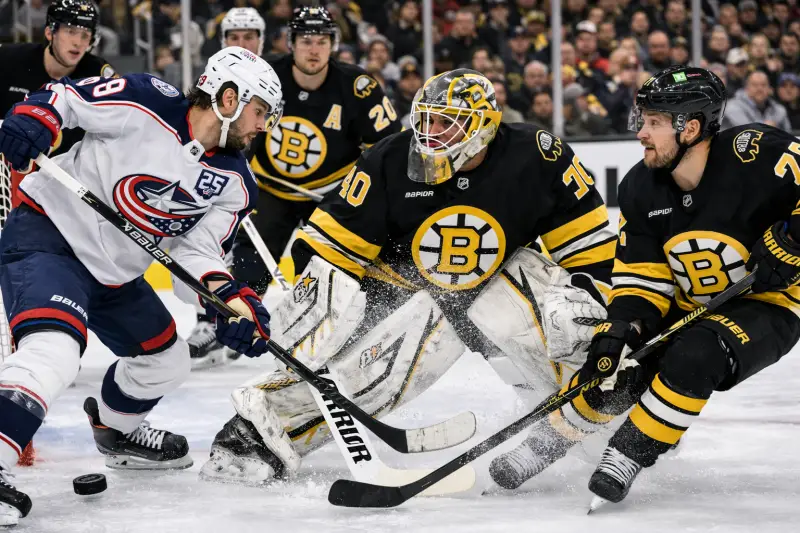
The Boston Bruins have a problem they can't fix at TD Garden. Their Bruins road record playoff wild card 2026 situation has become the most alarming storyline in the Eastern Conference — and nobody outside of New England is paying enough attention. Boston sits at 11-14-5 away from home this season, the worst road mark of any team currently occupying a playoff spot in the East. They cling to the second wild card by a single point over the Columbus Blue Jackets, who've grabbed points in eight consecutive games. And the schedule? Eleven of their final 18 games are on the road.
That's not a stretch run. That's an ambush.
The Bruins rolled into Saturday's matinee at Washington (3 PM ET, ABC) riding a seven-game road losing streak — 0-3-4 in their last seven away from the building where they've looked like a legitimate contender. At home, Boston posted a 13-game win streak before the Sharks snapped it Thursday. On the road, they've looked like a team auditioning for a top-ten draft pick. The gap between these two versions of the Bruins isn't just confusing. It's potentially fatal.
Boston's Road Implosion: 0-3-4 and the Numbers That Should Terrify Bruins Fans
Let's put the home-road split into perspective. The Bruins are 25-9-1 inside TD Garden — a .729 points percentage that would rank among the top five home records in the league. Flip the script, and their 11-14-5 road mark produces a .450 points percentage. That's a .279 swing between venues. For a team with serious playoff aspirations, that kind of split isn't a quirk. It's a structural failure.
The 0-3-4 stretch over the last seven road games tells an even uglier story. These weren't all losses to elite opponents. The Bruins dropped games to Nashville, Pittsburgh, and teams they'd handle comfortably at home. They've blown multi-goal leads on the road. They've gone flat in third periods. The pattern is consistent enough that it stopped being a coincidence weeks ago.
Head coach Marco Sturm was asked directly about the road woes after the latest defeat. His response didn't exactly inspire confidence.
"I don't wanna talk about struggling on the road. We just have to be focused and stay focused on our game, and kind of go from there."
He followed that up with an even more puzzling assessment: "I think we played well enough on the road..."
Played well enough? At 0-3-4? The disconnect between what Sturm sees and what the standings reflect is becoming a problem in itself. When a coach refuses to acknowledge a flaw this glaring, the fix gets harder, not easier.
The Wild Card Tightrope — One Point Between Playoffs and the Golf Course
Boston's positioning in the Eastern Conference wild card race is precarious to the point of absurdity. Here's where things stand heading into March 14:
- Detroit Red Wings (1st Wild Card): 36-23-7, 79 points — one point ahead of Boston
- Boston Bruins (2nd Wild Card): 36-23-6, 78 points
- Columbus Blue Jackets: 33-21-10, 76 points — two points back with games in hand
- Ottawa Senators: 73 points — five back but still alive
That one-point cushion over Columbus looks even thinner when you examine the Blue Jackets' recent surge. Columbus has points in eight straight games, posting a 6-1-3 record over their last 10. They're playing with the kind of desperate confidence that March hockey demands. Boston, meanwhile, has been collecting loser points on the road like frequent flyer miles — nice to have, but not enough to get you where you need to go.
The analytical models can't agree on Boston's chances, which tells you everything about how volatile this situation is. MoneyPuck gives the Bruins a 69.4% probability of making the postseason. HockeyStats has them at 68%. But The Athletic's model? Just 42%. That's a 27-point gap between projection systems watching the same team.
The reason for the disagreement comes down to one stat that should keep Don Sweeney awake at night: Boston is currently playing 12.1 goals above expected — the third-highest figure in the entire NHL. Translation? They've been finishing at an unsustainably lucky rate. Regression is coming. And if it hits during an 11-game road stretch, the math gets brutal fast.
Pastrnak Can't Do It Alone — Lindholm's $6.5M Disappearing Act
David Pastrnak has been carrying this offense like a man who knows his playoff life depends on it. Because it does. Pastrnak leads the Bruins with 78 points — 24 goals and 54 assists through 60 games — and entered the weekend on a four-game point streak (two goals, four assists). He's been everything Boston needs him to be.
The problem is the man skating beside him.
Elias Lindholm signed a seven-year contract worth $6.5 million per season to be the Bruins' top-line center. Through 51 games, his 40 points (12 goals, 28 assists) look passable on the surface. But dig into the post-Olympic break numbers and the picture collapses. Since returning from the break, Lindholm has produced just one goal, three points, and a minus-6 rating across eight games. At 5-on-5? Zero points in eight games. Absolute zero.
For a player earning $6.5M AAV to produce literally nothing at even strength over an eight-game window during the most important stretch of the season — that's not a slump. That's a crisis-level disappearance.
Sturm addressed it after Thursday's 4-2 loss to San Jose, where he scrambled lines mid-game trying to generate something.
"I was just trying to get something going. I feel like all the lines, a little bit, got stuck. I needed a little bit of push."
But here's where it gets interesting. At Friday's practice — the day before the Washington road game — Sturm kept Pastrnak and Lindholm together on the same line. When pressed on whether a reshuffle was coming, Sturm was noncommittal: "We talked about it. I thought about it. I'm not there yet. Might be different tomorrow."
That hesitation could cost them. Every game Lindholm ghosts through at 5-on-5 is a game where Pastrnak is essentially playing 1-on-5.
The Penalty Kill Collapse Nobody's Talking About
This is the number that should be generating panic in Boston's front office: 76.4% penalty kill — 28th in the NHL.
The Bruins have been built on special teams dominance for the better part of two decades. It's been the organizational identity. Kill penalties, generate shorthanded chances, flip momentum. That identity is gone in 2025-26, and it's gotten dramatically worse since the Olympic break.
Since returning from the break, Boston's penalty kill has cratered to 64.8%. That means opponents are scoring on more than one-third of their power plays against the Bruins. In the NHL, where games are decided by one or two goals, giving up power play goals at that clip is suicidal — especially on the road, where you don't get last change and referees tend to even up the whistle.
The power play hasn't compensated, either. Boston's man advantage ranks third in the league at 26.3% for the full season, but since the break, they've connected on just 3-of-21 opportunities — a 14.3% clip that's below league average. Lindholm's net-front presence, supposedly a key element of the PP1 unit, has produced almost nothing.
When both special teams units are bleeding simultaneously, that's not a coaching tweak away from being fixed. That's a systemic problem — and it explains why the road record is what it is. At home, the crowd bails them out. On the road, every mistake gets magnified by 200%.
Swayman's Shoulders: The Goaltender Carrying a Broken Team
Jeremy Swayman's overall numbers — 25-13-3, .906 save percentage, 2.76 GAA — look average. They don't tell the real story. Swayman has been significantly better than the team in front of him, and his March surge proves he's capable of stealing a playoff series if Boston can just get there.
In three March starts, Swayman has gone 3-0-0 with a .959 save percentage and a 1.00 goals-against average. Elite. Dominant. The kind of performance that makes you wonder what the rest of the team is doing with their time.
Boston.com's assessment was blunt: "Bruins' playoff hopes might rest on Jeremy Swayman's shoulders for this stretch run." That's probably accurate. But asking a goaltender to post a .959 save percentage for 18 more games while his penalty kill implodes and his top-line center produces nothing is asking for a miracle, not a plan.
The road splits are where Swayman's burden becomes clearest. The defensive breakdowns away from TD Garden mean he's facing higher-quality chances with less support. The Bruins' road defensive structure — whatever it is — doesn't resemble anything close to what they execute at home.
The Schedule Nightmare: 11 of 18 Remaining Games Away From TD Garden
Even if you think the Bruins can fix the road problem (and Sturm's comments suggest the coaching staff doesn't fully recognize it exists), the remaining schedule makes fixing it a requirement rather than an option.
Per Tankathon, Boston faces the second-toughest remaining schedule in the NHL. The breakdown:
- 11 of 18 remaining games on the road — where they're 11-14-5
- 8 of 18 against current playoff teams
- Two games at Columbus — March 29 and April 12
- Road trips to Tampa, Florida, and other hostile environments
Those two Columbus games are circled in red. If Boston and the Blue Jackets are still separated by one or two points when March 29 arrives, that game becomes a de facto playoff elimination match. And it's in Columbus — where Boston has historically struggled.
Sturm said after Thursday's loss that "three out of a possible six points would be a good result" on the upcoming three-game road trip. Three out of six. That's admitting he'd be satisfied with going 1-0-2 or 0-0-3 on a road swing where every point matters. That's not the mindset of a team hunting a playoff spot. That's survival mode.
Key Takeaways: Bruins Road Record and Playoff Wild Card 2026
- 11-14-5 on the road — worst road mark of any Eastern Conference playoff team; 0-3-4 in the last seven road games
- One-point lead over Columbus for the second wild card — Blue Jackets have points in 8 straight
- Penalty kill has cratered to 76.4% (28th in NHL), dropping to 64.8% since the Olympic break
- Lindholm invisible since the break: 1 goal, 3 points, minus-6, zero 5-on-5 points in 8 games
- 11 of 18 remaining games on the road with the 2nd toughest remaining schedule in the NHL
- Scoring regression imminent: 12.1 goals above expected (3rd highest in NHL) means their finishing luck is running out
- Playoff odds split: MoneyPuck says 69.4%, The Athletic says 42% — the models can't agree because this team is impossible to project
Statistical Comparison: Bruins vs. Eastern Conference Wild Card Rivals
| Team | GP | Record | PTS | L10 | Road | PP% | PK% |
|---|---|---|---|---|---|---|---|
| DET (WC1) | 66 | 36-23-7 | 79 | 5-3-2 | — | — | — |
| BOS (WC2) | 65 | 36-23-6 | 78 | 4-3-3 | 11-14-5 | 26.3% | 76.4% |
| CBJ | 64 | 33-21-10 | 76 | 6-1-3 | — | — | — |
| OTT | — | — | 73 | — | — | — | — |
The Columbus row is the one that should concern Boston most. The Blue Jackets' 6-1-3 over their last 10 is the best pace of any team in the wild card bubble. They're gaining ground while Boston bleeds points on the road.
Sweeney's Quiet Deadline: Was Lukas Reichel Enough?
While Detroit added Justin Faulk ($6.5M AAV defenseman) and David Perron at the trade deadline, Don Sweeney's only move was acquiring forward Lukas Reichel from Vancouver in exchange for a 2026 sixth-round pick. That's it. A sixth-round pick for a depth forward while your team clings to a playoff spot by a single point.
Sweeney's post-deadline press conference was revealing.
"We stayed committed, there's no question we didn't deviate from what we felt was the right choice."
He added that he hoped the decision would "pay dividends right now with the guys that are still here."
Before the deadline, Sweeney had set expectations low: "Not necessarily as aggressive and active, but we would like to continue to improve our hockey club, if possible." He noted that "the asks are going to be exorbitant" and that "the pure rental market is probably not at the top of the list."
Fair enough — overpaying for rentals is a real concern. But there's a difference between being prudent and being passive. When your penalty kill ranks 28th, your top-line center has vanished, and you're 11-14-5 on the road, acquiring a depth forward for a sixth-rounder isn't a bump. It's a band-aid on a compound fracture.
Sweeney acknowledged the broader tension in his approach: "You're not wrong in the fact that we spent likely too much collateral assets to try and win. I'm not going to apologize for trying to win; I'm going to apologize that we haven't won."
That line will either look prophetic or damning by mid-April.
Scoring Regression Is Coming — And Boston Can't Afford It
Here's the number that analytical models are flagging and mainstream coverage is ignoring: the Bruins are currently scoring 12.1 goals above expected — the third-highest figure in the NHL this season. That means their shooting percentage and finish rate are significantly outperforming their underlying chance quality.
In plain English? They've been getting lucky bounces, lucky tips, and lucky finishes at a rate that won't sustain itself over 18 more games. Expected goals models don't lie over large sample sizes. When the regression hits — and it always hits — Boston's already thin offensive margin disappears.
Combine that with the road schedule, the penalty kill collapse, and Lindholm's 5-on-5 drought, and you've got a team that's one cold week away from watching Columbus skate past them in the standings. The Bruins aren't built for a dogfight right now. They're built for TD Garden. And the schedule doesn't care.
What's Next for the Bruins
Saturday's game at Washington (3 PM ET, ABC) kicks off a three-game road trip that could define Boston's season. The Capitals sit at 33-27-7 with a strong 20-11-3 home record — this isn't a soft opener.
The critical dates on Boston's remaining schedule are March 29 and April 12, when they travel to Columbus for two games against the team breathing directly down their neck. If the Bruins road record playoff wild card 2026 situation hasn't improved by then, those games become sudden-death elimination matches in everything but name.
Sturm needs to fix the penalty kill. Sweeney needs Lindholm to find his game. Swayman needs to keep playing at a .959 clip. And all of it needs to happen on the road — the one place where nothing has worked for this team in months.
The margin for error isn't thin. It's gone.
Frequently Asked Questions
What is the Bruins' road record in 2025-26?
The Boston Bruins are 11-14-5 on the road in the 2025-26 season, including a 0-3-4 stretch over their last seven away games. Their road points percentage of .450 is the worst among Eastern Conference playoff teams.
Are the Bruins going to make the 2026 NHL Playoffs?
Playoff odds are split — MoneyPuck gives Boston a 69.4% chance, while The Athletic projects just 42%. The Bruins hold the second wild card by one point over Columbus, but face the second-toughest remaining schedule with 11 of 18 games on the road.
Why are the Bruins struggling on the road?
Multiple factors are driving the road collapse: a penalty kill ranked 28th in the NHL (76.4%), Elias Lindholm's post-Olympic disappearance (1 goal in 8 games), and a scoring rate that sits 12.1 goals above expected — signaling imminent regression. Coach Marco Sturm has been reluctant to acknowledge the issue publicly.
Who is ahead of the Bruins in the wild card race?
The Detroit Red Wings hold the first wild card with 79 points, one ahead of Boston's 78. The Columbus Blue Jackets trail Boston by two points at 76 but have games in hand and are on a 6-1-3 surge over their last 10 games. Ottawa sits five points back at 73.
What did the Bruins do at the 2026 trade deadline?
GM Don Sweeney made a single acquisition — forward Lukas Reichel from the Vancouver Canucks for a 2026 sixth-round pick. Sweeney said the team "stayed committed" to their approach, but critics argue Boston needed center depth and defensive reinforcements given their road struggles and penalty kill problems.
Frequently Asked Questions
What is the Bruins' road record in 2025-26?
The Boston Bruins are 11-14-5 on the road in the 2025-26 season, including a 0-3-4 stretch over their last seven away games. Their road points percentage of .450 is the worst among Eastern Conference playoff teams.
Are the Bruins going to make the 2026 NHL Playoffs?
Playoff odds are split — MoneyPuck gives Boston a 69.4% chance, while The Athletic projects just 42%. The Bruins hold the second wild card by one point over Columbus, but face the second-toughest remaining schedule with 11 of 18 games on the road.
Why are the Bruins struggling on the road?
Multiple factors are driving the road collapse: a penalty kill ranked 28th in the NHL (76.4%), Elias Lindholm's post-Olympic disappearance (1 goal in 8 games), and a scoring rate that sits 12.1 goals above expected — signaling imminent regression. Coach Marco Sturm has been reluctant to acknowledge the issue publicly.
Who is ahead of the Bruins in the wild card race?
The Detroit Red Wings hold the first wild card with 79 points, one ahead of Boston's 78. The Columbus Blue Jackets trail Boston by two points at 76 but have games in hand and are on a 6-1-3 surge over their last 10 games. Ottawa sits five points back at 73.
What did the Bruins do at the 2026 trade deadline?
GM Don Sweeney made a single acquisition — forward Lukas Reichel from the Vancouver Canucks for a 2026 sixth-round pick. Sweeney said the team "stayed committed" to their approach, but critics argue Boston needed center depth and defensive reinforcements given their road struggles and penalty kill problems.
Related Stories

How to Watch the NHL: 2026-27
How to watch the NHL in 2026-27: every channel (ESPN, ABC, TNT, NHL Network), every streaming option, the free routes, blackout traps, and t...
By Mike Johnson · 9 min read

NHL 2026-27: The 84-Game Season
The NHL 2026-27 season expands to 84 games, the first since 1993-94. Both new games are divisional. Here is why it changed, when it starts,...
By Mike Johnson · 10 min read

How to Watch the 2026 NHL Draft
Round 1 is June 26 at 7 p.m. ET, Rounds 2-7 are June 27 — but the channel changes between days. The full how-to-watch guide for the 2026 NHL...
By Mike Johnson · 6 min read

Who Is Gavin McKenna? The No. 1 Pick
A Yukon kid who dominated two leagues two years apart, now the consensus No. 1 for 2026. Inside Gavin McKenna's game, his NHL comps, and the...
By Mike Johnson · 9 min read
Comments
Be the first to share your take.
Get NHL trade rumors in your inbox
One email per week. Zero spam. Verified rumors only.