Sharks Mario Ferraro Extension Talks Stall — What’s Next?
Sharks Mario Ferraro extension talks stall as San Jose offers a short-term deal but the pending UFA wants $5-6M long-term. With prospects pushing for roster spots and zero cap space, GM Grier faces a tough call before July 1 free agency.
Live updates
No updates yet. Refreshing automatically.
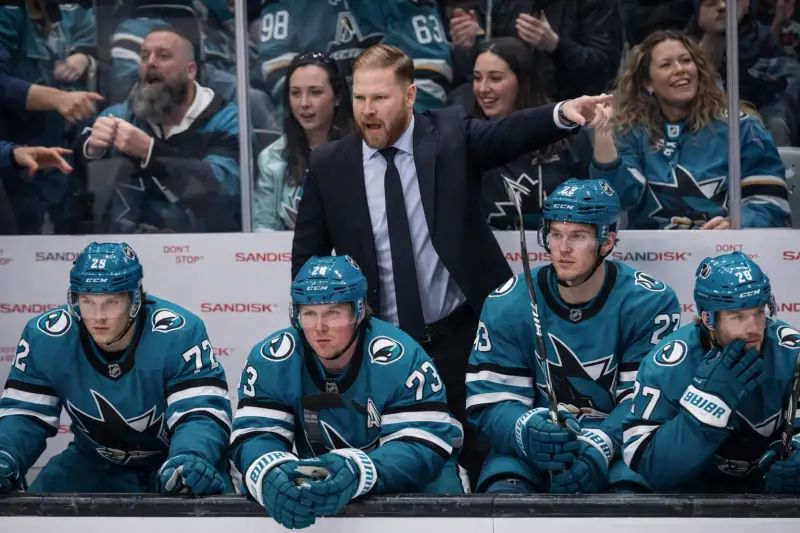
The Sharks Mario Ferraro extension saga has officially hit a wall — and the clock is ticking louder with every passing week. San Jose offered their longest-tenured player a short-term contract to stay, but the 27-year-old pending unrestricted free agent wants real commitment: four-plus years at a number that reflects his value as a top-four, penalty-killing shutdown defenseman. With Ferraro projected to command $5 million to $6 million annually on the open market and young blue-line prospects Sam Dickinson and Shakir Mukhamadullin knocking on the door, GM Mike Grier faces one of the most consequential roster decisions of his tenure.
This isn't just a contract negotiation. This is a franchise defining its identity — rebuild or compete — and Ferraro's future is the clearest indicator of which direction San Jose is actually headed.
Why the Sharks Won't Go Long-Term on Ferraro
Here's the uncomfortable truth for Ferraro and his camp: the Sharks don't see him as a cornerstone piece of their next contending team. Not at $5 million-plus per year. Not for five or six seasons.
San Jose's front office has made "overtures of a short-term contract," per multiple reports, but Ferraro — about to hit unrestricted free agency for the first time in his career — understandably wants term. He's earned it. Seven seasons in teal, 471 career games, an alternate captain's letter, and the kind of thankless defensive work that doesn't show up on highlight reels but absolutely shows up in advanced metrics and penalty kill efficiency.
But Grier's calculus is straightforward. Ferraro turns 28 in September. A five-year deal at $5.5 million AAV would carry him through age 32 — right into the window when San Jose expects Macklin Celebrini, Will Smith, and their young defensive core to be pushing for a Stanley Cup. Paying a second-pair defenseman that kind of money during a championship window is how teams end up in cap jail.
The Sharks aren't wrong to be cautious. They're also not wrong that Ferraro deserves more than what they're offering. Both things can be true simultaneously, and that's exactly why this situation feels stuck.
Ferraro's 2025-26 Season by the Numbers
Ferraro's stat line this season won't blow anyone away on the surface — 4 goals, 11 assists, 15 points through 63 games — but reducing his value to offensive production misses the point entirely.
He's averaging 20:53 of ice time per night, third among Sharks defensemen, while serving as San Jose's first-choice penalty killer alongside Vincent Desharnais. His 878 career blocked shots rank 17th in the entire NHL among all players since he entered the league. His 1,232 minutes and 9 seconds of shorthanded ice time? That's 13th. For a franchise that has cycled through roster overhauls and coaching changes, Ferraro has been the one constant on the back end.
Coach Ryan Warsofsky put it bluntly: "If you looked up a definition of a competitor, Mario's face would be right there. He gives you everything he has."
That's not coach-speak fluff. Watch the tape. Ferraro blocks shots in situations where most defensemen peel off. He finishes checks when the game is already decided. He's logged 100-plus hits in all six of his full NHL campaigns and posted at least 125 blocks in four consecutive seasons. The physical toll of that style of play is real — and it's part of why the Sharks are hesitant to commit long-term.
The career minus-120 rating looks ugly in isolation, but context matters. Ferraro has spent his entire career on one of the worst teams in the league. Asking a defensive defenseman to post positive numbers behind a roster that finished dead last in 2023-24 is like asking a goalie to post a shutout with no defense in front of him. The number reflects the team, not the player.
The Prospect Pipeline Forcing San Jose's Hand
This is the part Ferraro's camp probably doesn't want to hear, but it's the single biggest factor in the Sharks' reluctance to commit long-term money.
Sam Dickinson has been a revelation. The rookie left-shot defenseman has been a fixture in the lineup since early December, showing the kind of puck-moving ability and offensive instinct that the Sharks desperately need from their back end. Warsofsky has praised his ability to "get up in the rush" and his overall offensive upside, while acknowledging there's still work to do — "he goes a little rogue at times" — but the trajectory is clear. Dickinson is a future top-four guy on the left side.
Then there's Shakir Mukhamadullin, who's already played 59 NHL games with San Jose, posting 5 goals and 12 assists while averaging 17:25 in ice time. He's been in and out of the lineup — healthy scratches, inconsistent usage — but the coaching staff has been transparent about their belief in his ceiling. "We really liked Mukh," Warsofsky said. "He's going to be a really good defenseman."
And the Sharks already locked up Dmitry Orlov as a veteran presence on the left side during the offseason. That's three left-side defensemen — Orlov, Dickinson, Mukhamadullin — all under team control for multiple seasons.
Ferraro plays the left side too. The math doesn't work if you're paying him $5.5 million to be your fourth left-handed defenseman. From San Jose's perspective, the short-term offer makes organizational sense even if it doesn't make sense from Ferraro's personal standpoint.
Key Takeaways
- Short-term vs. long-term standoff: Sharks want a bridge deal; Ferraro wants 4+ years at $5-6M AAV reflecting his true market value
- Ferraro stayed at the deadline: Grier kept him despite receiving multiple trade calls, citing the team's playoff push and three-game winning streak
- Trade value was a 2nd-round pick: NHL scouts compared Ferraro to the Connor Murphy deal (traded for a 2nd-rounder with $2.2M retained)
- Prospect logjam on the left side: Dickinson, Mukhamadullin, and Orlov all play Ferraro's position with long-term team control
- Cap space is essentially zero: Sharks have roughly $161,000 in available cap room — any extension requires creative cap management
- Colorado was linked: The Avalanche, the West's top team, showed pre-deadline interest in Ferraro per multiple reports
- July 1 is the real deadline: If no extension is reached, Ferraro hits unrestricted free agency and the Sharks lose him for nothing
What Ferraro Could Command on the Open Market
This is where the negotiation gets really interesting — and where the Sharks' lowball approach could backfire spectacularly.
The most direct comparable is the Connor Murphy trade. Chicago sent Murphy to Edmonton for a second-round pick with $2.2 million AAV retained. Murphy is a similar player profile — physical, defensive-first, penalty kill specialist — but older and with a higher cap number. Multiple NHL scouts pegged Ferraro's trade value in that same range, per San Jose Hockey Now.
But trade value and free agent value are completely different animals. On the open market, Ferraro's contract projection looks closer to what we've seen from similar UFA defensemen:
| Player | Age at Signing | AAV | Term | Role |
|---|---|---|---|---|
| Mario Ferraro (projected) | 27 | $5-6M | 4-6 yrs | Top-4 shutdown D |
| Connor Murphy (trade) | 33 | $2.2M retained | Rental | Top-4 physical D |
| Dmitry Orlov (SJS) | 33 | $4.5M | 2 yrs | Veteran LHD |
| Ferraro current deal | 23 | $3.25M | 4 yrs | Emerging shutdown D |
The gap between San Jose's short-term offer and Ferraro's market value is significant. A contending team — Colorado was specifically linked per The Fourth Period's trade board — would almost certainly pay $5 million-plus for four or five years without blinking. The Avalanche need defensive depth badly, and Ferraro's skill set is exactly what championship-caliber teams covet at the deadline and in free agency: a guy who can step into your top four, kill penalties, block shots, and not need the puck on his stick to be effective.
From Ferraro's perspective, why would he accept a two-year bridge deal at $4 million when July 1 offers him generational financial security? He'd be leaving millions on the table.
San Jose's Cap Situation Makes This Even Harder
Let's talk numbers, because the Sharks' cap picture explains a lot about their negotiating posture.
San Jose currently has approximately $161,000 in available cap space. That's not a typo. One hundred sixty-one thousand dollars. The Sharks are functionally capped out for the remainder of 2025-26, which means any Ferraro extension would need to be structured to kick in next season under the 2026-27 salary cap.
The projected salary cap ceiling for 2026-27 is expected to rise to approximately $88 million. That gives San Jose some breathing room — but not as much as you'd think.
Here's why. The Sharks have to plan for massive extensions coming in the next two to three seasons:
- Macklin Celebrini — the franchise cornerstone, currently on his entry-level deal, will command a max or near-max extension
- Will Smith — another top prospect who'll need significant money
- Sam Dickinson — if he continues his current trajectory, he'll be due for a raise
Committing $5.5 million annually to Ferraro for five years means that money is locked in when Celebrini's $10-million-plus AAV kicks in. When you're building around a generational center, every dollar of cap space matters. The Sharks aren't being cheap — they're being strategic. Whether that strategy costs them a good player in the process is the gamble Grier is making.
Why Grier Kept Ferraro at the Trade Deadline
This is the part of the story that doesn't get enough attention. Grier had offers. He had calls on Ferraro and on John Klingberg. He could have flipped Ferraro for a second-round pick — a meaningful asset for a rebuilding franchise — and nobody would have criticized the move.
He didn't pull the trigger. And his explanation was surprisingly emotional for a GM known for playing things close to the vest.
"They've kind of earned it," Grier said after the deadline passed. "Not only these last three games, but really throughout the season. It's a group that deserves to have a chance to see what they can do."
The Sharks had rattled off three straight wins heading into the March 7 deadline. They sat just three points behind Seattle for the Western Conference's final wild card spot with two games in hand. MoneyPuck had their playoff odds at 74.8%. This wasn't a delusional front office ignoring reality — the Sharks genuinely had a shot.
Grier's only significant deadline move was shipping Timothy Liljegren to Washington for a 2026 fourth-round pick and extending goaltender Alex Nedeljkovic on a two-year, $6 million deal. He also grabbed Kiefer Sherwood from Vancouver for Cole Clayton and a pair of second-round picks (2026 and 2027). The message was clear: we're pushing for the playoffs, and we're not gutting this roster to stockpile mid-round picks.
But keeping Ferraro at the deadline doesn't solve the extension problem. It just delays it. And the longer the delay, the closer Ferraro gets to July 1 — where San Jose has zero leverage.
What Happens Next for Ferraro and the Sharks
The negotiating window isn't closed. Ferraro and the Sharks can still hammer out a deal before the season ends, during the offseason, or right up until free agency opens on July 1. But every week that passes without progress makes a walk more likely.
Grier has demonstrated he values Ferraro's contribution — the deadline decision proved that. The question is whether that value translates to the kind of contract Ferraro is seeking. A middle ground exists — maybe a three-year deal at $5 million AAV — but both sides would need to bend from their current positions.
There's a personal dimension here too. Ferraro and his wife McKenna welcomed their first child, Solenne, during the summer of 2025. He's spent seven seasons in San Jose. He was, in his own words, "the young one in this room...and now I feel like I'm the older one in here. It's crazy. Time goes by quick." The roots are deep.
But sentiment doesn't pay mortgages. And at 27, this is Ferraro's one shot at a career-defining payday. If San Jose won't meet his number, a team like Colorado — or any other contender desperate for defensive depth — absolutely will.
The Sharks Mario Ferraro extension drama is far from over. If anything, the real tension starts now. The playoff push bought Grier time. But time has a way of running out — and July 1 waits for nobody.
Frequently Asked Questions
What is Mario Ferraro's current contract with the Sharks?
Ferraro is in the final year of a four-year, $13 million contract ($3.25 million AAV) signed in August 2022. He becomes an unrestricted free agent on July 1, 2026, if no extension is reached.
Why won't the Sharks give Ferraro a long-term extension?
San Jose has young left-side defensemen Sam Dickinson and Shakir Mukhamadullin pushing for roster spots, plus veteran Dmitry Orlov already signed. Committing $5-6 million long-term to Ferraro would create a positional logjam and limit cap flexibility for upcoming extensions to Macklin Celebrini and Will Smith.
What is Mario Ferraro's trade value?
NHL scouts compared Ferraro's trade value to the Connor Murphy deal — approximately a second-round draft pick with salary retained. His free agent value is significantly higher, projected at $5-6 million AAV over four-plus years.
Which teams are interested in Mario Ferraro?
The Colorado Avalanche were specifically linked to Ferraro before the trade deadline per The Fourth Period's trade board. Any contending team needing a physical, top-four penalty-killing defenseman would be a logical fit in free agency.
Will Mario Ferraro stay with the San Jose Sharks?
That depends entirely on whether the Sharks move off their short-term offer. Ferraro wants term and money; San Jose wants flexibility. A compromise around three years at $5 million AAV could work, but as of now, both sides remain far apart and a July 1 departure is a real possibility.
Frequently Asked Questions
What is Mario Ferraro's current contract with the Sharks?
Ferraro is in the final year of a four-year, $13 million contract ($3.25 million AAV) signed in August 2022. He becomes an unrestricted free agent on July 1, 2026, if no extension is reached.
Why won't the Sharks give Ferraro a long-term extension?
San Jose has young left-side defensemen Sam Dickinson and Shakir Mukhamadullin pushing for roster spots, plus veteran Dmitry Orlov already signed. Committing $5-6 million long-term to Ferraro would create a positional logjam and limit cap flexibility for upcoming extensions to Macklin Celebrini and Will Smith.
What is Mario Ferraro's trade value?
NHL scouts compared Ferraro's trade value to the Connor Murphy deal — approximately a second-round draft pick with salary retained. His free agent value is significantly higher, projected at $5-6 million AAV over four-plus years.
Which teams are interested in Mario Ferraro?
The Colorado Avalanche were specifically linked to Ferraro before the trade deadline per The Fourth Period's trade board. Any contending team needing a physical, top-four penalty-killing defenseman would be a logical fit in free agency.
Will Mario Ferraro stay with the San Jose Sharks?
That depends entirely on whether the Sharks move off their short-term offer. Ferraro wants term and money; San Jose wants flexibility. A compromise around three years at $5 million AAV could work, but as of now, both sides remain far apart and a July 1 departure is a real possibility.
Related Stories
Hischier Trade Clock Hits July 1
Nico Hischier trade rumors are rising: extension talks with new GM Sunny Mehta are in their infancy, Montreal, LA and Minnesota are circling...
By Mike Johnson · 9 min read

Larkin-Robertson Swap: Who Says No?
Dallas has checked in on Dylan Larkin, but the Stars cannot fit his $8.7M until Jason Robertson and his unsigned $14M ask move out. Inside t...
By Mike Johnson · 11 min read

NHL Arbitration 2026: Eligible List
NHL RFAs must file for salary arbitration by July 5. Jason Robertson headlines the 2026 eligible class, but the Hearing Bluff means almost n...
By Mike Johnson · 9 min read

Darnell Nurse Trade: 4 Suitors
Edmonton wants Darnell Nurse's $9.25M off the books, but a buyout saves barely $1.53M and his no-move clause hands him the pen. The Bonus Sh...
By Mike Johnson · 12 min read
Comments
Be the first to share your take.
Get NHL trade rumors in your inbox
One email per week. Zero spam. Verified rumors only.