Owen Michaels Signs with Oilers: Inside The Frozen Four
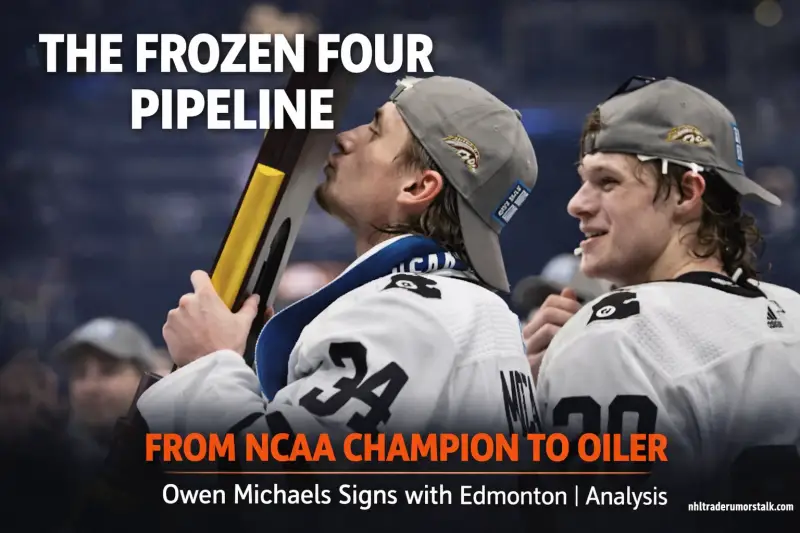
Owen Michaels, the 2025 Frozen Four MOP, signed a 1-year ELC with Edmonton — the second straight year Bowman has signed a standout from the same NCAA championship game. Inside The Frozen Four Pipeline strategy.
Live updates
No updates yet. Refreshing automatically.
The Edmonton Oilers signed Owen Michaels to a one-year entry-level contract on Wednesday. Every outlet covered it the same way: undrafted college kid, nice little championship pedigree, probably an AHLer. Next story.
They're all missing the bigger picture.
This isn't a one-off signing. This is the second straight April that Stan Bowman has pulled a standout performer from the same NCAA championship game into the Edmonton pipeline. Last April, he signed Quinn Hutson from the losing bench of the 2025 Frozen Four final. This April, he signed Owen Michaels from the winning bench of that same game. I'm calling it The Frozen Four Pipeline — Edmonton's systematic strategy of targeting players who've already proven they can perform when everything is on the line, regardless of whether an NHL draft board ever noticed them.
Hutson is now leading all AHL rookies in scoring with 27 goals and 55 points this season — tied for the AHL rookie scoring lead. The scouts who said he was "just a college player" went quiet around Christmas. Now Michaels gets the same shot — and if his Frozen Four tape is any indication, the 23-year-old from Northville, Michigan might have more to offer than the scouting consensus suggests.
🔑 Key Takeaways
- Owen Michaels, the 2025 Frozen Four Most Outstanding Player, signed a 1-year ELC with Edmonton — the second straight year the Oilers have signed a standout from the 2025 NCAA championship game
- 4 goals in 2 Frozen Four games — including a double-overtime winner in the semifinal — en route to Western Michigan's first-ever national title
- Joins a loaded Bakersfield forward group: AHL All-Star Quinn Hutson (27G, 55P — rookie co-leader) and 2025 Hobey Baker winner Isaac Howard (52P in 39GP)
- Bowman's "Frozen Four Pipeline" fills the void left by Edmonton's traded 2026 first-round pick — targeting championship DNA over draft pedigree
- Despite a modest ceiling projection, Michaels' two-way metrics (52.2% faceoff rate, +27, 25 blocks in championship season) suggest he's being undervalued
The Signing — What Edmonton Got and What It Costs
The Oilers announced the deal on April 2 — one day after Western Michigan's season ended with a 6-2 regional final loss to Denver. The contract is a standard one-year entry-level deal that takes effect for the remainder of the 2025-26 season, meaning Michaels is technically eligible to play NHL regular season games but cannot participate in the playoffs.
The one-year term is notable. When Bowman signed Quinn Hutson out of Boston University last April, he gave him a two-year ELC — a signal of higher organizational confidence. Michaels' one-year deal functions more like an audition: report to Bakersfield, prove you belong at the professional level, and earn the longer commitment.
For Edmonton, the risk profile is essentially zero. A one-year ELC for an undrafted 23-year-old costs nothing against the salary cap that matters. If Michaels develops, they've found another Hutson-style steal. If he doesn't, the contract expires and they move on. It's the kind of asymmetric bet that Bowman has built his entire prospect strategy around — low cost, high character, and a willingness to let the development process sort out the rest.
The timing matters, too. Michaels had options. As the reigning Frozen Four MOP and a Hobey Baker nominee, he drew interest from multiple NHL organizations. He chose Edmonton — and the chance to develop alongside a prospect pipeline that, for the first time in years, looks genuinely deep.
Championship DNA — Michaels' Frozen Four Masterclass
To understand why Bowman wanted Michaels, you need to rewind to April 2025 and what might be the most electrifying individual Frozen Four performance in the last decade.
Western Michigan entered the 2025 NCAA tournament as a program that had never won a national championship. Not once in their history. They were good — they'd made consecutive tournament appearances — but the Broncos weren't Michigan or North Dakota. They weren't supposed to be the team cutting down nets.
Then Owen Michaels decided otherwise.
In the semifinal against Denver, with the season on the line, Michaels scored twice — including the game-winning goal 26 seconds into double overtime. A 3-2 victory over the defending national champions, sealed by a 22-year-old who wasn't considered good enough to draft. Two nights later, facing Boston University in the final, he scored two more goals in a dominant 6-2 win that gave Western Michigan its first national championship in program history.
Four goals. Two games. One trophy. And the Frozen Four Most Outstanding Player award to show for it.
"He's a fierce competitor, a smart player — someone that you can trust and feel comfortable having on the ice in any situation."
What makes Michaels' career arc so compelling is the trajectory. As a freshman in 2023-24, he was a depth player — 2 goals and 9 points in 38 games. Nothing that would make anyone outside of Kalamazoo take notice. Then came what his coaches called a "tremendous summer" of development, and the sophomore who returned in 2024-25 was a fundamentally different player: 18 goals, 36 points, a plus-27 rating, a 52.2% faceoff win rate, and 25 blocked shots. The two-way completeness was what stood out. This wasn't a one-dimensional scorer riding a hot streak. This was a player who'd rebuilt his game from the ground up.
His final college season as captain in 2025-26 produced 13 goals and 26 points in 39 games — respectable numbers while shouldering the burden of being the opponent's primary focus every night. He earned a Hobey Baker Award nomination and led WMU to a 27-11-1 record and their fifth consecutive NCAA tournament appearance before Denver ended their title defense in the regional final.
The career totals — 33 goals and 66 points in 119 games — won't blow anyone away on paper. But paper doesn't capture double-overtime goals in national semifinals. And paper doesn't explain why a kid from Northville, Michigan, who was never drafted, became the most decorated player in Western Michigan hockey history.
The Frozen Four Pipeline — Bowman's College Free Agent Blueprint
Here's where the Owen Michaels signing becomes more than a transaction. It becomes evidence of a strategy.
On April 12, 2025, Western Michigan beat Boston University 6-2 to win the national championship. Owen Michaels scored twice for WMU. Quinn Hutson scored once for BU. One month later, Hutson signed a two-year entry-level contract with Edmonton. Exactly one year after that championship game, Michaels signed his own deal with the same organization.
Two players. Opposite benches. Same championship game. Now teammates in the Edmonton Oilers pipeline.
That's not coincidence. That's The Frozen Four Pipeline in action.
"We're trying to build a team, not just a collection of players."
Bowman inherited an Oilers organization that had systematically mortgaged its future for present-day competitiveness. The 2026 first-round pick was shipped to San Jose in the Jake Walman deal. The prospect cupboard, once bare, needed restocking through channels that didn't require draft capital. Bowman's solution: become the most aggressive team in NCAA free agency.
The results speak for themselves. Hutson, signed from BU's losing championship roster, has exploded in Bakersfield — 27 goals and 55 points — tied for the AHL rookie scoring lead — and earning both an All-Star selection and a two-year contract extension. Isaac Howard, the 2025 Hobey Baker Award winner acquired from Tampa Bay, has 52 points in 39 AHL games. Josh Samanski has 28 points in 39 games and was named to Germany's Olympic team. Viljami Marjala has emerged as another key contributor.
Now add Michaels — the Frozen Four MVP — to that mix.
What Bowman understands, and what most NHL front offices still undervalue, is that NCAA championship-game performance is a uniquely predictive data point. The pressure of a Frozen Four final — single elimination, 15,000-seat arena, national television, the culmination of a six-month season — creates conditions closer to NHL playoff hockey than anything else in the development pipeline. Players who thrive in those moments aren't just skilled. They're wired differently.
The broader data supports this. Seventy-one NCAA free agents appeared in NHL lineups during the 2025-26 season. The undrafted-to-NHL pipeline has produced legitimate impact players in recent years — Collin Graf went from Quinnipiac to meaningful minutes with San Jose, Sam Malinski earned a four-year extension with Colorado, and Bobby McMann became a core piece for Toronto. Go further back and you find Hall of Famers: Adam Oates (RPI), Joe Mullen (Boston College), Ed Belfour (North Dakota). All undrafted. All signed as college free agents.
The Frozen Four Pipeline is Bowman betting that the next wave of those success stories is sitting in championship game locker rooms, not on draft boards.
Inside Michaels' Game — Why "Just an AHLer" Might Be Underselling It
The scouting consensus on Michaels is measured. Daily Faceoff's Steven Ellis noted that skating limitations will likely prevent him from becoming an everyday NHL player. Pro Hockey Rumors projected him as "a high-end AHL contributor with some call-up potential." The general assessment: nice college career, decent character signing, don't expect much at the NHL level.
I think the scouts are underweighting three things.
First, the two-way metrics are legitimate. In his championship 2024-25 season, Michaels posted a 52.2% faceoff win rate — elite for a college player of any age. He added 25 blocked shots and finished plus-27, the kind of defensive impact rating that doesn't happen by accident over a 42-game season. The scouting reports that describe him as "one of the more underrated two-way players in college hockey" are backed by real numbers.
Second, the clutch production is off the charts. Four goals in two Frozen Four games. A double-overtime winner against the defending national champions. These aren't inflated stats against bottom-tier conference opponents. These are goals scored on the biggest stage college hockey offers, against the best goaltending and defense in the NCAA. The ability to elevate in elimination scenarios is either in your DNA or it isn't, and Michaels has proven it's in his.
Third, the development curve matters. Michaels went from a 2-goal freshman to an 18-goal sophomore to a Frozen Four MVP in the span of 14 months. Players who make that kind of leap — the ones who use a single offseason to fundamentally reinvent their game — tend to keep climbing. The concern about skating is valid, but skating is also the most improvable skill in hockey when a player has the work ethic to grind through a professional development program. Everything his coaches say about Michaels suggests the work ethic is not in question.
The comparison that comes to mind is Collin Graf. Undrafted out of Quinnipiac, signed as a free agent by San Jose, now a legitimate NHL contributor. Graf was also tagged with "limited ceiling" projections out of college. What the projections missed was that certain players respond to the professional environment — better coaching, better training, better competition every night — by unlocking another gear that the college game never required. Michaels has the two-way foundation and the championship mentality. Whether he has that extra gear is what the next 12 months in Bakersfield will determine.
Bakersfield's Loaded Depth Chart — Where Michaels Fits
Here's the challenge for Michaels: the Bakersfield Condors have become one of the AHL's most talented forward groups, and there's real competition for every roster spot.
| Player | Source | Age | Contract | AHL Stats | NHL Outlook |
|---|---|---|---|---|---|
| Quinn Hutson | NCAA FA (BU) | 24 | 2-yr extension | 27G, 55P | Top-9 push (2026-27) |
| Isaac Howard | Trade (TBL) | 22 | 3-yr ELC | 20G, 52P in 39GP | Top-9 push (2026-27) |
| Josh Samanski | NCAA FA | 24 | Signed | 7G, 28P in 39GP | Bottom-6 depth |
| Samuel Poulin | Trade (PIT) | 24 | Signed | 15 NHL GP | Call-up option |
| Owen Michaels | NCAA FA (WMU) | 23 | 1-yr ELC | N/A (just signed) | AHL starter → call-up |
Hutson is the headliner — a 27-goal AHL rookie who'll push for a permanent NHL roster spot next October. Howard, the reigning Hobey Baker winner, is right behind him with 52 points in 39 games. Samanski has been a steady contributor and carries international pedigree. Poulin, acquired from Pittsburgh in the Tristan Jarry deal, adds NHL experience.
Michaels isn't walking into a barren development program where minutes are guaranteed. He's walking into genuine competition — and that's exactly the kind of environment where his championship mentality should serve him best. The two-way reliability gives him a natural advantage in earning a coaching staff's trust. AHL coaches love forwards who can kill penalties, win faceoffs, and not be a liability in their own end. Michaels checks every one of those boxes.
The most realistic path looks like this: earn a middle-six role in Bakersfield during the 2026-27 season, demonstrate that the skating has improved under professional development, and position himself as an NHL call-up option by the second half of the year. It's the Hutson blueprint with a 12-month delay — and given where Hutson is now, that's not a bad model to follow.
The 1-Year Prove-It Deal — What Success Looks Like
The one-year contract tells us something important about how Edmonton views Michaels relative to its other NCAA signings. Hutson got two years because his college production (23 goals, 50 points in 37 games) was point-per-game dominant. Howard was a Hobey Baker winner with a three-year ELC built into his trade acquisition. Michaels' deal is shorter because his college numbers, while solid, weren't at that elite statistical tier.
But shorter doesn't mean less meaningful. A one-year ELC is essentially a formalized tryout with NHL infrastructure attached. If Michaels performs the way Hutson did — dominates AHL competition, demonstrates that his game translates to faster, heavier professional hockey — the extension will come. Hutson's path from one-year signing to two-year extension to AHL scoring leader took exactly 11 months. Michaels has the same runway.
The best-case scenario: Michaels posts 15-plus goals and 30-plus points in Bakersfield, earns a multi-year extension by January, and competes for an NHL call-up by the 2027 trade deadline. The realistic scenario: he becomes a reliable AHL contributor, earns a second contract, and develops into a depth call-up option in Edmonton's system. The floor: a good professional season in Bakersfield, the contract expires, and he signs elsewhere as an AHL free agent.
In every scenario, Edmonton wins. They've added a Frozen Four MVP to their development pipeline at virtually no cost, with no opportunity cost against the salary cap, and no long-term commitment if it doesn't work out. And that's the entire thesis of The Frozen Four Pipeline in miniature: it's not about finding undrafted players. It's about finding players who've already won when everything was on the line — and betting that the DNA doesn't change when the jersey does.
Frequently Asked Questions
Sources
- Edmonton Oilers Official — Oilers Sign Forward Owen Michaels
- Daily Faceoff — Oilers Sign Owen Michaels to ELC
- WMU Athletics — Owen Michaels Signs with Edmonton Oilers
- NCAA.com — Western Michigan Wins 2025 NCAA Championship
- Oil on Whyte — Bakersfield Condors Prospect Dominance
- TSN — Oilers Sign Michaels to One-Year ELC
- Pro Hockey Rumors — Oilers Sign Owen Michaels to ELC
- College Hockey News — Competitiveness Fuels Michaels' Success
Frequently Asked Questions
What does the Owen Michaels Edmonton Oilers mean for the 2026 NHL season?
Owen Michaels, the 2025 Frozen Four MOP, signed a 1-year ELC with Edmonton — the second straight year Bowman has signed a standout from the same NCAA championship game. Inside The Frozen Four Pipeline strategy.
What is The Signing — What Edmonton Got and What It Costs?
The Oilers announced the deal on April 2 — one day after Western Michigan's season ended with a 6-2 regional final loss to Denver. The contract is a standard one-year entry-level deal that takes effect for the remainder of the 2025-26 season, meaning Michaels is technically eligible to play NHL regular season games but cannot participate in the playoffs.
How does Championship DNA — Michaels' Frozen Four Masterclass affect the outcome?
To understand why Bowman wanted Michaels, you need to rewind to April 2025 and what might be the most electrifying individual Frozen Four performance in the last decade.
Related Stories

Golden Knights Offseason Squeeze
Vegas reached Game 6 of the 2026 Cup Final, then handed itself a summer with about $4.6M in cap space to re-sign Pavel Dorofeyev, replace a...
By Mike Johnson · 9 min read
Hischier Trade Clock Hits July 1
Nico Hischier trade rumors are rising: extension talks with new GM Sunny Mehta are in their infancy, Montreal, LA and Minnesota are circling...
By Mike Johnson · 9 min read
Larkin-Robertson Swap: Who Says No?
Dallas has checked in on Dylan Larkin, but the Stars cannot fit his $8.7M until Jason Robertson and his unsigned $14M ask move out. Inside t...
By Mike Johnson · 11 min read
Darnell Nurse Trade: 4 Suitors
Edmonton wants Darnell Nurse's $9.25M off the books, but a buyout saves barely $1.53M and his no-move clause hands him the pen. The Bonus Sh...
By Mike Johnson · 12 min read
Comments
Be the first to share your take.
Get NHL trade rumors in your inbox
One email per week, zero spam, verified rumors only.