Anaheim Ducks Franchise-Altering 2026: The Pronger Echo
After their 2nd-round exit, Pat Verbeek has $41.4M and four targets from Eric Stephens. Ranking the Pronger Echo by acquisition mechanism, cap math, and roster fit.
Live updates
No updates yet. Refreshing automatically.
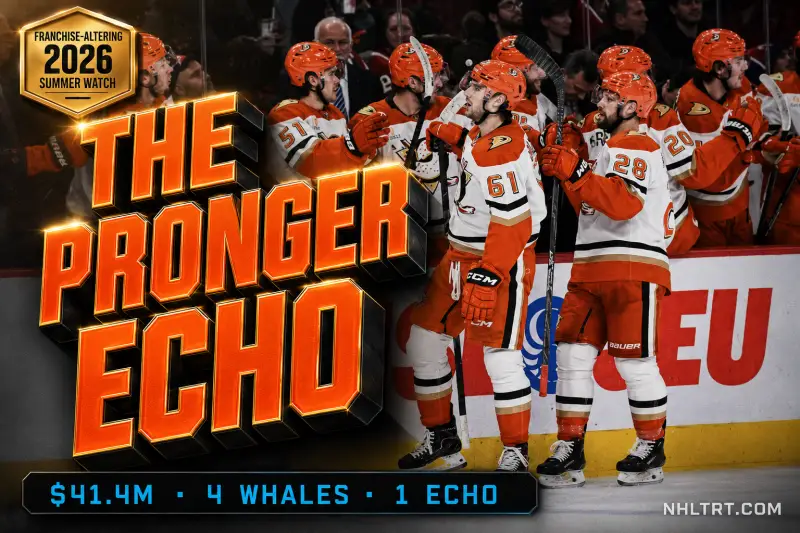
Eight years after Anaheim's last playoff appearance and nineteen since the Chris Pronger trade built a Stanley Cup roster, the Ducks have $41.4 million in projected cap space and four star-level targets named publicly by Eric Stephens in The Athletic. An Anaheim Ducks franchise-altering move in 2026 is the entire framing. Call it the Pronger Echo.
Anaheim's season ended Thursday at Honda Center with a 5-1 Game 6 loss to Vegas that closed the franchise's first playoff run in eight years, one round short of the Western Conference Final. The loss isn't the real story. What comes next is.
Stephens specifically named Auston Matthews, Jason Robertson, Robert Thomas, and Brady Tkachuk as possible Verbeek moves this offseason. Two captains. Three first-line centers. A 41-goal scorer.
Time to rank the four candidates by acquisition mechanism, contract math, and roster fit. The Pronger 2006 benchmark gives a useful price comparison. The real question, though, is which name actually moves the needle.
Because $41.4 million sounds like a war chest. It really doesn't work that way. Not after Carlsson and Gauthier sign their extensions.
Key Takeaways
- The Pronger Echo: Eric Stephens' "franchise-altering" framing maps directly to Anaheim's July 3, 2006 Pronger trade that built the 2007 Cup roster.
- $41.4M is the gross figure: Carlsson and Gauthier extensions project at $20M+ combined, leaving roughly $20M of real working room after summer signings.
- Matthews has the NMC: Toronto's centre carries a full no-movement clause through 2027-28. Anaheim isn't moving without his yes.
- Robertson is the RFA path: Dallas red-line is $12M (Rantanen comp). The Stars have ~$11M in cap space. A trade is back on the table.
- One name wins, three don't: The Pronger Echo only happens if the player wants Anaheim. Two of the four already have public reasons to say no.
What Stephens Actually Reported
The piece running in The Athletic this week is direct in its framing. Stephens, who covers Anaheim full-time, writes that Verbeek "shouldn't be ruled out" for a move like the one the Ducks made twenty years ago, when general manager Brian Burke acquired Pronger from Edmonton in July 2006 and won a Stanley Cup ten months later. The four names Stephens floats: Matthews from Toronto, Robertson from Dallas, Thomas from St. Louis, Tkachuk from Ottawa. Every one of them is either available, unsettled, or generating noise.
But that last point matters. Three of these players are publicly fielding trade questions. Only one of the four, Robertson, is a true asset on the market because of his RFA status. The others require a specific permission slip from the player or general manager to even start a conversation.
And Stephens' framing is also more careful than the rumor-aggregator versions floating around. He's not predicting Verbeek will land a star. He's saying the conditions for a big swing exist: the cap room, the prospects, the picks, the playoff momentum, the freshly extended GM.
The 2006 Pronger trade required Burke to package Joffrey Lupul, prospect Ladislav Smid, and three draft picks. Anaheim's 2026 cupboard has more than that.
The other context Stephens flags: Chris Pronger himself, in an April 2026 interview, said the franchise is "poised for resurgence" under Verbeek and head coach Joel Quenneville. That endorsement carries weight because Pronger lived the version of this move that worked.
Why $41.4M Doesn't Equal Spending Power
The headline number from PuckPedia and The Hockey News is $41.373 million in projected 2026-27 cap space. That number assumes Anaheim's books before any summer signings. It does not include the five restricted free agents the Ducks need to extend on July 1: Carlsson, Gauthier, Jackson LaCombe, Pavel Mintyukov, and Olen Zellweger.
The two big tickets are Carlsson and Gauthier. Carlsson, 21, just posted 29 goals and 67 points in 70 games in his third NHL season. Gauthier, 22, led the team with 41 goals and 69 points across 76 games. Daily Faceoff projects their combined cap hit at "more than or around $20 million" on long-term deals, with Carlsson "likely pushing $12-13 million per year" given the cap is projected to hit $113.5 million by 2027-28.
So back out roughly $20 million for the two centerpiece extensions and another $4-6 million for LaCombe, Mintyukov, and Zellweger together. The real working cap after RFA business is closer to $15-17 million. That's still enough to absorb Tkachuk's $8.223M cap hit or Thomas's $8.125M. It's tight against Matthews's $13.25M and Robertson's likely $13-14M ask, especially if Anaheim wants to retain a useful bottom-six.
This is where the historical template gets specific. The 2006 trade wasn't just a cap exercise. It was a salary-and-asset exercise: Burke moved a young Lupul and a developing Smid plus picks to take on Pronger's contract. Verbeek's version would likely include young roster players, not just picks.
The Ducks have those. Beckett Sennecke, Jackson LaCombe (if they shield Mintyukov), depth prospects in the system. The structure of the Pronger deal is the template, not the literal pieces.
Ranking the Four Whales by Acquisition Mechanism
Every one of these four players has a different gate keeping them off the market. Ranking them by Anaheim's actual probability of acquisition, not by player quality:
| Rank | Player | Gate | AAV / Status |
|---|---|---|---|
| 1 | Jason Robertson | RFA contract impasse | $7.75M → $13-14M |
| 2 | Robert Thomas | Modified NTC + STL asking price | $8.125M · 5 yrs left |
| 3 | Auston Matthews | Full NMC + waiver decision | $13.25M · 2 yrs left |
| 4 | Brady Tkachuk | Ottawa "no appetite" per Dreger | $8.223M · 2 yrs · captain |
Robertson tops the list because the leverage works in Anaheim's favor. Dallas has $11 million in cap space and a $12 million red line on Robertson, set by what Mikko Rantanen is making. Robertson's camp wants north of $12M. The market expects $13-14M.
That gap is real. Sportsnet's Jeff Marek summarized the situation as "either we have a deal, or we have a trade" on May 7. If Dallas can't bridge it, Verbeek can offer a sign-and-trade package built around a long-term extension Anaheim can absorb that Dallas can't.
Thomas is second because the price is partially known. The Blues' asking price has reportedly settled around a four-asset package equivalent to multiple firsts, with Buffalo's talks falling apart over the exact shape of that package. Anaheim's prospect pool, paired with a 2026 first or 2027 first from the Carlson trade fallout, gets in the room.
Thomas has five years left at $8.125M, which is a bargain at his production level. He also has a modified no-trade list. The Blues just rejected a Wallstedt-Yurov package from Minnesota, which tells you Doug Armstrong's standard is higher than most teams want to meet.
Matthews drops to third despite being the biggest fish. His full no-movement clause and his stated need to evaluate Toronto's new front office under John Chayka and advisor Mats Sundin means he controls every conversation. Chris Johnston of The Athletic reported in early May that Matthews is "unsure if he will be back" with Toronto for 2026-27. Anaheim isn't on the obvious list of preferred destinations a player with his leverage typically lands on.
Tkachuk falls to last because the Senators have stated publicly there's "no appetite" for a deal, per Darren Dreger reporting at TSN. Brady himself addressed the rumors on April 29 and called them "frustrating" and "a distraction." Ottawa is not selling its captain coming off a first-round sweep where he posted zero points.
That's the public version. The private one might be different in three weeks. It probably isn't.
"I don't think Matthews has decided what he wants to do. He's going to take time, watch what the new management team puts together, and react to that. The team running the franchise this year is not the same team he signed up for."
— Chris Johnston, The Athletic (May 2026) (via Daily Faceoff)The Pronger 2006 Benchmark
Burke's July 3, 2006 trade for Pronger sent five pieces to Edmonton: Joffrey Lupul, Ladislav Smid, Anaheim's 2007 first-round pick (became Riley Nash, 21st overall), a conditional first-round pick tied to making the Cup Final (became Jordan Eberle), and a 2008 second-round pick. The condition triggered because Anaheim went to the 2007 Final and won. Pronger played his first NHL game in Anaheim that October. He won the Conn Smythe runner-up vote that following June.
That's the bar Stephens is invoking, and it sets a real benchmark for what Verbeek can spend. Five assets in 2006 dollars was a top prospect, a developing prospect, two first-round picks, and a second.
The 2026 equivalent in roughly the same currency is: Beckett Sennecke or similar young roster forward, a top prospect outside the top-three group, the 2026 first (already conditional from the Carlson trade), and a 2027 second or third. That gets in the room for Thomas. It probably doesn't move the needle for Matthews.
But the thing the 2006 trade had that the 2026 version probably won't: Burke had a roster ready to win the next year. The 2005-06 Ducks had Teemu Selanne back, Andy McDonald, Ryan Getzlaf as a rookie, and a fresh-off-the-rebuild core. Pronger was the final piece.
Verbeek's 2026-27 Ducks are still adding pieces. They beat Edmonton in the first round behind Carlsson and Gauthier, then got handled by Vegas in the second round in part because Lukas Dostal posted an .864 save percentage and the power play collapsed from 50 percent in Round 1 to 18.2 percent in Round 2.
A franchise-altering forward doesn't fix the goaltending. Stephens knows that. Verbeek knows that.
This is why the historical template plays as a multi-year arc, not a single July move. Stephens isn't ruling out a star this summer. He's also not ruling out the bigger swing happening at the 2026-27 trade deadline once the Carlson contract is closer to expiring and the young extensions are signed.
"They've got the pieces in place. Verbeek and Quenneville are doing the right things. I can see this team being a real contender in the next year or two."
— Chris Pronger, April 2026 interview (via National Today)Why Three of the Four Names Won't Happen
The destination-rejection exercise is short here. Three of these four players have a clear public reason they don't end up in Anaheim, and the math is doing most of the talking.
Tkachuk won't happen because Ottawa isn't selling. The Senators have a captain on a $8.223M cap hit through 2027-28 who just put up 40-plus goals three different times. The team made the playoffs and lost in Round 1. That's a frustrating spring, not a structural problem.
Dreger's "no appetite" reporting is the cleanest signal in this group. Tkachuk also has no movement protection in his contract structure to lean on, but a captain doesn't get traded out of a market without his team initiating it. Ottawa won't.
Matthews won't happen because he probably re-engages with Toronto. The Leafs' subtraction spiral after another playoff exit gave Matthews enough leverage to force a front-office change, and he got it. John Chayka and Mats Sundin are now constructing the team he asked for.
The likeliest outcome is Matthews waits, watches Toronto retool, and signs an extension at 8x$15M or higher. A trade is the dramatic outcome. The boring outcome is he stays. Anaheim isn't on his preferred-destination list unless that list expands considerably.
Thomas might not happen because the Blues' asking price is irrational. The Doug Armstrong-to-Team-Canada transition leaves the new front office with a price point that's already broken Buffalo talks and rejected a Minnesota package built around Jesper Wallstedt.
If Anaheim offers Sennecke plus a first plus a top prospect, the Blues say no. If Anaheim offers two firsts plus a roster player, the Blues might still say no. Thomas at $8.125M for five years is one of the best contract values in the league. The Blues know it.
And that leaves Robertson, who is the most plausible summer-target because the leverage stacks for Anaheim. Dallas needs to clear cap. Robertson wants term and a $13M-plus AAV. Anaheim has the room and the prospects.
The deal works if Verbeek is willing to go all-in. He said publicly on his March 6 media call that it was "worth it" to finally trade the collected assets. That quote came after the Carlson acquisition, and he hasn't softened the posture since.
If Anaheim doesn't get one of these four, the fallback isn't a Stamkos-style 600-goal vet who'd treat Anaheim as an exit destination. It's the trade deadline next March, with a different set of names that haven't surfaced yet. Verbeek knows that too.
Sources and Reporting
- NHL.com Game 6 recap: 5-1 Vegas win, series details, Dostal SV%
- The Sporting Tribune: Game 6 wrap, power-play splits, "springboard season" framing
- PuckPedia — Anaheim Ducks: 2026-27 cap projections, active roster, RFA pool
- CapWages — Anaheim Ducks: AAV verification across roster
- Daily Faceoff: Carlsson and Gauthier extension projections
- The Hockey News: $41.373M projected cap, five RFAs detail
- Wikipedia — Chris Pronger: 2006 trade compensation, conditional pick history
- CBC Sports archive: Original July 3, 2006 trade announcement
- National Today: Pronger's April 2026 interview praising Verbeek and Quenneville
- Spectors Hockey NHL Rumor Mill: Eric Stephens' Athletic piece, four-target framing
- Russian Machine Never Breaks: Jeff Marek "deal or trade" quote on Robertson impasse
- Washington Times: Brady Tkachuk April 29 press conference quotes
- The Sporting Tribune: Verbeek "worth it" trade-deadline media call quote
The Pronger Echo · Likelihood Index
Acquisition probability per target, weighted by contract leverage, public posture, and Anaheim's available cap after Carlsson/Gauthier extensions.
The Verdict: The Pronger Echo
Treat the Pronger Echo as a structural setup, not a guarantee. Anaheim has the cap room, the prospects, the picks, the recently extended GM, and a young core that just won a playoff round.
And that's the same checklist Burke had in 2006, minus the proven Cup core. My prediction: Verbeek lands one of the four by August 1, and Robertson is the most plausible name. If the Stars' $12M red line doesn't move, Dallas will be forced into a sign-and-trade conversation by July. Anaheim is the cleanest match on cap, term, and prospect capital.
But if that path closes, the next franchise-altering swing gets delayed to the 2027 deadline, when Anaheim's window is fully open and Verbeek has the asset stack to chase a name we haven't even discussed yet.
Stephens framed this correctly. Anaheim isn't planning to wait. They just have to pick the right target. The Toronto front-office overcorrection that Matthews is reading right now is the same kind of moment Verbeek can exploit on the other side of the league.
Frequently Asked Questions
What is the Anaheim Ducks' projected cap space for 2026-27?
The Anaheim Ducks have approximately $41.373 million in projected cap space for the 2026-27 season according to PuckPedia and The Hockey News reporting from May 2026. That figure does not account for five upcoming restricted free agents who must be re-signed July 1, including Leo Carlsson and Cutter Gauthier, who project to combine for $20-plus million in new AAV.
Did Eric Stephens name specific players in his Athletic piece?
Yes. Stephens specifically named Auston Matthews, Jason Robertson, Robert Thomas, and Brady Tkachuk as potential franchise-altering targets for Verbeek's summer. He framed the move as comparable to Brian Burke's July 2006 trade for Chris Pronger, which led to Anaheim winning its only Stanley Cup the following spring in 2007.
What did Anaheim give up for Chris Pronger in 2006?
On July 3, 2006, the Ducks sent forward Joffrey Lupul, prospect Ladislav Smid, their 2007 first-round pick (which became Riley Nash, 21st overall), a conditional first-round pick tied to reaching the Stanley Cup Final (which became Jordan Eberle), and a 2008 second-round pick to Edmonton in exchange for Pronger. Pronger played three seasons in Anaheim before being traded again to Philadelphia in June 2009.
Can Auston Matthews refuse a trade to Anaheim?
Yes. Matthews carries a full no-movement clause through the 2027-28 season as part of his $13.25 million AAV contract with Toronto. Any potential trade requires Matthews' explicit approval of the destination. Matthews, the 2021-22 Hart Trophy winner as NHL most valuable player, is reportedly evaluating Toronto's new front office under general manager John Chayka before deciding on his long-term future.
Frequently Asked Questions
What is the Anaheim Ducks' projected cap space for 2026-27?
The Anaheim Ducks have approximately $41.373 million in projected cap space for the 2026-27 season according to PuckPedia and The Hockey News reporting from May 2026. That figure does not account for five upcoming restricted free agents who must be re-signed July 1, including Leo Carlsson and Cutter Gauthier, who project to combine for $20-plus million in new AAV.
Did Eric Stephens name specific players in his Athletic piece?
Yes. Stephens specifically named Auston Matthews, Jason Robertson, Robert Thomas, and Brady Tkachuk as potential franchise-altering targets for Verbeek's summer. He framed the move as comparable to Brian Burke's July 2006 trade for Chris Pronger, which led to Anaheim winning its only Stanley Cup the following spring in 2007.
What did Anaheim give up for Chris Pronger in 2006?
On July 3, 2006, the Ducks sent forward Joffrey Lupul, prospect Ladislav Smid, their 2007 first-round pick (which became Riley Nash, 21st overall), a conditional first-round pick tied to reaching the Stanley Cup Final (which became Jordan Eberle), and a 2008 second-round pick to Edmonton in exchange for Pronger. Pronger played three seasons in Anaheim before being traded again to Philadelphia in June 2009.
Can Auston Matthews refuse a trade to Anaheim?
Yes. Matthews carries a full no-movement clause through the 2027-28 season as part of his $13.25 million AAV contract with Toronto. Any potential trade requires Matthews' explicit approval of the destination. Matthews, the 2021-22 Hart Trophy winner as NHL most valuable player, is reportedly evaluating Toronto's new front office under general manager John Chayka before deciding on his long-term future.
Related Stories
Golden Knights Offseason Squeeze
Vegas reached Game 6 of the 2026 Cup Final, then handed itself a summer with about $4.6M in cap space to re-sign Pavel Dorofeyev, replace a...
By Mike Johnson · 9 min read
Hischier Trade Clock Hits July 1
Nico Hischier trade rumors are rising: extension talks with new GM Sunny Mehta are in their infancy, Montreal, LA and Minnesota are circling...
By Mike Johnson · 9 min read
Larkin-Robertson Swap: Who Says No?
Dallas has checked in on Dylan Larkin, but the Stars cannot fit his $8.7M until Jason Robertson and his unsigned $14M ask move out. Inside t...
By Mike Johnson · 11 min read

Darnell Nurse Trade: 4 Suitors
Edmonton wants Darnell Nurse's $9.25M off the books, but a buyout saves barely $1.53M and his no-move clause hands him the pen. The Bonus Sh...
By Mike Johnson · 12 min read
Comments
Be the first to share your take.
Get NHL trade rumors in your inbox
One email per week, zero spam, verified rumors only.