TJ Hughes to Oilers? Why Edmonton Needs This Signing
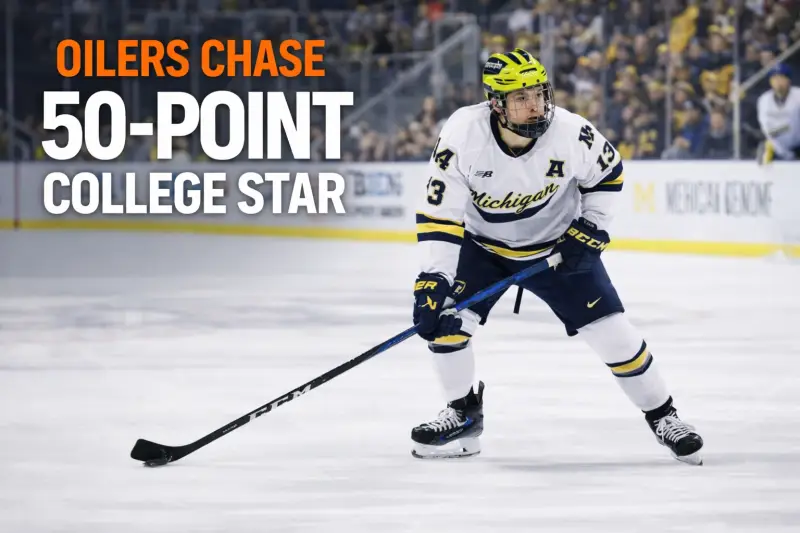
The Oilers scouted Michigan captain TJ Hughes in person, per Jeff Marek. With no first-round pick until 2028, Edmonton's pursuit of the 50-point college free agent is about survival, not luxury.
Live updates
No updates yet. Refreshing automatically.
Edmonton's Pipeline Problem Is Bigger Than One College Forward
The Edmonton Oilers don't have a first-round pick in 2026. They don't have one in 2027 either — not unless they crater into the bottom 12, which would be its own disaster. The earliest Stan Bowman can hand a draft card to a teenager in the first round is 2028. TJ Hughes isn't just some college free agent Edmonton happens to like. He's a patch for a self-inflicted hole in the organization's future.
Jeff Marek reported on the Sekeres & Price podcast Friday that the Oilers recently scouted Michigan's captain in person. Hughes, a 24-year-old right-shot center from Hamilton, Ontario, has 50 points in 36 games for the top-ranked Wolverines this season. Marek described him as someone who can "walk in and start to produce." That distinction matters. Most college free agents need two years in the AHL before they sniff NHL ice. Hughes might not.
- Edmonton traded its 2026 first-rounder to San Jose in the Jake Walman deal last March — a move that looked fine at the time and looks expensive now
- The 2027 first went to Chicago on March 4 for Jason Dickinson and Colton Dach, top-12 protected but almost certainly conveying for a team built to make the playoffs
- The Oilers' prospect pipeline was ranked 30th by Elite Prospects heading into this season — Matthew Savoie and Isaac Howard are the only blue-chip names in the system
- Hughes has 172 career points in 152 NCAA games, a number that puts him in rare air for undrafted college free agents
- Michigan is the #1 seed heading into the Frozen Four (April 9-11 in Las Vegas), meaning Hughes won't be available to sign until mid-April at the earliest
Who Is T.J. Hughes — And Why Is a 24-Year-Old Still in College?
Hughes' path to this moment makes zero sense on paper and perfect sense when you watch him play. He didn't get drafted. Not in the OHL. Not in the NHL. He spent three years in the AJHL with the Brooks Bandits, a league most casual hockey fans couldn't find on a map. In his final junior season, Hughes put up 66 goals and 127 points in 60 games. Sixty-six goals. In a league where 30 is considered elite.
Michigan noticed. Nobody else seemed to care.
Four years later, he's the captain of the top-ranked program in the country. But the trajectory wasn't linear, and that's what makes his development worth examining closely.
| Season | GP | G | A | PTS | PPG |
|---|---|---|---|---|---|
| 2022-23 (Fr.) | 39 | 13 | 23 | 36 | 0.92 |
| 2023-24 (So.) | 41 | 19 | 29 | 48 | 1.17 |
| 2024-25 (Jr.) | 36 | 15 | 23 | 38 | 1.06 |
| 2025-26 (Sr.) | 36 | 19 | 31 | 50 | 1.39 |
That junior year dip from 48 to 38 points? Context matters. Michigan lost significant roster pieces after the 2023-24 season, and Hughes had to shoulder a different role — more defensive responsibility, tougher matchups, fewer finishers around him. His PPG only dropped from 1.17 to 1.06. He wasn't worse. He was carrying a worse team.
Now look at the senior year. Back above a point per game, leading Michigan to a 28-7-1 record, wearing the C. The 31 assists are a career high. The 19 goals match his sophomore total in five fewer games. And his last 10 games — six goals, six assists, plus-3. He's peaking at exactly the right time.
Daily Faceoff's scouting report describes him as "intense, quick and always looking to get in the way to steal pucks." That off-puck game separates Hughes from the typical college free agent forward who lights up the NCAA but disappears against NHL-caliber checking. At 6-foot, 185 pounds with a right-handed shot, he's not going to overpower anyone physically. But he processes the game fast enough that he doesn't need to.
The College Free Agent Market Is Shrinking — Edmonton Waited
Tyson Gross was the consensus top college free agent this year. Was. Calgary signed him on March 12 — a two-year, two-way deal worth $975K per season — four days before Marek dropped the Hughes connection to Edmonton. Gross had been the prize: a 23-year-old center from St. Cloud State who was a finalist for NCHC Player of the Year, Forward of the Year, and Defensive Forward of the Year in the same season. He's off the board.
So who's left? Hughes is arguably the best unsigned forward remaining. The free agent market looks thin at every level right now, which makes the college pipeline that much more valuable:
- T.J. Hughes, C, Michigan — 50 PTS in 36 GP, captain, right shot, 24 years old. Highest PPG among unsigned forwards
- Josh Eernisse, RW, Michigan — Hughes' teammate. 6'3", 216 lbs. Power forward profile, more of a fourth-line projection
- Dylan Hryckowian, RW, Northeastern — Only 21, but 5'10" and hasn't cracked 36 points in any college season. Upside play, not a win-now fit
- Hank Cleaves, C, Dartmouth — 6'4" with 35 points in 30 games. Intriguing size but projects as a bottom-six checking center
Hughes stands out for one reason the others can't match: production combined with maturity. He's 24, which means his entry-level contract would be a one-year deal under the CBA — not the three-year runway a teenager gets. Some teams view that as a negative, less cost control. For Edmonton, a team that needs help now, it might actually be the point. You're not stashing this guy in Bakersfield for two seasons hoping he develops. If he signs, he's competing for a roster spot in October.
What This Actually Costs Edmonton
An entry-level deal for Hughes carries a cap hit around $950K — the CBA maximum. That's it. In a world where the Oilers are paying Leon Draisaitl $14 million and Connor McDavid $12.5 million, finding a forward who can chip in 25-35 points for under a million dollars is how you keep a contender's depth chart alive. Nobody throws a parade for an ELC signing. But Edmonton's pipeline situation means college free agents are the cheapest and fastest path to inject talent — and they can't afford to miss on the good ones.
Timing is the complication. Michigan plays in the Frozen Four starting April 9. If the Wolverines make a deep run — and at 28-7-1, they probably will — Hughes won't be available to sign until mid-April. By then, other teams will have circled. Marek didn't mention competing suitors, but online chatter among Oilers fans suggests they're not the only ones watching (they rarely are with 50-point college captains). Edmonton went to see him in person for a reason — they want to be first in line when the handshake window opens.
One college free agent won't fix a franchise that traded away its next two first-round picks. That's just math. But a 24-year-old captain putting up 1.39 points per game at the top-ranked program in the country, available for under a million bucks? Edmonton's current situation doesn't leave room to pass on that.
Frequently Asked Questions
Is T.J. Hughes an NHL draft pick?
No. Hughes went undrafted and took the junior-A-to-college route, playing three seasons with the Brooks Bandits in the AJHL before earning a scholarship at Michigan. His 66-goal AJHL season in 2021-22 is what caught the Wolverines' attention. At 24, he's older than most college free agents, which actually works in his favor — teams view him as closer to NHL-ready than a 21-year-old sophomore would be.
How many points does T.J. Hughes have in his college career?
Hughes has 172 points (66 goals, 106 assists) in 152 career games at Michigan. His senior year has been his best — 50 points in 36 games for a 1.39 points-per-game average, up from 1.06 PPG as a junior. He also recorded a career-high five-point game (four goals, one assist) against Penn State in November 2024.
When can NCAA free agents sign with NHL teams?
Players can sign once their college season officially ends or when they leave their program. For Hughes, that means after Michigan's NCAA tournament involvement concludes. With the Frozen Four scheduled for April 9-11 in Las Vegas, Hughes could be available as early as mid-April. Teams typically begin informal conversations before the signing window opens, which is what Edmonton's in-person scouting trip likely represented.
Why don't the Edmonton Oilers have first-round draft picks?
Edmonton traded its 2026 first-rounder to San Jose in March 2025 as part of the Jake Walman acquisition. The 2027 first-round pick went to Chicago on March 4, 2026, in the deal for Jason Dickinson and Colton Dach — that pick is top-12 protected but will almost certainly convey given the Oilers are a perennial playoff team. This draft capital drought is why college free agents like Hughes have become a strategic priority for GM Stan Bowman.
Frequently Asked Questions
Is T.J. Hughes an NHL draft pick?
No. Hughes went undrafted and took the junior-A-to-college route, playing three seasons with the Brooks Bandits in the AJHL before earning a scholarship at Michigan. His 66-goal AJHL season in 2021-22 is what caught the Wolverines' attention. At 24, he's older than most college free agents, which actually works in his favor — teams view him as closer to NHL-ready than a 21-year-old sophomore would be.
How many points does T.J. Hughes have in his college career?
Hughes has 172 points (66 goals, 106 assists) in 152 career games at Michigan. His senior year has been his best — 50 points in 36 games for a 1.39 points-per-game average, up from 1.06 PPG as a junior. He also recorded a career-high five-point game (four goals, one assist) against Penn State in November 2024.
When can NCAA free agents sign with NHL teams?
Players can sign once their college season officially ends or when they leave their program. For Hughes, that means after Michigan's NCAA tournament involvement concludes. With the Frozen Four scheduled for April 9-11 in Las Vegas, Hughes could be available as early as mid-April. Teams typically begin informal conversations before the signing window opens, which is what Edmonton's in-person scouting trip likely represented.
Why don't the Edmonton Oilers have first-round draft picks?
Edmonton traded its 2026 first-rounder to San Jose in March 2025 as part of the Jake Walman acquisition. The 2027 first-round pick went to Chicago on March 4, 2026, in the deal for Jason Dickinson and Colton Dach — that pick is top-12 protected but will almost certainly convey given the Oilers are a perennial playoff team. This draft capital drought is why college free agents like Hughes have become a strategic priority for GM Stan Bowman.
Related Stories

How to Watch the NHL: 2026-27
How to watch the NHL in 2026-27: every channel (ESPN, ABC, TNT, NHL Network), every streaming option, the free routes, blackout traps, and t...
By Mike Johnson · 9 min read

NHL 2026-27: The 84-Game Season
The NHL 2026-27 season expands to 84 games, the first since 1993-94. Both new games are divisional. Here is why it changed, when it starts,...
By Mike Johnson · 10 min read
How to Watch the 2026 NHL Draft
Round 1 is June 26 at 7 p.m. ET, Rounds 2-7 are June 27 — but the channel changes between days. The full how-to-watch guide for the 2026 NHL...
By Mike Johnson · 6 min read

Who Is Gavin McKenna? The No. 1 Pick
A Yukon kid who dominated two leagues two years apart, now the consensus No. 1 for 2026. Inside Gavin McKenna's game, his NHL comps, and the...
By Mike Johnson · 9 min read
Comments
Be the first to share your take.
Get NHL trade rumors in your inbox
One email per week. Zero spam. Verified rumors only.