Yegor Chinakhov Penguins: Extension Math for Crosby's Window
Chinakhov's RFA extension with the Penguins will cost $3.5-4.5M AAV. Cap math and Crosby window analysis inside.
Live updates
No updates yet. Refreshing automatically.
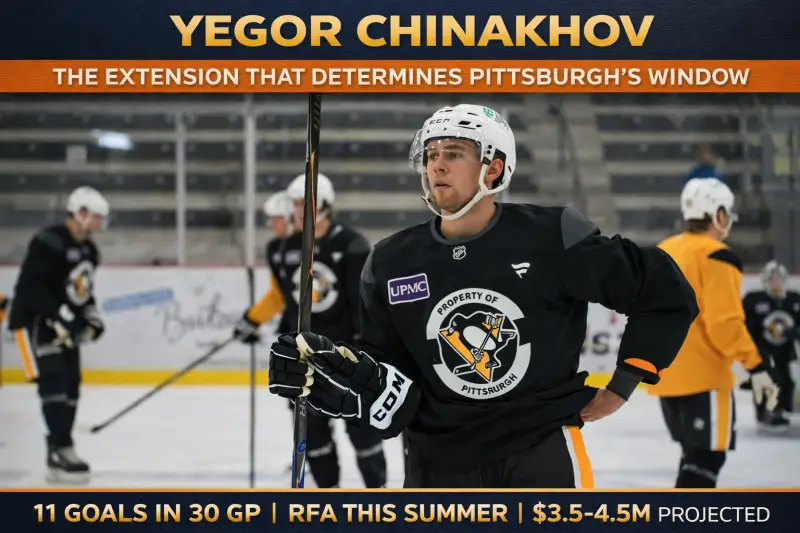
The Yegor Chinakhov Penguins trade is three months old and already looks like theft. Pittsburgh sent Danton Heinen, a 2026 second-round pick, and a 2027 third-round pick to Columbus on December 29 — and got back a 25-year-old former first-rounder who's scoring at a 20-goal pace. The math on what the Penguins gave up versus what they got back isn't even close.
The part of this story that matters more than the trade itself: what happens when Chinakhov needs a new contract this summer?
The Penguins have acquired forward Yegor Chinakhov from the @BlueJacketsNHL in exchange for forward Danton Heinen, a 2026 second-round draft pick, and a 2027 third-round draft pick.
— Pittsburgh Penguins (@penguins) December 29, 2025
His $2.1 million salary cap mechanics expires in July. He's a restricted free agent. The extension he signs — probably somewhere between $3.5 million and $4.5 million — will determine whether Pittsburgh can build a contender around Crosby's final contracted season or whether the cap math simply doesn't work.
Key Takeaways
- Chinakhov's production explosion: 11 goals and 22 points in 30 games with Pittsburgh after just 3 goals and 6 points in 29 games with Columbus — a completely different player under a new coaching staff
- The trade cost was minimal: Danton Heinen has 5 points in 31 games since joining the Blue Jackets and has spent time in the AHL. The picks were mid-rounders. Pittsburgh got an NHL top-six wing for spare parts
- RFA extension projection: Comparable deals (Batherson $4.975M, DeBrincat's bridge $4.5M) suggest Chinakhov's next contract lands at $3.5-4.5M AAV on a 2-3 year bridge
- Cap space isn't the issue — timing is: The Penguins have $50M+ in projected space for 2026-27 with a $104M ceiling, but Crosby's deal expires after next season. Every dollar spent must maximize the final window
- The "Chinakhov Template": Dubas has publicly named this trade as the blueprint for future acquisitions — young, controllable forwards acquired for draft capital
What Columbus Lost (and Won't Get Back)
Three goals in 29 games. That's what Chinakhov was producing in Columbus before the trade. He'd requested a move during the offseason after clashing with head coach Dean Evason, and the Blue Jackets made him a healthy scratch for two straight games before finally pulling the trigger.
Since January 1, he's been a different player. Second on the Penguins in points with 19 in that stretch. First in goals with 11. His ice time jumped from barely 10 minutes a night in Columbus to nearly 15 in Pittsburgh. The coaching staff — led by Mike Sullivan — unlocked something that Evason either couldn't or wouldn't.
What did Pittsburgh actually give up? Heinen has 3 goals and 5 points in 31 games with Columbus since the trade. He's been shuttling between the NHL roster and AHL Cleveland. The second-round pick was originally St. Louis's. The third-rounder was Washington's. None of those assets are keeping Don Waddell up at night.
Columbus didn't make a terrible trade given the circumstances — Chinakhov wanted out and was barely playing. But the gap between what Heinen is producing and what Chinakhov is doing in Pittsburgh makes this look worse by the week.
The Extension Nobody's Talking About
"No hesitation. We have a lot of draft picks, and we need to use them to procure high-potential young players."
— Kyle Dubas, Penguins GM (via Pittsburgh Hockey Now)Dubas spent draft picks to get Chinakhov. Now he has to spend real money to keep him.
Chinakhov's current deal — $2.1 million AAV signed while he was still with Columbus — expires this summer. As an RFA, the Penguins control his negotiating rights. Nobody's throwing Chinakhov an offer sheet at his current production level, so the negotiation stays in-house.
The question is how much. Look at the comparables:
| Player | AAV | Term | Stats at Signing |
|---|---|---|---|
| Drake Batherson | $4.975M | 6 yrs | 44 pts in 79 GP |
| Alex DeBrincat (OTT) | $4.5M | 2 yrs | 27G, 55 pts |
| Joel Farabee | $5.0M | 6 yrs | 38 pts in 55 GP |
| Chinakhov (proj.) | $3.5-4.5M | 2-3 yrs | 14G, 28 pts |
The split-season complicates things. Chinakhov's combined line — 14 goals and 28 points in 59 games — doesn't scream $5 million. But his post-trade production, isolated to Pittsburgh? That's a 20-goal, 50-point pace over a full 82. If Dubas's camp argues the Columbus numbers were an environmental disaster (which they were), they've got a case for something north of $4 million.
My projection: bridge deal, 2-3 years, $3.5-4.5 million AAV. Dubas has historically preferred bridge contracts for players who haven't sustained elite production across a full season. Lock him in cheap, let him prove it for two more years, then figure out whether he's a $6 million player or a $3 million one.
The Crosby Clock and Pittsburgh's Cap Reality
Chinakhov's extension changes the entire cap picture — and most coverage of this trade completely ignores that.
Crosby is signed through 2026-27 at $8.7 million. One more year. Letang is locked in at $6.1 million through 2027-28. Malkin — a pending unrestricted free agent this summer — wants to come back on a one-year deal. Anthony Mantha is another UFA question the Penguins have to answer before October.
Add Chinakhov at $4 million, and Pittsburgh's core four costs under $24 million. With the cap ceiling jumping to $104 million and roughly $50 million in projected space, there's room. Plenty of it.
But room for what? Dubas needs to fill out an entire roster around three players in their late 30s and a 25-year-old former reclamation project. Every contract matters. Every dollar spent on Chinakhov is a dollar that can't go toward a top-four defenseman or a second-line center to play behind Crosby. Just look at how Edmonton's superstar window is collapsing under similar cap pressure.
The frustrating part: five years ago, this franchise had Crosby, Malkin, and Letang surrounded by a supporting cast good enough to make annual playoff runs. Now they're hoping a guy who was healthy-scratched in Columbus turns into a core piece. That's not a rebuild plan — it's a prayer wrapped in salary cap gymnastics.
The "Chinakhov Template" — Why It Could Backfire
Dubas told reporters ahead of the trade deadline that the Chinakhov acquisition was the "template" for future trades. Young, controllable forwards acquired for draft capital. Guys other teams have given up on who might thrive in a different environment.
It worked once. The concern is whether Dubas starts treating every disgruntled 24-year-old with a first-round pedigree as the next Chinakhov. For every reclamation success story, there are ten guys who got traded because they genuinely weren't good enough — not because coaching failed them.
The shooting percentage is the other red flag nobody's touching. Chinakhov is shooting well above his career average since arriving in Pittsburgh — his Columbus numbers sat around 9-10% across three seasons. Some regression is coming. Whether he settles at 12-13% (still a 20-goal scorer) or drops back to single digits (a 14-goal third-liner overpaid at $4 million) is the difference between a brilliant trade and an OK one.
He's neither the 30-goal wing the optimists see nor the Columbus castoff the skeptics remember. Chinakhov is a genuine NHL top-nine forward with a real shot and real speed — and Pittsburgh needs him to be just good enough that the extension doesn't wreck their cap math. That's the bet.
What Comes Next for Chinakhov and Pittsburgh's Window
The immediate priority is the stretch run. Pittsburgh is clinging to a wild card spot, and Chinakhov's production is a massive reason they're still in the conversation. If the Penguins make the playoffs, he'll have proven he can produce when games matter — and that changes the extension calculus entirely.
This summer, expect the RFA negotiation to move quickly. Dubas doesn't drag out contract disputes, and Chinakhov has every reason to sign early — he's found a home where the coaching staff trusts him and the system fits his game. A bridge deal gets done by August.
What decides the legacy of this trade is whether Pittsburgh's acquisition of Chinakhov becomes the foundation of something real or just a nice story in a lost decade. Crosby's window is measured in months now, not years. If Chinakhov is part of a playoff team next spring, this trade goes down as one of Dubas's best moves. If Pittsburgh misses and Crosby walks? A footnote in a franchise that ran out of time.
Frequently Asked Questions
What did the Penguins trade for Yegor Chinakhov?
Danton Heinen, a 2026 second-rounder, and a 2027 third-rounder. That's it. Heinen has 5 points in 31 games since — Pittsburgh got the better player by a mile.
How much will Chinakhov's RFA extension cost?
Expect $3.5-4.5 million AAV on a 2-3 year bridge deal. Comparable extensions from Batherson ($4.975M) and DeBrincat ($4.5M) set the range. Dubas prefers bridges for guys who haven't proven it over a full season yet.
What are Chinakhov's stats with the Penguins?
11 goals and 22 points in 30 games since the December 29 trade. For context, he had 3 goals in 29 games with Columbus before Pittsburgh rescued him. He's been the team's leading goal scorer in 2026.
What is Kyle Dubas's "Chinakhov Template" strategy?
Dubas wants to keep acquiring young, controllable forwards with first-round pedigree who flopped elsewhere — then bet that Sullivan's coaching staff can fix them. It worked with Chinakhov. The risk is assuming every disgruntled former first-rounder is a diamond in the rough.
Sources and Reporting
- NHL.com — Chinakhov trade details and official announcement
- PuckPedia — Contract data for Chinakhov, Crosby, Malkin, and Letang
- Pittsburgh Post-Gazette — Chinakhov coaching impact and early returns feature
- Pittsburgh Hockey Now — Dubas "no hesitation" quote and trade rationale
- The Hockey News — "Chinakhov Template" strategy analysis
- ESPN — Chinakhov 2025-26 season statistics
- Hockey-Reference — Danton Heinen post-trade production
Frequently Asked Questions
What did the Penguins trade for Yegor Chinakhov?
Danton Heinen, a 2026 second-rounder, and a 2027 third-rounder. That's it. Heinen has 5 points in 31 games since — Pittsburgh got the better player by a mile.
How much will Chinakhov's RFA extension cost?
Expect $3.5-4.5 million AAV on a 2-3 year bridge deal. Comparable extensions from Batherson ($4.975M) and DeBrincat ($4.5M) set the range. Dubas prefers bridges for guys who haven't proven it over a full season yet.
What are Chinakhov's stats with the Penguins?
11 goals and 22 points in 30 games since the December 29 trade. For context, he had 3 goals in 29 games with Columbus before Pittsburgh rescued him. He's been the team's leading goal scorer in 2026.
What is Kyle Dubas's "Chinakhov Template" strategy?
Dubas wants to keep acquiring young, controllable forwards with first-round pedigree who flopped elsewhere — then bet that Sullivan's coaching staff can fix them. It worked with Chinakhov. The risk is assuming every disgruntled former first-rounder is a diamond in the rough.
Related Stories

How Do Line Changes Work in Hockey?
A line change is hockey's strangest routine: you swap players while the puck is live, but only inside a five-foot pocket beside your own ben...
By Mike Johnson · 10 min read
What Is the Long Change in Hockey?
The long change is not jargon, it is bench geography. Teams switch ends each period but keep the same bench, so in the second period a tired...
By Mike Johnson · 9 min read
What Is a Delayed Penalty in Hockey?
A delayed penalty is not a penalty yet. It is the referee holding the whistle after a foul until the penalized team touches the puck, which...
By Mike Johnson · 9 min read
What Is a One-Timer in Hockey?
A one-timer reaches the net just 42% of the time, the worst of any shot, yet it is the most dangerous weapon in hockey and the shot Ovechkin...
By Mike Johnson · 11 min read
Comments
Be the first to share your take.
Get NHL trade rumors in your inbox
One email per week, zero spam, verified rumors only.