Robert Thomas Trade: The Four-First Problem Explained
The Robert Thomas trade is coming this summer per LeBrun. The Blues want 4 first-round equivalents — but his full NTC suppresses the bidding war that would produce that return. Cap math, destinations, and projections inside.
Live updates
No updates yet. Refreshing automatically.
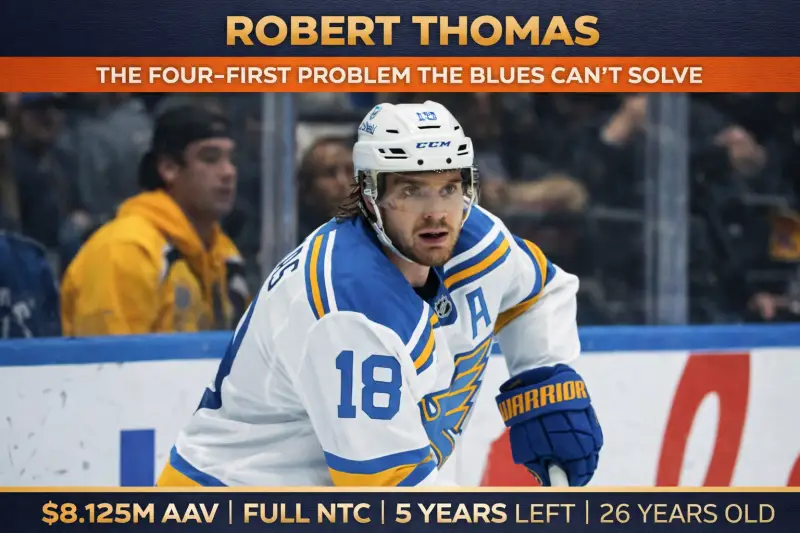
The Robert Thomas trade is coming this summer. Pierre LeBrun says "most likely." The asking price is "astronomical." And the Blues are right to demand what they're demanding — a 26-year-old number-one center on a $8.125 million cap hit with five years of team control doesn't hit the trade market in the NHL. Ever. The problem is that Thomas holds a full no-trade clause, which means he picks where he goes. And when the player controls the destination, the bidding war that would produce an astronomical return doesn't happen. I'm calling it the Four-First Problem — the Blues need four first-round equivalents to justify moving Thomas, but the NTC ensures they'll never get them.
The trade deadline isn't until tomorrow but today feels mighty important on the Robert Thomas trade watch. Because as a reminder, as per his full no-trade clause, any deal needs his blessing. As we've seen with other players with those clauses this past week, a player needs time
— Pierre LeBrun (@PierreVLeBrun) March 5, 2026
That tension between value and collectability is the entire story of this offseason.
Key Takeaways
- LeBrun confirmed it: Thomas "most likely gets moved this summer." The Blues quietly entertained offers at the deadline but never pulled the trigger — the asking price was too high for buyers and too important for St. Louis to settle
- The asking price is justified: 26-year-old franchise centers on $8.125M AAV with 5 years of control trade for the equivalent of 4 first-round picks. Thomas's age, position, and contract make him the rarest asset in hockey
- The NTC kills the return: Thomas's full no-trade clause means he approves the destination. Fewer bidders = suppressed competition = lower return. The Blues can't auction him to the highest bidder
- Top destinations: Utah Mammoth (Armstrong connection, $25M salary cap mechanics), Buffalo Sabres (deep talks at deadline, prospect-rich), Montreal Canadiens (Hage + Guhle package). Detroit is the dark horse
- New GM inherits the decision: Alex Steen replaces Doug Armstrong this summer. His first move as GM might be trading the franchise's best forward — with zero pre-existing relationship to negotiate with
Why the Blues Are Right to Ask for the Moon
Before you call the asking price delusional, look at what $8.125 million buys on the open market in 2026. A second-line center. Maybe a good one. You're not getting a 26-year-old who's produced at a point-per-game pace across multiple seasons, who plays both ends of the ice, and who's signed through his prime at a number that looks like a bargain against the $104 million cap ceiling.
"26-year-old No. 1 centres on a decent contract don't come around very often."
— Pierre LeBrun, The Athletic (via NHL Trade Rumors)Thomas's 2025-26 season — 12 goals and 23 assists for 35 points in 43 games — looks underwhelming on the surface. He missed time with a lower-body injury and a personal matter. But pro-rate those numbers to 82 games and you get a 23-goal, 67-point pace. That's a legitimate first-line center producing through adversity on a last-place team with no supporting cast. Context matters.
What kills me is how the Blues' situation has deteriorated to the point where trading Thomas is even a conversation. Two years ago, he signed that 8-year extension because he believed in the rebuild. Now Doug Armstrong has stepped aside, Alex Steen is the incoming GM, and the roster around Thomas has been stripped for parts. The player didn't fail the team. The team failed the timeline.
The Comparable Trades That Set the Floor
To understand what Thomas should fetch, look at what other number-one centers have commanded in recent trades. None of them were as young, as cheap, or as controllable as Thomas — which is exactly why the Blues' "astronomical" ask is defensible.
| Player | Age | AAV | Return |
|---|---|---|---|
| Bo Horvat (VAN→NYI, Jan 2023) | 27 | $5.5M (expiring) | Beauvillier + Raty + 1st |
| PL Dubois (WPG→LAK, Jun 2023) | 25 | $5.0M (RFA) | Vilardi + Iafallo + Kupari + 2nd |
| Ryan O'Reilly (STL→TOR, Feb 2023) | 32 | $7.5M (expiring) | 4 picks + prospect |
| Robert Thomas (projected) | 26 | $8.125M (5 yrs) | ? |
Horvat fetched a first-rounder, a prospect, and a roster player — as an expiring UFA. Dubois got three roster players and a second — as a disgruntled RFA who'd already asked out. O'Reilly returned a prospect and four picks — as a 32-year-old rental.
Thomas is younger than all of them, cheaper than the open-market replacement cost, and comes with five years of control. By any reasonable calculation, he should fetch MORE than any of those returns. A first-round pick, a top prospect, a young roster player, and another pick. That's the floor. The Blues aren't crazy to ask for it.
They're crazy to think they'll get it with a full NTC attached.
The Four-First Problem: How the NTC Destroys the Return
This is the paradox at the center of the Blues' entire offseason. Thomas is worth four first-round equivalents because of his age, position, contract, and talent. But his full no-trade clause means he decides where he goes — and when the player controls the destination, the dynamics of a trade negotiation flip entirely.
Without an NTC, the Blues call 31 teams. Multiple teams bid. The price gets driven up by competition. That's how you get four firsts.
With a full NTC, Thomas submits a list of approved teams. Maybe it's 5 teams. Maybe it's 3. Suddenly the Blues aren't running an auction — they're negotiating one-on-one with a shortlist of buyers who know they're the only options. Each buyer knows the seller has no leverage to walk away. The price drops.
I watched this exact dynamic play out with Nashville and Stamkos. The Predators turned down "really good offers" because Stamkos refused to waive. Trotz couldn't trade him to the highest bidder because the highest bidder wasn't on Stamkos's approved list. The NTC doesn't just limit destinations — it limits value.
My projection for Thomas: the Blues ask for four firsts equivalent. They settle for three. A first-round pick, a top-tier prospect (like Buffalo's Jiri Kulich or Utah's Tij Iginla package), and a young roster player. The missing fourth asset is the tax the NTC charges. Call it the Four-First Problem — the gap between what a player is worth and what his trade clause allows the team to collect.
Destination Breakdown: Who Can Actually Afford Thomas
Utah Mammoth — The Frontrunner
Bill Armstrong drafted Thomas 20th overall in 2017 when he was the Blues' director of amateur scouting. That relationship matters — Thomas is more likely to approve a trade to a GM he trusts than to a stranger. Utah has $25 million in projected cap space for 2026-27, plus a prospect pipeline deep enough to meet the asking price. The Mammoth have been connected to Thomas since January, and multiple insiders have them as the most likely landing spot.
Buffalo Sabres — The Deal That Almost Happened
The #sabres are viewed around the industry as a potential dark horse team that could spice up this trade deadline. Further to @DarrenDreger report, Buffalo is believed to be dangling the equivalent of multiple 1st-rounders in Robert Thomas talks.
— Chris Johnston (@reporterchris) March 4, 2026
The Sabres and Blues had deep trade discussions at the deadline, per Darren Dreger. Buffalo has over $30 million in projected space and a prospect system loaded with high-end pieces. But the Sabres weren't willing to meet St. Louis's full asking price in March — the question is whether a summer of reflection (and the pressure to build around their young core) changes the calculus.
Montreal Canadiens — The Wildcard Package
LeBrun reported the Blues' ask from Montreal involved "the likes of Michael Hage, David Reinbacher, plus, plus" — two of the Canadiens' best young assets in a single package. The Blues also expressed interest in defenseman Kaiden Guhle. That's a strong package on paper. But would Thomas approve Montreal? The Canadiens are a rebuilding team in a market that eats players alive. Thomas leaving one rebuild for another — even one with more talent — doesn't scream "destination of choice."
Why Detroit Doesn't Work
The Red Wings have been mentioned as interested, and their current hot streak makes them tempting. But Detroit's prospect currency is thinner than Utah's or Buffalo's. They'd have to overpay in picks to compensate, and with Thomas controlling the destination, the Wings might not even get the call.
What Alex Steen Inherits
Doug Armstrong built the Blues' rebuild around Thomas. Then Armstrong stepped aside, handing the keys to Alex Steen — who now has to decide whether to keep the player his predecessor viewed as untouchable or trade him for the assets that accelerate a rebuild Steen didn't design.
The cap picture makes the decision easier. St. Louis has $31.75 million committed for 2026-27. Thomas ($8.125M) and Kyrou ($8.125M) combine for $16.25M — 15.6% of the $104M cap ceiling on a team going nowhere. If Steen moves BOTH, he frees $16.25M in space plus the return assets. If he keeps both, he's paying $16.25M for a first-line center and a winger on a team that finished last in the Central.
I don't think Steen keeps both. One of Thomas or Kyrou goes this summer — and Thomas fetches significantly more because of his position and age. The logical move is to trade Thomas for a haul and build around Kyrou at the same cost. Whether Steen has the nerve to make that call in his first week as GM is the question nobody can answer yet.
Sources and Reporting
- NHL Trade Rumors — LeBrun: Thomas "most likely gets moved this summer," 6 destinations listed
- ClutchPoints — "Astronomical" asking price, Sabres trade talks heating up
- PuckPedia — Thomas contract details ($8.125M AAV, full NTC, 5 years remaining)
- The Hockey News — Sabres emerge in Thomas sweepstakes, Dreger reporting
- Daily Faceoff — Thomas says he was never asked to waive NTC
- ESPN — Thomas 2025-26 season stats
- PuckPedia — Blues cap space and roster commitments for 2026-27
- The Hockey Writers — Blues' ideal return in Mammoth trade scenario
The Four-First Problem isn't going away. Thomas is worth every asset the Blues are demanding — and his NTC guarantees they'll never collect it all. The gap between what a 26-year-old franchise center should command and what a player-controlled trade market actually produces is where this deal lives. My projection: Utah acquires Thomas by July for a package equivalent to three first-round picks — a 2026 first, Tij Iginla or a comparable top prospect, and a young roster player. The Blues will call it a win publicly and know privately they left a first-rounder on the table. That's the tax the NTC charges. The Four-First Problem, solved at three.
The Arguments You'll Hear (And Why They Don't Hold Up)
"Thomas has a full NTC — doesn't that mean he's untradeable?"
Eight years, $65M ($8.125M AAV) signed in 2022, running through 2030-31. Full no-trade clause in years 3 through 7 — he has absolute veto power over any deal right now. In the final year (2030-31), it converts to a 15-team no-trade list. Five years of control remaining at a number well below market for a first-line center.
"If Thomas is so good, why are the Blues trading him?"
The asking price was too high and Thomas was never asked to waive his NTC. He told ESPN directly: "I was never asked, and nor did I ever ask for a trade." The Blues entertained calls quietly but nobody met the "astronomical" price tag. LeBrun says the summer market will have more willing buyers — teams that miss the playoffs become more desperate in June than they are in March.
"Utah is the frontrunner — but can they actually meet the price?"
Utah Mammoth. GM Bill Armstrong drafted Thomas in 2017 when he ran St. Louis's amateur scouting. That personal connection matters when a player with a full NTC has to approve a destination. Utah has $25M in cap space and the prospect depth to meet the asking price. Buffalo came close at the deadline but walked away over cost. Montreal has the pieces but Thomas might block a trade to another rebuild.
"Four first-round equivalents is unrealistic — nobody pays that."
The ask is roughly four first-round equivalents. My projection: they'll settle for three — a 2026 first-round pick, a top prospect (Tij Iginla-caliber if Utah, Jiri Kulich-caliber if Buffalo), and a young roster player. The missing fourth asset is the NTC tax. When a player controls the destination, the bidding war that drives prices up doesn't happen. Three firsts is still an elite return — just not the haul they'd get without the clause.
Frequently Asked Questions
What does the Robert Thomas trade mean for the 2026 NHL season?
The Robert Thomas trade is coming this summer per LeBrun. The Blues want 4 first-round equivalents — but his full NTC suppresses the bidding war that would produce that return. Cap math, destinations, and projections inside.
What is Why the Blues Are Right to Ask for the Moon?
Before you call the asking price delusional, look at what $8.125 million buys on the open market in 2026. A second-line center. Maybe a good one. You're not getting a 26-year-old who's produced at a point-per-game pace across multiple seasons, who plays both ends of the ice, and who's signed through his prime at a number that looks like a bargain against the $104 million cap ceiling.
How does The Comparable Trades That Set the Floor affect the outcome?
To understand what Thomas should fetch, look at what other number-one centers have commanded in recent trades. None of them were as young, as cheap, or as controllable as Thomas — which is exactly why the Blues' "astronomical" ask is defensible.
Related Stories

Golden Knights Offseason Squeeze
Vegas reached Game 6 of the 2026 Cup Final, then handed itself a summer with about $4.6M in cap space to re-sign Pavel Dorofeyev, replace a...
By Mike Johnson · 9 min read
Hischier Trade Clock Hits July 1
Nico Hischier trade rumors are rising: extension talks with new GM Sunny Mehta are in their infancy, Montreal, LA and Minnesota are circling...
By Mike Johnson · 9 min read

Larkin-Robertson Swap: Who Says No?
Dallas has checked in on Dylan Larkin, but the Stars cannot fit his $8.7M until Jason Robertson and his unsigned $14M ask move out. Inside t...
By Mike Johnson · 11 min read

Darnell Nurse Trade: 4 Suitors
Edmonton wants Darnell Nurse's $9.25M off the books, but a buyout saves barely $1.53M and his no-move clause hands him the pen. The Bonus Sh...
By Mike Johnson · 12 min read
Comments
Be the first to share your take.
Get NHL trade rumors in your inbox
One email per week, zero spam, verified rumors only.