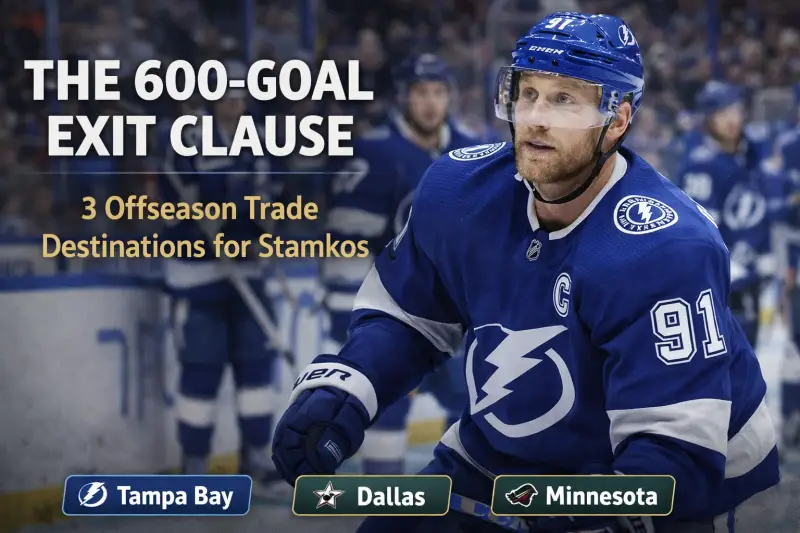
The 600-Goal Exit Clause: 3 Offseason Trade Destinations
Stamkos scored his 600th goal on New Year's Eve. Now with 618 goals, a full NMC, and 3 preferred destinations, The 600-Goal Exit Clause will define the 2026 offseason trade market.
Live updates
No updates yet. Refreshing automatically.
Steven Stamkos scored his 600th career goal on New Year's Eve. Three months later, that milestone has become his most powerful negotiating weapon.
At 618 goals and counting — 22nd on the NHL's all-time list — Stamkos isn't just a player with a no-movement clause rules. He's a legacy case. And legacy cases don't get shipped to rebuilding franchises without their consent. I'm calling it The 600-Goal Exit Clause: the unwritten rule that says once you've joined the most exclusive scoring club in hockey history, you don't just get traded. You choose your stage.
At 36, Stamkos has posted 36 goals in 74 games this season after a resurgent 2025-26 campaign that reminded the entire league why Tampa Bay built a dynasty around his release. He leads the NHL with 10 game-winning goals. He's seventh all-time in power-play goals. And after telling reporters there was "zero" chance he'd waive his no-movement clause at the deadline, the conversation has officially shifted to the offseason — where his three-team preferred destination list becomes the most consequential document in the NHL's summer trade market.
🔑 Key Takeaways
- Stamkos has 618 career goals — the 22nd player in NHL history to reach 600, giving him enormous trade leverage via his full NMC
- Three preferred destinations: Tampa Bay Lightning, Dallas Stars, and Minnesota Wild — per Pierre LeBrun
- Trotz's retirement means Nashville's incoming GM inherits a player who can veto any deal he doesn't want
- Tampa Bay leads his list — an emotional reunion where he scored 555 of his career goals and won two Cups
- Minnesota may be the smartest fit — with ~$23.6M in projected 2026-27 cap space and a gaping hole at second-line center
Nashville's Summer Reckoning — Why Stamkos Becomes Available
The dominoes started falling on February 2, when Barry Trotz announced his retirement as Nashville's general manager. After three seasons behind the desk, the 63-year-old informed owner Bill Haslam that the 2025-26 campaign would be his last — and that the search for Nashville's third-ever GM should begin immediately. The goal is to have a successor in place by the NHL Draft in late June, with Trotz transitioning into an advisory role and a search committee that includes minority owner Nick Saban.
That timeline matters enormously for Stamkos's future. The new GM won't have built this roster. They won't carry the same loyalty to the veteran core that Trotz assembled. And they'll be inheriting a franchise that, despite Stamkos's individual brilliance, couldn't translate his 36-goal season into sustained playoff contention.
"With this group, we want to be together. I can only control what I can control, but I love being here. There is zero chance I'm waiving my no-movement clause."
That statement held through the March 6 deadline. But the deadline and the offseason are two fundamentally different animals. At the deadline, Stamkos was protecting his group. This summer, that group gets dismantled by someone else's hands regardless.
Pierre LeBrun reported that Stamkos prepared a three-team preferred destination list — topped by Tampa Bay, followed by Dallas and Minnesota — in the event Nashville approached him about waiving his NMC. LeBrun added that an offseason trade was "more likely" than an in-season move. He was right. And now, with Trotz stepping aside and a rebuild on the horizon, The 600-Goal Exit Clause transforms from hypothetical to inevitable. No incoming GM burns political capital forcing a 600-goal scorer to stay while tearing down the roster around him.
Tampa Bay Lightning — Where 555 Goals Still Echo
There's a reason Tampa Bay sits atop Stamkos's preferred list, and it has nothing to do with cap math. Sixteen seasons. Two Stanley Cups. Five hundred and fifty-five goals — more than any player in Lightning franchise history. When Stamkos left as a free agent in July 2024, the departure stung both sides. Now, the chance to write a different final chapter has the hockey world captivated.
I think the emotional pull of this reunion is genuinely unprecedented in modern NHL history. We've seen aging stars return to their original franchises — Mark Messier to the Rangers, Mario Lemieux unretiring — but few combined a 600-goal resume with an open door back to the franchise that defined them. Stamkos wearing Lightning blue again as a member of the most exclusive scoring club in hockey would be the kind of moment that transcends a regular Tuesday night in April.
But emotion doesn't clear cap space. Tampa committed $9 million annually to Jake Guentzel through 2030-31, and faces critical decisions on Nikita Kucherov and Victor Hedman, both of whom could hit unrestricted free agency. The Lightning would need Nashville to retain roughly $4 million of Stamkos's $8 million cap hit — and even then, it requires creative roster management from Julien BriseBois.
The trade package from Tampa's side is more appealing than you'd expect. Unlike Dallas, the Lightning still have their first-round picks and a prospect pipeline with several NHL-ready assets. If Nashville's new GM is prioritizing the future, Tampa can actually pay the price. The question is whether BriseBois views a 36-year-old center as the piece that pushes Tampa back into Cup contention, or whether the contender's tax makes him hesitate.
Dallas Stars — The Rantanen Gambit's Missing Piece
Dallas went all-in this season, and I mean all in. The blockbuster that brought Mikko Rantanen from a Colorado franchise navigating its own crossroads cost the Stars Logan Stankoven, their 2026 first-round pick (which conveyed to Carolina after Dallas clinched a playoff spot), a conditional 2028 first-rounder, and third-round picks in both 2026 and 2027. At the deadline, they stacked further — adding Michael Bunting from Nashville and Tyler Myers from Vancouver.
So why add a 36-year-old center on top of that? Because Dallas's depth scoring remains the Achilles heel behind their Cup ambitions. Rantanen and Stamkos on the same roster would give the Stars arguably the most dangerous top-six in the Western Conference, with Stamkos's elite power-play one-timer complementing Rantanen's playmaking vision. And at $8 million annually for a 600-goal scorer who just led the NHL in game-winning goals, the cap hit is more reasonable than the age suggests.
"We got a lot of calls on him. There were some really good offers. But he made it clear — and I respect his decision completely."
The problem is currency. Dallas has almost nothing left to trade. Their prospect pipeline was thinned before the Rantanen deal, and now they're operating without first-round picks in the two most valuable draft years. Nashville's incoming GM will want future assets — picks, prospects, players with term — and Dallas simply can't compete with Tampa Bay or Minnesota on that front.
What strikes me about the Dallas scenario is the risk calculus. If the Stars win the Cup this spring, Stamkos becomes less necessary. If they fall short, the front office faces an existential question: is doubling down again, without your own draft picks, sustainable? The 600-Goal Exit Clause favors Dallas in one respect — this is a team that can deliver a deep playoff run, and a 600-goal scorer wants every remaining game to matter. But wanting and affording are two different things.
| Factor | Tampa Bay | Dallas | Minnesota |
|---|---|---|---|
| Projected 2026-27 Cap Space | Tight (needs ~$4M cleared) | ~$8M projected | ~$23.6M projected |
| Primary Need Stamkos Fills | Scoring depth | 2C / top-six scoring | 2C (critical need) |
| Contender Status | Fringe playoff team | Stanley Cup favorite | Rising contender |
| Draft Capital for Trade | ✅ Picks intact | ❌ Depleted | ✅ Picks intact |
| Salary Retention Needed | Yes (~50%) | Possible (~25%) | None required |
| Legacy Fit | 555 goals scored here, 2 Cups | Rantanen complement | Kaprizov's elite 2C |
Minnesota Wild — The Cap Space Sweet Spot
If Tampa Bay is the heart pick and Dallas is the win-now pick, Minnesota is the smart-money pick. And here's the thing about The 600-Goal Exit Clause — it doesn't just serve the player. It serves the team that can most fully commit to honoring a generational scorer. Minnesota can do that without Nashville retaining a single dollar of Stamkos's contract.
The Wild's 2026-27 cap situation is unlike any other team on Stamkos's list. Even with Kirill Kaprizov's massive raise kicking in, Minnesota projects roughly $23.6 million in available space — enough to absorb the full $8 million hit and still address other roster needs. No retention gymnastics. No cap wizardry. Just a clean acquisition from a position of financial strength.
The on-ice fit is equally compelling. Minnesota traded Marco Rossi — their top center prospect — in a package for defenseman Quinn Hughes, a move that solved their blue-line questions but ripped open a crater at second-line center. Stamkos doesn't just fill that hole; he transforms it into a weapon. Imagine Kaprizov driving the top line while Stamkos anchors the second unit with 36-goal upside and a power-play one-timer that goalies still haven't solved after 17 NHL seasons.
The analytics support it, too. Stamkos's shooting percentage this season sits right in line with his career mark — this isn't an unsustainable heater. His 10 game-winning goals lead the league, and since November 26 he's been tied with Cole Caufield for the most goals in the NHL. At 36, Stamkos hasn't declined — he's adapted, using positioning and release speed to compensate for any lost straight-line quickness.
GM Bill Guerin would also have the draft capital to build an appealing return package. With first-round picks intact and a prospect system among the league's deepest, the Wild can offer the kind of future-oriented return that Nashville's rebuild demands. In today's NHL, where contract value is being reassessed league-wide, Stamkos's $8 million for a 600-goal scorer producing at a first-line rate is a bargain the Wild can exploit.
The 600-Goal Exit Clause Verdict — Who Lands Stamkos?
History tells us aging stars rarely end up where pure logic says they should. Jarome Iginla went to Colorado instead of Boston, then Pittsburgh instead of staying put. Joe Thornton chased a ring in Toronto, then Florida. The emotional calculus of where to finish a career is deeply personal, and it almost never aligns perfectly with the analytical best fit.
I'd argue this situation is different, though. Stamkos isn't ring-chasing — he has two. He's not looking for a fresh start — he's looking for the right stage to cement his place among the greatest goal scorers who ever lived. The 600-Goal Exit Clause means his decision will be governed by legacy as much as loyalty, and that changes the equation entirely.
Tampa Bay remains my prediction for the most likely outcome. It's number one on his list for a reason. The narrative of Stamkos returning to Amalie Arena as a member of the 600-goal club — the building where he scored 555 of his career goals — would be one of the most powerful moments in modern hockey. BriseBois has the draft picks to build a real return package, and the retention math, while complicated, isn't prohibitive. Just as Steve Yzerman's front office reshaping in Detroit proved that veteran stars need the right organizational structure around them, Tampa's familiarity with Stamkos gives them a uniquely informed perspective on his fit.
But if I'm advising Stamkos purely on hockey fit? Minnesota is the answer. The Wild check every box: cap space, positional need, contending trajectory, and the ability to absorb his full contract without retention strings. Alongside Kaprizov, Stamkos would be the centerpiece of a legitimate Cup threat.
Dallas is the long shot. The Stars are already all-in, but they've spent their trade currency. Unless Nashville's incoming GM accepts a package built around NHL roster players — which would undermine the rebuild — the Stars can't match what Tampa or Minnesota offer. Like other teams navigating the complexities of offseason trade candidates, Nashville's new front office will prioritize picks and prospects above all.
My call: Stamkos lands in Tampa Bay at 50% retained salary, with Nashville receiving a 2027 first-round pick and a B-level prospect. He steps onto Amalie Arena ice as a 600-goal scorer in Lightning blue by opening night. And The 600-Goal Exit Clause becomes the defining trade storyline of the 2026 offseason — proof that when you've already written yourself into the history books, you don't just get traded. You choose your stage.
Frequently Asked Questions
Sources
- NHL.com — Stamkos scores 600th NHL goal, Predators defeat Golden Knights
- NHL.com — Trade Buzz: Stamkos says 'zero' chance he waives NMC (Feb 28, 2026)
- TSN — Insider Trading: Stamkos's preferred destination list revealed
- Daily Faceoff — Predators received 'lot of calls' on Stamkos at deadline
- NHL.com — Predators GM Barry Trotz announces retirement plans
Frequently Asked Questions
What does the Steven Stamkos trade destinations mean for the 2026 NHL season?
Stamkos scored his 600th goal on New Year's Eve. Now with 618 goals, a full NMC, and 3 preferred destinations, The 600-Goal Exit Clause will define the 2026 offseason trade market.
What is Nashville's Summer Reckoning — Why Stamkos Becomes Available?
The dominoes started falling on February 2, when Barry Trotz announced his retirement as Nashville's general manager. After three seasons behind the desk, the 63-year-old informed owner Bill Haslam that the 2025-26 campaign would be his last — and that the search for Nashville's third-ever GM should begin immediately. The goal is to have a successor in place by the NHL Draft in late June, with Trotz transitioning into an advisory role and a ...
How does Tampa Bay Lightning — Where 555 Goals Still Echo affect the outcome?
There's a reason Tampa Bay sits atop Stamkos's preferred list, and it has nothing to do with cap math. Sixteen seasons. Two Stanley Cups. Five hundred and fifty-five goals — more than any player in Lightning franchise history. When Stamkos left as a free agent in July 2024, the departure stung both sides. Now, the chance to write a different final chapter has the hockey world captivated.
Related Stories

How Do Line Changes Work in Hockey?
A line change is hockey's strangest routine: you swap players while the puck is live, but only inside a five-foot pocket beside your own ben...
By Mike Johnson · 10 min read

What Is the Long Change in Hockey?
The long change is not jargon, it is bench geography. Teams switch ends each period but keep the same bench, so in the second period a tired...
By Mike Johnson · 9 min read

What Is a Delayed Penalty in Hockey?
A delayed penalty is not a penalty yet. It is the referee holding the whistle after a foul until the penalized team touches the puck, which...
By Mike Johnson · 9 min read
What Is a One-Timer in Hockey?
A one-timer reaches the net just 42% of the time, the worst of any shot, yet it is the most dangerous weapon in hockey and the shot Ovechkin...
By Mike Johnson · 11 min read
Comments
Be the first to share your take.
Get NHL trade rumors in your inbox
One email per week, zero spam, verified rumors only.