Maple Leafs GM Search: Inside the Overcorrection Cycle
Toronto has hired five GMs since 2008. Each one represented the opposite philosophy of the last. Burke was toughness. Dubas was data. Treliving was balance. All got fired. The Overcorrection Cycle explains why Sunny Mehta and Chris Pronger — the two front-runners — might fall into the same trap.
Live updates
No updates yet. Refreshing automatically.
Five GMs in 18 Years. Toronto Keeps Solving the Wrong Problem.
Brian Burke promised truculence. Kyle Dubas promised algorithms. Brad Treliving promised stability. All three got fired.
The Maple Leafs GM search is now in its second week, and the hockey media landscape is doing what it always does — profiling candidates. Sunny Mehta. Chris Pronger. Doug Armstrong. Hayley Wickenheiser. Everybody has a favorite. Nobody is asking the harder question: Why does Toronto keep churning through general managers at a rate that would embarrass a fast-food franchise?
The answer isn't bad luck. It's a pattern I'm calling The Overcorrection Cycle — a two-decade loop where each new GM represents the exact opposite philosophy of the person who just got fired. Burke was toughness after John Ferguson Jr.'s passivity. Dubas was data after Lamoriello's rigidity. Treliving was veteran balance after Dubas's youth-and-spreadsheets approach. Now MLSE CEO Keith Pelley is demanding a "data-centric" leader — the same philosophical direction they tried under Dubas, which produced five playoff appearances and exactly one series win.
Until Toronto confronts this cycle, the name on the door doesn't matter.
Pelley's March 31 press conference contained the contradiction that defines the entire search. "We didn't have the alignment, we didn't have the culture, we didn't have the structure that we needed to be successful," he told reporters after firing Treliving with eight games left in a 32-31-13 season. Toronto was about to miss the playoffs for the first time since 2016. Then, in the same breath, Pelley described his ideal successor: someone who makes "evidence-based decisions" and understands where "AI is changing our business." He name-dropped Carolina Hurricanes GM Eric Tulsky — a physicist-turned-analytics-pioneer — as the gold standard.
Culture was the stated problem. Data was the proposed solution. If that contradiction doesn't alarm you, you haven't been paying attention to the last 18 years.
Key Takeaways
- The Overcorrection Cycle: Toronto has hired five GMs since 2008, each representing the philosophical opposite of the last — guaranteeing the same failure from a new direction.
- Pelley's contradiction: He fired Treliving for "culture" failures but wants a "data-centric" successor — an approach that already failed under Kyle Dubas.
- Sunny Mehta's résumé: The Panthers AGM has two Stanley Cup rings and built the NHL's first dedicated analytics department, but his profile mirrors the Dubas hire of 2018.
- Chris Pronger's pitch: The Hall of Famer already diagnosed Toronto's culture rot on live television — but "culture-first" was Burke's sales pitch in 2008.
- The Matthews clock: Whoever gets hired has roughly 18 months to extend Auston Matthews at $15-16 million or risk losing the franchise centerpiece to free agency in 2028.
The Overcorrection Cycle: Burke to Treliving, Mapped
| GM (Tenure) | Hired to "Fix" | Philosophy | What Broke |
|---|---|---|---|
| Burke (2008-13) | JFJ's passivity | Old-school toughness | Cap disasters, Clarkson deal |
| Nonis (2013-15) | Burke's volatility | Safe continuity | Inherited mess, no vision |
| Lamoriello (2015-18) | Accountability void | Authoritarian discipline | Analytics stagnation |
| Dubas (2018-23) | Outdated methods | Analytics-first | 1 series win in 5 playoffs |
| Treliving (2023-26) | Dubas's drama | Balanced veteran | Missed playoffs, lost Marner |
Read that table vertically, not horizontally. Each "Hired to Fix" column is a direct reaction to the previous GM's perceived weakness. Burke's combativeness created cap chaos, so Nonis was the safe inside pick. Nonis's paralysis demanded authority, so Lamoriello brought an iron fist. Lou's rigidity suppressed innovation, so Dubas became the analytics revolution. Dubas's regular-season brilliance produced playoff humiliation, so Treliving was the steady hand from Calgary who wouldn't rock the boat.
None of this is random. The press conference language is predictable down to the adjectives. Burke promised "pugnacity, testosterone, truculence, and belligerence" in November 2008. Eighteen years later, Pelley promised "evidence-based decisions" and "data-centric" leadership. Both were overcorrections dressed as strategy.
Here's what kills me about this cycle: it guarantees every new hire arrives perfectly equipped to solve the PREVIOUS problem while being utterly unprepared for the next one. Burke could build a physical team but couldn't navigate a salary cap. Dubas could navigate the cap in his sleep but couldn't build a team that competed past April. Toronto doesn't hire general managers. It hires reactions.
Edmonton ran a strikingly similar experiment during its lost decade — cycling through Steve Tambellini, Craig MacTavish, and Peter Chiarelli before Ken Holland finally brought stability in 2019. The Oilers had Connor McDavid as their safety net. Toronto has Auston Matthews on a two-year runway with a torn MCL and zero guarantees about his future in the city. The margin for another overcorrection is nonexistent.
Sunny Mehta: The Poker Player Who Built Florida's Two-Cup Dynasty
If Pelley gets his analytics darling, the front-runner is Sunny Mehta — the 47-year-old assistant general manager of the Florida Panthers. Elliotte Friedman put the name into public orbit during Sportsnet's Saturday Headlines in early April.
"One name I do think is gonna be part of Toronto's search is Sunny Mehta, one of the assistant general managers of the Florida Panthers. I do think he's gonna be a factor."
— Elliotte Friedman, Sportsnet Saturday Headlines (via The Leafs Nation)Mehta's path to an NHL front office reads like a screenplay no studio would greenlight. Jazz guitar degree from the University of Miami. Seven years as a professional poker player. Two bestselling poker strategy books. A master's in data science. Then a hard pivot into hockey analytics blogging in the early 2010s, which led to consulting work with the Coyotes and a full-time hire with the New Jersey Devils in 2014. In Newark, Mehta built the first dedicated analytics department in the history of the National Hockey League.
Bill Zito brought him to Florida in 2020 as Vice President of Hockey Strategy & Intelligence. Three years later, the Panthers promoted him to assistant GM and head of analytics. Two years after that, Florida had back-to-back Stanley Cups. Since Mehta joined the front office, the Panthers have posted a 236-119-29 record. His fingerprints are all over the depth acquisitions that don't make SportsCenter but win playoff rounds — players like Evan Rodrigues and Niko Mikkola, scooped at market-value discounts before anyone else saw the value. Mehta reads roster inefficiencies the way he once read poker tables: by calculating odds everyone else ignores.
But here's my problem with the Mehta-to-Toronto pipeline. Pelley is describing the exact candidate profile that Brendan Shanahan described in 2018 when he hired Dubas. Young. Data-obsessed. Non-traditional path into hockey. John Chayka occupies the same mold — and the Leafs have already spoken with him, too. Toronto has a type when it swings toward the analytics pole. That type has already failed in this building once.
Mehta's edge over Dubas? He has two championship rings and a decision-making track record that extends well beyond regular-season point totals. But rings earned as an assistant in Bill Zito's front office don't automatically transfer to running the show in the most media-saturated hockey market on earth. Florida's organizational culture gave Mehta room to cook. Toronto's organizational anxiety has consumed every GM who's walked through those doors. The question isn't whether Mehta is brilliant. It's whether Toronto will let him be.
Chris Pronger: The Hall of Famer Who Already Diagnosed the Disease
While Mehta represents the data pole of the Overcorrection Cycle, Chris Pronger occupies the culture pole — and he didn't wait for an interview to audition.
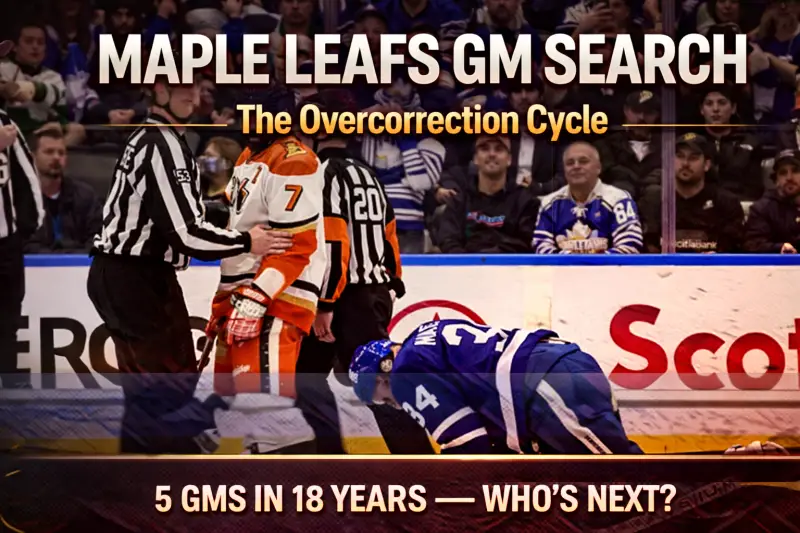
When Anaheim's Radko Gudas delivered a season-ending hit on Auston Matthews on March 13, not a single Leaf stepped up. No confrontation. No retribution. Not even an immediate check on the franchise's $13.25 million center lying on the ice. Pronger watched it unfold on television. His reaction was blistering.
"I laughed in disbelief. Nobody confronted Gudas. Nobody even checked on their captain right away. That's not a coaching issue — that's a locker room issue. Clearly, it's going in the wrong direction."
— Chris Pronger, via The Leafs Nation / Leafs Morning TakePronger is 51 years old, a Hart Trophy winner, a 2007 Stanley Cup champion with Anaheim, and a Hockey Hall of Fame inductee. After retiring, he spent three years with the NHL's Department of Player Safety and then served as senior VP of hockey operations with the Florida Panthers from 2017 to 2020. He's not a traditional front-office lifer — but he carries a presence and moral authority that few candidates in this search can match.
Nick Kypreos confirmed in early April that contact exists between Pronger and the Leafs organization. Pronger hasn't hidden the interest. "I never say never about anything," he said on Leafs Morning Take. "For me to do anything in hockey operations, though, it needs to be the right fit." He's also said publicly that Matthews' time in Toronto is "on a clock" — a level of bluntness that terrifies soft organizations and energizes functional ones.
What draws the Leafs to Pronger isn't complicated. He sees the culture vacuum that Pelley identified. He's lived in dressing rooms that won. He commands instant respect from players who grew up watching him play. I don't doubt any of that. The question I keep coming back to: haven't we seen this movie?
Burke walked into Toronto in November 2008 carrying the same diagnosis. Same energy. Same promise to install a backbone in a franchise that had gone soft. He lasted four years and left behind the David Clarkson contract, a failed culture overhaul, and a cap sheet that his successor couldn't repair. Culture-first executives often lack the cap sophistication and asset-management precision that modern GMs need to operate under a hard ceiling. Coaching hires alone can't fix a roster that's been misbuilt at the executive level. Pronger knows hockey. Whether he knows the CBA's recapture penalties and performance bonus overages is an entirely different question.
What Breaking the Cycle Actually Requires
Neither Mehta nor Pronger — as archetypes — can fix the Leafs. Not because they're bad candidates individually. Because the job description itself is fundamentally broken.
Pelley wants "data-centric" leadership AND cultural transformation. He referenced Eric Tulsky, Carolina's GM who is both a nanotechnologist with 27 US patents and an executive who fosters genuine coaching buy-in and player accountability. Tulsky didn't choose between data and culture. He refused the false binary altogether. That's the model Toronto needs — a general manager who treats evidence and accountability as the same project, not as opposing ends of a hiring spectrum.
There's also a franchise-defining decision that won't wait for philosophical debates. Matthews is recovering from the MCL tear that ended his season on March 13. He has two years left on a $13.25 million AAV deal. The next GM gets roughly 18 months to either negotiate an extension — likely in the $15-16 million range — or explore trade options that reshape the franchise for the next decade. Approximately $46.4 million in projected salary cap mechanics under the 2026-27 ceiling of $104 million gives the new front office real flexibility. Whether that space is used to build around Matthews or to begin a franchise reset is the question that separates a retool from a rebuild.
My read: Mehta is the stronger candidate to break the cycle — but only if the franchise allows him to build infrastructure without the political noise that consumed Dubas. The poker player knows when to fold a losing hand. He knows when odds shift and it's time to walk away from a bet your ego wants to keep making. Dubas never demonstrated that instinct, especially during the Mitch Marner negotiation that ended with the franchise's best winger heading to Vegas in a sign-and-trade last summer. Mehta's ability to identify and acquire undervalued assets in Florida suggests he can make uncomfortable decisions when the math demands them.
But if Pelley hires a Mehta-type and surrounds him with hockey people who quietly resent the analytics mandate — the way some of Burke's staff reportedly clashed with his truculence culture — the cycle resets. Again. The only path forward is to stop treating data and culture as opposite ends of a spectrum. Both are just tools. Toronto has been trying to figure that out since 2008, and through five GMs and eighteen years and roughly half a billion dollars in player salaries, they haven't come close.
Companion read:
Toronto's GM cycle creates ripple effects in the 2026 NHL Coaching Carousel, where bench-staff evaluation comes next.
Sources and Reporting
- ESPN — Pelley press conference quotes, "alignment" and "culture" comments, Treliving firing context
- The Leafs Nation / Sportsnet — Elliotte Friedman on Sunny Mehta as Toronto's GM target
- The Leafs Nation / Leafs Morning Take — Chris Pronger on Toronto's locker room culture and Matthews hit
- NHL.com — Pelley "data-centric" criteria, Eric Tulsky reference, hiring timeline
- CBC News — Full post-Treliving press conference breakdown
- NHL.com / Florida Panthers — Sunny Mehta official biography and career path
- Pro Hockey Rumors — Doug Armstrong unavailable for Leafs search
- PuckPedia — Auston Matthews contract verification ($13.25M AAV, UFA 2028)
- NHL.com — Chris Pronger hockey operations experience and Panthers tenure
- Toronto Maple Leafs / NHL.com — Official Treliving departure announcement
The Overcorrection Cycle doesn't end with a brilliant hire. It ends when the organization stops treating every vacancy as a referendum on the last GM's failures. My projection: Toronto hires Mehta or a Mehta-type by mid-May, gives him a three-year window tied directly to the Matthews extension decision, and we're back here in 2029 asking the same questions if he can't win a second-round series. The cycle is that durable. Breaking it requires something no GM candidate can bring alone — institutional self-awareness at the ownership level. Pelley's press conference, with its culture diagnosis and data prescription, suggested he doesn't have it yet.
Who are the top candidates for the Maple Leafs GM job in 2026?
Sunny Mehta (Panthers AGM) leads the data-centric field per Elliotte Friedman. Chris Pronger (Hockey Hall of Famer) has had organizational contact and hasn't ruled himself out. Brandon Pridham is the internal dark horse. Doug Armstrong is NOT available — the Blues won't release him from his president contract. Chayka and Gillis have already interviewed. MLSE targets a mid-May hire before the NHL Scouting Combine.
Why was Brad Treliving fired as Maple Leafs GM?
MLSE CEO Keith Pelley cited failures of "alignment," "culture," and "structure." The Leafs went 32-31-13 in 2025-26 — their worst season in a decade. Auston Matthews suffered a season-ending MCL tear on March 13 from a Radko Gudas hit. Toronto missed the playoffs for the first time since 2016. Pelley pulled the trigger with eight games remaining in the regular season.
What does Keith Pelley mean by a "data-centric" GM?
Pelley wants a leader who treats "every single decision" as "evidence-based" and understands AI's emerging role in hockey operations. He specifically name-dropped Carolina Hurricanes GM Eric Tulsky — a former nanotechnology researcher — as the archetype. Several observers have noted this profile overlaps significantly with Kyle Dubas, whom the Leafs fired in 2023 after five seasons and one playoff series win.
Is Doug Armstrong available for the Maple Leafs GM position?
No. Armstrong signed an extension with the St. Louis Blues that transitions him from general manager to president of hockey operations on July 1, 2026. Blues ownership has no interest in releasing him for Toronto's interview process. Armstrong also reportedly doesn't match the analytically forward profile Pelley has publicly outlined for the role.
When will the Maple Leafs announce their new general manager?
MLSE has not set a formal public timeline, but Pelley described the search as "exhaustive" with an apparent target of mid-May 2026, ahead of the NHL Scouting Combine. Brandon Pridham and Ryan Hardy are managing daily front-office operations as interim leadership. Formal interviews are expected to accelerate once Toronto's regular season concludes in mid-April.
Frequently Asked Questions
Key Takeaways The Overcorrection Cycle: Toronto has hired five GMs since 2008, each representing the philosophical opposite of the last — guaranteeing the same failure from a new direction. Pelley's contradiction: He fired Treliving for "culture" failures but wants a "data-centric" successor — an approach that already failed under Kyle Dubas. Sunny Mehta's résumé: The Panthers AGM has two Stanley Cup rings and built the NHL's first dedicated analytics department, but his profile mirrors the Dubas hire of 2018. Chris Pronger's pitch: The Hall of Famer already diagnosed Toronto's culture rot on live television — but "culture-first" was Burke's sales pitch in 2008. The Matthews clock: Whoever gets hired has roughly 18 months to extend Auston Matthews at $15-16 million or risk losing the franchise centerpiece to free agency in 2028. The Overcorrection Cycle: Burke to Treliving, Mapped GM (Tenure)Hired to "Fix"PhilosophyWhat Broke Burke (2008-13)JFJ's passivityOld-school toughnessCap disasters, Clarkson deal Nonis (2013-15)Burke's volatilitySafe continuityInherited mess, no vision Lamoriello (2015-18)Accountability voidAuthoritarian disciplineAnalytics stagnation Dubas (2018-23)Outdated methodsAnalytics-first1 series win in 5 playoffs Treliving (2023-26)Dubas's dramaBalanced veteranMissed playoffs, lost Marner Read that table vertically, not horizontally. Each "Hired to Fix" column is a direct reaction to the previous GM's perceived weakness. Burke's combativeness created cap chaos, so Nonis was the safe inside pick. Nonis's paralysis demanded authority, so Lamoriello brought an iron fist. Lou's rigidity suppressed innovation, so Dubas became the analytics revolution. Dubas's regular-season brilliance produced playoff humiliation, so Treliving was the steady hand from Calgary who wouldn't rock the boat. None of this is random. The press conference language is predictable down to the adjectives. Burke promised "pugnacity, testosterone, truculence, and belligerence" in November 2008. Eighteen years later, Pelley promised "evidence-based decisions" and "data-centric" leadership. Both were overcorrections dressed as strategy. Here's what kills me about this cycle: it guarantees every new hire arrives perfectly equipped to solve the PREVIOUS problem while being utterly unprepared for the next one. Burke could build a physical team but couldn't navigate a salary cap. Dubas could navigate the cap in his sleep but couldn't build a team that competed past April. Toronto doesn't hire general managers. It hires reactions. Edmonton ran a strikingly similar experiment during its lost decade — cycling through Steve Tambellini, Craig MacTavish, and Peter Chiarelli before Ken Holland finally brought stability in 2019. The Oilers had Connor McDavid as their safety net. Toronto has Auston Matthews on a two-year runway with a torn MCL and zero guarantees about his future in the city. The margin for another overcorrection is nonexistent. Sunny Mehta: The Poker Player Who Built Florida's Two-Cup Dynasty If Pelley gets his analytics darling, the front-runner is Sunny Mehta — the 47-year-old assistant general manager of the Florida Panthers. Elliotte Friedman put the name into public orbit during Sportsnet's Saturday Headlines in early April. "One name I do think is gonna be part of Toronto's search is Sunny Mehta, one of the assistant general managers of the Florida Panthers. I do think he's gonna be a factor." — Elliotte Friedman, Sportsnet Saturday Headlines (via The Leafs Nation) Mehta's path to an NHL front office reads like a screenplay no studio would greenlight. Jazz guitar degree from the University of Miami. Seven years as a professional poker player. Two bestselling poker strategy books. A master's in data science. Then a hard pivot into hockey analytics blogging in the early 2010s, which led to consulting work with the Coyotes and a full-time hire with the New Jersey Devils in 2014. In Newark, Mehta built the first dedicated analytics department in the history of the National Hockey League. Bill Zito brought him to Florida in 2020 as Vice President of Hockey Strategy & Intelligence. Three years later, the Panthers promoted him to assistant GM and head of analytics. Two years after that, Florida had back-to-back Stanley Cups. Since Mehta joined the front office, the Panthers have posted a 236-119-29 record. His fingerprints are all over the depth acquisitions that don't make SportsCenter but win playoff rounds — players like Evan Rodrigues and Niko Mikkola, scooped at market-value discounts before anyone else saw the value. Mehta reads roster inefficiencies the way he once read poker tables: by calculating odds everyone else ignores. But here's my problem with the Mehta-to-Toronto pipeline. Pelley is describing the exact candidate profile that Brendan Shanahan described in 2018 when he hired Dubas. Young. Data-obsessed. Non-traditional path into hockey. John Chayka occupies the same mold — and the Leafs have already spoken with him, too. Toronto has a type when it swings toward the analytics pole. That type has already failed in this building once. Mehta's edge over Dubas? He has two championship rings and a decision-making track record that extends well beyond regular-season point totals. But rings earned as an assistant in Bill Zito's front office don't automatically transfer to running the show in the most media-saturated hockey market on earth. Florida's organizational culture gave Mehta room to cook. Toronto's organizational anxiety has consumed every GM who's walked through those doors. The question isn't whether Mehta is brilliant. It's whether Toronto will let him be. Chris Pronger: The Hall of Famer Who Already Diagnosed the Disease While Mehta represents the data pole of the Overcorrection Cycle, Chris Pronger occupies the culture pole — and he didn't wait for an interview to audition. When Anaheim's Radko Gudas delivered a season-ending hit on Auston Matthews on March 13, not a single Leaf stepped up. No confrontation. No retribution. Not even an immediate check on the franchise's $13.25 million center lying on the ice. Pronger watched it unfold on television. His reaction was blistering. "I laughed in disbelief. Nobody confronted Gudas. Nobody even checked on their captain right away. That's not a coaching issue — that's a locker room issue. Clearly, it's going in the wrong direction." — Chris Pronger, via The Leafs Nation / Leafs Morning Take Pronger is 51 years old, a Hart Trophy winner, a 2007 Stanley Cup champion with Anaheim, and a Hockey Hall of Fame inductee. After retiring, he spent three years with the NHL's Department of Player Safety and then served as senior VP of hockey operations with the Florida Panthers from 2017 to 2020. He's not a traditional front-office lifer — but he carries a presence and moral authority that few candidates in this search can match. Nick Kypreos confirmed in early April that contact exists between Pronger and the Leafs organization. Pronger hasn't hidden the interest. "I never say never about anything," he said on Leafs Morning Take. "For me to do anything in hockey operations, though, it needs to be the right fit." He's also said publicly that Matthews' time in Toronto is "on a clock" — a level of bluntness that terrifies soft organizations and energizes functional ones. What draws the Leafs to Pronger isn't complicated. He sees the culture vacuum that Pelley identified. He's lived in dressing rooms that won. He commands instant respect from players who grew up watching him play. I don't doubt any of that. The question I keep coming back to: haven't we seen this movie? Burke walked into Toronto in November 2008 carrying the same diagnosis. Same energy. Same promise to install a backbone in a franchise that had gone soft. He lasted four years and left behind the David Clarkson contract, a failed culture overhaul, and a cap sheet that his successor couldn't repair. Culture-first executives often lack the cap sophistication and asset-management precision that modern GMs need to operate under a hard ceiling. Coaching hires alone can't fix a roster that's been misbuilt at the executive level. Pronger knows hockey. Whether he knows the CBA's recapture penalties and performance bonus overages is an entirely different question. What Breaking the Cycle Actually Requires Neither Mehta nor Pronger — as archetypes — can fix the Leafs. Not because they're bad candidates individually. Because the job description itself is fundamentally broken. Pelley wants "data-centric" leadership AND cultural transformation. He referenced Eric Tulsky, Carolina's GM who is both a nanotechnologist with 27 US patents and an executive who fosters genuine coaching buy-in and player accountability. Tulsky didn't choose between data and culture. He refused the false binary altogether. That's the model Toronto needs — a general manager who treats evidence and accountability as the same project, not as opposing ends of a hiring spectrum. There's also a franchise-defining decision that won't wait for philosophical debates. Matthews is recovering from the MCL tear that ended his season on March 13. He has two years left on a $13.25 million AAV deal. The next GM gets roughly 18 months to either negotiate an extension — likely in the $15-16 million range — or explore trade options that reshape the franchise for the next decade. Approximately $46.4 million in projected salary cap mechanics under the 2026-27 ceiling of $104 million gives the new front office real flexibility. Whether that space is used to build around Matthews or to begin a franchise reset is the question that separates a retool from a rebuild. My read: Mehta is the stronger candidate to break the cycle — but only if the franchise allows him to build infrastructure without the political noise that consumed Dubas. The poker player knows when to fold a losing hand. He knows when odds shift and it's time to walk away from a bet your ego wants to keep making. Dubas never demonstrated that instinct, especially during the Mitch Marner negotiation that ended with the franchise's best winger heading to Vegas in a sign-and-trade last summer. Mehta's ability to identify and acquire undervalued assets in Florida suggests he can make uncomfortable decisions when the math demands them. But if Pelley hires a Mehta-type and surrounds him with hockey people who quietly resent the analytics mandate — the way some of Burke's staff reportedly clashed with his truculence culture — the cycle resets. Again. The only path forward is to stop treating data and culture as opposite ends of a spectrum. Both are just tools. Toronto has been trying to figure that out since 2008, and through five GMs and eighteen years and roughly half a billion dollars in player salaries, they haven't come close. Sources and Reporting ESPN — Pelley press conference quotes, "alignment" and "culture" comments, Treliving firing context The Leafs Nation / Sportsnet — Elliotte Friedman on Sunny Mehta as Toronto's GM target The Leafs Nation / Leafs Morning Take — Chris Pronger on Toronto's locker room culture and Matthews hit NHL.com — Pelley "data-centric" criteria, Eric Tulsky reference, hiring timeline CBC News — Full post-Treliving press conference breakdown NHL.com / Florida Panthers — Sunny Mehta official biography and career path Pro Hockey Rumors — Doug Armstrong unavailable for Leafs search PuckPedia — Auston Matthews contract verification ($13.25M AAV, UFA 2028) NHL.com — Chris Pronger hockey operations experience and Panthers tenure Toronto Maple Leafs / NHL.com — Official Treliving departure announcement The Overcorrection Cycle doesn't end with a brilliant hire. It ends when the organization stops treating every vacancy as a referendum on the last GM's failures. My projection: Toronto hires Mehta or a Mehta-type by mid-May, gives him a three-year window tied directly to the Matthews extension decision, and we're back here in 2029 asking the same questions if he can't win a second-round series. The cycle is that durable. Breaking it requires something no GM candidate can bring alone — institutional self-awareness at the ownership level. Pelley's press conference, with its culture diagnosis and data prescription, suggested he doesn't have it yet. Who are the top candidates for the Maple Leafs GM job in 2026?
Sunny Mehta (Panthers AGM) leads the data-centric field per Elliotte Friedman. Chris Pronger (Hockey Hall of Famer) has had organizational contact and hasn't ruled himself out. Brandon Pridham is the internal dark horse. Doug Armstrong is NOT available — the Blues won't release him from his president contract. Chayka and Gillis have already interviewed. MLSE targets a mid-May hire before the NHL Scouting Combine.
Why was Brad Treliving fired as Maple Leafs GM?
MLSE CEO Keith Pelley cited failures of "alignment," "culture," and "structure." The Leafs went 32-31-13 in 2025-26 — their worst season in a decade. Auston Matthews suffered a season-ending MCL tear on March 13 from a Radko Gudas hit. Toronto missed the playoffs for the first time since 2016. Pelley pulled the trigger with eight games remaining in the regular season.
What does Keith Pelley mean by a "data-centric" GM?
Pelley wants a leader who treats "every single decision" as "evidence-based" and understands AI's emerging role in hockey operations. He specifically name-dropped Carolina Hurricanes GM Eric Tulsky — a former nanotechnology researcher — as the archetype. Several observers have noted this profile overlaps significantly with Kyle Dubas, whom the Leafs fired in 2023 after five seasons and one playoff series win.
Is Doug Armstrong available for the Maple Leafs GM position?
No. Armstrong signed an extension with the St. Louis Blues that transitions him from general manager to president of hockey operations on July 1, 2026. Blues ownership has no interest in releasing him for Toronto's interview process. Armstrong also reportedly doesn't match the analytically forward profile Pelley has publicly outlined for the role.
When will the Maple Leafs announce their new general manager?
MLSE has not set a formal public timeline, but Pelley described the search as "exhaustive" with an apparent target of mid-May 2026, ahead of the NHL Scouting Combine. Brandon Pridham and Ryan Hardy are managing daily front-office operations as interim leadership. Formal interviews are expected to accelerate once Toronto's regular season concludes in mid-April.
Related Stories
NHL Buyout Candidates 2026
The NHL buyout window opens June 15. Rielly, Gallagher, Kotkaniemi, and Frederic are the names in play, but the Dead-Cap Tail means most buy...
By Mike Johnson · 10 min read

Bill Guerin Wild Window Paradox: $17M Meets $1.18M
Wild GM Bill Guerin said 'we're in a window now' and 'you can't trade your way out of problems' five days after a Game 5 collapse. Then Kapr...
By Mike Johnson · 11 min read
Brady Tkachuk Checked Out: The Belief Gap | Senators 2026
Per Frank Seravalli, Brady Tkachuk has been 'checked out in Ottawa.' 3 Olympic goals to 0 playoff points in 60 days. Inside The Belief Gap o...
By Mike Johnson · 9 min read
Kris Knoblauch Oilers Fired? The Cup Final Tax 2026
Per Frank Seravalli, Kris Knoblauch is 'absolutely in the crosshairs' if Oilers lose to Ducks. Two Cup Finals reached. Two wins from termina...
By Mike Johnson · 11 min read
Get NHL trade rumors in your inbox
One email per week. Zero spam. Verified rumors only.