Auston Matthews Surgery: The 12-Week Clock Toronto Can't Stop
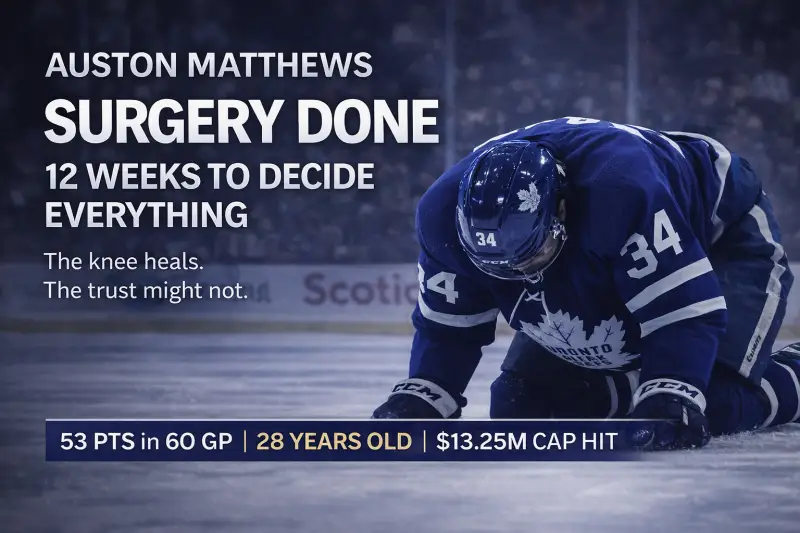
Auston Matthews underwent MCL surgery in New York on March 19, with a 12-week recovery. But this countdown extends far beyond medical — it's the window where Matthews decides whether his future is still in Toronto.
Live updates
No updates yet. Refreshing automatically.
Auston Matthews had MCL reconstruction surgery in New York on March 19, repairing a Grade 3 tear — a complete rupture — of the medial collateral ligament in his left knee. Elliotte Friedman reports the Leafs and Matthews' camp have "still plenty of confidence he will start next season on time," projecting a 12-week recovery that puts him back on ice by mid-June.
But the surgery itself isn't really the story here. The 12-week recovery window overlaps with every major offseason decision point the Leafs face: the NHL Draft in late June, free agency in July, and training camp in September. Matthews — who had 27 goals and 26 assists in 60 games this season before the injury, his first campaign finishing below a point-per-game pace since his rookie year — will be rehabbing in New York while Brad Treliving decides the direction of this franchise.
Last updated: March 20, 2026. This article reflects Elliotte Friedman's reporting on the surgery outcome and Chris Johnston's reporting on Matthews' offseason discussions with management.
Key Takeaways
- Matthews underwent MCL reconstruction March 19 — 12-week recovery puts return at mid-June
- Four teammates watched the Gudas hit and didn't respond — Berube, Tkachuk brothers publicly criticized the inaction
- $13.25M cap hit through 2027-28 with full NMC means Toronto can't move him without his consent
- Johnston reports Matthews needs "clear sense of organization's direction" before committing
- Recovery overlaps with NHL Draft, free agency, and every major roster decision Toronto must make
- $46.4M projected cap space, but 27th-ranked prospect pool and traded-away draft picks limit the pitch
Four Skaters Watched. None of Them Moved.
On March 12, during the second period against Anaheim at Scotiabank Arena, Matthews carried the puck through the neutral zone. Radko Gudas stepped into him with a lateral knee-on-knee hit that caught Matthews' left leg while it was planted. The contact buckled the knee inward. Matthews went down immediately and couldn't put weight on the leg. Gudas received a five-minute major for kneeing and a game misconduct on the spot. The diagnosis came later: Grade 3 MCL tear plus a quad contusion. Season over.
Four Maple Leafs were on the ice when it happened — William Nylander, rookie Easton Cowan, Morgan Rielly, and Brandon Carlo. None of them confronted Gudas while Matthews was down.
Craig Berube was blunt afterward: "Obviously, we should have four guys in there doing something about it, but it didn't happen." Nylander told reporters, "I should have probably gotten in there. But I mean, in the situation at the time, I didn't really understand until like 15 seconds later, there was more than what I thought it was." Fifteen seconds is a long time on the ice. Rielly took a different approach: "I take full responsibility for not being the first one in there or being there quicker to respond."
Asked Auston Matthews' agent, Judd Moldaver about his response to the ruling. Here is his reply: "In light of the obvious severity of the play, I am very disappointed and shocked that the league would allow for such a ruling. A phone hearing and five games is just laughable and preposterous. The player safety department should be suspended."
— Elliotte Friedman (@FriedgeHNIC) March 13, 2026
Brad Treliving wasn't at the game — he was on the road. According to Friedman, the GM called the players involved afterward. Friedman described Treliving as "absolute wild about what happened on Thursday night." Treliving also pushed the league hard for a significant Gudas suspension. He got five games. Connor McDavid publicly questioned whether that was enough. The Tkachuk brothers went further, criticizing the entire Leafs roster for failing to stand up for their captain.
Having covered the Leafs through the Kessel and Tavares eras, this reaction — or lack of one — felt different. When players on rival teams are publicly calling out your locker room, the conversation has moved well past the original hit.
What the MCL Surgery Means for Matthews' Recovery
A Grade 3 MCL tear is a complete rupture of the ligament. The Leafs initially evaluated whether rest and physical therapy alone would be enough, but Friedman reported that "surgery will be part of Auston Matthews' recovery" — the team and his medical staff determined a complete rupture with a concurrent quad contusion required surgical repair.
MCL reconstruction in a 28-year-old professional athlete typically results in a full return to pre-injury form. The procedure is well-understood, and the 12-week recovery timeline is considered conservative for someone of Matthews' conditioning level. The Leafs have said they expect him at training camp. The physical recovery is not the concern.
The concern is what happens during those 12 weeks. Matthews won't be in the facility day-to-day. He won't be at exit interviews or early offseason meetings. He'll be rehabbing in New York — away from the organization, away from teammates — with a lot of time to think. And there's a lot to think about.
It's also worth noting that Matthews was already set to represent Team USA at the 2026 Winter Olympics in Milano Cortina this February before the event was postponed. That's another missed opportunity layered onto a season that was already trending the wrong direction.
The $13.25M Contract and No-Movement Clause
Matthews signed a four-year, $53 million extension in August 2023 — a $13.25 million annual cap hit running through 2027-28. The deal includes a full no-movement clause, meaning Toronto cannot trade him without his explicit consent. They can't buy him out without absorbing the cap penalty. The NMC gives Matthews complete control over where he plays for the next two seasons.
Chris Johnston of The Athletic reported that "substantial conversations were already planned between management and Matthews before the injury occurred." That's significant. The uncertainty about Matthews' future in Toronto predates the Gudas hit. Johnston added that Matthews needs a "clear sense of the organization's direction" before committing long-term. That's the language of a player who's weighing his options, not one who's settled.
Here's how the recovery timeline overlaps with the Leafs' offseason calendar:
| Window | Recovery Phase | Organizational Milestone |
|---|---|---|
| Weeks 1-3 (Mar 19 – Apr 9) | Post-op, non-weight-bearing | Leafs season ends, exit interviews |
| Weeks 4-6 (Apr 9 – Apr 30) | Early rehab, light movement | Treliving evaluates roster direction |
| Weeks 7-9 (Apr 30 – May 21) | Progressive loading, skating TBD | Draft lottery (May), management meetings |
| Weeks 10-12 (May 21 – Jun 11) | Return to full activity | NHL Draft (late June), FA prep |
Recovery timeline based on Friedman's 12-week projection. Organizational dates estimated from standard NHL calendar.
The critical window is weeks 4-6. That's when Treliving needs to determine whether he's building around Matthews or preparing for life without him. It's also when Matthews hasn't been around the team in a month. If Johnston's "substantial conversation" happens during this window, it's happening between a GM under pressure and a franchise center who's had six weeks to think about teammates who didn't defend him, an organization sitting 12 points out of the playoffs, and a prospect pipeline ranked 27th in the league by ESPN.
"Obviously, we should have four guys in there doing something about it, but it didn't happen."
— Craig Berube, March 13, 2026 (via NHL.com)Trade Destinations: Who Wants Matthews?
At the trade deadline, Friedman reported there was effectively zero chance Matthews would be moved. The summer is a different conversation.
The Minnesota Wild keep coming up. GM Bill Guerin has reportedly been keeping cap flexibility specifically to make a run at Matthews. Florida is in the mix — Matthews has a connection to Matthew Tkachuk, the Panthers offer a zero-tax state and a roster that just won the Stanley Cup. Dallas checks similar boxes: no state income tax, a Cup-contending window, and the physical identity that Toronto has been trying to build for years.
The NMC complicates any trade. Matthews chooses where he goes, or he doesn't go at all. For Toronto, that means any trade return is automatically discounted — the acquiring team has to get Matthews' approval first, and he holds the leverage. Compare that to the Matthew Knies trade deadline situation: five teams bid aggressively on Knies because he had zero trade protection. Toronto controlled that process. With Matthews, it's the opposite.
Can Toronto Actually Convince Him to Stay?
The Leafs have approximately $46.4 million in projected cap space for 2026-27, with the salary ceiling jumping to $104 million. That's a significant number — enough to keep Matthews and make real additions around him. On paper, the cap math works for a competitive retool.
The problem is everything around the numbers. Toronto traded away first and second-round picks at the deadline. The prospect pool ranks 27th in the league, per ESPN's pipeline rankings. Treliving's roster moves have focused on acquiring grit and identity rather than stacking talent. When Matthews sits down with management and asks what the plan looks like, the honest answer is cap space and vibes. That's a tough pitch to a 28-year-old who's never won a playoff series.
There's one wrinkle that hasn't gotten much attention: the Leafs have actually played harder since Matthews went down. In three full games without him, Toronto is 1-1-1 — a loss in Buffalo where they managed just 18 shots, a gritty 4-2 win in Minnesota, and a 1-3 home loss to the Islanders. The results are mixed, but the identity shift is real: Morgan Rielly dropped the gloves against New York after Joseph Woll got bumped, a response that would have been unthinkable a week earlier. TSN reported that Berube's message after the Gudas non-response has "got across" in the room. If Matthews is watching from New York — and you know he is — that cuts two ways. Maybe the team needed a wake-up call. Or maybe they found something without him that they couldn't find with him. Neither reading is great for the "please stay" conversation.
What Happens Next
The Leafs' season effectively ended on March 12. At 29-28-12 with 13 games left and a 12-point deficit to the wild card, Toronto won't be in the playoffs. Exit interviews happen in roughly three weeks. At the GM meetings in Florida, Treliving told reporters there are "no plans to make a decision today" about Matthews' future, with deeper discussions pushed to the offseason.
That's corporate speak for "we don't know yet either."
Matthews will recover. The knee will heal. He'll almost certainly be at training camp in September. What won't heal in 12 weeks is the image of four teammates standing still while their captain got kneed, or a roster that's been declining year-over-year, or a prospect pipeline that's been traded away piece by piece. Toronto's recent track record of keeping its own players doesn't help the case either.
The MCL will be fine by June. Whether Auston Matthews is still a Maple Leaf by October depends on a conversation that hasn't happened yet — and right now, Toronto doesn't have a great hand to play.
Frequently Asked Questions
What happened to Auston Matthews?
On March 12, 2026, Anaheim Ducks defenseman Radko Gudas delivered a knee-on-knee hit to Matthews during the second period at Scotiabank Arena. The hit caused a Grade 3 (complete) MCL tear and a quad contusion in Matthews' left knee, ending his 2025-26 season. Gudas was assessed a five-minute major and game misconduct on the play, and later received a five-game suspension from the Department of Player Safety.
What surgery did Auston Matthews have?
Matthews underwent MCL reconstruction surgery in New York on March 19, 2026. The procedure repaired the completely ruptured medial collateral ligament in his left knee. Elliotte Friedman reported that the Leafs initially evaluated whether rest and physical therapy alone could heal the injury, but determined that surgical repair was necessary for a complete Grade 3 tear with a concurrent quad contusion.
How long is Auston Matthews out for?
The projected recovery timeline is approximately 12 weeks, putting Matthews' return to full activity around mid-June 2026. The Leafs have expressed confidence he'll be ready for the start of the 2026-27 season and training camp in September. MCL reconstruction recovery for professional athletes typically ranges from 6 to 12 weeks, with 12 weeks being the conservative estimate for a player carrying Matthews' workload.
What is Auston Matthews' salary and contract?
Matthews is on a four-year, $53 million contract signed in August 2023, carrying a $13.25 million annual cap hit through the 2027-28 season. His 2025-26 compensation includes a $775,000 base salary and a $14.425 million signing bonus. The deal includes a full no-movement clause, giving Matthews veto power over any trade. He becomes an unrestricted free agent after 2027-28.
Will the Maple Leafs trade Auston Matthews?
It remains uncertain. Matthews' full no-movement clause means Toronto cannot trade him without his consent. Chris Johnston of The Athletic reported that "substantial conversations" between Matthews and management were planned even before the Gudas injury. The Minnesota Wild, Florida Panthers, and Dallas Stars have all been linked as potential destinations. The key factor is whether Toronto can present a convincing competitive plan — with a 27th-ranked prospect pool and traded draft picks, that's a difficult case to make.
What were Auston Matthews' stats before the injury?
In 60 games during the 2025-26 season, Matthews had 27 goals and 26 assists for 53 points — a minus-4 rating and his first season finishing below a point-per-game pace since his NHL rookie year in 2016-17. The statistical dip, combined with earlier injury concerns across the past two seasons, adds context to the broader questions about whether Matthews' prime years are being wasted in Toronto.
How did the Gudas suspension get decided?
The NHL Department of Player Safety conducted a phone hearing — not an in-person hearing, which is reserved for suspensions exceeding five games — and handed Gudas a five-game ban. Matthews' agent Judd Moldaver called the ruling "laughable and preposterous" through Friedman, adding that "the player safety department should be suspended." Connor McDavid publicly questioned the league's disciplinary standards, and the Tkachuk brothers criticized the Leafs for not physically responding to the hit on the ice.
Sources and Reporting
- NHL.com — Matthews out for season for Maple Leafs with Grade 3 MCL tear
- The Hockey News — Friedman: Surgery will be part of Matthews' recovery
- The Hockey News — 'Furious' Treliving phoned Leafs involved after Gudas hit
- Heavy.com — Johnston: Matthews needs 'clear sense of organization's direction'
- CBS Sports — Matthews injury: season-ending MCL tear on Gudas hit
- PuckPedia — Auston Matthews contract details ($13.25M × 4yr, full NMC)
- NHL.com — Video: Gudas suspended five games for kneeing Matthews
Frequently Asked Questions
What happened to Auston Matthews?
On March 12, 2026, Anaheim Ducks defenseman Radko Gudas delivered a knee-on-knee hit to Matthews during the second period at Scotiabank Arena. The hit caused a Grade 3 (complete) MCL tear and a quad contusion in Matthews' left knee, ending his 2025-26 season. Gudas was assessed a five-minute major and game misconduct on the play, and later received a five-game suspension from the Department of Player Safety.
What surgery did Auston Matthews have?
Matthews underwent MCL reconstruction surgery in New York on March 19, 2026. The procedure repaired the completely ruptured medial collateral ligament in his left knee. Elliotte Friedman reported that the Leafs initially evaluated whether rest and physical therapy alone could heal the injury, but determined that surgical repair was necessary for a complete Grade 3 tear with a concurrent quad contusion.
How long is Auston Matthews out for?
The projected recovery timeline is approximately 12 weeks, putting Matthews' return to full activity around mid-June 2026. The Leafs have expressed confidence he'll be ready for the start of the 2026-27 season and training camp in September. MCL reconstruction recovery for professional athletes typically ranges from 6 to 12 weeks, with 12 weeks being the conservative estimate for a player carrying Matthews' workload.
What is Auston Matthews' salary and contract?
Matthews is on a four-year, $53 million contract signed in August 2023, carrying a $13.25 million annual cap hit through the 2027-28 season. His 2025-26 compensation includes a $775,000 base salary and a $14.425 million signing bonus. The deal includes a full no-movement clause, giving Matthews veto power over any trade. He becomes an unrestricted free agent after 2027-28.
Will the Maple Leafs trade Auston Matthews?
It remains uncertain. Matthews' full no-movement clause means Toronto cannot trade him without his consent. Chris Johnston of The Athletic reported that "substantial conversations" between Matthews and management were planned even before the Gudas injury. The Minnesota Wild, Florida Panthers, and Dallas Stars have all been linked as potential destinations. The key factor is whether Toronto can present a convincing competitive plan — with a 27th-ranked prospect pool and traded draft picks, that's a difficult case to make.
What were Auston Matthews' stats before the injury?
In 60 games during the 2025-26 season, Matthews had 27 goals and 26 assists for 53 points — a minus-4 rating and his first season finishing below a point-per-game pace since his NHL rookie year in 2016-17. The statistical dip, combined with earlier injury concerns across the past two seasons, adds context to the broader questions about whether Matthews' prime years are being wasted in Toronto.
How did the Gudas suspension get decided?
The NHL Department of Player Safety conducted a phone hearing — not an in-person hearing, which is reserved for suspensions exceeding five games — and handed Gudas a five-game ban. Matthews' agent Judd Moldaver called the ruling "laughable and preposterous" through Friedman, adding that "the player safety department should be suspended." Connor McDavid publicly questioned the league's disciplinary standards, and the Tkachuk brothers criticized the Leafs for not physically responding to the hit on the ice.
Related Stories
How Do Line Changes Work in Hockey?
A line change is hockey's strangest routine: you swap players while the puck is live, but only inside a five-foot pocket beside your own ben...
By Mike Johnson · 10 min read

What Is the Long Change in Hockey?
The long change is not jargon, it is bench geography. Teams switch ends each period but keep the same bench, so in the second period a tired...
By Mike Johnson · 9 min read
What Is a Delayed Penalty in Hockey?
A delayed penalty is not a penalty yet. It is the referee holding the whistle after a foul until the penalized team touches the puck, which...
By Mike Johnson · 9 min read
What Is a One-Timer in Hockey?
A one-timer reaches the net just 42% of the time, the worst of any shot, yet it is the most dangerous weapon in hockey and the shot Ovechkin...
By Mike Johnson · 11 min read
Comments
Be the first to share your take.
Get NHL trade rumors in your inbox
One email per week, zero spam, verified rumors only.