George Parros Defends NHL Player Safety After Gudas
George Parros defended NHL Player Safety after Connor McDavid's public criticism. But the phone hearing format — not judgment — capped the Gudas suspension at five games before deliberation started.
Live updates
No updates yet. Refreshing automatically.
The Phone Hearing Is the Punishment — Everything After Was Theater
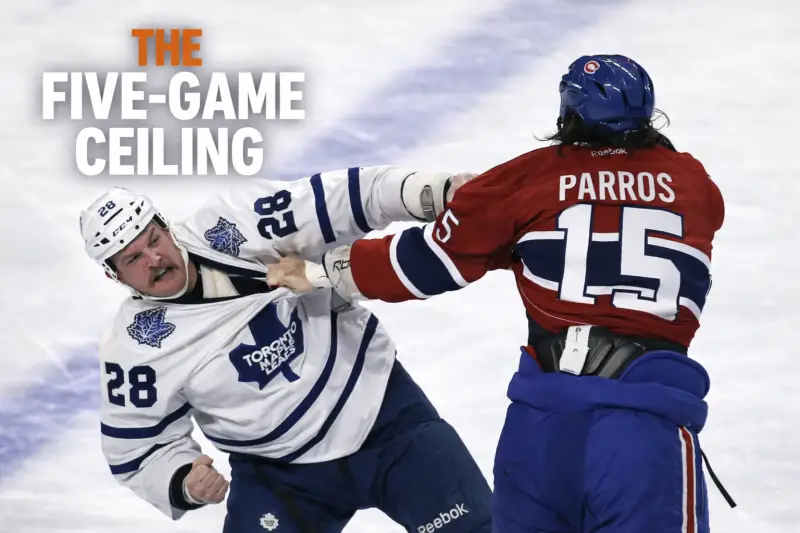
George Parros spoke to reporters Tuesday morning at the NHL's annual general manager meetings in Manalapan, Florida, and told them he feels "very confident" in his department's process. And look, he probably should feel confident. The system is built so that the guy running it never has to stick his neck out.
Radko Gudas kneed Auston Matthews on March 12. Grade 3 MCL tear, quad contusion, season over with 16 games left. Gudas got five games. But that number did not come from deliberation or careful analysis of Gudas's history. It came from a checkbox on a form. Parros's department chose a phone hearing, and under the CBA, phone hearings cap suspensions at five games. The ceiling was set before anyone even queued up the replay.
An in-person hearing has no maximum. Parros could have gone that route. He didn't.
That's the whole story, really. Everything else — the press conference, the quotes about consistency, the carefully worded statement — is just noise layered on top of a decision that was already made.
- The CBA spells it out clearly: phone hearing means five games max. In-person hearing gets offered when the infraction might warrant six or more. There is no gray area here.
- Gudas has been suspended five times in 13 NHL seasons, totaling 26 games — illegal check to the head in 2015 (3 games), interference in 2016 (6), slashing Perreault while he was down in 2017 (10), high-sticking Kucherov in 2019 (2), and now this.
- Matthews finishes 2025-26 with 27 goals and 53 points in 60 games. Toronto sits last in the Atlantic at 28-27-11, 10 points out of a wild card spot. Their season was already on life support. Now it's flatlined.
- Gudas forfeited $104,166.65 in salary. Matthews lost the rest of his year. I don't think you need anyone to explain which side got the worse end of that exchange.
McDavid Went Public, and That Should Scare the League Office
Connor McDavid does not do this. He's maybe the most media-trained superstar in professional sports — always deflects, always keeps it vague, never gives anyone a headline. So when he stood in front of reporters on March 15 before Edmonton's game against Nashville and openly questioned the NHL's disciplinary process, it was genuinely jarring.
He was careful about it. Acknowledged the department has a tough job, said he thinks they're trying their best. But then he asked a question that nobody at the league office seems interested in answering:
"If every time there is a suspension everybody complains about it, why don't we take a look at the process and figure out if there's a better way to make sure that both parties are happy? It seems like there's a lot of frustration."
— Connor McDavid, March 15, 2026 (via TSN)It's not exactly a revolutionary idea, but coming from McDavid it lands differently.
Parros responded Tuesday by defending his staff and repeating the word "consistent" several times. He said the department evaluates "the play, not the players" — which, honestly, sounds great as a talking point right up until you remember that ignoring a player's five-suspension history is the exact thing everyone is furious about. He talked about his team's experience. He talked about how hard they work every night reviewing plays. What he did not talk about is why he chose a phone hearing for a five-time repeat offender who just ended a franchise player's season.
Craig Berube was blunter. Toronto's coach told reporters straight up the suspension wasn't enough — you lose your captain for the year because of a repeat offender, and the guy sits out five games? John Tavares said it could've been longer. Matthew Knies didn't hold back either, pointing out that Matthews misses way more time than Gudas does. The whole Leafs room is frustrated, and they're barely trying to hide it.
The Agents Aren't Being Polite About This
Judd Moldaver, Matthews' agent, called the five-game suspension "laughable and preposterous" and said the entire department should be put on a timeout. Not in a private call. Not off the record. In a public statement. That's an agent representing one of the five most marketable players in the sport openly torching the league's disciplinary arm. You don't see that very often.
Allan Walsh went further — and Walsh tends to go further. The veteran agent called Parros "tone deaf, defensive, arrogant" and demanded a complete teardown of the department. New people, new process, clearly delineated guidelines. He's been vocal about player safety before, but this is the first time he explicitly said Parros should be fired. There's a difference between "the system needs work" and "the guy running it needs to go," and Walsh chose the second one on purpose.
Tone deaf, defensive, arrogant and unwilling to thoughtfully consider any criticisms levied against him from Clubs, Agents and Players. Parros thinks he and his slick group of video producers are doing a great job for the game! A train wreck of comments. I rest my case.
— Allan Walsh (@walsha) March 17, 2026
Now, in fairness to Parros — and I realize this is not a popular position right now — the guy is working within a system that the CBA created. He did not write the phone hearing rules. He did not design the five-game cap. The structural problem exists regardless of who sits in his chair. But (and this is a big but) he chose the hearing format. He had the option to go in-person and open the door to a longer suspension, and he didn't take it. That's on him, not on the CBA.
And then there's the optics problem that Toronto analyst Sid Seixeiro put on the record: Parros played 474 NHL games, roughly 355 of them with the Anaheim Ducks. Won the 2007 Stanley Cup in Anaheim. He's now making the call on an incident where an Anaheim player ended a rival star's season. Is there actual bias? Maybe not. But the fact that you even have to ask the question is a problem the league should've addressed years ago.
| Gudas Suspension | Year | Games | Infraction |
|---|---|---|---|
| 1st | 2015 | 3 | Illegal check to the head |
| 2nd | 2016 | 6 | Interference (late high hit on Austin Czarnik) |
| 3rd | 2017 | 10 | Slashing Mathieu Perreault while down on ice |
| 4th | 2019 | 2 | High-sticking Nikita Kucherov |
| 5th | 2026 | 5 | Knee-on-knee hit on Auston Matthews |
Five suspensions, 26 total games, spread across 13 seasons. The league will point to the seven-year gap between suspensions four and five as justification for the lighter hearing format. Fine. But a Grade 3 MCL tear doesn't care how long it's been since the last incident. The damage to Matthews is exactly the same whether Gudas's previous suspension was seven months ago or seven years ago.
What Would Actually Fix This (and Why It Won't Happen)
We've been here before. We'll be here again. The cycle is always the same — bad hit, outrage, agents go public, media pressure builds for a few days, and then the news cycle moves on and nothing changes. Parros keeps his job because the CBA provides cover and the league has zero interest in meaningful reform.
If anyone actually wanted to fix the system, here's where you'd start:
1. Mandatory in-person hearings for repeat offenders. Two or more prior suspensions? Automatic in-person hearing, full stop. The five-game phone cap should not apply to guys with documented histories of dangerous play. 2. Injury-based minimum thresholds. If an illegal play ends someone's season, there should be a minimum suspension floor. The DoPS claims it considers injury as a factor, but that claim is pretty hollow when the phone hearing format makes the whole conversation moot before it starts. 3. Independent oversight — take the league out of the business of policing itself. Former players, medical professionals, legal experts who don't collect an NHL paycheck. 4. Published criteria. Walsh's demand for "clearly delineated guidelines" shouldn't be controversial. The NFL, NBA, and MLB all publish clearer disciplinary frameworks than the NHL. It's an absolute joke that we're still having this conversation in 2026.
None of that happens before the playoffs. Probably doesn't happen before the next CBA negotiation either. But the fact that the biggest names in the sport — McDavid, agents representing franchise-level talent, head coaches — are saying this publicly? The pressure is different this time. Whether it's enough to actually force change is another question, and honestly, I'm not optimistic.
Matthews will heal. Gudas serves his five games and comes back. And the next time a repeat offender ends someone's season with a reckless play, we'll do this whole thing again. Same outrage, same talking points, same result. The system works exactly how it was designed to work. That's the problem.
Frequently Asked Questions
What is the difference between an NHL phone hearing and an in-person hearing?
Short answer: the cap. Under CBA supplementary discipline rules, a phone hearing maxes out at five games. An in-person hearing gets offered when six or more games are possible, and there's no upper limit. Players can waive their right to an in-person hearing, but the initial call on hearing format belongs to the DoPS. Most fans don't realize that the hearing type effectively decides the punishment range before anyone even reviews the play.
How many times has Radko Gudas been suspended?
Five times across four different teams — Tampa Bay, Philadelphia, Washington, and now Anaheim — for a combined 26 games. The worst was 10 games in 2017 for slashing Perreault while he was down on the ice. There was a seven-year gap between suspension four and five, which the league likely used to justify the phone hearing. Whether that gap should matter when the result is a season-ending injury — depends on who you ask.
Why did Connor McDavid criticize NHL player safety?
This one surprised everyone. McDavid almost never comments on league governance, but on March 15 he suggested the disciplinary process needs re-examination after the Gudas suspension. He was diplomatic about it — said the department has a tough job — but the message was clear enough. When the best player alive is publicly questioning your system, you've got a credibility problem.
Could George Parros be fired as head of NHL player safety?
Unlikely in the short term, but the calls are getting louder. Allan Walsh publicly called for his removal, Seixeiro raised the Anaheim conflict-of-interest angle (Parros played 355 of his 474 career games with the Ducks), and the broader hockey media isn't exactly rushing to defend him. But Parros reports to the commissioner's office, and the league has given zero indication they're considering a change. Realistically, any structural overhaul would need to come through CBA negotiations between the NHL and NHLPA. So don't hold your breath.
Frequently Asked Questions
What is the difference between an NHL phone hearing and an in-person hearing?
Short answer: the cap. Under CBA supplementary discipline rules, a phone hearing maxes out at five games. An in-person hearing gets offered when six or more games are possible, and there's no upper limit. Players can waive their right to an in-person hearing, but the initial call on hearing format belongs to the DoPS. Most fans don't realize that the hearing type effectively decides the punishment range before anyone even reviews the play.
How many times has Radko Gudas been suspended?
Five times across four different teams — Tampa Bay, Philadelphia, Washington, and now Anaheim — for a combined 26 games. The worst was 10 games in 2017 for slashing Perreault while he was down on the ice. There was a seven-year gap between suspension four and five, which the league likely used to justify the phone hearing. Whether that gap should matter when the result is a season-ending injury — depends on who you ask.
Why did Connor McDavid criticize NHL player safety?
This one surprised everyone. McDavid almost never comments on league governance, but on March 15 he suggested the disciplinary process needs re-examination after the Gudas suspension. He was diplomatic about it — said the department has a tough job — but the message was clear enough. When the best player alive is publicly questioning your system, you've got a credibility problem.
Could George Parros be fired as head of NHL player safety?
Unlikely in the short term, but the calls are getting louder. Allan Walsh publicly called for his removal, Seixeiro raised the Anaheim conflict-of-interest angle (Parros played 355 of his 474 career games with the Ducks), and the broader hockey media isn't exactly rushing to defend him. But Parros reports to the commissioner's office, and the league has given zero indication they're considering a change. Realistically, any structural overhaul would need to come through CBA negotiations between the NHL and NHLPA. So don't hold your breath.
Related Stories

2026 NHL Awards: Every Winner
Every 2026 NHL Awards winner in one place: Kucherov over McDavid in a coin-flip Hart, Schaefer's unanimous Calder, Werenski's Norris, and Jo...
By Mike Johnson · 8 min read

Golden Knights Offseason Squeeze
Vegas reached Game 6 of the 2026 Cup Final, then handed itself a summer with about $4.6M in cap space to re-sign Pavel Dorofeyev, replace a...
By Mike Johnson · 9 min read
Highest-Paid NHL Players 2026-27
The highest-paid NHL players for 2026-27, ranked by cap hit. Kirill Kaprizov leads at a record $17M, Connor McDavid sits sixth by choice, an...
By Mike Johnson · 10 min read
How to Watch the NHL: 2026-27
How to watch the NHL in 2026-27: every channel (ESPN, ABC, TNT, NHL Network), every streaming option, the free routes, blackout traps, and t...
By Mike Johnson · 9 min read
Comments
Be the first to share your take.
Get NHL trade rumors in your inbox
One email per week, zero spam, verified rumors only.