Maple Leafs Roster Changes After Matthews Injury:
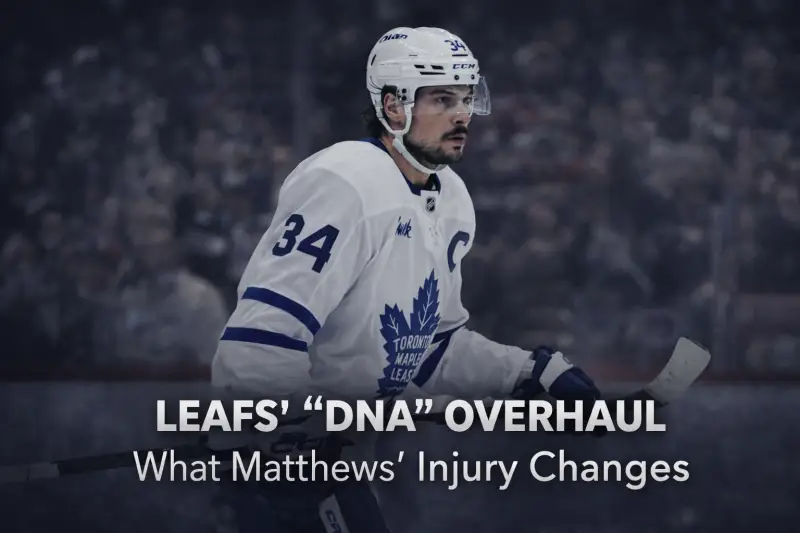
Matthews is out for the season with a Grade 3 MCL tear after the Gudas hit. Friedman reports the Leafs are "apoplectic." With ~$22M in usable cap space, Treliving targets a roster identity overhaul this summer.
Live updates
No updates yet. Refreshing automatically.
A Season-Ending Hit and the Fallout Nobody in Toronto Saw Coming
Auston Matthews won't play another game in 2025-26. The Maple Leafs roster changes after Matthews injury are no longer a summer talking point — they're an organizational emergency that started the moment Radko Gudas drove his knee into Toronto's franchise center on Thursday night, March 12, at Scotiabank Arena.
The diagnosis came Friday: a Grade 3 MCL tear and quad contusion. Season over. Matthews had just scored a power-play goal to cut Anaheim's lead to 3-2 when he tried to get around Gudas in front of the Ducks' net. Gudas lunged, extended his left knee, and Toronto's $13.25-million captain crumpled to the ice.
Gudas got five games. The Department of Player Safety couldn't go higher because the hearing was conducted by phone — a procedural ceiling that has infuriated the Leafs front office and Matthews' agent Judd Moldaver, who publicly called the ruling "disappointing and shocking." This was Gudas's fifth career suspension — he'd already accumulated four bans totaling 21 games between 2015 and 2019 for hits to the head, interference, slashing, and high-sticking. The NHLPA argued his recent seven-year clean stretch warranted leniency. The league agreed. Toronto didn't.
Treliving Wasn't Even in the Building — And That Made It Worse
Brad Treliving was on a scouting trip when the hit happened. He wasn't at Scotiabank Arena. He found out about the injury remotely and, according to multiple reports, started making phone calls from the road. Those calls were not pleasant.
Elliotte Friedman's reporting on Saturday's Headlines segment filled in what the official pressers wouldn't say. Friedman told viewers he'd spoken to as many people within the organization as he could, and "words like 'embarrassed' and 'apoplectic' were thrown around" about the organization's internal reaction. The anger wasn't just about the hit. It was about what happened — or didn't happen — afterward on the ice. Friedman added that the incident would have "ramifications on the future and the construction of the team."
When Treliving did speak publicly — in a TSN interview on March 16 — his tone was measured but pointed. He said he told the league directly that "the event itself — the hit, the play, the injury, and the player history — all leaned toward something that would be larger" than five games. On the roster's future, he kept it vague: they'd address things as the offseason approached. But the subtext was already public, thanks to Friedman.
The Locker Room Responses Told the Whole Story
Rewind the tape. Matthews takes the hit, goes down hard, needs help getting off the ice. Gudas gets his five and a game misconduct. And the Leafs — the team that just watched their captain get his season ended — skate back to the bench without incident. Nobody grabs Gudas. Nobody does anything.
The post-game pressers the next day only made it worse.
Morgan Rielly, who was on the ice when the hit happened: "I didn't have a good view of it just because the puck was going the other way, but it's on me for not responding earlier." The puck going the other way. A $7.5-million alternate captain didn't see the most violent play of the game unfolding behind him.
William Nylander, asked why nobody stepped up: "I didn't know the severity of it, and I should have probably gone in there. Yeah, I should have jumped in there." Probably. Even the accountability had a qualifier attached to it.
John Tavares called the hit "dirty." Max Domi fired what reporters described as a warning shot at Gudas during his media availability. Words, all of it. Said into microphones, 24 hours after the fact, in a media room — not on the ice where it counted.
This disconnect — between what the players said publicly and what they did in the actual moment — is exactly the identity problem Treliving has been flagging since last May. After the Leafs' second-round exit to Florida, Treliving told reporters "there's some DNA that has to change" in this team. He talked about building a group that could "be our best at the most critical moments." Nine months later, the most critical moment of the regular season arrived, and nothing had changed. The evidence is on video.
What Treliving Can Actually Do About It This Summer
Here's where Maple Leafs roster changes after Matthews injury get concrete. Toronto's cap situation heading into 2026-27 creates genuine room to reshape the roster — but the numbers need context.
PuckPedia's current projection shows approximately $46.4 million in raw cap space for next season. That sounds enormous, but it's the number before re-signing restricted free agents and filling out a 23-man roster. DailyHive's more conservative estimate, which accounts for expected RFA deals and necessary roster spots, puts realistic usable space closer to $22 million. Either way, there's room to work with — especially since John Tavares's $4.389 million, Calle Jarnkrok's deal, Bobby McMann, Scott Laughton, and Anthony Stolarz all come off the books as UFAs.
The problem is that the specific type of player Toronto needs — physical, defensively responsible, willing to protect teammates — isn't as available in this summer's free agent class as you'd think. A few names worth watching:
- Connor Murphy (UFA, last with Edmonton) — The Blackhawks traded him to the Oilers at the deadline for a 2028 second-round pick. He's 32, plays a hard-nosed defensive game, blocks shots, and kills penalties. Projects to sign in the $3–4M range. Not flashy, but exactly the type of presence Toronto was missing on March 12.
- Alex Tuch (UFA, Buffalo) — The most interesting name, but complicated. Tuch is 6'4", physical, legitimately skilled, and reportedly seeking $10M+ AAV on his next deal. The Sabres kept him past the trade deadline, and Tuch has said publicly he wants to stay in Buffalo. Toronto would need him to hit the open market on July 1 and then beat out what's expected to be significant competition — a long shot, but Treliving has the cap room if Tuch actually walks.
- Rasmus Andersson (UFA, Calgary) — A two-way defenseman Treliving knows from his time running the Flames. Physical, competitive, and still just 29. However, recent reporting from The Hockey Writers suggests Vegas is the expected landing spot, with the Golden Knights clearing space through Pietrangelo's offseason LTIR. Not impossible for Toronto, but not the favorite.
The honest assessment: there's no obvious toughness fix sitting in free agency that solves what happened on March 12. Treliving might need to combine a couple of mid-range signings with a trade — similar to how he acquired Chris Tanev and Oliver Ekman-Larsson in the 2024 offseason. The cap space exists. The question is whether the specific players who change Toronto's identity are actually available.
Everything Leads Back to 2028
Here's the part nobody in the Leafs organization is addressing publicly but everyone is thinking about: Auston Matthews becomes an unrestricted free agent in the summer of 2028. His four-year, $13.25-million contract carries a full no-movement clause through the end and then nothing. He walks if he wants to.
Matthews shares an agent with Connor McDavid — Judd Moldaver represents both. McDavid's deal expires the same summer. The 2028 UFA class could be the most significant in NHL history, and Matthews will be 30, presumably healthy, and choosing whether to commit his prime years to a city where a player kneed him and his teammates stood around watching.
Friedman's framing of the situation drives this point home. The injury, he said on Headlines, "allows Matthews to start the clock on how he feels about things." A player recovering from a season-ending knee injury has months of idle time to think about whether this organization is worth his thirties.
That makes every roster move this summer a two-for-one. Sign a physical defenseman? That's Treliving telling Matthews we'll protect you. Let the summer pass without meaningful change? That's the strongest possible argument for Matthews to leave in 2028.
Frequently Asked Questions
How long is Auston Matthews out after the Gudas hit?
Matthews is done for the 2025-26 season. The Maple Leafs announced on March 13 that he suffered a Grade 3 MCL tear and quad contusion in his left knee. The team said he'd be re-evaluated in two weeks, but there is no scenario in which he returns this year. A Grade 3 MCL tear is a complete ligament rupture — recovery typically takes four to six months depending on whether surgery is required.
Why couldn't the NHL suspend Gudas for more than five games?
The Department of Player Safety conducted the hearing by phone rather than in person. Under the current CBA framework, phone hearings cap the maximum suspension at five games. An in-person hearing would have allowed for a longer ban. Gudas's agent and the NHLPA pointed to his seven-year gap since his last suspension to argue for leniency, even though he has four prior bans totaling 21 games on his career record.
What is the Maple Leafs' actual cap space for 2026-27?
PuckPedia's raw projection shows roughly $46.4 million before accounting for RFA re-signings and roster fill. More realistic estimates from DailyHive put usable space at approximately $22 million after expected commitments. Key expiring contracts include John Tavares ($4.389M UFA), Calle Jarnkrok, Bobby McMann, Scott Laughton, and Anthony Stolarz.
Could this incident affect whether Matthews re-signs with Toronto?
Elliotte Friedman explicitly connected the two, saying the injury "allows Matthews to start the clock on how he feels about things." Matthews' contract expires after 2027-28, the same summer as Connor McDavid's deal in Edmonton. Both share agent Judd Moldaver. The Leafs' front office is aware that roster decisions between now and 2028 directly influence that conversation.
Frequently Asked Questions
How long is Auston Matthews out after the Gudas hit?
Matthews is done for the 2025-26 season. The Maple Leafs announced on March 13 that he suffered a Grade 3 MCL tear and quad contusion in his left knee. The team said he'd be re-evaluated in two weeks, but there is no scenario in which he returns this year. A Grade 3 MCL tear is a complete ligament rupture — recovery typically takes four to six months depending on whether surgery is required.
Why couldn't the NHL suspend Gudas for more than five games?
The Department of Player Safety conducted the hearing by phone rather than in person. Under the current CBA framework, phone hearings cap the maximum suspension at five games. An in-person hearing would have allowed for a longer ban. Gudas's agent and the NHLPA pointed to his seven-year gap since his last suspension to argue for leniency, even though he has four prior bans totaling 21 games on his career record.
What is the Maple Leafs' actual cap space for 2026-27?
PuckPedia's raw projection shows roughly $46.4 million before accounting for RFA re-signings and roster fill. More realistic estimates from DailyHive put usable space at approximately $22 million after expected commitments. Key expiring contracts include John Tavares ($4.389M UFA), Calle Jarnkrok, Bobby McMann, Scott Laughton, and Anthony Stolarz.
Could this incident affect whether Matthews re-signs with Toronto?
Elliotte Friedman explicitly connected the two, saying the injury "allows Matthews to start the clock on how he feels about things." Matthews' contract expires after 2027-28, the same summer as Connor McDavid's deal in Edmonton. Both share agent Judd Moldaver. The Leafs' front office is aware that roster decisions between now and 2028 directly influence that conversation.
Related Stories
Hischier Trade Clock Hits July 1
Nico Hischier trade rumors are rising: extension talks with new GM Sunny Mehta are in their infancy, Montreal, LA and Minnesota are circling...
By Mike Johnson · 9 min read

Larkin-Robertson Swap: Who Says No?
Dallas has checked in on Dylan Larkin, but the Stars cannot fit his $8.7M until Jason Robertson and his unsigned $14M ask move out. Inside t...
By Mike Johnson · 11 min read

Darnell Nurse Trade: 4 Suitors
Edmonton wants Darnell Nurse's $9.25M off the books, but a buyout saves barely $1.53M and his no-move clause hands him the pen. The Bonus Sh...
By Mike Johnson · 12 min read
Darren Raddysh Free Agent 2026: 4 Teams
Darren Raddysh's 70-point breakout turned his $975K cap hit into a four-team bidding war. The Athletic linked him to Philadelphia, San Jose,...
By Mike Johnson · 13 min read
Comments
Be the first to share your take.
Get NHL trade rumors in your inbox
One email per week. Zero spam. Verified rumors only.