Hockey Positions Explained
Hockey positions explained: six players per side, five skaters and a goalie. What the center, wingers, defensemen, and goalie each do, how lines and pairs work, the seventh skater the NHL deleted in 1917, and how the map flips on special teams.
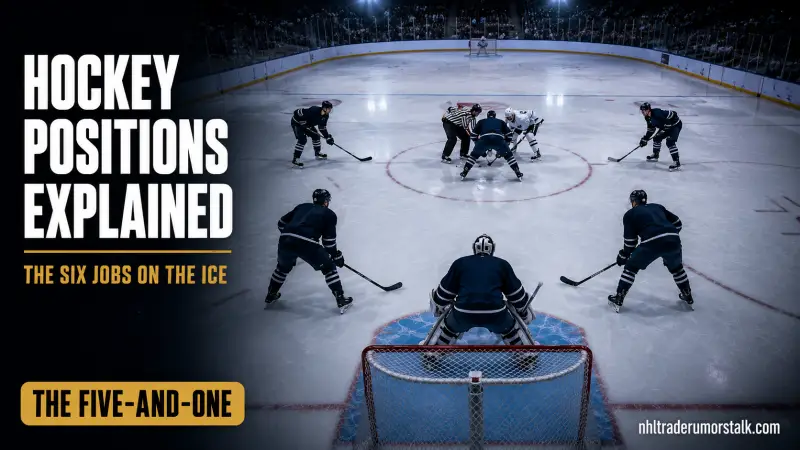
Six players. That is how many each team puts on the ice in a normal NHL shift: five skaters and a goalie. It looks like chaos to a newcomer, ten skaters swarming a puck while two goalies wait, but it is actually a tidy system of six jobs. Learn the hockey positions and the blur turns into a map. We call that map the Five-and-One, and the strange part is that the game used to run a seventh man until the NHL cut him.
Every team ices three forwards, two defensemen, and one goaltender. Each has a distinct job, a home patch of ice, and a partner or line it works with. Here is what all six do, how they fit together, the position hockey deleted a century ago, and how the map redraws itself on a power play.
- The count: six players per side, five skaters plus one goalie.
- The forwards: a center between a left and right wing, the scoring trio.
- The defense: two defensemen who work as a pair, not a line.
- The quirk: hockey once had a seventh skater, the rover, gone since 1917.
The Five-and-One, position by position
The five skaters split into three forwards and two defensemen, and then there is the goalie. Start at the middle and work out.
The center is the closest thing hockey has to a quarterback. He takes most of the faceoffs, plays the full 200 feet of the ice, and links the defense to the attack. A good center is responsible at both ends, which is why the best two-way centers swing a game without ever topping the scoresheet, a value the raw plus-minus number tries to capture.
The two wingers, left and right, ride the boards on their side of the rink. Their job is offense first: get open, finish plays, and forecheck the puck loose. On defense, a winger covers the opposing point men along the blue line and respects the offside line on every zone entry. Some wingers add a second trade entirely, getting under the other team's skin as an agitator.
The two defensemen, left and right, are the last skaters back. They block shots, box out the front of the net, and start the breakout with the first clean pass. They guard the ice just outside the goal crease, and the good ones turn defense into offense in one pass. Defensemen work in fixed pairs rather than rotating lines, because reading a partner's habits takes time to build.
The goaltender is the most specialized athlete in the sport, the last line, the one player allowed to catch and cover the puck. Even his puck-handling has a rule of its own, the restricted area we cover in the trapezoid explainer.
How the six hockey positions fit together
Positions are the jobs. Lines and pairs are how coaches deploy them. The three forwards skate as a unit called a line, and a line that clicks can stay together for weeks. The two defensemen form a pair that tends to stay glued for the same reason. A team dresses four forward lines, three defense pairs, and two goalies, which is why the lineup math lands on the 20 players a team can dress and why a healthy body sometimes watches from above.
| Unit | Players | How they deploy |
|---|---|---|
| Forward line | Center + 2 wingers | Three who skate together, often for weeks |
| Defense pair | 2 defensemen (L/R) | Fixed partners, built on chemistry |
| Goaltender | 1 (2 dressed) | The starter, plus a backup |
| On the ice | 6 per side | 5 skaters + 1 goalie |
The position the game deleted
The Five-and-One has not always been the shape. In the late 1800s and into the early 1900s, hockey ran SEVEN players a side: a goalie, two defensemen, three forwards, and a seventh skater called the rover, who answered to no zone.
The rover did not have a set position, and roamed the ice at will. (Hockey's pre-1917 seven-man rules)
The rover got squeezed out as the game sped up. The National Hockey Association dropped him shortly after it formed in 1910, the NHL played six-a-side from its very first season in 1917, and the Pacific Coast league held onto him until 1923 before agreeing he simply crowded the ice. Cutting the seventh skater is what created the modern game. Every "positionless" defenseman who jumps into the rush today is, in a small way, channeling the ghost of the rover.
When the map redraws itself
The Five-and-One is the even-strength default. Penalties bend it. When a team draws a penalty it goes on the power play and often pulls a defenseman for a fourth forward, loading up for offense with four attackers and one defenseman. The team in the box flips to its penalty kill, four skaters defending in a box with no winger or center in the usual sense, just four killers protecting one goalie. The positions you learned do not vanish on special teams; they get reassigned.
The same flexibility shows up at even strength. Modern coaches preach a "positionless" style where wingers and centers swap on the fly and defensemen lead the attack. The labels loosen. But the underlying jobs, win the middle, hold the walls, defend the net, stop the puck, are exactly as old as the rink.
The Five-and-One holds
Six jobs, one sheet of ice. A center to run the middle, two wingers to work the walls, two defensemen to guard the net and spark the breakout, and a goalie behind them all. That is the Five-and-One, the structure left standing after the rover was cut in 1917, and it has survived every tactical fashion since. Watch any game with those six jobs in mind and a question answers itself in real time: who is supposed to be where, and who just left their post? Find the center on the next faceoff, and the whole map opens up from there.
How we checked this: the six-position structure (three forwards, two defensemen, one goaltender) and line/pair deployment are drawn from NHL.com and standard hockey references; the seven-man history and rover elimination (NHA after 1910, NHL from 1917, PCHA in 1923) are verified against documented hockey-history records; special-teams reassignment follows the NHL rulebook.
Frequently Asked Questions
What are the positions in hockey?
There are six positions on the ice per team: center, left wing, and right wing (the three forwards), a left and right defenseman (the two defensemen), and the goaltender. The five skaters plus the goalie make up the standard alignment.
How many players are on the ice in hockey?
Each team has six players on the ice at even strength: five skaters and one goaltender, for twelve skaters and two goalies total. That number drops on a penalty kill and can shift on a power play.
What does a center do in hockey?
The center is the team's playmaker, the closest thing to a quarterback. He takes most faceoffs, plays the full 200 feet of the ice at both ends, and links the defense to the attack. The best centers are responsible defensively as well as offensively.
What is the difference between a forward line and a defense pair?
A forward line is three players (a center and two wingers) who skate together as a unit, often for weeks at a time. A defense pair is two defensemen, a left and a right, who play as fixed partners. Both are kept consistent so teammates learn each other's habits.
Did hockey used to have more positions?
Yes. Early hockey used seven skaters a side, including a seventh man called the rover who roamed the ice freely. The National Hockey Association dropped the rover shortly after 1910, the NHL played six-a-side from its first season in 1917, and the PCHA followed in 1923.
Related Stories

What Is GAA in Hockey?
What is GAA in hockey? Goals against average is goals per 60 minutes, the oldest goalie stat and the most misleading. How it is calculated,...
By Mike Johnson · 7 min read

What Is a Penalty Kill in Hockey?
What is a penalty kill in hockey? The short-handed team's stand against the power play, four against five. The rules that help the underdog...
By Mike Johnson · 7 min read

What Is a Pest in Hockey?
What is a pest in hockey? An agitator who chirps and goads stars into dumb penalties, usually without fighting. How a pest differs from an e...
By Mike Johnson · 8 min read

What Is a Healthy Scratch in Hockey?
What is a healthy scratch in hockey? A fully fit player the coach leaves out of the lineup, watching from the press box in a suit, not injur...
By Mike Johnson · 8 min read
Comments
Be the first to share your take.
Get NHL trade rumors in your inbox
One email per week, zero spam, verified rumors only.