What Is a Power Play in Hockey? Explained
What is a power play in hockey? A plain-English guide to the man advantage: five-on-four and five-on-three, why a minor penalty ends on a goal but a major does not, the penalty kill and shorthanded goals, and how to read power-play percentage.

The 2022-23 Edmonton Oilers scored on 32.4 percent of their power plays, the best single-season rate in NHL history. That one number captures why teams pour so much practice time into the man advantage: a good power play can swing a game, a series, even a season. So what is a power play in hockey, how do the different man-advantage situations work, and what is the penalty kill trying to do on the other side? Here is the whole system through one idea: The Man-Advantage Math.
A power play happens when one team has more skaters on the ice than the other because an opponent is serving a penalty in the box. For two minutes, or sometimes more, one side gets to attack five-on-four while the short-handed team scrambles to survive. Almost every NHL game is decided in these windows, which is why "special teams" is hockey shorthand for the power play and penalty kill together.
| Figure | What it represents |
|---|---|
| 32.4% | The 2022-23 Oilers' power-play conversion rate, an NHL record (89 goals on 275 chances), per Guinness World Records |
| 5-on-3 | The two-man advantage, the most dangerous situation in hockey, when both teams are short two skaters apart |
One number shows the ceiling of a great power play, and the other names the situation that produces the cleanest scoring chance in the sport.
Key Takeaways
- What it is: A power play is a man advantage, when one team has more skaters because an opponent is serving a penalty.
- The math: the most common edge is five-on-four; a five-on-three two-man advantage is the most dangerous of all.
- Minor vs major: a two-minute minor ends early if the power-play team scores; a five-minute major runs the full time no matter how many goals go in.
- The penalty kill: the short-handed team may ice the puck freely and can even score a shorthanded goal.
- The stat: power-play percentage (PP%) is goals divided by opportunities; the all-time record is the 2022-23 Oilers at 32.4%.
What a Power Play in Hockey Means
When a player commits a penalty, he goes to the penalty box and his team must play short a skater until the penalty expires. The team with the full complement now has the power play, a temporary numerical edge it uses to set up in the offensive zone and pepper the net. The simplest version is five skaters against four, since most penalties remove one player at a time. The advantage lasts as long as the penalty does, which is where the math starts to matter.
The power play exists because penalties have to cost something. If breaking a rule only sent a player to the box with no further consequence, there would be little reason not to hook, trip or slash whenever it helped. The man advantage turns every penalty into a genuine threat, and a team that takes too many trips to the box usually pays for it on the scoreboard. Our guide to penalty minutes breaks down exactly which infractions send a player away and for how long.
The Man-Advantage Math: 5-on-4, 5-on-3 and More
Not every advantage carries the same weight. A two-minute minor is the standard penalty, and it ends the instant the power-play team scores, sending the penalized player back out. A five-minute major, given for the most serious infractions, is different: it runs the full five minutes no matter how many goals the other team scores, so a team can give up two or three on a single major. A double minor counts as two minors back to back, for four minutes total.
When a team takes a second penalty while already short-handed, the edge becomes five-on-three, a two-man advantage that is the closest thing to a free look in hockey. There is also a quirk before the whistle even blows: on a delayed penalty, when the team about to be penalized does not have the puck, play continues until they touch it, so the other team often pulls its goalie for a sixth attacker and an extra beat of pressure. Every one of these situations is the same idea in different sizes, the math of one team having more bodies than the other.
The Penalty Kill
The flip side of the power play is the penalty kill, the job of the short-handed team. Killing a penalty means defending for two minutes a skater down, blocking shots, clearing the puck and running out the clock. A team on the penalty kill is also allowed to ice the puck without a whistle, the one time a team may deliberately ice it for relief, which lets defenders fire it the length of the rink to buy a breather. Our icing explainer covers that exception in full.
A penalty kill is not purely defensive, either. A short-handed team can still score, and a goal scored while down a skater is called a shorthanded goal, one of the biggest momentum swings in the game. Coaches treat both halves of special teams as the difference between winning and losing.
Special teams are so important. We won so many games throughout the playoffs and regular season on special teams: power play, penalty kill have been really good.
— Kris Knoblauch, then Edmonton Oilers head coach, NHL.com
Reading PP% and PK%
Two numbers tell you how good a team's special teams are. Power-play percentage, or PP%, is simply power-play goals divided by power-play opportunities; a rate in the low 20s is solid, and anything above 25 percent is elite. Penalty-kill percentage, or PK%, measures how often a team kills off the penalties it takes, with the best units living in the mid-80s. Add the two together and you get a quick read on whether a team wins the special-teams battle.
The ceiling for a power play is that 2022-23 Oilers team, whose 32.4 percent shattered the previous record of 31.9 percent set by the 1977-78 Montreal Canadiens, the first benchmark since the NHL began tracking the stat in 1977. Those rates are why coaches guard their special teams so fiercely.
Our special teams have been a difference maker for us this year in the playoffs, and they have to continue to be.
— Pete DeBoer, then Dallas Stars head coach, NHL.com
Special teams sit at the center of how games are won. The same thread runs through how zone entries are policed by offside, how overtime is decided, what the plus/minus stat does and does not count, how standings and tiebreakers stack up, and even how long a hockey game really runs once the penalties pile up.
Written by Mike Johnson, NHL Senior Editor, with 15 years covering the league. The power-play and penalty-kill mechanics, the minor-versus-major rules, and the special-teams statistics were checked against the NHL rulebook, NHL.com and Wikipedia; the 2022-23 Oilers record (32.4%, 89 goals on 275 chances) and the 1977-78 Montreal benchmark are confirmed via Guinness World Records. Both quotes were traced verbatim to NHL.com with inline links. The Man-Advantage Math is my framework for the special-teams system, introduced in this piece. Published June 23, 2026. Editorial review and fact-check: Sarah Chen, Hockey Operations Editor. Corrections: editorial@nhltraderumorstalk.com.
Sources and Reporting
- Power play (sporting term): man-advantage definition, minor and major rules
- Guinness World Records: 2022-23 Oilers record (32.4%, 89/275), 1977-78 Montreal mark
- NHL.com: Kris Knoblauch on special teams
- NHL.com: Pete DeBoer on special teams
The Verdict: The Man-Advantage Math
So the next time a penalty is called and a team sets up with the extra skater, you will know exactly what is at stake. A power play is a man advantage that lasts as long as the penalty, a minor dies the moment a goal goes in while a major never does, a five-on-three is the golden chance, and the penalty kill fights all of it a skater down. The Man-Advantage Math is the quiet engine of special teams, and it is where seasons like the 2022-23 Oilers' are made.
Frequently Asked Questions
What is a power play in hockey?
A power play is a man advantage that happens when one team has more skaters on the ice than the other because an opponent is serving a penalty in the box. The most common version is five-on-four. The team with the extra skater uses the time, usually two minutes, to set up in the offensive zone and try to score.
What is the difference between 5-on-4 and 5-on-3?
Five-on-four is a one-man advantage from a single penalty and is the standard power play. Five-on-three is a two-man advantage, which happens when a team takes a second penalty while already short-handed. The two-man edge is the most dangerous situation in hockey because the defending team simply cannot cover all the open ice.
Does a power play end when a goal is scored?
It depends on the penalty. A two-minute minor ends immediately if the power-play team scores, sending the penalized player back onto the ice. A five-minute major does not end early; it runs the full five minutes no matter how many goals are scored, so a team can surrender two or three goals on a single major.
What is a penalty kill, and can you score short-handed?
The penalty kill is the job of the short-handed team while it serves a penalty: defending a skater down by blocking shots, clearing the puck and running out the clock. A team on the penalty kill is also allowed to ice the puck without a whistle. And yes, a short-handed team can score; that is called a shorthanded goal.
What is a good power-play percentage?
Power-play percentage (PP%) is power-play goals divided by power-play opportunities. A rate in the low 20s is solid and anything above 25 percent is elite. The all-time single-season record belongs to the 2022-23 Edmonton Oilers at 32.4 percent (89 goals on 275 chances), breaking the 1977-78 Montreal Canadiens mark of 31.9 percent.
Related Stories

What Is the Crease in Hockey? Explained
What is the crease in hockey? A plain-English guide to the goalie's blue paint: the 6-foot protected zone, the strict skate-in-the-crease ru...
By Mike Johnson · 7 min read
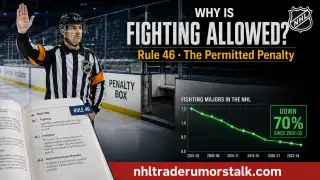
Why Is Fighting Allowed in Hockey? Explained
Why is fighting allowed in hockey? An educational guide to Rule 46: how it penalizes fighting with a five-minute major instead of an ejectio...
By Mike Johnson · 7 min read
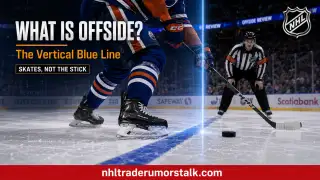
What Is Offside in Hockey? Rules Explained
What is offside in hockey? A plain-English guide to the blue-line rule: why offside is judged by the skates and not the stick, the 2020-21 v...
By Mike Johnson · 8 min read
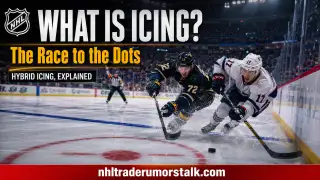
What Is Icing in Hockey? Rules Explained
What is icing in hockey? A plain-English guide to the rule: the red line and goal line, the three icing systems (touch, no-touch and hybrid)...
By Mike Johnson · 8 min read
Comments
Be the first to share your take.
Get NHL trade rumors in your inbox
One email per week, zero spam, verified rumors only.