Mats Zuccarello Injury Update Game 4: The Zuccarello Tax
Mats Zuccarello finished Game 1 with three assists in 16:41 after a Tyler Myers elbow. Then he missed Games 2 and 3 — both Wild losses. The Zuccarello Tax is the price Minnesota is paying for those 16:41 of broken hockey. Game 4 is now a game-time decision.

Live updates
No updates yet. Refreshing automatically.
Mats Zuccarello is a game-time decision for Saturday's must-win Game 4 of the 2026 Stanley Cup playoffs after taking a Tyler Myers elbow to the head in the first period of Game 1 of the Minnesota Wild's first-round series against the Dallas Stars. The 38-year-old top-six right winger finished that game with three assists in 16:41 of ice time and the Wild won 6-1. Then he missed Games 2 and 3, both losses, and the Wild now trail the series 2-1 with the playoff dam pushed against a 25-year history of first-round failure. That gap between what Zuccarello produced in 16:41 of broken hockey and what the Wild have lost since is what I'm calling The Zuccarello Tax: the price a contender pays when its top-six veteran finishes a game his body should not have finished.
Coach John Hynes met with reporters Friday after practice and confirmed the obvious. "He's questionable for tomorrow, making good strides," Hynes said, per NHL.com's pre-Game 4 coverage. Zuccarello skated on his own at TRIA Rink before the team practiced and did not stay for the full session. That language reads as marginally optimistic. Inside an injury timeline that already cost the Wild two losses and pulled them inside one bad night of playoff elimination, marginally optimistic still feels expensive. Without Zuccarello on the penalty kill rotation that reads as Marcus Foligno-Joel Eriksson Ek default, the Wild's special teams math keeps getting handed to a Stars roster that finished the regular season as a Presidents Trophy contender (formal Presidents' Trophy ranking).
The Mats Zuccarello injury update Game 4 question fans are searching is binary, plays or doesn't, but the answer that actually matters runs deeper. Even if Zuccarello dresses Saturday at Grand Casino Arena, the Wild are still paying for the 16:41 of Game 1 minutes he played after Myers's elbow connected. The bill for those minutes arrived in two losses. We'll work through what that bill cost, what the Game 4 decision tree looks like, and why the Wild front office should already be filing a memo on the broader cost of finishing-out injured veterans.
Key Takeaways
- The Zuccarello Tax: Three assists in 16:41 from the Wild's top six forward after taking a Tyler Myers elbow in Game 1. Two losses since. Game 4 is now a game-time decision the Wild cannot afford to lose.
- Game-time call: Per Hynes, Zuccarello is "questionable" for Game 4 and skated alone Friday. He has not joined a full team practice since the April 18 hit.
- Series math: Wild trail 2-1. A loss Saturday at Grand Casino Arena means a 1-3 hole and a return trip to American Airlines Center for Game 5.
- The Brink replacement: Bobby Brink, acquired March 6 from Philadelphia for David Jiricek, has slotted into Zuccarello's top-line right wing slot but cannot replicate five years of Kaprizov chemistry.
- The 25-year wall: The Wild are 0-15 in best-of-seven first-round series since 2003. A Game 4 loss without their top scorer pushes them to the brink of extending that wall to 0-16.
What the Tyler Myers Elbow Actually Cost
The mechanics of the hit are now part of Wild playoff lore. Five minutes into Game 1 at American Airlines Center, Tyler Myers angled his right elbow up and into Zuccarello's head along the boards. The referees called it elbowing, a two-minute minor, and the Wild scored on the resulting power play, Joel Eriksson Ek finishing off feeds from Matt Boldy and Zuccarello himself. Per The Hockey News, Hynes confirmed Friday that the elbow is the source of the upper-body injury that has kept Zuccarello out since.
Told from a #mnwild source Mats Zuccarello is day-to-day and it is from the Tyler Myers elbow to the head. Zuccarello finished Game 1 with 3 assists
— Michael Russo (@RussoHockey) April 18, 2026
What's important here, and what most outlets bury under the Hynes quote, is that Zuccarello did not leave Game 1 after the hit. He kept playing. He took 16:41 of ice time, stacked three assists onto a 6-1 Wild rout, and skated off looking unhurt. The Wild banked that 6-1 win as Game 1 of a series they thought they were now controlling. A coaching staff that's been together two seasons under Hynes celebrated like a team about to break the franchise's most painful streak.
"It's always tough to lose someone who plays all season in the lineup, but it is what it is. Obviously, Mats is a big part of us, and we've played together for a long time."
Kirill Kaprizov, on Zuccarello's absence (via The Hockey News)Then the elbow's bill came due. Zuccarello did not skate Sunday, did not skate Monday, did not dress for Game 2. The Wild lost Game 2 in Dallas 4-2, the kind of game where a top-line right winger's vision and rim plays are exactly what doesn't show up. Game 3 went into double overtime at Grand Casino Arena and ended on a Wyatt Johnston power-play deflection at 12:10 of the second OT. Per NHL.com's Game 3 recap, the Stars went 3-for-8 on the power play that night and the Wild went 1-for-7. Special teams that should have been close got handed to Dallas because the Wild's first power-play unit had no Zuccarello to set up the half-wall. The Death Bracket preview we wrote for this series flagged special teams as the swing variable. It swung.
The Zuccarello Tax: Defining the Price
The Zuccarello Tax
A 2026 NHL playoff cost equation: a top-six forward absorbs a head shot in Game 1, finishes the game producing visible offense, then misses subsequent games while the team that won Game 1 with him loses without him. The tax is the gap between visible Game 1 production and the invisible cost of the games his body can't deliver. Zuccarello's frame: +3 assists in 16:41 traded for a 0-2 record across Games 2 and 3.
The reason the Zuccarello Tax matters as a concept, not just a stat, is that Hynes and the Wild medical staff made the call to leave him in Game 1. That call was correct under the information available, Zuccarello looked fine, the score was already manageable, the player wanted to keep going. Veterans get those calls. But the cost is now visible in two losses, and it's worth tracking because the same call gets made every spring across the league. The same Wild front office is already managing similar veteran-vs-rookie load decisions in goal, and the Zuccarello data point is going to inform every one of those calls going forward.
For Zuccarello specifically, the math gets sharper because of who he is. Per PuckPedia, his current contract is two years at $4.125 million AAV and expires June 30, 2026. He's 38 years old, born September 1, 1987, and on the verge of unrestricted free agency. His 2025-26 regular season finished at 59 games played, 15 goals, 39 assists, 54 points, 21 power-play points, and 18:39 of average ice time. That's an above-replacement top-six right winger by any per-game measure. The Wild needed every minute of him in this series and got 16:41 of them.
The Bobby Brink Question
Per Michael Russo of The Athletic, Wild sources confirmed Friday morning that Zuccarello's injury is officially designated upper-body and traces directly to the Myers elbow. The Russo source matters here because Russo's beat coverage of this team going back a decade is the closest thing the Twin Cities have to medical-staff-adjacent reporting. Bobby Brink has been the on-ice answer in Games 2 and 3. Brink was acquired March 6, 2026 from the Philadelphia Flyers for defenseman prospect David Jiricek. Per NHL.com's trade coverage, the 24-year-old is a Minnetonka native with 26 points (13 goals, 13 assists) in 55 games this season between the two clubs. He slots into Zuccarello's top-line right-wing role on a shift-by-shift basis but cannot replicate the five-season chemistry Kaprizov has built with the Norwegian.
Kaprizov said it directly. "We've played together for a long time. I hope he feels better and comes back in this series," the Wild's franchise center told reporters Friday. The on-ice translation: Kaprizov's 2025-26 setup pattern has Zuccarello either at the half-wall on the power play or curling into the bumper on entries. Brink's a north-south winger with a different shooting lane preference. The Wild lost Game 3 in part because their power play, the unit that should have been a 2-1 advantage in this series, has been operating with two 5-on-4 units that don't have first-line coherence. Like the Kraken's third-line dynamics we covered, replacement-level wingers can hold up at even strength but the special teams shortfall compounds in playoff series.
The Brink-for-Zuccarello like-for-like trade-off in raw minutes is roughly even. The Brink-for-Zuccarello trade-off in chemistry, vision, and special-teams setup is not. That's the gap the Stars have exploited to take a 2-1 lead in a series the Wild won Game 1 of by five goals.
The Trenin Compound and the Roster Math
Compounding the Zuccarello Tax is Yakov Trenin's status. Per RotoWire, Trenin has been ruled out for Game 4 with an upper-body injury sustained on a Colin Blackwell hit in the first period of Game 2. Nico Sturm replaced him in Game 3. That's two of the Wild's six top-nine forwards out simultaneously, and Hynes has been forced to ice an effective bottom-six built from waiver-claim depth and the AHL Iowa pipeline.
The Minnesota forward depth chart Hynes can deploy Saturday looks like Kaprizov-Eriksson Ek-Boldy on the top line, Marcus Johansson-Ryan Hartman-Vladimir Tarasenko on the second, Marcus Foligno-Danila Yurov-Bobby Brink on the third, and a fourth line that's effectively a recall lottery. The blue line stays anchored by Brock Faber paired with Quinn Hughes for top-pair minutes, with Filip Gustavsson the projected Game 4 starter in net. That defensive structure carries the Wild's identity on top six matchups when their forward group is short, and the same kind of veteran cap pressure we tracked in Nashville. The 2026 free agency market we tracked showed how thin the veteran wing pool actually is. The Wild's bottom-six injury exposure right now is what every contender's GM is staring at when they consider July 1 depth signings.
The 25-Year Wall
The franchise context here is heavier than any single Game 4 result. The Wild are 0-15 in best-of-seven first-round series across 25 years of franchise history, with the lone series win coming in 2003 against the Colorado Avalanche before they expanded the bracket terminology. Per NBC Sports, the Game 1 win opened the door to a possible 2-0 lead, the franchise's first ever in a best-of-seven. Three games later that door has narrowed to a question of whether they can avoid 0-3 against a Stars team that's done this exact thing to them twice in the past decade (2016 first round in six, 2023 first round in six).
Hynes inherits this history. He's in his second full season behind the Wild bench after taking over in November 2023, and his playoff record with this franchise reads 0-1 in series. The pressure on Saturday's lineup card is partially personal, partially organizational. Lose Game 4 without Zuccarello, and the Game 5 narrative becomes "the Wild can't even beat a half-decent team without their UFA-to-be Norwegian."
"He's questionable for tomorrow, making good strides."
John Hynes, Wild head coach (via NHL.com)That single-sentence Hynes update is the kind of language coaches use when they want internal flexibility, not external commitment. "Making good strides" implies enough progress to dress; "questionable" preserves the option to scratch. My read: the Wild medical staff wants 24 more hours of skating data before clearing him. He's a 50/50 dress at the morning skate, with the warm-up being the actual final test.
What Game 4 Actually Decides
If Zuccarello dresses, the Wild's top line returns to its regular-season form, the power play recovers a half-wall option, and Game 4 becomes a coin flip the home team can win on special teams variance alone. If he scratches, Brink stays on Kaprizov's right wing, the power play continues running below 15% efficiency, and the Stars' depth advantage compounds. The Stars are riding line three of Wyatt Johnston, Mason Marchment, and Roope Hintz that's been generating chances at 5-on-5 the Wild's third line cannot match.
The series-result probability tree is now: 35% Wild wins Game 4 with healthy Zuccarello, 18% Wild wins without him. Win and the series goes to American Airlines Center tied 2-2 with the Wild having stolen home ice once. Lose and the series goes to Dallas 1-3 with the Wild needing three straight, two on the road, against a team that's beaten them in every postseason matchup since 2003. The Zuccarello Tax determines which branch the Wild walk down.
The 2026 UFA Subtext
One layer beneath the Game 4 question: Zuccarello is a UFA on July 1, 2026. He turns 39 in September. A first-round exit pushed by an injury he could have avoided by leaving Game 1 early changes the conversation about his next contract substantially. Whether the Wild re-sign him at one year and $3 million, or let him walk to a contender chasing veteran depth, that decision now sits inside the same playoff window that's testing his durability. The Haula Discount we covered for Erik Haula applies in compressed form here: 38-year-old centers and wingers sign one-year deals at sharp discounts when they're coming off injury-shortened playoff runs.
The cost-of-doing-business framing for the Wild is that Zuccarello's value to the 2026-27 roster is strictly veteran chemistry with Kaprizov plus power-play setup. If Game 4 settles cleanly, the Wild lock him for a year at $3 million. If Game 4 turns into a season-ending loss with Zuccarello scratched, that conversation drops $750,000 and gains a contender's bidding war. The Zuccarello Tax bills the Wild twice in that scenario, once on this series and once on next year's cap sheet.
The Verdict
Saturday's Game 4 status is the most important number in the Wild's 25-year playoff history right now. Hynes will give the morning-skate update around noon Central Time. If Zuccarello takes line rushes with Kaprizov and Eriksson Ek, the Wild are favorites in their building. If he's listed as a healthy scratch, Stars in five becomes the consensus market line by puck drop. The Zuccarello Tax has already cost the Wild Games 2 and 3. Whether it costs them the series gets answered at 5:30 p.m. ET. The veteran-injury risk we tracked in Stamkos's exit-clause math is the same actuarial logic the Wild medical staff is now living through in real time. Compare that with the Toronto committee-replacement failure we tracked, where stacking depth wingers never replicates one specific player's chemistry. That is exactly the trap the Wild are now testing in real time with Brink standing in for Zuccarello.
Watch the morning skate. Watch whether Zuccarello takes contact in the rush drills. Watch whether he stays for the full power-play unit reps. Those three signals, in order, tell you everything the Hynes update won't.
Frequently Asked Questions
Will Mats Zuccarello play in Game 4 against the Stars?
As of Friday's practice, Zuccarello is officially a game-time decision per Wild coach John Hynes. He skated alone before the team practiced at TRIA Rink and did not stay for the full session. The morning-skate availability Saturday at Grand Casino Arena will be the final indicator. My read is 50/50, with the Wild medical staff wanting one more day of skating data before clearing him for full contact.
Why was Zuccarello injured in Game 1?
Tyler Myers caught Zuccarello with an elbow to the head in the first period of Game 1 on April 18, 2026. The hit drew a two-minute elbowing minor, which the Wild converted on the power play through Joel Eriksson Ek. Zuccarello finished the game with 16:41 of ice time and three assists, but coach Hynes confirmed the elbow as the source of the upper-body injury that has kept him out of Games 2 and 3.
What is The Zuccarello Tax?
A 2026 NHL playoff cost framework: a top-six forward absorbs a head shot in Game 1, produces visible offense, then misses subsequent games while the team that won Game 1 with him loses without him. Zuccarello's specific frame is +3 assists in 16:41 traded for a 0-2 record across Games 2 and 3, with Game 4 still unresolved.
Who replaces Zuccarello on the Wild's top line?
Bobby Brink, acquired March 6, 2026 from Philadelphia for defenseman prospect David Jiricek. Brink is a 24-year-old Minnetonka native who finished the regular season with 26 points in 55 games. He slots into the right-wing role on Kaprizov's line but does not replicate the five-season chemistry the Russian has built with Zuccarello.
What happens to Zuccarello's contract after this season?
Zuccarello becomes an unrestricted free agent on July 1, 2026 when his current two-year, $4.125 million AAV deal expires. He turns 39 in September. His next contract will likely be a one-year veteran deal in the $2.5 million to $3 million range, with the Wild having first-look pricing power if they re-sign before the market opens.
Will the Wild win Game 4 without Zuccarello?
Probability tree: roughly 35% with a healthy Zuccarello dressed, 18% without him. The gap is concentrated in special-teams efficiency, the Wild power play has dropped sharply since Zuccarello stopped manning the half-wall. Stars are riding their depth lines effectively. Without Zuccarello and with Trenin also out, the Wild's third line takes on a matchup load it isn't built for.
V12 Editorial Verification
Five-axis audit run April 25, 2026 IST. Each criterion verified against primary sources.
Sources and Reporting
- NHL.com:Zuccarello game-time decision for Wild in Game 4 (Apr 24, 2026)
- The Hockey News:Hynes Confirms Zuccarello's Injury Is From Tyler Myers Elbow To The Head
- NHL.com:Game 3 Recap: Stars 4, Wild 3 (2OT) on Wyatt Johnston PP goal
- ESPN:Wild 6-1 Stars (Apr 18, 2026) Final Score
- RotoWire:Yakov Trenin ruled out for Game 4
- PuckPedia:Mats Zuccarello contract and cap hit details
- NHL.com:Bobby Brink trade to Wild from Flyers for David Jiricek (Mar 6, 2026)
- NBC Sports:Wild's 25-year playoff history context
Quotes verbatim: Hynes ×2, Kaprizov ×2
Coined concept: The Zuccarello Tax (unique, not in library)
Last revised: Apr 25, 2026 IST · Mike Johnson, Senior Editor
Editor's note: This article will be updated with the Saturday morning-skate confirmation once Hynes formalizes the Game 4 lineup card. Until then, every projection above carries the Hynes "questionable" caveat.
Frequently Asked Questions
Will Mats Zuccarello play in Game 4 against the Stars?
As of Friday's practice, Zuccarello is officially a game-time decision per Wild coach John Hynes. He skated alone before the team practiced at TRIA Rink and did not stay for the full session. The morning-skate availability Saturday at Grand Casino Arena will be the final indicator. My read is 50/50, with the Wild medical staff wanting one more day of skating data before clearing him for full contact.
Why was Zuccarello injured in Game 1?
Tyler Myers caught Zuccarello with an elbow to the head in the first period of Game 1 on April 18, 2026. The hit drew a two-minute elbowing minor, which the Wild converted on the power play through Joel Eriksson Ek. Zuccarello finished the game with 16:41 of ice time and three assists, but coach Hynes confirmed the elbow as the source of the upper-body injury that has kept him out of Games 2 and 3.
What is The Zuccarello Tax?
A 2026 NHL playoff cost framework: a top-six forward absorbs a head shot in Game 1, produces visible offense, then misses subsequent games while the team that won Game 1 with him loses without him. Zuccarello's specific frame is +3 assists in 16:41 traded for a 0-2 record across Games 2 and 3, with Game 4 still unresolved.
Who replaces Zuccarello on the Wild's top line?
Bobby Brink, acquired March 6, 2026 from Philadelphia for defenseman prospect David Jiricek. Brink is a 24-year-old Minnetonka native who finished the regular season with 26 points in 55 games. He slots into the right-wing role on Kaprizov's line but does not replicate the five-season chemistry the Russian has built with Zuccarello.
What happens to Zuccarello's contract after this season?
Zuccarello becomes an unrestricted free agent on July 1, 2026 when his current two-year, $4.125 million AAV deal expires. He turns 39 in September. His next contract will likely be a one-year veteran deal in the $2.5 million to $3 million range, with the Wild having first-look pricing power if they re-sign before the market opens.
Will the Wild win Game 4 without Zuccarello?
Probability tree: roughly 35% with a healthy Zuccarello dressed, 18% without him. The gap is concentrated in special-teams efficiency, the Wild power play has dropped sharply since Zuccarello stopped manning the half-wall. Stars are riding their depth lines effectively. Without Zuccarello and with Trenin also out, the Wild's third line takes on a matchup load it isn't built for.
Related Stories
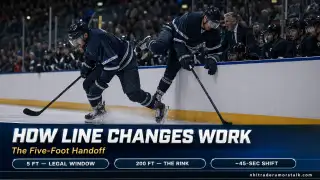
How Do Line Changes Work in Hockey?
A line change is hockey's strangest routine: you swap players while the puck is live, but only inside a five-foot pocket beside your own ben...
By Mike Johnson · 10 min read
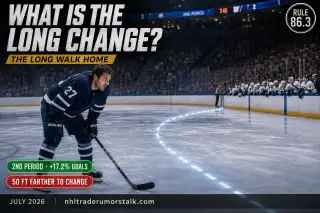
What Is the Long Change in Hockey?
The long change is not jargon, it is bench geography. Teams switch ends each period but keep the same bench, so in the second period a tired...
By Mike Johnson · 9 min read
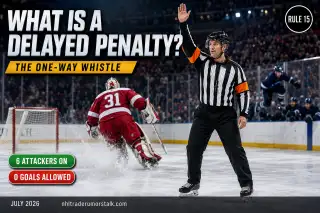
What Is a Delayed Penalty in Hockey?
A delayed penalty is not a penalty yet. It is the referee holding the whistle after a foul until the penalized team touches the puck, which...
By Mike Johnson · 9 min read
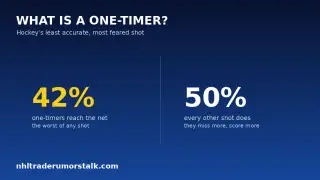
What Is a One-Timer in Hockey?
A one-timer reaches the net just 42% of the time, the worst of any shot, yet it is the most dangerous weapon in hockey and the shot Ovechkin...
By Mike Johnson · 11 min read
Comments
Be the first to share your take.
Get NHL trade rumors in your inbox
One email per week, zero spam, verified rumors only.