Bobby McMann Kraken Extension: The $5M Gamble
Bobby McMann has 7 goals in 8 games since joining Seattle. The Kraken want to extend him, but is his explosive start sustainable enough to justify $5M AAV? A full contract projection with comparables.
Live updates
No updates yet. Refreshing automatically.
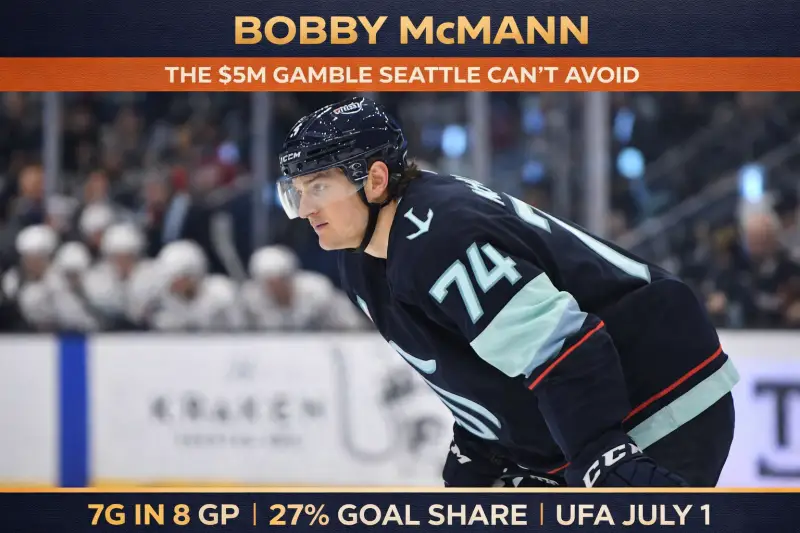
Bobby McMann has scored 27% of Seattle's goals since his trade deadline arrival — seven goals in eight games, the most prolific post-deadline stretch in Kraken franchise history. Now the Kraken want to lock him up with an extension, and McMann's camp reportedly wants five years at $5 million annually. The question isn't whether Seattle should re-sign McMann. It's whether the player they're paying for is the one who showed up these past three weeks or the one who spent four years grinding through the AHL and ECHL before getting a real NHL look at age 26. I've been calling this "The McMann Multiplier" — his production has multiplied exponentially since leaving Toronto's rigid structure for Lane Lambert's green-light system. But multipliers based on eight games of data have a nasty habit of reverting to the mean.
Key Takeaways
- Post-deadline dominance: McMann has 7 goals and 4 assists in 8 games with Seattle, making him the most productive deadline acquisition in Kraken history
- Contract gap killed the Toronto deal: McMann's camp wanted 5yr/$5M; the Leafs wouldn't go near that number, leading to the March 6 trade
- The Sherwood benchmark: Kiefer Sherwood's 5yr/$5.75M deal is the primary comparable, but McMann's production exceeds Sherwood's pre-signing output
- Cap room exists: Seattle projects $16.7M in 2026-27 cap space with Gourde and Tanev off the books — plenty of room for a $4.5-5M AAV deal
- Sustainability question: McMann's 2025-26 shooting percentage is tracking well above his career average — regression risk is real and must be priced into any extension
The Fastest Start in Kraken Trade Deadline History
Let's get the absurd numbers out of the way first. Since resolving his visa issues and finally suiting up for Seattle on March 14, Bobby McMann has scored seven goals and added four assists in eight games. He debuted with two goals and an assist in a 5-2 demolition of Vancouver. Then he added a power-play goal and an assist in a 6-2 rout of Florida that pushed Seattle into the second wild-card spot. His sixth goal in seven games came against Buffalo on March 28 — a game the Kraken ultimately lost in a shootout, but McMann's fingerprints were all over the scoresheet with a goal and an assist.
That 27% goal share is staggering. McMann scored 7 of the Kraken's 26 goals in those eight games. For context, Leon Draisaitl's goal share in Edmonton — playing alongside Connor McDavid — typically hovers around 18-20%. McMann is doing this on a Kraken team that ranks in the bottom third of the league offensively.
BOBBY MCMANN GOAL 🚨 In his first game with the @SeattleKraken, Bobby McMann finds the back of the net for his 20th of the season!
— NHL (@NHL) March 14, 2026
Coach Lane Lambert hasn't been shy about giving McMann the runway.
"We're giving him plenty of opportunity. He's earned it. He's fit in real nicely with Kakko and Chandler Stephenson. His speed is key. We see that on a nightly basis."
— Lane Lambert, Seattle Kraken Head Coach (via Pacific North Hockey)That line combination — McMann with Kaapo Kakko and Chandler Stephenson — has become Seattle's most dangerous unit. McMann provides the speed and net-front chaos, Stephenson controls tempo, and Kakko works the cycle. It's working because Lambert is letting McMann play his way instead of boxing him into a checking role.
Why Toronto Let Him Walk — And Why It Might Haunt Them
The McMann trade didn't happen because Toronto wanted to move him. It happened because the Maple Leafs and McMann's camp couldn't agree on money. Not even close.
Chris Johnston reported before the deadline that McMann's camp was looking at Kiefer Sherwood's five-year, $5.75 million AAV extension with San Jose as the comparable. McMann — bigger, faster, and more productive than Sherwood — saw no reason to take less than $5 million. The Leafs, perpetually squeezed against the cap with Auston Matthews' situation and the Matthew Knies deadline drama, weren't prepared to go anywhere near that number.
Context matters here. McMann didn't take the traditional path to the NHL. He went undrafted, played four years at Colgate University, then signed with the Toronto Marlies in the AHL. His first pro season was split between the Marlies and the ECHL's Wichita Thunder — the lowest rung of professional hockey. He scored just 2 goals in 21 AHL games that year. Then something clicked: 24 goals in 61 games the following season (a Marlies rookie record), then 21 goals in 30 games in 2022-23 before Toronto finally gave him a real NHL look. He was 26 years old. By comparison, most NHL regulars debut at 19-21. McMann spent 118 AHL games and 22 ECHL games proving he belonged — and now he's scoring at a pace that makes the Kraken's top line look like a finished product.
McMann himself addressed the failed negotiations after the trade: he wanted a long-term deal in Toronto, liked the organization, but the gap was too wide. When a player says "the gap was too wide," that typically means the team's offer was insulting relative to what the market dictated. My read? Toronto offered something in the $3-3.5M range, McMann's camp countered at $5M, and neither side budged.
Seattle knows what happens when you let a goal-scorer slip through your fingers. Morgan Geekie — a former Kraken fourth-liner who left for Boston as a free agent in 2023 — is finishing his second consecutive 30-goal season with the Bruins. Geekie scored 7 goals in 73 games his first year in Seattle. Now he's putting up 33 in Boston. McMann is threatening to become the next cautionary tale if Botterill doesn't get this done.
The McMann Multiplier — Is This Real or a Mirage?
Here's where I'd bet most of the hockey world is getting this wrong. The hot take is that McMann has "found his game" in Seattle and will sustain this pace. The cold take is that eight games means nothing. The truth requires actual math.
McMann has 26 goals on approximately 145 shots this season across both Toronto and Seattle — a shooting percentage around 17.9%. His career shooting percentage before this season hovered around 12-13%. That's a significant gap. If McMann's shooting percentage regresses even halfway toward his career average — say to 15% — his goal total drops from a 30-goal pace to roughly 25 over a full season. Still good. But not "pay me $5 million" good.
The expected goals model adds another layer. McMann's 26 actual goals this season likely exceed his individual expected goals (ixG) by a meaningful margin — a sign he's converting at an unsustainably high rate. When a player's goals outpace his expected goals by 5+ over a full season, history says at least half that gap closes the following year. McMann isn't a sniper with elite shot selection like Auston Matthews. He's a volume shooter with speed who gets to dangerous spots. That profile produces goals, but it also means his conversion rate is more volatile than a pure finisher's. The analytics almost certainly flag McMann as an overperformer right now — the question is how much of that overperformance is real skill development versus random variance.
The eight-game Kraken stretch is even more extreme. Seven goals on roughly 25-30 shots is a shooting percentage north of 23%. Nobody sustains that. Not McDavid. Not Ovechkin in his prime. Not anyone.
| Scenario | SH% | 82-Game Pace | Contract Value |
|---|---|---|---|
| Current 8-game rate | ~23% | 72 goals | $7M+ (fantasy) |
| Full-season rate | ~17.9% | 31 goals | $5M range |
| Career regression | ~13% | 23 goals | $3.5-4M range |
| Split difference | ~15% | 26 goals | $4-4.5M range |
This is the central tension of The McMann Multiplier. The player Seattle is watching right now is a first-line winger worth every penny of $5 million. The player the data says he'll be over 82 games next season is a solid middle-six forward worth $4-4.5 million. Seattle has to decide which version they're paying for.
There's a historical precedent worth examining. Blake Coleman signed a six-year, $4.9M AAV deal with Calgary in 2021 after back-to-back Stanley Cups with Tampa Bay. Coleman had shown flashes of 20-goal upside in a supportive role but was never a primary scorer. Calgary bet on the upside. Coleman delivered 17 goals his first year, then 15, then was traded. Late-blooming power forwards who hit their stride at 28-29 can sustain production, but the ones who do — guys like the veterans still producing deep into their careers — usually have a longer track record of NHL scoring before the big payday.
The Comparables Table — What McMann's Contract Should Look Like
Here's the part where I stop guessing and let the numbers argue. David Pagnotta reported that $5M AAV is the ballpark. But comparables tell a more specific story.
| Player | Age | Pre-Signing Stats | AAV |
|---|---|---|---|
| Kiefer Sherwood (SJS) | 29 | 17G, 23P in 47 GP | $5.75M x 5yr |
| Blake Coleman (CGY) | 29 | 14G, 22P in 57 GP | $4.9M x 6yr |
| Zach Aston-Reese (TOR) | 28 | 10G, 18P in 68 GP | $1.75M x 2yr |
| Bobby McMann (SEA) | 29 | 26G, 41P in 68 GP | $4.5-5M x 4yr? |
McMann's production blows away every comparable on this list. He has more goals at the time of negotiation than Sherwood, Coleman, or Aston-Reese. That's his leverage. But McMann also has far fewer total NHL games than any of them did at the time of their deals — just 213 career games versus Sherwood's 300+ and Coleman's 400+. That's the counter-argument.
My projection: four years at $4.75M AAV. Here's why I land there instead of the five-year, $5M McMann's camp reportedly wants. First, Seattle shouldn't go to five years on a player who'll be 30 when the deal starts and has only two full NHL seasons on his resume. Second, the shooting percentage regression risk means McMann's goal totals will likely settle in the 22-26 range, not 30+. Third, the Jordan Kyrou situation in St. Louis shows what happens when teams overpay based on a hot stretch — they end up trying to move the contract two years later.
"I don't think it's gone very far down the road yet. We're under the impression the Kraken have indicated to McMann that they would like to try and keep him. He's been an excellent fit."
— Elliotte Friedman, NHL Insider (via Pacific North Hockey)That Friedman quote is revealing. "Haven't gone very far down the road" means Seattle is watching. They want McMann, but they're not rushing to lock in a number based on three weeks of data. Smart. GM Jason Botterill has called re-signing McMann "Job 1" for the offseason, which signals intent without committing to a price. That's the right play.
Can Seattle Afford It? The Cap Math Says Yes — Barely
Seattle projects to have approximately $16.7 million in cap space for 2026-27. With the salary cap ceiling expected to jump to $104 million — an $8.5 million increase — the Kraken have more breathing room than most teams chasing UFA forwards this summer.
But McMann isn't the only financial priority. Kaapo Kakko is an RFA who'll need a raise from his $2.4M AAV. Brandon Tanev and Yanni Gourde are off the books (Gourde was traded at the deadline), which frees up roughly $10M combined. The Eberle extension at $5.5M AAV is already accounted for.
A McMann deal at $4.75M fits comfortably. Even at $5M, Seattle can accommodate it and still have $10-11M for Kakko's bridge deal, depth signings, and prospect call-ups. The cap isn't the obstacle here. The disagreement — if there is one — will be about term, not dollars.
What kills me is the alternative. If McMann walks to free agency in July, Seattle has spent a second-round pick and a fourth-round pick on 20 games of a rental. For a franchise that traded away Bjorkstrand, Gourde, and others at the deadline to stockpile draft capital, losing McMann for nothing would be a brutal contradiction. You don't sell futures to acquire a player and then let him leave. That's not a rebuild strategy — that's just losing assets with extra steps.
Compare this to how Florida handled Sergei Bobrovsky's extension — the Panthers identified their priority, accepted a slight overpay for certainty, and locked it down before the market could inflate the price. Seattle should take notes.
Sources and Reporting
- Pacific North Hockey — McMann quotes, Lambert quotes, extension talks, game performance details
- NHL.com — Official trade details, Botterill quotes, McMann's Toronto stats
- Chris Johnston (X/Twitter) — Sherwood comparable analysis, Leafs negotiation details
- PuckPedia — Contract details, cap hit, trade breakdown
- Elliotte Friedman (X/Twitter) — Extension talks, Kraken's intent to retain McMann
- The Leafs Nation — McMann on failed Toronto extension
- ESPN — Career stats, game logs, season totals
The Bottom Line: Seattle's $5M Bet on Velocity
The McMann Multiplier is real, but it's not as big as the last eight games suggest. McMann isn't going to score at a 72-goal pace. He's probably not going to hit 30 goals next season either. What he will do — based on his career trajectory, physical tools, and the way Lambert is deploying him — is settle into a 23-27 goal, 45-55 point range. That's a top-nine forward worth somewhere between $4.25M and $5M annually.
My projection: McMann signs a four-year extension with Seattle at $4.75M AAV before free agency opens on July 1. I'd bet Botterill offers four years at $4.5M in the next two weeks, McMann's camp counters at five years and $5.25M, and they split the difference. A no-trade clause in years one and two gets the deal done.
What I didn't see coming is how perfectly McMann fits Lambert's system. This isn't just a hot streak — the speed, the net-front presence, the willingness to shoot from everywhere — that's a 6-foot-2, 217-pound winger doing exactly what he was built to do in a system that actually wants him to do it. Toronto's loss. Seattle's gain. And if Botterill lets this one walk to July, he'll be explaining The McMann Multiplier to his ownership group for years.
The Counter-Arguments
"He's just on a hot streak — 8 games means nothing."
Except McMann didn't start scoring in Seattle. He had 19 goals in 60 games in Toronto before the trade — top-six production in a system that wasn't designed for his skillset. The 8-game Kraken explosion is the ceiling, sure, but his floor is a 22-goal pace over a full season across two different systems. That floor alone is worth $4M+. The shooting percentage will regress from 23%, but even at 15%, you're looking at 26 goals over 82 games. That's not a heater — that's a legitimate second-line winger.
"Why would Seattle pay $5M for a guy Toronto wouldn't keep?"
Toronto didn't let McMann walk because they thought he was bad. They let him walk because they couldn't afford him. The Leafs have $33M+ committed to their top three forwards. McMann's $5M ask was reasonable — it just didn't fit Toronto's math. Seattle has $16.7M in projected cap space. The Leafs' inability to pay has nothing to do with McMann's value and everything to do with their own roster construction.
"$5M for a 29-year-old with 213 NHL games? That's risky."
It would be — if the alternative wasn't worse. Seattle traded a second-round pick and a fourth-round pick to acquire McMann. If he walks in July, those picks are gone for 20 games of a rental. Sherwood got $5.75M with worse production numbers. Coleman got $4.9M with fewer goals. The comparables say $4.5-5M is market rate. The risk isn't paying McMann — it's paying the next guy more because you let McMann leave.
"Can't Seattle just wait and see if he regresses?"
No. McMann becomes an unrestricted free agency cap rules on July 1. Every day Seattle waits, another GM watches the highlight reel and adds McMann to their offseason board. The Kraken's leverage is right now — while McMann is happy, settled, and playing on a line that works. Once he hits the open market, you're bidding against 10 teams with cap space. The "wait and see" approach is exactly how Seattle lost Morgan Geekie. That lesson cost them a 30-goal scorer.
"What if Seattle misses the playoffs? Does the extension still make sense?"
This extension has nothing to do with April 2026 and everything to do with October 2026. Seattle is 32-29-11 right now — a team with talent that hasn't figured out consistency. McMann at $4.75M on a roster with Stephenson, Kakko, Beniers, and the incoming draft capital is a core piece for next season's push. You don't sign a 29-year-old winger because of a wild card race. You sign him because he's the best goal-scorer on your roster and you can't replace that production in free agency without spending more.
Frequently Asked Questions
What does the Bobby McMann Kraken extension mean for the 2026 NHL season?
Bobby McMann has 7 goals in 8 games since joining Seattle. The Kraken want to extend him, but is his explosive start sustainable enough to justify $5M AAV? A full contract projection with comparables.
What is The Fastest Start in Kraken Trade Deadline History?
Let's get the absurd numbers out of the way first. Since resolving his visa issues and finally suiting up for Seattle on March 14, Bobby McMann has scored seven goals and added four assists in eight games. He debuted with two goals and an assist in a 5-2 demolition of Vancouver. Then he added a power-play goal and an assist in a 6-2 rout of Florida that pushed Seattle into the second wild-card spot. His sixth goal in seven games came against B...
How does Why Toronto Let Him Walk — And Why It Might Haunt Them affect the outcome?
The McMann trade didn't happen because Toronto wanted to move him. It happened because the Maple Leafs and McMann's camp couldn't agree on money. Not even close.
Related Stories

How Do Line Changes Work in Hockey?
A line change is hockey's strangest routine: you swap players while the puck is live, but only inside a five-foot pocket beside your own ben...
By Mike Johnson · 10 min read
What Is the Long Change in Hockey?
The long change is not jargon, it is bench geography. Teams switch ends each period but keep the same bench, so in the second period a tired...
By Mike Johnson · 9 min read
What Is a Delayed Penalty in Hockey?
A delayed penalty is not a penalty yet. It is the referee holding the whistle after a foul until the penalized team touches the puck, which...
By Mike Johnson · 9 min read
What Is a One-Timer in Hockey?
A one-timer reaches the net just 42% of the time, the worst of any shot, yet it is the most dangerous weapon in hockey and the shot Ovechkin...
By Mike Johnson · 11 min read
Comments
Be the first to share your take.
Get NHL trade rumors in your inbox
One email per week, zero spam, verified rumors only.