McDavid Pillow Fight: The Pacific Division Problem
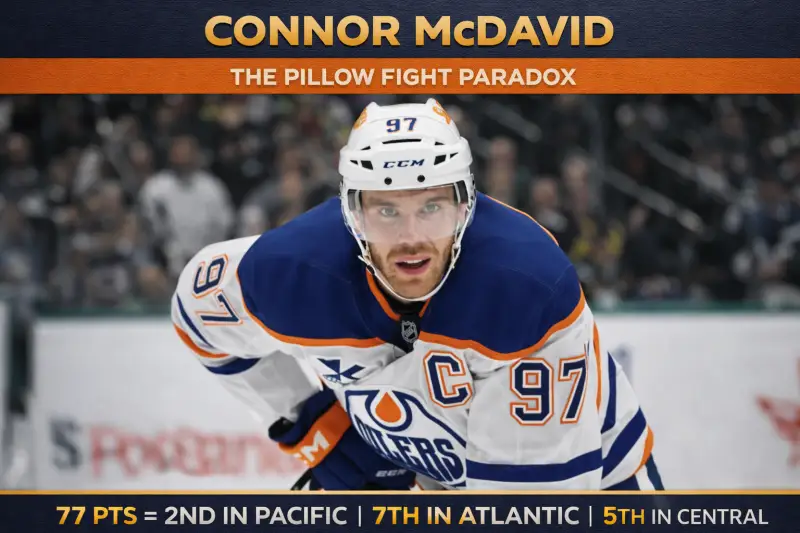
McDavid called the Pacific a "pillow fight" after losing 5-2 to Tampa. The real story: Edmonton's 77 points would rank 5th-7th in any other division. The weak competition is hiding coaching problems.
Live updates
No updates yet. Refreshing automatically.
Connor McDavid called the Pacific Division "a bit of a pillow fight" after the Oilers' 5-2 loss to Tampa Bay on Saturday night. Every outlet ran the quote. Nobody ran the math.
So I did. Edmonton's 77 points would put them 5th in the Central, 6th in the Metropolitan, and 7th in the Atlantic. They're 2nd in the Pacific — and that's the McDavid pillow fight problem in one sentence. The Oilers aren't good enough for the playoffs in three of four NHL divisions. They just happen to play in the one where 77 points buys you a home-ice series.
The Oilers aren't good enough for the playoffs in three of four NHL divisions. Fifth in the Central. Sixth in the Metropolitan. Seventh in the Atlantic — below Ottawa. And McDavid didn't stop at the division. He praised Tampa as "perfectly coached," then told reporters to "ask Knoblauch" what it takes to get there. The most public callout of his career, on the same night he admitted the Pacific is a joke. His salary cap hit calculations discount extension runs through 2027-28. Two seasons to win. And the division he's playing in rewards mediocrity with playoff seeding.
The Division-Transplant Test Nobody's Running
I pulled the current NHL standings and dropped Edmonton's 77 points into each division. The results are ugly.
| Division | Rank | Ahead of Them |
|---|---|---|
| Pacific | 2nd | Anaheim (80) |
| Central | 5th | COL (102), DAL (97), MIN (92), UTA (78) |
| Metropolitan | 6th | CAR (96), PIT (86), CBJ (85), NYR (83), WSH (80) |
| Atlantic | 7th | BUF (94), TBL (90), MTL (86), BOS (86), DET (84), OTT (81) |
Seventh in the Atlantic. Let that register for a second. Edmonton — Connor McDavid's team, Leon Draisaitl's team, the team that went to the Cup Final two years ago — would be below Ottawa in the Atlantic Division. Below the Senators. The franchise that hasn't won a playoff round since 2017.
The gap between the Pacific and the rest of the NHL isn't a slight difference. Colorado has 102 points. Anaheim leads the Pacific with 80. That's a 22-point chasm between the best team in the Central and the best team in the Pacific. In what universe is that competitive balance?
What McDavid Actually Said — And the Part Everyone's Ignoring
"We're fortunate to play in this division. A lot of teams are fortunate to play in this division. It's a bit of a pillow fight right now."
— Connor McDavid, postgame March 21, 2026 (via Daily Faceoff)Every outlet grabbed that quote. "Pillow fight" was trending on hockey Twitter within minutes. Good line. But the pillow fight part was the appetizer.
The main course came when reporters asked McDavid what it takes to play like Tampa Bay — the team that had just beaten his Oilers 5-2 with a level of structure Edmonton couldn't match. McDavid praised the Lightning's system, calling them "perfectly coached" and saying their players "all know what they're doing all over the ice."
Then came the shot heard 'round Edmonton: "That's a coaching question. You can ask Knoblauch that question."
If you've followed McDavid's media availability for any length of time, you know he doesn't do this. He's the guy who deflects, who talks about "getting better as a group," who protects his coaching staff even when they don't deserve it. Telling reporters to redirect a question about team structure to his head coach is the most pointed public criticism McDavid has ever leveled at anyone in the Oilers organization.
And it came on the same night he called his own division a pillow fight. Connect those two statements and the picture gets clear: McDavid knows his team isn't good enough, knows the coaching isn't sharp enough, and knows the only reason nobody's panicking is because the Pacific is terrible enough to paper over the cracks.
The Pillow Fight Paradox: How Weak Competition Hides Real Problems
Call it the Pillow Fight Paradox: the part of this story that matters more than any quote.
A weak division doesn't just inflate your standings position. It actively prevents you from fixing the problems that will destroy you in the playoffs. When you're winning enough games against rebuilding Vancouver (50 points) and Calgary (63 points) to stay in a playoff spot, there's no urgency to overhaul your systems. No reason to fire the coach. No pressure to make a trade.
Edmonton is 4-6 in their last 10 games against Eastern Conference opponents. That's not a blip — that's who they are against real competition. The Oilers beat up on the Pacific's bottom feeders, lose to legitimate contenders, and end up with a record that looks acceptable because the division is so weak that 77 points buys second place.
I don't buy the idea that this team is a contender. Their record says playoff team. Their underlying play says first-round exit.
The historical precedent backs this up. The 2023-24 Oilers went to the Cup Final from a Pacific that was stronger than this year's version — and they needed McDavid playing at a superhuman level just to get there. This year's Edmonton team is worse, the coaching is shakier, and the division is even softer. What exactly is the argument for a deep run?
McDavid's $12.5M Clock Is Ticking
Here's the part that makes the Pillow Fight Paradox genuinely dangerous for Edmonton's future.
McDavid signed a 2-year, $25 million extension at $12.5M AAV — well below his market value — specifically to give the Oilers cap flexibility to build a winner. That deal runs through 2027-28. Two seasons. Then he's a UFA, and every team in the league lines up with max offers.
He took a discount to win. What he's watching instead is a team that's "perfectly coached" according to Tampa Bay's blueprint, and "somewhat rehearsed and organized, but not to their level" according to his own assessment of Edmonton.
Draisaitl already voiced frustration earlier this season. Now McDavid is publicly questioning the coaching structure. Both of the franchise's generational players are unhappy with the same thing — and the Oilers are hiding behind a division where 77 points is good enough for second place.
My read: if Edmonton gets bounced in the first round this spring — which I'd bet on — Knoblauch is fired by June. McDavid's patience has a shelf life, and that shelf life is measured in playoff rounds, not regular-season standings inflated by pillow fights.
A Division Where the Leader Gets Outscored
The stat that crystallizes the Pacific Division problem: Anaheim leads at 80 points with a goal differential of -8. The division leader is getting outscored on the season. Six of eight Pacific teams have negative differentials. Only Vegas (+2) and Edmonton (+1) are above zero — and barely.
In the Atlantic, Buffalo (94 points) has one of the best goal differentials in the league. In the Central, Colorado (102 points) is a juggernaut. In the Pacific, the best team is a .500 club that's allowed more goals than it's scored and has 80 points because the rest of the division is even worse.
Edmonton's goal differential is +1. Plus-one. In 71 games. The second-place team in the Pacific has been outscored almost as much as they've outscored opponents. For context, Colorado's differential is north of +40. Carolina and Buffalo are both above +30. The Oilers are treading water, and they're in second place.
The 2019 Blues Precedent — And Why It Doesn't Apply
Oilers fans will point to the 2019 St. Louis Blues as proof that a struggling team can flip a switch and win the Cup. Fair comparison on the surface — the Blues were dead last in the NHL on January 3, 2019, and lifted the Cup in June.
But the Blues' problem was a coaching crisis that got solved when Craig Berube replaced Mike Yeo. The system changed overnight. Jordan Binnington arrived and played like a different species. The underlying talent was always there — it was being coached out of the team.
Edmonton's situation is the opposite. The talent is world-class — you have the two best forwards alive on the same roster. The system is the issue. And unlike the 2019 Blues, where ownership acted decisively to fix it, the Oilers are drifting into the playoffs with a coach their captain just publicly undermined on national television.
The last time a team from the weakest division in the NHL won the Cup was... well, it depends on how you define "weakest," but weak-division teams have historically poor records in the Conference Finals and beyond. Playoff competition doesn't care about your regular-season division. It cares whether your team can play structured hockey against real opponents for four rounds.
Sources and Reporting
- Daily Faceoff — Original McDavid "pillow fight" quotes and Pacific Division context
- The Hockey Writers — McDavid's coaching callout quotes and Knoblauch analysis
- ESPN — Full NHL standings data for all four divisions
- PuckPedia — McDavid contract details ($12.5M AAV, 2yr extension)
- ESPN Player Stats — McDavid's 2025-26 season stats (38G, 78A, 116P)
- The Hockey News — Division weakness analysis and historical context
- OilersNation — Knoblauch job security reporting and fan sentiment
The Pillow Fight Paradox isn't going away. McDavid knows it. Draisaitl knows it. The only question is whether Edmonton's front office acknowledges it before the playoffs expose it. My projection: the Oilers make the postseason from the Pacific's second seed, draw a Central Division team in Round 2, and get swept. The pillow fight ends when real competition starts — and 77 points in the weakest division in modern NHL history isn't a résumé. It's an indictment.
The Counter-Arguments (And Why They Don't Hold Up)
"But they're still in a playoff spot, right?"
Sure — in the Pacific. Drop Edmonton's 77 points into the Atlantic and they're 7th, below Ottawa. In the Metro, 6th behind Washington. In the Central, 5th behind Utah. The Oilers are a playoff team the same way a student passes a class graded on a curve where nobody studied. The division leader has 80 points and a -8 goal differential. That's not a playoff race. That's a pillow fight.
"McDavid was just venting after a loss — it doesn't mean anything."
McDavid has lost hundreds of games in his career. He's never told reporters to redirect a question about systems to his head coach. "That's a coaching question — you can ask Knoblauch that question" isn't venting. It's a public performance review. When Draisaitl voiced the same frustration weeks earlier, it was a data point. When both generational talents say it, it's a pattern. Knoblauch's seat is scorching.
"The 2019 Blues were last in January and won the Cup. Anything can happen."
The Blues fixed their problem by firing their coach mid-season and getting career-best goaltending from Binnington. Edmonton's problem IS coaching — and the front office hasn't acted. The talent is world-class. The system isn't. Unlike St. Louis, the Oilers are drifting into April with the same coach their captain just undermined on national TV. The Blues precedent only works if someone actually pulls the trigger.
"McDavid took a discount — doesn't that show he believes in this team?"
He signed a 2-year, $25M extension at $12.5M AAV — well below what he could command — to give Edmonton cap flexibility to build a contender. Two years. That's the window. If the Oilers waste it playing pillow fights in a bad division while the coaching staff gets publicly questioned by both superstars, the UFA conversation goes from whisper to megaphone fast.
Frequently Asked Questions
What does the McDavid pillow fight mean for the 2026 NHL season?
McDavid called the Pacific a "pillow fight" after losing 5-2 to Tampa. The real story: Edmonton's 77 points would rank 5th-7th in any other division. The weak competition is hiding coaching problems.
What is The Division-Transplant Test Nobody's Running?
I pulled the current NHL standings and dropped Edmonton's 77 points into each division. The results are ugly.
How does What McDavid Actually Said — And the Part Everyone's Ignoring affect the outcome?
Full breakdown provided in the main article with primary-source verification.
Related Stories
How Do Line Changes Work in Hockey?
A line change is hockey's strangest routine: you swap players while the puck is live, but only inside a five-foot pocket beside your own ben...
By Mike Johnson · 10 min read

What Is the Long Change in Hockey?
The long change is not jargon, it is bench geography. Teams switch ends each period but keep the same bench, so in the second period a tired...
By Mike Johnson · 9 min read
What Is a Delayed Penalty in Hockey?
A delayed penalty is not a penalty yet. It is the referee holding the whistle after a foul until the penalized team touches the puck, which...
By Mike Johnson · 9 min read
What Is a One-Timer in Hockey?
A one-timer reaches the net just 42% of the time, the worst of any shot, yet it is the most dangerous weapon in hockey and the shot Ovechkin...
By Mike Johnson · 11 min read
Comments
Be the first to share your take.
Get NHL trade rumors in your inbox
One email per week, zero spam, verified rumors only.