NHL 2026-27: The 84-Game Season
The NHL 2026-27 season expands to 84 games, the first since 1993-94. Both new games are divisional. Here is why it changed, when it starts, and every key date.
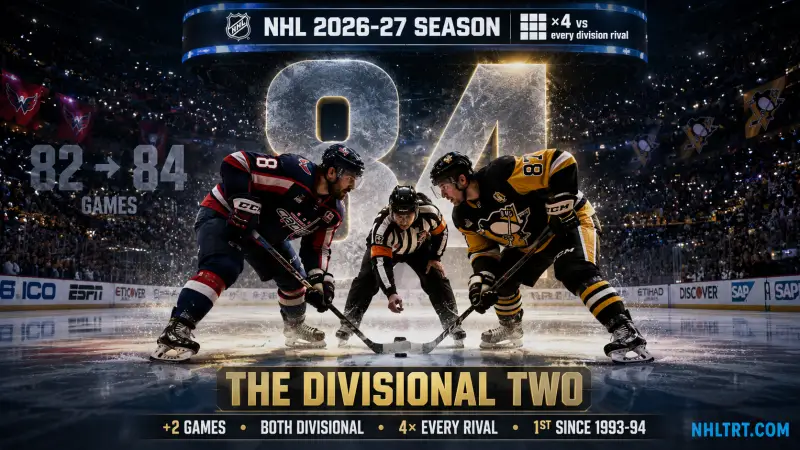
Eighty-four. That is how many games every team will play in the NHL 2026-27 season, the longest league schedule since 1993-94. The jump from 82 looks tiny on paper, two extra nights, but it is the headline change in a new collective bargaining agreement that reshapes the calendar from training camp to the Stanley Cup. Here is what the NHL 2026-27 season actually looks like: a longer schedule, a shorter preseason, an earlier start, and two new games that land entirely inside your own division.
The CBA was ratified in 2025 and runs through 2029-30, so this is locked, not a rumor. The full schedule drops in late June or early July, but the structure is already set. And the structure is the interesting part.
10 min read · ~1,850 words•Updated June 13, 2026•Share: X · Reddit · Facebook · EmailIn this guide| Figure | What it represents |
|---|---|
| 84 | Regular-season games per team in 2026-27, up from 82, the first 84-game NHL season since 1993-94 |
| 1,344 | Total league games on the 2026-27 calendar (84 × 32 ÷ 2), per the Globe and Mail |
Two more games per team does not sound like much until you notice where both of them go, and how the league paid for them.
Key Takeaways
84 games, locked: the new CBA (2026-27 through 2029-30) lifts the schedule from 82 to 84, the longest NHL regular season since 1993-94.
Two divisional games: both new games are intra-division, so every team now plays its division rivals exactly four times each.
Shorter camp: the preseason drops to four games per team, and anyone with 100-plus career games is capped at two exhibition appearances.
Earlier start: to fit 84 games, the season opens in late September 2026 instead of early-to-mid October.
Cap keeps climbing: the ceiling rises to roughly $104 million for 2026-27, on its way past $113 million by 2027-28.
What Is Actually Changing in 2026-27
Start with the number that matters. The regular season grows by two games, from 82 to 84, and it kicks in for 2026-27. Across 32 teams that is 1,344 total games, up from 1,312. The league last played an 84-game schedule in 1992-93 and 1993-94, when two of the games were staged at neutral sites, an experiment that died after the 1994-95 lockout. So this is the first 84-game season in more than three decades, and the first ever where all 84 count in your own buildings and your rivals'.
It comes bundled with the rest of the new CBA, which the league and players ratified in 2025 to run through 2029-30. Contract terms shrink (a max of seven years to re-sign your own player, six to sign elsewhere), the preseason is cut, and the regular season stretches. The salary cap, meanwhile, keeps doing what it has done since the flat-cap years ended: it climbs to about $104 million for 2026-27 and is tracking past $113 million the year after. We broke the cap mechanics down in our 2026 salary cap guide, and the spending power it unlocks in the War Chest Index.
The Divisional Two: Where the Extra Games Go
Here is the part most fans miss: the two new games are not scattered across the league at random, they are both divisional. Under the old 82-game format, some inter-division opponents only visited three times a year, and the math never quite evened out. At 84, the schedule squares the circle: every team plays each of its division rivals exactly four times, home and home, twice each way. The league pointed to rivalries like Toronto and Boston, Dallas and Colorado, Washington and Pittsburgh as the matchups that finally get a clean four-game slate.
Call it the Divisional Two. The season did not just get longer by two games, it got harder by two games, because the additions land against the teams that already know you best and want to beat you most. A fourth Battle of Ontario. A fourth Avalanche-Stars grind in a division that produced last spring's brutal first-round bracket. For a bubble team, two extra divisional games is two extra four-point swings against the exact opponents it is racing for a playoff spot. Those two games reward depth and punish thin rosters, and they do it in the matchups that matter most for seeding.
Here is how the league frames the logic, in deputy commissioner Bill Daly's own words.
"One of the things we agreed on with the players' association is extending the regular season by two games, which entails a corresponding reduction in the duration of our training camps, and should allow us to start the season earlier. So we're not really extending our overall season; it should actually get a little shorter over time." — Bill Daly, NHL Deputy Commissioner, via ESPN (2025)
Daly's point is the quiet trick of the whole deal: more games on the calendar, but a tighter calendar overall.
When the Season Starts, and Why It Is Earlier
Two more games have to come from somewhere. The NHL found the room by opening earlier. Instead of the usual early-to-mid October launch, the 2026-27 regular season is expected to begin in late September 2026, with the Stanley Cup still handed out in mid-June. The exact opening night is not public yet because the full schedule has not dropped, but the late-September window is the reported plan.
When does the full schedule come out? Typically in late June or early July, right after the Cup is won and the draft and free agency clear. So if you are waiting to book your team's opener or a road trip, the calendar you want is days away, not months. Once it lands, the league's three outdoor games already have dates: a Heritage Classic in Winnipeg in late October, a Winter Classic on New Year's Eve in Salt Lake City, and a Stadium Series in Dallas in February. All three are in the key-date table below.
The Trade-Off: More Real Games, Fewer Fake Ones
The league did not just bolt two games onto the old structure. It traded exhibition hockey for regular-season hockey. The preseason shrinks to four games per team, and any player with 100 or more career NHL games is capped at two preseason appearances. Veterans get a shorter, lighter camp; the two games they lose in September become two that count later. For fans, that is a straight upgrade: fewer August-roster scrimmages, more nights that move the standings.
Players see both sides of it. NHLPA executive director Marty Walsh, who negotiated the deal, has been open that the union weighed the wear-and-tear against the upside.
"My concern with the 84 games was wear-and-tear on a player's body. Going to 84 games, the league wanted that, but they gave some things up, too. Having 84 games allows us to have more fans and more opportunities to see a game." — Marty Walsh, NHLPA Executive Director, via The Hockey News (2026)
Not everyone is sold that the math works for the players. Daily Faceoff's Paul Pidutti laid out the case against, and it is a fair one: the 2024-25 season saw the fewest man-games lost to injury in 23 years, and adding games risks reversing that. He points to the load on stars like Connor McDavid, who packed more than 230 game-days into a 21-month stretch once you fold in playoffs and international play, and argues that load management becomes inevitable when the grind climbs. His sharpest point is the simplest: with the cap rising nearly 29% by 2027-28, the league does not actually need the extra revenue, which makes two more games on tired legs a hard sell on health grounds. Red Wings GM Steve Yzerman, for what it is worth, has said he likes the longer season, so the hockey world is not unanimous either way.
My read is that the Divisional Two is good for the standings and a coin flip for the players. Two more four-point games against a rival is appointment hockey. Two more games on a 34-year-old top-pair defenseman's odometer is exactly what the union flagged, and both of those things are true at once.
Every Key Date for the 2026-27 Season
Here is the calendar as it stands today, with the locked dates marked and the expected ones flagged. Update bookmarks once the full schedule drops.
| Event | Date | Status |
|---|---|---|
| 2026 NHL Draft (KeyBank Center, Buffalo) | June 26-27, 2026 | Confirmed |
| Free agency opens (12 p.m. ET) | July 1, 2026 | Confirmed |
| Full 2026-27 schedule release | Late June / early July 2026 | Expected |
| Training camps open | Mid-September 2026 | Expected |
| Regular-season opener (84-game slate) | Late September 2026 | Expected |
| Heritage Classic, Winnipeg vs Montreal (Princess Auto Stadium) | Oct. 25, 2026 | Confirmed |
| Winter Classic, Utah Mammoth vs Colorado (Rice-Eccles, Salt Lake City) | Dec. 31, 2026 | Confirmed |
| Stadium Series, Dallas vs Vegas (AT&T Stadium) | Feb. 20, 2027 | Confirmed |
| Trade deadline | Early March 2027 | Expected |
| Stanley Cup Final concludes | Mid-June 2027 | Expected |
A few of those connect to stories we are already tracking. The draft headlines a generational class led by Gavin McKenna, and if you want the broadcast plan for draft weekend it is in our draft viewing guide. July 1 is mapped in our 2026 free-agent board and team-by-team in the Need-Fit Map, and every signing lands on our live trade board. The Winter Classic, fittingly, features a Colorado club we wrote about in the 82-Game Mirage, a regular-season framing that now needs a small rewrite, because the regular season is 84.
About this guideWritten by Mike Johnson, NHL Senior Editor, 15 years covering the league, the cap, and the calendar. The 84-game move, the divisional structure, the preseason cap, and the CBA term (2026-27 through 2029-30) were checked against ESPN's CBA coverage, the Globe and Mail, and NHL.com; the Daly and Walsh quotes are verbatim from ESPN and The Hockey News with inline source links; outdoor-game dates come from NHL.com. The Divisional Two is our analytical framework, introduced here, for the two added games landing entirely inside each team's division. Published June 13, 2026. Editorial review: Sarah Chen, Hockey Operations Editor. Corrections: editorial@nhltraderumorstalk.com.
Sources and Reporting
ESPN: CBA extension through 2029-30, 84-game confirmation, contract-term changes
ESPN: Bill Daly on the earlier start and shorter camp
The Globe and Mail: 1,344-game total, divisional rivalry structure
The Hockey News: Marty Walsh on wear-and-tear and trade-offs
Daily Faceoff: Paul Pidutti's case against the 84-game schedule
NHL.com: 2027 Winter Classic and the season's outdoor games
Wikipedia: the 1992-93 and 1993-94 84-game seasons
The Verdict: The Divisional Two
The 84-game season is not a gimmick, and it is not a money grab dressed up as growth. It is a real structural change with a clear winner and a clear cost. The winner is the rivalry: four guaranteed meetings with every division foe, two more four-point games on the calendar, a regular season that finally evens out. The cost is the body, and the union said so out loud. Watch the bottom of each division in March 2027. The Divisional Two will decide a wild-card race before it ever decides a player's legs, and the first team that misses the playoffs by a single point on a late divisional loss will know exactly which two games to blame.
Frequently Asked Questions
How many games are in the 2026-27 NHL season?
Each NHL team plays 84 regular-season games in 2026-27, up from 82. That is 1,344 total games across the 32-team league, and it is the first 84-game NHL season since 1993-94.
Why is the NHL going to 84 games?
The new collective bargaining agreement (2026-27 through 2029-30) added two games. Both are intra-division, so every team now plays each division rival exactly four times. To make room, the preseason was cut to four games per team and the season starts earlier.
When does the 2026-27 NHL season start?
The regular season is expected to open in late September 2026, earlier than the usual early-October start, to fit the 84-game schedule. The full schedule is released in late June or early July, and the Stanley Cup is awarded in mid-June 2027.
Does the 84-game season mean a longer preseason?
No. The preseason is shortened to four games per team. Any player with 100 or more career NHL games is capped at two preseason appearances, so veterans get a lighter camp while the regular season grows.
Related Stories

How to Watch the NHL: 2026-27
How to watch the NHL in 2026-27: every channel (ESPN, ABC, TNT, NHL Network), every streaming option, the free routes, blackout traps, and t...
By Mike Johnson · 9 min read
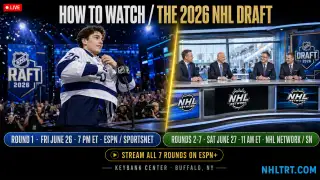
How to Watch the 2026 NHL Draft
Round 1 is June 26 at 7 p.m. ET, Rounds 2-7 are June 27 — but the channel changes between days. The full how-to-watch guide for the 2026 NHL...
By Mike Johnson · 6 min read

Who Is Gavin McKenna? The No. 1 Pick
A Yukon kid who dominated two leagues two years apart, now the consensus No. 1 for 2026. Inside Gavin McKenna's game, his NHL comps, and the...
By Mike Johnson · 9 min read
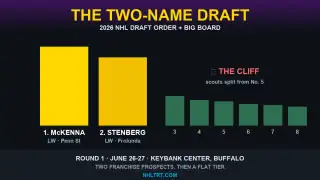
2026 NHL Draft Order: McKenna, Stenberg & the Two-Name Draft
McKenna and Stenberg are the only two locks in a top-heavy class. Inside the projected 2026 first-round order, the big board, the cliff afte...
By Mike Johnson · 6 min read
Comments
Be the first to share your take.
Get NHL trade rumors in your inbox
One email per week. Zero spam. Verified rumors only.