NHL 2026: Every Team's Biggest Need & Dream UFA Fit
A thin free-agent class makes 2026 about fit, not fame. The Need-Fit Map names all 32 teams' biggest hole and the realistic target who fills it — and why half the league points at one winger.
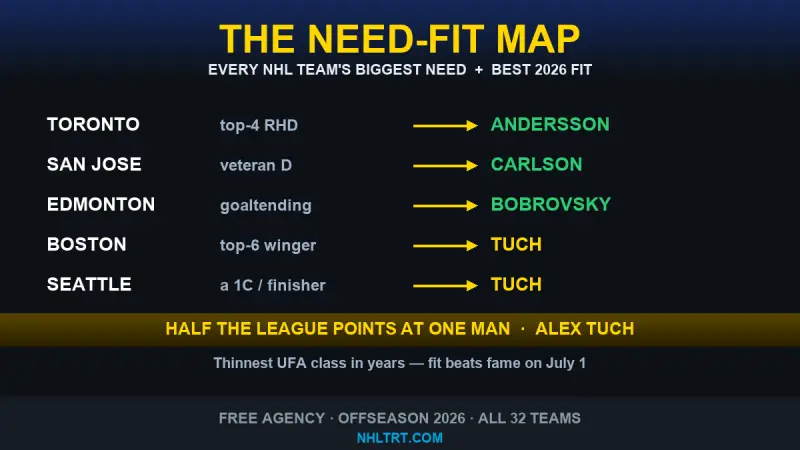
The 2026 free-agent class is one of the thinnest in recent memory, which makes the offseason less about who chases the biggest name and more about which team's specific hole lines up with a player who can actually fill it. That match — need meeting available fit — is what decides who improves in a quiet summer and who just spends. So we built The Need-Fit Map: one clean read of all 32 teams, the single biggest hole each one carries into July 1, and the realistic free-agent or trade target who fits it. No fantasy splashes. Just the fit that makes sense against each roster and each cap sheet.
Key Takeaways
- One hole each: The Need-Fit Map names the single biggest need for all 32 teams plus the realistic target who fits it — not a wish list.
- The board is shallow up front: Alex Tuch is the only true top-six winger, so half the contenders' "fit" points at the same man — pure scarcity.
- Defense is where needs get met: John Carlson, Rasmus Andersson and Darren Raddysh give the blue-line-needy teams actual options the forward-needy teams don't have.
- Goalies are a crisis tier: with Sergei Bobrovsky and Connor Ingram nearly the whole market, every crease-needy team is bidding on two names.
- Money ≠ fit: the teams with the most room (see our cap-space rankings) mostly need youth, not veterans — the fits cluster on capped-out contenders instead.
How the Need-Fit Map Works
Every team has a wish list. The Need-Fit Map throws the wish list out and asks a narrower question: given this roster, this cap sheet, and a famously thin market, what is the one move that actually moves the needle? A contender's "need" might be a 30-goal winger it cannot afford; a rebuilder's need might simply be term discipline and a goalie who steals ten games. We grade fit, not fame. A minimum-contract depth center can be a better fit than a marquee name a team has no room for, and the map says so.
Two market truths shape every row below. First, the forward tier is barren — Alex Tuch headlines a class with little behind him, so the contenders all point at the same handful of names and the price climbs. Our 2026 free-agent list by position lays the full board out, and the $104M cap ceiling sets the budget every fit is measured against. Second, the money sits with the wrong teams: the clubs with real cap room are mostly rebuilding, which our War Chest Index breaks down team by team. Put those together and the Need-Fit Map explains why a quiet July 1 can still reshuffle the league.
The 2026 free-agent class is shaping up as one of the least dynamic groups in recent memory — limited elite, franchise-altering talent — a dangerous environment for general managers. — The Hockey Writers (2026)
Atlantic Division
| Team | Biggest need | Best fit |
|---|---|---|
| Toronto Maple Leafs | Top-four right-shot defenseman | Rasmus Andersson (RHD, top-pair minutes) |
| Tampa Bay Lightning | Cheap middle-six scoring under the cap | Anthony Mantha on a one-year prove-it |
| Florida Panthers | Depth on a wall-to-wall cap sheet | League-minimum veterans only |
| Boston Bruins | A genuine top-six winger | Alex Tuch — the whole summer in one name |
| Buffalo Sabres | Re-sign or replace Tuch + goaltending | Keep Tuch, or pivot the savings to Bobrovsky |
| Ottawa Senators | A starting goaltender | Connor Ingram or a Bobrovsky run |
| Detroit Red Wings | A reset around a finisher | Trade route — the Larkin market sets the price |
| Montreal Canadiens | A top-six scoring winger | Tuch chase, or a Mantha-tier middle-six add |
Toronto is the cleanest fit in the division. The Leafs lack a top-four right-shot defenseman, and right-handed top-four shots are scarce on both the trade market and in free agency, so Toronto may have to pay a premium to land one — which makes Rasmus Andersson the rare board name that answers the exact question being asked. Detroit is the messiest: the captain wants out, and the return shapes the whole offseason, which we mapped in the Larkin-Robertson swap breakdown. Buffalo's entire summer is a referendum on whether Tuch stays.
Metropolitan Division
| Team | Biggest need | Best fit |
|---|---|---|
| Carolina Hurricanes | A finisher who converts the volume | Alex Tuch (if the term doesn't scare them) |
| New York Rangers | Middle-six scoring + cap relief | Move a contract first, then a value winger |
| New York Islanders | Secondary scoring on the wing | Anthony Mantha |
| New Jersey Devils | Goaltending insurance + winger depth | Connor Ingram tandem fit |
| Washington Capitals | A bridge to the post-Ovechkin blue line | Re-sign or replace John Carlson |
| Pittsburgh Penguins | Get younger — defense + goaltending | Patience: convert the league's biggest war chest into futures, not veterans |
| Philadelphia Flyers | A real first-line center | Trade route — no UFA 1C exists |
| Columbus Blue Jackets | Bottom-six grit and reliable depth | Physical, cap-friendly depth forwards |
Pittsburgh is the division's instructive case. The Penguins carry the most cap space in the league, but their need is youth, not a 30-something free agent, as they transition out of the Crosby-Malkin era while patching defensive issues and shaky goaltending. That is the gap between money and fit in one team, and it's why their best move is restraint — exactly what we flagged in the War Chest Index. Columbus, by contrast, has the talent and simply needs reliable depth to support it.
Central Division
| Team | Biggest need | Best fit |
|---|---|---|
| Dallas Stars | Resolve Jason Robertson — sign or trade | The Robertson decision is the whole offseason |
| Colorado Avalanche | Goaltending certainty | Sergei Bobrovsky on a short, rich deal |
| Winnipeg Jets | Scoring depth around the core | Value middle-six on term |
| Minnesota Wild | A cap-clean splash on the wing | Alex Tuch — the room finally exists |
| Nashville Predators | Bounce-back scoring + a top-four D | Darren Raddysh fits the blue line |
| St. Louis Blues | A top-four defenseman | Rasmus Andersson or Raddysh |
| Chicago Blackhawks | Veterans to support Bedard's window | Short-term scoring vets, not commitments |
| Utah Mammoth | Top-six scoring to build on the breakthrough | A Tuch/Mantha-tier winger |
Dallas is the Need-Fit Map's pressure point: the Stars must re-sign Jason Robertson to an expensive new contract or trade him, and that single fork dictates whether they're buyers or sellers — the math is in our Robertson contract-gap breakdown. Utah's rise is the division's feel-good story; after years rebuilding through the Arizona era, the Mammoth broke through to the playoffs, and a top-six scorer is the move that pushes them from guest to threat.
Pacific Division
| Team | Biggest need | Best fit |
|---|---|---|
| Vegas Golden Knights | Depth with almost no room ($4.6M) | Minimum-deal additions after a clear-out |
| Edmonton Oilers | Goaltending — the perennial answer | Sergei Bobrovsky or Connor Ingram |
| Los Angeles Kings | A scoring winger with size | Alex Tuch fit, Mantha fallback |
| Calgary Flames | Keep Rasmus Andersson or reset | The Andersson decision defines the summer |
| Vancouver Canucks | A genuine second-line center | Trade route — the UFA pool is empty here |
| Seattle Kraken | A true 1C / finisher | Spend the room on Tuch |
| San Jose Sharks | Multiple veteran defensemen | John Carlson and/or Darren Raddysh |
| Anaheim Ducks | Scoring + veteran leadership | One real swing with their war chest |
San Jose is the textbook Need-Fit match: the Sharks had one of the league's most porous defenses and need multiple veteran defensemen, and the board — Carlson, Raddysh, Andersson — is unusually deep at exactly that spot. Edmonton's need never changes; goaltending is the line between another deep run and another what-if. The teams sitting on the most room here will mostly stay disciplined, the same paradox the cap-floor breakdown traces — having to spend is not the same as having a fit.
The Verdict: The One Name That Breaks the Map
Run all 32 rows and the same player keeps appearing: Alex Tuch. Boston, Carolina, Minnesota, Los Angeles, Seattle and more all map to him, because he is the only top-six winger the open market offers in 2026. That is the Need-Fit Map's real lesson — in a thin year, the league's needs converge on a tiny number of fits, the price on those fits detonates, and everyone else pivots to defense, goaltending, or the trade market to solve a forward problem. The teams that win this summer won't be the ones with the most money; they'll be the ones whose need happens to match a player nobody else is fighting for. For the leverage games underneath it all, see the offer-sheet board, the arbitration list, and the buyout candidates that quietly reshape supply. Track every move as it lands on our live trade and free-agency board, and for who can actually pay, start with the War Chest Index.
Sources and Reporting
- The Hockey Writers: every team's biggest need (Toronto RHD, Columbus depth, San Jose defense)
- ESPN: offseason keys, free-agency plans and cap space by team
- ESPN: free-agency rankings — Tuch, Andersson, Carlson, the defense tier
- The Hockey Writers: the thin 2026 class and the risk it creates for GMs
- NHL Insight: Pittsburgh's youth-first transition and defensive/goaltending needs
Frequently Asked Questions
What is the NHL Need-Fit Map?
It is our framework that names the single biggest roster need for all 32 NHL teams heading into the 2026 offseason, then pairs each with the most realistic free-agent or trade target that actually fits that hole and the team's cap sheet — fit over fame, not a wish list.
Which team has the clearest free-agency fit in 2026?
Toronto. The Maple Leafs need a top-four right-shot defenseman, a scarce commodity in both trade and free agency, which makes Rasmus Andersson the rare board name that answers the exact question. San Jose (multiple veteran defensemen) is another clean match given the deep blue-line tier.
Why does Alex Tuch fit so many teams in 2026?
Because the 2026 class is one of the thinnest in years and Tuch is effectively the only true top-six winger available. Boston, Carolina, Minnesota, Los Angeles and Seattle all map to him, which is why his price is expected to climb well past his prior $4.75M cap hit.
Do the teams with the most cap space sign the best free agents?
Usually not in 2026. The clubs with the most room — Pittsburgh, Chicago, San Jose — are rebuilding and need youth, not veterans. The best fits cluster on capped-out contenders who must clear room first, which is the paradox detailed in our War Chest Index cap-space rankings.
Related Stories
2026 NHL Draft Order: McKenna, Stenberg & the Two-Name Draft
McKenna and Stenberg are the only two locks in a top-heavy class. Inside the projected 2026 first-round order, the big board, the cliff afte...
By Mike Johnson · 6 min read
NHL Cap Space 2026: Who Can Actually Sign Tuch?
A quarter-billion in unspent cap room sits across the NHL — and almost none of it belongs to a team that wants to win. The War Chest Index r...
By Mike Johnson · 10 min read

NHL Arbitration 2026: Eligible List
NHL RFAs must file for salary arbitration by July 5. Jason Robertson headlines the 2026 eligible class, but the Hearing Bluff means almost n...
By Mike Johnson · 9 min read
NHL Buyout Candidates 2026
The NHL buyout window opens June 15. Rielly, Gallagher, Kotkaniemi, and Frederic are the names in play, but the Dead-Cap Tail means most buy...
By Mike Johnson · 10 min read
Comments
Be the first to share your take.
Get NHL trade rumors in your inbox
One email per week. Zero spam. Verified rumors only.