Tom Fitzgerald Fired: Devils' Deadline Deficit
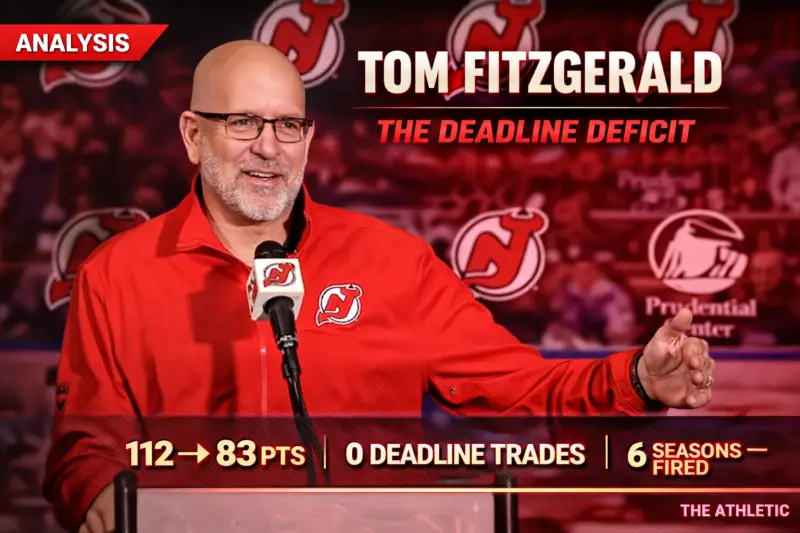
Tom Fitzgerald fired after a 29-point decline from 112 to 83 points. The Deadline Deficit — three years of trade deadline inaction — sealed his fate. New Jersey, Toronto, and Nashville all searching for GMs simultaneously. The next hire inherits real talent and $24M in projected cap space.
Live updates
No updates yet. Refreshing automatically.
The New Jersey Devils fired Tom Fitzgerald on April 6, 2026. Six seasons as general manager — the last two with the additional title of president of hockey operations — ended with a phone call from Managing Partner David Blitzer and a statement crafted to sound mutual. Fitzgerald's tenure peaked at a franchise-record 112 points in 2022-23 and bottomed out at 83 points in 2025-26, with the club sitting seventh in the Metropolitan Division and seven points out of a playoff spot with five games remaining.
That 29-point collapse across three seasons is not a slump. It is a pattern — one built on contracts that aged badly, depth that was never addressed, and trade deadlines where Fitzgerald consistently chose to do nothing when action was required.
I didn't expect the firing to come before the regular season ended. But looking at the full arc of Fitzgerald's six years, the only surprise is that Blitzer waited this long.
Key Takeaways
- The Deadline Deficit: Fitzgerald's pattern of trade deadline inaction — culminating in zero moves at the 2026 deadline — allowed fixable roster problems to compound until they became terminal
- 112 to 83: The Devils went from a franchise-record 112-point season in 2022-23 to an 83-point campaign in 2025-26, the fastest decline-to-firing arc in the franchise's modern history
- The Meier contract: An 8-year, $70M commitment to Timo Meier became the signature overpay that restricted Fitzgerald's flexibility for every season that followed
- Markstrom's .883: Fitzgerald's last major move — extending Jacob Markstrom — produced a .883 save percentage and a 3.12 GAA that accelerated the team's collapse
- Three-way GM talent war: New Jersey, Toronto, and Nashville are all searching for general managers simultaneously, creating the most competitive executive hiring cycle in recent NHL history
From 112 Points to a Pink Slip
Tom Fitzgerald inherited a franchise that had bottomed out. When he replaced Ray Shero as interim GM in January 2020, the Devils were a lottery team built around two teenage centers — Jack Hughes and Nico Hischier — with almost nothing else. The cupboard was bare.
Credit where it's due: Fitzgerald's early moves were smart. He extended the homegrown core, signed Dougie Hamilton as a marquee free agent, and traded for Timo Meier at the 2023 deadline to push for a playoff run.
It worked. The 2022-23 Devils set a franchise record with 52 wins and 112 points, a 49-point improvement over the prior season that represented the largest single-season jump in the NHL since the league adopted its 82-game schedule. They beat the Rangers in a seven-game first-round series and lost to the Carolina Hurricanes in the second round.
Everything after that went sideways.
| Season | Record | Pts | Playoff Result |
|---|---|---|---|
| 2022-23 | 52-22-8 | 112 | Lost R2 (Carolina) |
| 2023-24 | 38-39-5 | 81 | Missed playoffs |
| 2024-25 | 42-33-7 | 91 | Lost R1 (Carolina, 5 games) |
| 2025-26 | 40-34-3 | 83 | Missed playoffs (fired) |
The 2023-24 season was catastrophic. A franchise-record campaign disintegrated into a 38-39-5 mess that missed the playoffs entirely. Fitzgerald fired head coach Lindy Ruff and hired Sheldon Keefe — a move that produced a modest bounce in 2024-25 (91 points, first-round exit to Carolina in five games) but never restored the team to legitimate contender status.
By 2025-26, the regression was structural. Jack Hughes missed significant time with injuries, playing just 56 of the team's 77 games before the firing. Even when healthy, Hughes was dominant — 72 points in those 56 appearances — but the roster around him couldn't compensate for his absences.
Depth scoring vanished. The defense leaked goals. And the goaltending that was supposed to stabilize everything did the opposite.
Blitzer's statement acknowledged Fitzgerald's contributions, including "setting a franchise record for points in a season and helping make New Jersey a hockey destination." That phrasing tells you everything. When ownership has to reach back three years for the last genuinely positive accomplishment, the conversation is already over.
#BREAKING: New Jersey Devils Managing Partner David Blitzer announced today that Tom Fitzgerald will depart the organization.
— New Jersey Devils (@NJDevils) April 6, 2026
The Deadline Deficit: Fitzgerald's Pattern of Inaction
Every general manager makes bad trades. The market moves, players underperform, contracts age poorly. That is the nature of roster construction in a salary-cap league. What defined Fitzgerald's tenure was not the moves he made — it was the moves he refused to make when the roster was screaming for reinforcements.
Call it The Deadline Deficit — the compounding cost of a GM who consistently chose inaction at trade deadlines, allowing fixable roster weaknesses to metastasize into structural failures that eventually closed the competitive window around him.
The 2026 deadline was the most visible example. The Devils sat well outside the playoff picture, and the consensus expectation across the league was that New Jersey would sell — moving assets like Dougie Hamilton, Jonas Siegenthaler, or Johnny Kovacevic for draft capital and prospects.
Fitzgerald did nothing. For the first time since 2012, the Devils made zero trades on deadline day.
"I thought it was going to be very quiet from the get go. When you're talking about trying to make hockey trades, swapping out some young players for maybe more established players... I just really thought there could be some traction with teams, but I guess there was just a lot of tire kicking."
That explanation rang hollow then. It sounds worse now. Fitzgerald cited the CBA rule change disallowing same-day double salary retention as the primary obstacle.
But 30 other GMs operated under the same restriction and still found ways to transact. The Devils' inaction was not a market problem. It was a decision-making problem.
I'd argue the real damage wasn't done solely at the 2026 deadline. Look at the pattern. It accumulated across multiple seasons of refusing to address the same weakness: depth scoring.
Fitzgerald traded Pavel Zacha to Boston in 2022. Zacha has since become a legitimate top-six center — 61 points in 74 games this season, a career-best pace at 28. He included Yegor Sharangovich in the Tyler Toffoli deal. Sharangovich posted 59 points for Calgary in 2023-24. Two productive forwards shipped out. Neither replaced.
The Devils' offense vanished every time Hughes or Hischier missed a week, and Fitzgerald never found the secondary scoring to fix it. That's The Deadline Deficit in a single sentence.
The Deadline Deficit is not about one bad March. It is about a GM who watched the same problem erode his roster for three consecutive years and chose passivity over action at every inflection point.
The Meier Contract and the Markstrom Gamble
Two moves define Fitzgerald's legacy more than any others. Both were big swings. Both missed.
The Timo Meier trade at the 2023 deadline was the kind of aggressive, all-in move that GMs get celebrated for when it works. Fitzgerald sent a first-round pick, a second-round pick, two NHL players (Fabian Zetterlund and Shakir Mukhamadullin), and multiple prospects to San Jose for Meier. Then came the kicker: an eight-year, $70-million extension ($8.8M AAV) before Meier had played a full season in Newark.
The production never showed up. The Devils played Meier at left wing despite his entire San Jose career being on the right side — a positional mismatch that analysts flagged from day one. His underlying numbers told the story: in two of his three full seasons in New Jersey, Meier's 5-on-5 on-ice expected goals percentage sat below 50%, meaning the Devils were being outchanced at even strength with him on the ice.
The $8.8M cap hit runs through 2030-31. That's top-line winger money for bottom-six production. The math never added up.
My read on the Markstrom move: Fitzgerald was trying to buy himself one more season. After the goaltending carousel of the prior offseason, the Devils acquired and extended Jacob Markstrom to stabilize the crease. Stabilize. That was literally the pitch.
Here's what he delivered: a .883 save percentage, a 3.12 GAA, and a Goals Saved Above Expected (GSAx) that ranked dead last among Metropolitan Division starters with 20-plus appearances in 2025-26. In plain English — Markstrom cost the Devils more goals relative to league average than any other starter in the division. Those aren't playoff numbers. Those are tear-it-down numbers.
Markstrom turns 37 next January. His contract expires this summer — the one genuine silver lining for whoever replaces Fitzgerald. But the damage from this season is already baked in. You don't get those points back.
Three GM Chairs, One Offseason
Fitzgerald's firing creates an unusual dynamic in the NHL's executive market. He is the second general manager dismissed in the span of a week — Brad Treliving was fired by the Toronto Maple Leafs on March 30. Meanwhile, the Nashville Predators are conducting their own GM search following Barry Trotz's retirement announcement.
Three open GM chairs in the same offseason is rare. Three open chairs in the same two-week window? Unprecedented in the cap era.
The Devils' candidate list will overlap heavily with Toronto's and Nashville's. Names already circulating include Sunny Mehta (Florida Panthers assistant GM), Mike Gillis (former Canucks GM), Doug Armstrong (stepping down as Blues GM after this season), and John Chayka.
Not every name on that list makes sense for New Jersey. Chayka's analytics pedigree is real — he was the youngest GM in NHL history when Arizona hired him at 26 — but his exit from the Coyotes remains a red flag. The NHL suspended him through 2021 for conduct detrimental to the league after he secretly interviewed with another team while still under contract.
Arizona also forfeited a first-round pick and a second-round pick under his watch for hosting an illegal private scouting combine. Blitzer is looking for stability after Fitzgerald. Chayka's résumé is the opposite of that.
Mehta is the most intriguing option for New Jersey specifically. A Wyckoff, New Jersey native with a master's degree in data science, he previously served as the Devils' director of hockey analytics before joining Florida, where he spent three seasons as assistant GM under Bill Zito. The Panthers won the Stanley Cup in 2024. Mehta was in the room for that.
He knows the Devils' organization from the inside. He knows the ownership group. And he brings an analytics-forward approach that Fitzgerald's tenure increasingly lacked.
What kills me about the timing is the historical echo. In January 2020, the Devils fired Ray Shero after he'd built the foundation of the current core — Hughes first overall in 2019, Hischier first overall in 2017 — but couldn't construct a competitive roster around those pieces. Fitzgerald replaced Shero and finished the job, turning lottery picks into a 112-point season.
Then he failed in the exact same way. Same franchise. Same blind spot. Same ending.
What the Next GM Inherits
The Devils' roster is not broken. That is what makes this job appealing despite the dysfunction of the last three years.
Jack Hughes, at 24, is locked in at $8M AAV through 2029-30 — a contract that looked aggressive when signed but now sits well below market rate for a franchise center producing 90-point seasons. That's a gift. Nico Hischier ($7.25M) is an underrated two-way center whose deal expires after 2026-27, making an extension a Day One priority. Jesper Bratt has quietly become one of the most productive wingers in the East.
The problems are concentrated in three areas. Dougie Hamilton's $9M cap hit runs through 2027-28, and his modified no-trade clause (10-team trade list) limits the new GM's ability to move him. A $7.4M signing bonus due on July 1 further complicates any trade discussions. Timo Meier's $8.8M sits on the books through 2030-31 with diminishing returns.
Goaltending is an open question. Markstrom's contract expires this summer, giving the new GM flexibility but also urgency — finding a starter in a thin goaltender market is nobody's idea of a simple task.
The coaching situation adds another layer. Keefe has two years left on the four-year deal he signed in May 2024. Whether he survives depends entirely on the new GM's preferences. Per Chris Johnston of TSN, coaching changes in New Jersey remain a live possibility.
The projected cap space of approximately $24M for 2026-27 — before any Hughes extension adjustments — gives the next GM room to operate. The salary ceiling is expected to rise to roughly $104M in 2026-27 and $113.5M in 2027-28, which will gradually ease the pressure of the Hamilton and Meier contracts. This is not a cap-trapped rebuild. It is a retool with a genuine star at center and enough flexibility to reshape the supporting cast — provided the new GM does what Fitzgerald never did and actually addresses the depth.
Sources and Reporting
- NHL.com — Official Devils statement on Fitzgerald's departure, Blitzer and Fitzgerald quotes
- Pro Hockey Rumors — Fitzgerald firing details, GM search context, LeBrun contract report
- Yahoo Sports — Fitzgerald tenure overview and season-by-season context
- TSN — LeBrun on Fitzgerald's remaining contract, Johnston on coaching situation
- Pucks and Pitchforks — Trade deadline inaction analysis and roster construction criticism
- All About The Jersey — Deadline analysis and Fitzgerald quote on inactivity
- PuckPedia — Devils salary cap data and contract verification
- Yahoo Sports — GM candidate profiles including Mehta, Gillis, and Armstrong
The Verdict: The Deadline Deficit
Give Tom Fitzgerald his credit. He took a franchise that hadn't mattered in a decade and turned it into a 112-point powerhouse in three years. That's real. Nobody erases that.
But The Deadline Deficit doesn't care about past accomplishments. It only compounds. And the next GM's first job isn't fixing what Fitzgerald broke — it's fixing what he refused to touch.
That $24M in projected cap space, the expiring Markstrom deal, a franchise center locked in below market rate through 2030 — the pieces are there. They've been there for two years. Fitzgerald just stopped building around them.
My projection: the Devils hire Sunny Mehta by the June 27 Draft in Buffalo. His analytics background, his organizational familiarity, and his championship fingerprints from Florida make him the strongest fit for a franchise that needs a scalpel, not a sledgehammer. The Deadline Deficit ends the day New Jersey hires a GM who treats every market window — not just the headline-grabbing ones — as a chance to add. Not stand still. Add.
Frequently Asked Questions
Why was Tom Fitzgerald fired by the Devils?
Blitzer pulled the trigger on April 6, 2026, with the Devils sitting at 40-34-3 — seven points out of a playoff spot and five games left. Per TSN's Pierre LeBrun, Fitzgerald had a year left on his deal, but ownership refused to let a lame-duck GM run the offseason. Not with Toronto and Nashville both hunting for GMs at the same time. Speed mattered more than courtesy.
Who are the top candidates to replace Tom Fitzgerald?
Sunny Mehta is the frontrunner — former Devils analytics director, current Panthers assistant GM, and a Cup ring from Florida's 2024 championship. Other names: Mike Gillis, Doug Armstrong, John Chayka. The wrinkle? Toronto and Nashville want the same candidates, so the Devils need to move before the June Draft or risk losing their top choice.
Is Sheldon Keefe still the Devils' head coach?
For now. Keefe has two years left on the four-year deal he signed in May 2024. But per TSN's Chris Johnston, coaching changes in New Jersey remain a live possibility. Translation: the new GM gets full authority to decide Keefe's future. If Mehta or whoever gets hired wants their own bench boss, Keefe's seat gets hot fast.
What is the Devils' salary cap situation for 2026-27?
Roughly $24M in projected space, with the cap ceiling expected to jump to $104M. Big commitments: Hamilton ($9M), Meier ($8.8M), Hughes ($8M), Hischier ($7.25M). The silver lining is Markstrom's expiring deal — it frees the goaltending slot entirely. The rising ceiling over the next two years will gradually ease the Hamilton and Meier pressure.
What was Tom Fitzgerald's overall record as Devils GM?
Six seasons, 224-199-35 in the regular season. One franchise-record 112-point campaign (2022-23), one second-round appearance, one first-round exit, two missed playoffs. He was promoted to president of hockey operations in January 2024 but held both titles for just over two years before Blitzer showed him the door. The peak was real. The decline was faster.
Frequently Asked Questions
Why was Tom Fitzgerald fired by the Devils?
Blitzer pulled the trigger on April 6, 2026, with the Devils sitting at 40-34-3 — seven points out of a playoff spot and five games left. Per TSN's Pierre LeBrun, Fitzgerald had a year left on his deal, but ownership refused to let a lame-duck GM run the offseason. Not with Toronto and Nashville both hunting for GMs at the same time. Speed mattered more than courtesy.
Who are the top candidates to replace Tom Fitzgerald?
Sunny Mehta is the frontrunner — former Devils analytics director, current Panthers assistant GM, and a Cup ring from Florida's 2024 championship. Other names: Mike Gillis, Doug Armstrong, John Chayka. The wrinkle? Toronto and Nashville want the same candidates, so the Devils need to move before the June Draft or risk losing their top choice.
Is Sheldon Keefe still the Devils' head coach?
For now. Keefe has two years left on the four-year deal he signed in May 2024. But per TSN's Chris Johnston, coaching changes in New Jersey remain a live possibility. Translation: the new GM gets full authority to decide Keefe's future. If Mehta or whoever gets hired wants their own bench boss, Keefe's seat gets hot fast.
What is the Devils' salary cap situation for 2026-27?
Roughly $24M in projected space, with the cap ceiling expected to jump to $104M. Big commitments: Hamilton ($9M), Meier ($8.8M), Hughes ($8M), Hischier ($7.25M). The silver lining is Markstrom's expiring deal — it frees the goaltending slot entirely. The rising ceiling over the next two years will gradually ease the Hamilton and Meier pressure.
What was Tom Fitzgerald's overall record as Devils GM?
Six seasons, 224-199-35 in the regular season. One franchise-record 112-point campaign (2022-23), one second-round appearance, one first-round exit, two missed playoffs. He was promoted to president of hockey operations in January 2024 but held both titles for just over two years before Blitzer showed him the door. The peak was real. The decline was faster.
Related Stories

Canucks Fire Foote: Malhotra Leading
Vancouver fired head coach Adam Foote on May 19, 2026 after a 25-49-8 season. Manny Malhotra leads the candidate list. The Voice Mandate exp...
By Mike Johnson · 9 min read

Jamie Benn Fine 2026: Max NHL Punishment Explained
Jamie Benn fined $2,604 for cross-checking Hartman in Game 5. CBA Article 18 math, three-incident pattern in five games, and the 2023 Stone...
By Mike Johnson · 8 min read

Canucks GM Candidates 2026: 8 Names, Finalists in 48 Hours
The Vancouver Canucks GM search just narrowed to eight named candidates. Bill Scott is the frontrunner. Shane Doan is the wild card. Don Tay...
By Mike Johnson · 10 min read

McDavid Game 5 Game-Time Decision: The 3:57 Tax (2026)
Connor McDavid posted 138 points in the regular season. He has 4 in this playoff series. Now he's a Game 5 game-time decision after an ankle...
By Mike Johnson · 8 min read
Get NHL trade rumors in your inbox
One email per week. Zero spam. Verified rumors only.