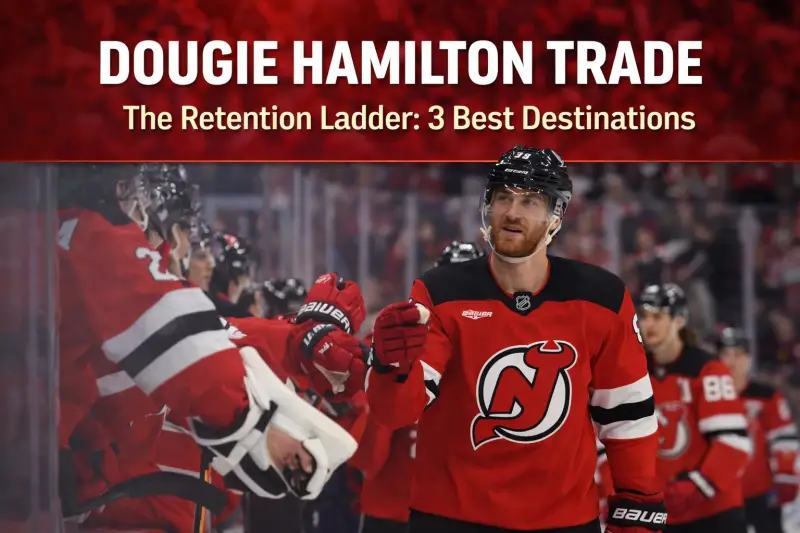
Dougie Hamilton Trade: 3 Best Devils Destinations Ranked
Dougie Hamilton's $9 million cap hit makes him the hardest defenseman to trade this offseason. Our Retention Ladder framework shows how Devils salary retention at 0%, 25%, or 50% unlocks three completely different tiers of trade destinations — from cap-floor rebuilders to elite Cup contenders.
Live updates
No updates yet. Refreshing automatically.
Dougie Hamilton's $9 million cap hit has turned into the NHL's most complex offseason puzzle. The New Jersey Devils defenseman has been a trade candidate since the midseason scratch that signaled the fracture between player and organization, and now — with the Devils clinging to fading playoff hopes at 39-34-2 and GM Tom Fitzgerald publicly stating he'll look to "shake one of those defensemen loose" this summer — the question isn't whether Hamilton gets traded. It's where. And the answer depends entirely on how much money the Devils are willing to eat.
I've been tracking Hamilton's market for months, cross-referencing cap situations, trade protection details, and insider projections from Chris Johnston, Darren Dreger, and Elliotte Friedman. What emerged isn't a simple list of three teams. It's a framework I'm calling The Retention Ladder — a tiered model showing how different levels of Devils salary retention mechanics unlock completely different classes of trade destinations. The higher New Jersey climbs that ladder, the better the landing spot for Hamilton. But the worse the return package gets for Fitzgerald. That tension defines the most interesting defenseman trade of the 2026 offseason — and it echoes a growing trend of veteran stars navigating complicated trade markets across the league.
Hamilton has changed organizations three times already — from Boston to Calgary to Carolina to New Jersey. Each move came amid organizational frustration. Each time, Hamilton landed somewhere he believed was better. Whether that pattern holds depends on which rung of the Retention Ladder the Devils are willing to climb.
Key Takeaways
- Hamilton is getting traded this summer: Devils GM Tom Fitzgerald confirmed intent to move a defenseman. Hamilton's $9M cap hit and strained locker room relationship make him the obvious candidate.
- The Retention Ladder controls everything: At 0% retention ($9M hit), only cap-floor teams bite. At 25% ($6.75M), playoff contenders enter the market. At 50% ($4.5M), elite Cup favorites start calling.
- Carolina is the most likely destination: The Athletic's Chris Johnston projects Hamilton back to the Hurricanes, where he spent three productive seasons and left on good terms as a free agent in 2021.
- Toronto's hometown pull is real but expensive: Hamilton was born in Toronto and has a pre-existing relationship with Leafs GM Brad Treliving from their Calgary days — but the Leafs need 50% retention to make the cap math work.
- July 1 is the hard deadline: Hamilton is owed a $7.4 million signing bonus on July 1, 2026. The Devils need to complete a trade before that check is cut, or they lose significant leverage and absorb a massive sunk cost.
The $9 Million Problem — Why Hamilton Must Move This Summer
The Devils' 2025-26 season has been a slow-motion identity crisis. At 39-34-2 with 80 points and sitting four points outside the wild card with seven games remaining, New Jersey is too talented to tank and too flawed to contend — the worst possible purgatory for a franchise that made the playoffs just last spring before losing to Carolina in the first round. Tom Fitzgerald is running out of runway. One playoff series win in five years isn't the résumé that earns extensions, and the organizational pressure is mounting from every direction.
Hamilton sits at the center of the financial problem. His $9 million AAV represents the largest defensive contract on the roster — a seven-year, $63 million commitment that runs through 2027-28. With RFAs Simon Nemec and Arseny Gritsyuk needing new deals this summer, that $9 million needs to be redirected toward the players who represent the Devils' future, not their past. Fitzgerald was blunt about the math: he'll be looking to move a defenseman once the offseason opens.
The on-ice case for trading Hamilton is more nuanced than the cap arithmetic. In 2022-23, Hamilton was a Norris Trophy-caliber defenseman — 22 goals, 74 points, sixth in Norris voting. That feels like a different player now. A pectoral injury in 2023-24 robbed him of first-step explosiveness, and his production has declined steadily: from 74 points to 33 this season across 69 games with a minus-7 rating. The shot volume is still there — 184 shots on net, 81 hits, 72 blocked shots — and he posted 12 points with a +1 rating in 16 games after the Olympic break, suggesting the talent hasn't evaporated entirely. But at 32, the trajectory is pointing the wrong direction for a player earning top-pair money.
"Hamilton's agent, J.P. Barry, considers the scratch a business move designed to push Hamilton toward accepting a trade to a team outside his preferred list."
— Elliotte Friedman, Sportsnet Saturday Headlines (via Pucks and Pitchforks)Then there's the relationship. Hamilton was healthy-scratched in January — a stunning move for a $9 million defenseman that sent shockwaves through the locker room. Friedman reported on Sportsnet's Saturday Headlines that the Devils had found a trade partner last summer in the San Jose Sharks, but Hamilton blocked the deal using his 10-team no-trade list. The scratch felt retaliatory. Hamilton's agent, J.P. Barry, went public — telling reporters his client would be flexible beyond the 10-team list "for the right destination." That's not the language of a player who expects to be in New Jersey next October. The marriage is over. Now it's about the terms of the divorce.
The Retention Ladder — How Salary Retention Reshapes Hamilton's Entire Market
Here's where most Hamilton trade articles get it wrong. They list three or five destinations and analyze the hockey fit without ever addressing the mechanism that controls everything: salary retention. The Devils' willingness to retain 0%, 25%, or 50% of Hamilton's $9 million AAV doesn't just change the cap math. It fundamentally transforms who can bid, what they'll offer in return, and whether the trade happens at all.
I've mapped this into what I'm calling The Retention Ladder — a three-tier framework showing how each step up the retention scale opens a new class of trade partner while simultaneously diminishing the return package the Devils can expect.
| Retention Level | Effective Cap Hit | Unlocked Destinations | Likely Return to Devils | Trade Probability |
|---|---|---|---|---|
| 0% (Full $9M) | $9,000,000 | San Jose, Utah | Late pick + salary dump swap | Low |
| 25% ($6.75M) | $6,750,000 | Carolina, Pittsburgh, Anaheim | 2nd-round pick + B-prospect | Medium |
| 50% ($4.5M) | $4,500,000 | Toronto, Dallas, Colorado | 1st-round pick + quality prospect | High |
The bottom rung — zero retention — limits the Devils to teams sitting near the salary cap floor who can absorb the full $9 million without financial pain. San Jose has the room for it, which would be the cleanest possible outcome for Fitzgerald. But Hamilton already blocked a proposed Sharks deal last summer, and while San Jose has taken a step forward this season, there's no guarantee he changes his mind. Utah is another option at full freight, but the Western Conference location clashes with Hamilton's known preference for East Coast proximity to his Toronto hometown.
The middle rung — 25% retention, knocking the effective hit to $6.75 million — is where the market gets genuinely interesting. Carolina, Pittsburgh, and Anaheim all enter the conversation at this price point. The Devils eat $2.25 million per year for two seasons, which is painful but manageable if the return package includes a draft pick and a prospect with upside.
The top rung — 50% retention at $4.5 million — is where elite contenders start bidding. Toronto, Dallas, and potentially Colorado can absorb a $4.5 million defenseman without restructuring their rosters. The return at this tier should be significantly better: a first-round pick, a quality prospect, maybe both. But the Devils are then paying $4.5 million per year for two seasons to not have Dougie Hamilton on their roster. That's the tension at every rung of the ladder — and it's why Fitzgerald's decision will define New Jersey's offseason more than any other move he makes.
"I will be looking to shake one of those defensemen loose in the offseason."
— Tom Fitzgerald, Devils GM (via All About The Jersey)Destination 1 — Carolina Hurricanes: The Reunion That Makes Too Much Sense
The Athletic's Chris Johnston projects Hamilton back to Carolina, and it's hard to argue with the logic. Hamilton spent three of his best seasons in Raleigh from 2018 to 2021 — a span that included a career-high 40 points in 47 games during the shortened 2020-21 campaign and back-to-back years of 17+ goal production. He left as a free agent for the Devils' $63 million offer, not because the relationship soured. That distinction matters enormously in trade dynamics. Hamilton knows the coaching staff, the puck-possession system, and the locker room culture. There's no adjustment period, no learning curve, no chemistry experiments. He walks in and fits on Day 1.
The cap math works cleanly at the 25% retention level. Carolina is projected to carry roughly $8.4 million in cap space heading into the offseason, and a $6.75 million effective hit slots in without requiring roster gymnastics. The Hurricanes already have an elite blue line — Jaccob Slavin, K'Andre Miller (acquired from the Rangers in last summer's blockbuster sign-and-trade), Shayne Gostisbehere on the power play, and the recently signed Alexander Nikishin — but Hamilton adds a right-shot dimension that none of those players provide. His ability to quarterback a second power-play unit from the right circle gives Carolina a weapon they haven't had since Hamilton left five years ago.
A realistic return framework looks like this: a 2026 first-round pick and a B-level prospect — someone in the tier just outside Carolina's untouchable core. The Hurricanes have the prospect depth to make this trade without gutting their pipeline, and they have the organizational patience to absorb Hamilton's remaining term knowing his contract expires after 2027-28. There's no long-term cap risk here. It's two years of a known commodity in a system he's already proven he can dominate.
The NTC factor seals it. Hamilton left Carolina on excellent terms — this wasn't a messy breakup like Boston or a cold war like New Jersey. The Hurricanes are almost certainly on his 10-team trade list. No waiver negotiation, no leverage game, no agent theatrics. Both sides want this.
Retention Ladder position: Rung 2 (25% retention / $6.75M effective cap hit)
Destination 2 — Toronto Maple Leafs: The Hometown Gravitational Pull
Hamilton was born in Toronto and grew up in St. Catharines, Ontario — less than two hours from Scotiabank Arena. His general manager in Calgary from 2015 to 2018 was Brad Treliving, the same Brad Treliving now running the Maple Leafs' front office. Treliving was the executive who originally traded for Hamilton in 2015, sending a first-round pick and two seconds to Boston to acquire him. He saw Hamilton's potential before anyone outside of New England did. That combination of hometown roots and front-office familiarity makes Toronto the most emotionally compelling destination on this list — even if the cap math makes it the most complicated.
The Leafs' defensive need is urgent and well-documented. Chris Tanev's injury exposed how thin Toronto's blue line becomes without its top shutdown option, and the team desperately needs someone who can quarterback the defensive unit. Hamilton's 184 shots on goal and 11 goals this season prove his offensive instincts haven't eroded. On a Leafs power play loaded with forward talent, Hamilton becomes the point-shot triggerman the unit has been missing — the kind of player who can change a game from the blue line in ways Toronto hasn't had since the Auston Matthews injury reshuffled the team's offensive priorities.
But the cap hit is a serious problem. Toronto can't absorb $9 million. They probably can't absorb $6.75 million either. This is a 50% retention scenario — the top rung of the Retention Ladder — where the Devils eat $4.5 million per year and Hamilton appears on the Leafs' cap sheet at a manageable number. Even then, Toronto likely needs to send a roster player back to balance the money. The return at this retention level should be meaningful: a mid-to-late first-round pick (the Leafs project as a contender, so the pick won't be in the lottery) plus the salary-matching piece heading to New Jersey.
The Treliving connection is consistently underrated in media coverage. Every analysis of the Leafs' front-office strategy points toward aggressive offseason moves to upgrade the roster around their remaining core. Treliving knows Hamilton's work habits, his personality, his strengths and limitations — that level of intel eliminates the scouting risk that makes $9 million defensemen terrifying trade targets. It's also why Toronto keeps surfacing in every Hamilton conversation despite the financial obstacles. The relationship between GM and player is the X-factor that cap spreadsheets can't capture.
Retention Ladder position: Rung 3 (50% retention / $4.5M effective cap hit)
Destination 3 — Dallas Stars: The Missing Puzzle Piece for a Cup Run
This is the dark horse — and the best pure hockey fit on the entire list. Dallas has been searching for an offensive right-shot defenseman to complement Miro Heiskanen, and Hamilton is exactly the archetype Jim Nill's front office has been targeting for three trade cycles running. Picture the pairing: Heiskanen handling the shutdown minutes and transition game on the left side while Hamilton runs the right-side power play, generates offense from the point, and provides the shot-creation element the Stars' blue line currently lacks. That's an elite, complementary D pair — one that addresses Dallas's biggest structural weakness without disrupting anything that already works.
The Stars reached the Stanley Cup Final in 2024 and remain a legitimate contender in the Western Conference. Hamilton's career history suggests he performs best when surrounded by elite talent on a winning team — his Norris-caliber 74-point season in 2022-23 came precisely when the Devils were unexpectedly competitive and the energy in the building was electric. Dallas would provide that environment again, with a deeper roster and a more proven playoff core than anything Hamilton has played behind since his Carolina years.
The cap math sits somewhere between the middle and top rung of the Retention Ladder — likely 25 to 50% retention depending on Dallas's other offseason commitments. The Stars have a deep prospect pipeline, which means the return package to New Jersey could be stronger than what Carolina offers. A first-round pick plus a legitimate prospect isn't unreasonable if the Devils agree to retain at the higher level.
The wildcard is Hamilton's 10-team trade list. Dallas is a Western Conference destination, and Hamilton has demonstrated a clear preference for East Coast teams closer to his Toronto hometown — that preference is exactly what torpedoed the San Jose deal last summer. But there's a meaningful difference between the rebuilding Sharks and a Cup-contending Stars roster. If J.P. Barry can frame Dallas as the best chance Hamilton has at a deep playoff run — potentially the first real postseason success of his career — the geography becomes a secondary concern. The Western Conference is wide open heading into the offseason, and a Hamilton–Heiskanen pairing could be the difference between a second-round exit and a conference final berth.
Retention Ladder position: Rung 2-3 (25-50% retention / $4.5M-$6.75M effective cap hit)
The Verdict — Which Rung Wins?
If I'm ranking these destinations by probability, it's Carolina first, Toronto second, Dallas third. The Hurricanes check every box: system familiarity, cap fit at a reasonable 25% retention level, NTC compliance almost guaranteed, and a return package that won't embarrass Fitzgerald in front of ownership. Johnston's projection from The Athletic carries weight precisely because it's backed by every structural advantage in the trade. Carolina isn't the sexiest answer. It's the right one.
Toronto is the most dramatic outcome and the one that generates the most headlines. Hamilton coming home to play for the team he grew up watching, reunited with the GM who first believed in him — that's a narrative the league's marketing department would love. But the 50% retention requirement makes it genuinely expensive for a Devils franchise whose entire offseason strategy revolves around freeing up cap space, not committing more dead money to a player wearing someone else's sweater. If Treliving can engineer a creative salary-matching structure — involving a roster player heading back to New Jersey who fills a real need — the deal becomes viable. Otherwise, the Retention Ladder math favors Carolina every time.
Dallas is the best hockey fit but the hardest deal to close. Hamilton's East Coast preference and the NTC mechanics create friction that neither Carolina nor Toronto have to navigate. Still, Jim Nill is one of the league's most aggressive and creative offseason operators. The Heiskanen–Hamilton pairing is too compelling on paper to dismiss entirely, and if Dallas makes a strong enough case directly to Hamilton and his agent, the geography concern might dissolve.
One date matters more than any destination name: July 1, 2026. That's when Hamilton is owed a $7.4 million signing bonus. If the Devils haven't completed a trade before that check is cut, they absorb a massive sunk cost and lose the financial urgency that drives the other side to close quickly. Fitzgerald knows this. Every GM calling about Hamilton knows this. The Retention Ladder dictates where Hamilton lands. The calendar dictates when. Expect a deal by late June — and expect the Devils to climb at least to the second rung before they shake hands.
Sources and Reporting
- TSN — Hamilton willing to be flexible beyond 10-team trade list; agent J.P. Barry quotes on scratching
- Puckpedia — Hamilton contract details ($9M AAV), NTC structure, salary and bonus breakdown
- Pucks and Pitchforks — Comprehensive trade status overview, Friedman Saturday Headlines reporting, Sharks blocked trade details
- NHL Trade Rumors — Reference article on Hamilton's potential trade destinations
- Toronto Hockey Daily — Maple Leafs defensive upgrade analysis, Treliving–Hamilton connection
- All About The Jersey — Fitzgerald offseason quotes, organizational overhaul analysis
- ClutchPoints — Trade destination analysis, Pittsburgh/Utah/Chicago scenarios
- Spotrac — Salary breakdown, July 1 bonus verification, year-by-year compensation
- Hockey-Reference — Career statistics, season-by-season performance data
The Retention Ladder tells you everything about where Dougie Hamilton ends up this summer. Not the team's system, not the coach's preferences, not even the player's hometown connections. In a salary-cap league, money moves first and everything else follows. The Devils control the ladder. Hamilton controls the list. And July 1 controls the clock. Whichever franchise figures out how to satisfy all three constraints first gets a 6-foot-6, right-shot defenseman who — even at 32, even after the pectoral injury, even after the scratching and the drama — can still change a power play and a playoff series. Carolina is the smart bet. Toronto is the romantic one. Dallas is the hockey purist's dream. My money is on smart.
What is Dougie Hamilton's contract and cap hit?
Hamilton is signed through 2027-28 on a seven-year, $63 million contract with a $9 million average annual value. His deal includes a modified no-movement clause that converted to a 10-team trade list starting in 2025-26. He is owed a $7.4 million signing bonus on July 1, 2026, which creates a hard deadline for the Devils to complete any trade before absorbing that sunk cost.
Does Dougie Hamilton have a no-trade clause?
Yes. Hamilton's contract includes a modified NMC with a 10-team trade list, meaning he can block trades to 21 of 32 NHL teams. However, his agent J.P. Barry has publicly stated that Hamilton is willing to be flexible beyond the 10-team list "for the right destination." The failed Sharks trade last summer — which Hamilton blocked using his NTC — demonstrates he will use the protection when the fit isn't right, but the door is open for compelling offers.
Which team is the most likely trade destination for Dougie Hamilton?
The Athletic's Chris Johnston projects the Carolina Hurricanes as the most likely landing spot. Hamilton spent three productive seasons in Raleigh from 2018 to 2021 and left on good terms as a free agent. The Hurricanes have approximately $8.4 million in projected cap space and the prospect depth to construct a compelling return package. With 25% salary retention from the Devils, the effective cap hit drops to $6.75 million — well within Carolina's budget and requiring no roster gymnastics to accommodate.
Would the Devils need to retain salary in a Hamilton trade?
Almost certainly. Hamilton's $9 million AAV makes him nearly impossible to move at full salary. At 0% retention, only cap-floor teams like San Jose or Utah can absorb the full hit — and Hamilton already blocked a Sharks deal once. At 25% retention ($6.75M effective), contenders like Carolina and Pittsburgh enter the market. At 50% retention ($4.5M effective), elite Cup favorites like Toronto and Dallas become realistic destinations. The trade-off is clear: more retention means a better destination but a worse return package for New Jersey.
How has Dougie Hamilton played in 2025-26?
Hamilton has recorded 11 goals and 33 points in 69 games with a minus-7 rating, averaging 21:39 of ice time per game. While those numbers are well below his Norris-caliber 2022-23 season (74 points, 22 goals), he showed significant improvement after the Olympic break — posting 12 points and a +1 rating in 16 games. It marks his first double-digit goal season since 2022-23, and his 184 shots on net suggest the offensive instincts remain intact even as overall production has declined from peak levels.
Frequently Asked Questions
Key Takeaways Hamilton is getting traded this summer: Devils GM Tom Fitzgerald confirmed intent to move a defenseman. Hamilton's $9M cap hit and strained locker room relationship make him the obvious candidate. The Retention Ladder controls everything: At 0% retention ($9M hit), only cap-floor teams bite. At 25% ($6.75M), playoff contenders enter the market. At 50% ($4.5M), elite Cup favorites start calling. Carolina is the most likely destination: The Athletic's Chris Johnston projects Hamilton back to the Hurricanes, where he spent three productive seasons and left on good terms as a free agent in 2021. Toronto's hometown pull is real but expensive: Hamilton was born in Toronto and has a pre-existing relationship with Leafs GM Brad Treliving from their Calgary days — but the Leafs need 50% retention to make the cap math work. July 1 is the hard deadline: Hamilton is owed a $7.4 million signing bonus on July 1, 2026. The Devils need to complete a trade before that check is cut, or they lose significant leverage and absorb a massive sunk cost. The $9 Million Problem — Why Hamilton Must Move This Summer The Devils' 2025-26 season has been a slow-motion identity crisis. At 39-34-2 with 80 points and sitting four points outside the wild card with seven games remaining, New Jersey is too talented to tank and too flawed to contend — the worst possible purgatory for a franchise that made the playoffs just last spring before losing to Carolina in the first round. Tom Fitzgerald is running out of runway. One playoff series win in five years isn't the résumé that earns extensions, and the organizational pressure is mounting from every direction. Hamilton sits at the center of the financial problem. His $9 million AAV represents the largest defensive contract on the roster — a seven-year, $63 million commitment that runs through 2027-28. With RFAs Simon Nemec and Arseny Gritsyuk needing new deals this summer, that $9 million needs to be redirected toward the players who represent the Devils' future, not their past. Fitzgerald was blunt about the math: he'll be looking to move a defenseman once the offseason opens. The on-ice case for trading Hamilton is more nuanced than the cap arithmetic. In 2022-23, Hamilton was a Norris Trophy-caliber defenseman — 22 goals, 74 points, sixth in Norris voting. That feels like a different player now. A pectoral injury in 2023-24 robbed him of first-step explosiveness, and his production has declined steadily: from 74 points to 33 this season across 69 games with a minus-7 rating. The shot volume is still there — 184 shots on net, 81 hits, 72 blocked shots — and he posted 12 points with a +1 rating in 16 games after the Olympic break, suggesting the talent hasn't evaporated entirely. But at 32, the trajectory is pointing the wrong direction for a player earning top-pair money. "Hamilton's agent, J.P. Barry, considers the scratch a business move designed to push Hamilton toward accepting a trade to a team outside his preferred list." — Elliotte Friedman, Sportsnet Saturday Headlines (via Pucks and Pitchforks) Then there's the relationship. Hamilton was healthy-scratched in January — a stunning move for a $9 million defenseman that sent shockwaves through the locker room. Friedman reported on Sportsnet's Saturday Headlines that the Devils had found a trade partner last summer in the San Jose Sharks, but Hamilton blocked the deal using his 10-team no-trade list. The scratch felt retaliatory. Hamilton's agent, J.P. Barry, went public — telling reporters his client would be flexible beyond the 10-team list "for the right destination." That's not the language of a player who expects to be in New Jersey next October. The marriage is over. Now it's about the terms of the divorce. The Retention Ladder — How Salary Retention Reshapes Hamilton's Entire Market Here's where most Hamilton trade articles get it wrong. They list three or five destinations and analyze the hockey fit without ever addressing the mechanism that controls everything: salary retention. The Devils' willingness to retain 0%, 25%, or 50% of Hamilton's $9 million AAV doesn't just change the cap math. It fundamentally transforms who can bid, what they'll offer in return, and whether the trade happens at all. I've mapped this into what I'm calling The Retention Ladder — a three-tier framework showing how each step up the retention scale opens a new class of trade partner while simultaneously diminishing the return package the Devils can expect. Retention LevelEffective Cap HitUnlocked DestinationsLikely Return to DevilsTrade Probability 0% (Full $9M)$9,000,000San Jose, UtahLate pick + salary dump swapLow 25% ($6.75M)$6,750,000Carolina, Pittsburgh, Anaheim2nd-round pick + B-prospectMedium 50% ($4.5M)$4,500,000Toronto, Dallas, Colorado1st-round pick + quality prospectHigh The bottom rung — zero retention — limits the Devils to teams sitting near the salary cap floor who can absorb the full $9 million without financial pain. San Jose has the room for it, which would be the cleanest possible outcome for Fitzgerald. But Hamilton already blocked a proposed Sharks deal last summer, and while San Jose has taken a step forward this season, there's no guarantee he changes his mind. Utah is another option at full freight, but the Western Conference location clashes with Hamilton's known preference for East Coast proximity to his Toronto hometown. The middle rung — 25% retention, knocking the effective hit to $6.75 million — is where the market gets genuinely interesting. Carolina, Pittsburgh, and Anaheim all enter the conversation at this price point. The Devils eat $2.25 million per year for two seasons, which is painful but manageable if the return package includes a draft pick and a prospect with upside. The top rung — 50% retention at $4.5 million — is where elite contenders start bidding. Toronto, Dallas, and potentially Colorado can absorb a $4.5 million defenseman without restructuring their rosters. The return at this tier should be significantly better: a first-round pick, a quality prospect, maybe both. But the Devils are then paying $4.5 million per year for two seasons to not have Dougie Hamilton on their roster. That's the tension at every rung of the ladder — and it's why Fitzgerald's decision will define New Jersey's offseason more than any other move he makes. "I will be looking to shake one of those defensemen loose in the offseason." — Tom Fitzgerald, Devils GM (via All About The Jersey) Destination 1 — Carolina Hurricanes: The Reunion That Makes Too Much Sense The Athletic's Chris Johnston projects Hamilton back to Carolina, and it's hard to argue with the logic. Hamilton spent three of his best seasons in Raleigh from 2018 to 2021 — a span that included a career-high 40 points in 47 games during the shortened 2020-21 campaign and back-to-back years of 17+ goal production. He left as a free agent for the Devils' $63 million offer, not because the relationship soured. That distinction matters enormously in trade dynamics. Hamilton knows the coaching staff, the puck-possession system, and the locker room culture. There's no adjustment period, no learning curve, no chemistry experiments. He walks in and fits on Day 1. The cap math works cleanly at the 25% retention level. Carolina is projected to carry roughly $8.4 million in cap space heading into the offseason, and a $6.75 million effective hit slots in without requiring roster gymnastics. The Hurricanes already have an elite blue line — Jaccob Slavin, K'Andre Miller (acquired from the Rangers in last summer's blockbuster sign-and-trade), Shayne Gostisbehere on the power play, and the recently signed Alexander Nikishin — but Hamilton adds a right-shot dimension that none of those players provide. His ability to quarterback a second power-play unit from the right circle gives Carolina a weapon they haven't had since Hamilton left five years ago. A realistic return framework looks like this: a 2026 first-round pick and a B-level prospect — someone in the tier just outside Carolina's untouchable core. The Hurricanes have the prospect depth to make this trade without gutting their pipeline, and they have the organizational patience to absorb Hamilton's remaining term knowing his contract expires after 2027-28. There's no long-term cap risk here. It's two years of a known commodity in a system he's already proven he can dominate. The NTC factor seals it. Hamilton left Carolina on excellent terms — this wasn't a messy breakup like Boston or a cold war like New Jersey. The Hurricanes are almost certainly on his 10-team trade list. No waiver negotiation, no leverage game, no agent theatrics. Both sides want this. Retention Ladder position: Rung 2 (25% retention / $6.75M effective cap hit) Destination 2 — Toronto Maple Leafs: The Hometown Gravitational Pull Hamilton was born in Toronto and grew up in St. Catharines, Ontario — less than two hours from Scotiabank Arena. His general manager in Calgary from 2015 to 2018 was Brad Treliving, the same Brad Treliving now running the Maple Leafs' front office. Treliving was the executive who originally traded for Hamilton in 2015, sending a first-round pick and two seconds to Boston to acquire him. He saw Hamilton's potential before anyone outside of New England did. That combination of hometown roots and front-office familiarity makes Toronto the most emotionally compelling destination on this list — even if the cap math makes it the most complicated. The Leafs' defensive need is urgent and well-documented. Chris Tanev's injury exposed how thin Toronto's blue line becomes without its top shutdown option, and the team desperately needs someone who can quarterback the defensive unit. Hamilton's 184 shots on goal and 11 goals this season prove his offensive instincts haven't eroded. On a Leafs power play loaded with forward talent, Hamilton becomes the point-shot triggerman the unit has been missing — the kind of player who can change a game from the blue line in ways Toronto hasn't had since the Auston Matthews injury reshuffled the team's offensive priorities. But the cap hit is a serious problem. Toronto can't absorb $9 million. They probably can't absorb $6.75 million either. This is a 50% retention scenario — the top rung of the Retention Ladder — where the Devils eat $4.5 million per year and Hamilton appears on the Leafs' cap sheet at a manageable number. Even then, Toronto likely needs to send a roster player back to balance the money. The return at this retention level should be meaningful: a mid-to-late first-round pick (the Leafs project as a contender, so the pick won't be in the lottery) plus the salary-matching piece heading to New Jersey. The Treliving connection is consistently underrated in media coverage. Every analysis of the Leafs' front-office strategy points toward aggressive offseason moves to upgrade the roster around their remaining core. Treliving knows Hamilton's work habits, his personality, his strengths and limitations — that level of intel eliminates the scouting risk that makes $9 million defensemen terrifying trade targets. It's also why Toronto keeps surfacing in every Hamilton conversation despite the financial obstacles. The relationship between GM and player is the X-factor that cap spreadsheets can't capture. Retention Ladder position: Rung 3 (50% retention / $4.5M effective cap hit) Destination 3 — Dallas Stars: The Missing Puzzle Piece for a Cup Run This is the dark horse — and the best pure hockey fit on the entire list. Dallas has been searching for an offensive right-shot defenseman to complement Miro Heiskanen, and Hamilton is exactly the archetype Jim Nill's front office has been targeting for three trade cycles running. Picture the pairing: Heiskanen handling the shutdown minutes and transition game on the left side while Hamilton runs the right-side power play, generates offense from the point, and provides the shot-creation element the Stars' blue line currently lacks. That's an elite, complementary D pair — one that addresses Dallas's biggest structural weakness without disrupting anything that already works. The Stars reached the Stanley Cup Final in 2024 and remain a legitimate contender in the Western Conference. Hamilton's career history suggests he performs best when surrounded by elite talent on a winning team — his Norris-caliber 74-point season in 2022-23 came precisely when the Devils were unexpectedly competitive and the energy in the building was electric. Dallas would provide that environment again, with a deeper roster and a more proven playoff core than anything Hamilton has played behind since his Carolina years. The cap math sits somewhere between the middle and top rung of the Retention Ladder — likely 25 to 50% retention depending on Dallas's other offseason commitments. The Stars have a deep prospect pipeline, which means the return package to New Jersey could be stronger than what Carolina offers. A first-round pick plus a legitimate prospect isn't unreasonable if the Devils agree to retain at the higher level. The wildcard is Hamilton's 10-team trade list. Dallas is a Western Conference destination, and Hamilton has demonstrated a clear preference for East Coast teams closer to his Toronto hometown — that preference is exactly what torpedoed the San Jose deal last summer. But there's a meaningful difference between the rebuilding Sharks and a Cup-contending Stars roster. If J.P. Barry can frame Dallas as the best chance Hamilton has at a deep playoff run — potentially the first real postseason success of his career — the geography becomes a secondary concern. The Western Conference is wide open heading into the offseason, and a Hamilton–Heiskanen pairing could be the difference between a second-round exit and a conference final berth. Retention Ladder position: Rung 2-3 (25-50% retention / $4.5M-$6.75M effective cap hit) The Verdict — Which Rung Wins? If I'm ranking these destinations by probability, it's Carolina first, Toronto second, Dallas third. The Hurricanes check every box: system familiarity, cap fit at a reasonable 25% retention level, NTC compliance almost guaranteed, and a return package that won't embarrass Fitzgerald in front of ownership. Johnston's projection from The Athletic carries weight precisely because it's backed by every structural advantage in the trade. Carolina isn't the sexiest answer. It's the right one. Toronto is the most dramatic outcome and the one that generates the most headlines. Hamilton coming home to play for the team he grew up watching, reunited with the GM who first believed in him — that's a narrative the league's marketing department would love. But the 50% retention requirement makes it genuinely expensive for a Devils franchise whose entire offseason strategy revolves around freeing up cap space, not committing more dead money to a player wearing someone else's sweater. If Treliving can engineer a creative salary-matching structure — involving a roster player heading back to New Jersey who fills a real need — the deal becomes viable. Otherwise, the Retention Ladder math favors Carolina every time. Dallas is the best hockey fit but the hardest deal to close. Hamilton's East Coast preference and the NTC mechanics create friction that neither Carolina nor Toronto have to navigate. Still, Jim Nill is one of the league's most aggressive and creative offseason operators. The Heiskanen–Hamilton pairing is too compelling on paper to dismiss entirely, and if Dallas makes a strong enough case directly to Hamilton and his agent, the geography concern might dissolve. One date matters more than any destination name: July 1, 2026. That's when Hamilton is owed a $7.4 million signing bonus. If the Devils haven't completed a trade before that check is cut, they absorb a massive sunk cost and lose the financial urgency that drives the other side to close quickly. Fitzgerald knows this. Every GM calling about Hamilton knows this. The Retention Ladder dictates where Hamilton lands. The calendar dictates when. Expect a deal by late June — and expect the Devils to climb at least to the second rung before they shake hands. Sources and Reporting TSN — Hamilton willing to be flexible beyond 10-team trade list; agent J.P. Barry quotes on scratching Puckpedia — Hamilton contract details ($9M AAV), NTC structure, salary and bonus breakdown Pucks and Pitchforks — Comprehensive trade status overview, Friedman Saturday Headlines reporting, Sharks blocked trade details NHL Trade Rumors — Reference article on Hamilton's potential trade destinations Toronto Hockey Daily — Maple Leafs defensive upgrade analysis, Treliving–Hamilton connection All About The Jersey — Fitzgerald offseason quotes, organizational overhaul analysis ClutchPoints — Trade destination analysis, Pittsburgh/Utah/Chicago scenarios Spotrac — Salary breakdown, July 1 bonus verification, year-by-year compensation Hockey-Reference — Career statistics, season-by-season performance data The Retention Ladder tells you everything about where Dougie Hamilton ends up this summer. Not the team's system, not the coach's preferences, not even the player's hometown connections. In a salary-cap league, money moves first and everything else follows. The Devils control the ladder. Hamilton controls the list. And July 1 controls the clock. Whichever franchise figures out how to satisfy all three constraints first gets a 6-foot-6, right-shot defenseman who — even at 32, even after the pectoral injury, even after the scratching and the drama — can still change a power play and a playoff series. Carolina is the smart bet. Toronto is the romantic one. Dallas is the hockey purist's dream. My money is on smart. What is Dougie Hamilton's contract and cap hit?
Hamilton is signed through 2027-28 on a seven-year, $63 million contract with a $9 million average annual value. His deal includes a modified no-movement clause that converted to a 10-team trade list starting in 2025-26. He is owed a $7.4 million signing bonus on July 1, 2026, which creates a hard deadline for the Devils to complete any trade before absorbing that sunk cost.
Does Dougie Hamilton have a no-trade clause?
Yes. Hamilton's contract includes a modified NMC with a 10-team trade list, meaning he can block trades to 21 of 32 NHL teams. However, his agent J.P. Barry has publicly stated that Hamilton is willing to be flexible beyond the 10-team list "for the right destination." The failed Sharks trade last summer — which Hamilton blocked using his NTC — demonstrates he will use the protection when the fit isn't right, but the door is open for compelling offers.
Which team is the most likely trade destination for Dougie Hamilton?
The Athletic's Chris Johnston projects the Carolina Hurricanes as the most likely landing spot. Hamilton spent three productive seasons in Raleigh from 2018 to 2021 and left on good terms as a free agent. The Hurricanes have approximately $8.4 million in projected cap space and the prospect depth to construct a compelling return package. With 25% salary retention from the Devils, the effective cap hit drops to $6.75 million — well within Carolina's budget and requiring no roster gymnastics to accommodate.
Would the Devils need to retain salary in a Hamilton trade?
Almost certainly. Hamilton's $9 million AAV makes him nearly impossible to move at full salary. At 0% retention, only cap-floor teams like San Jose or Utah can absorb the full hit — and Hamilton already blocked a Sharks deal once. At 25% retention ($6.75M effective), contenders like Carolina and Pittsburgh enter the market. At 50% retention ($4.5M effective), elite Cup favorites like Toronto and Dallas become realistic destinations. The trade-off is clear: more retention means a better destination but a worse return package for New Jersey.
How has Dougie Hamilton played in 2025-26?
Hamilton has recorded 11 goals and 33 points in 69 games with a minus-7 rating, averaging 21:39 of ice time per game. While those numbers are well below his Norris-caliber 2022-23 season (74 points, 22 goals), he showed significant improvement after the Olympic break — posting 12 points and a +1 rating in 16 games. It marks his first double-digit goal season since 2022-23, and his 184 shots on net suggest the offensive instincts remain intact even as overall production has declined from peak levels.
Related Stories

NHL Buyout Candidates 2026
The NHL buyout window opens June 15. Rielly, Gallagher, Kotkaniemi, and Frederic are the names in play, but the Dead-Cap Tail means most buy...
By Mike Johnson · 10 min read

Bill Guerin Wild Window Paradox: $17M Meets $1.18M
Wild GM Bill Guerin said 'we're in a window now' and 'you can't trade your way out of problems' five days after a Game 5 collapse. Then Kapr...
By Mike Johnson · 11 min read

Brady Tkachuk Checked Out: The Belief Gap | Senators 2026
Per Frank Seravalli, Brady Tkachuk has been 'checked out in Ottawa.' 3 Olympic goals to 0 playoff points in 60 days. Inside The Belief Gap o...
By Mike Johnson · 9 min read

Kris Knoblauch Oilers Fired? The Cup Final Tax 2026
Per Frank Seravalli, Kris Knoblauch is 'absolutely in the crosshairs' if Oilers lose to Ducks. Two Cup Finals reached. Two wins from termina...
By Mike Johnson · 11 min read
Get NHL trade rumors in your inbox
One email per week. Zero spam. Verified rumors only.