How NHL Overtime Works
How does NHL overtime work? The regular season is a 5-minute 3-on-3 then a shootout; the playoffs are full 5-on-5 sudden death until someone scores. Inside every rule, the shootout, and the loser point that warps the standings: the Three-Point Game.
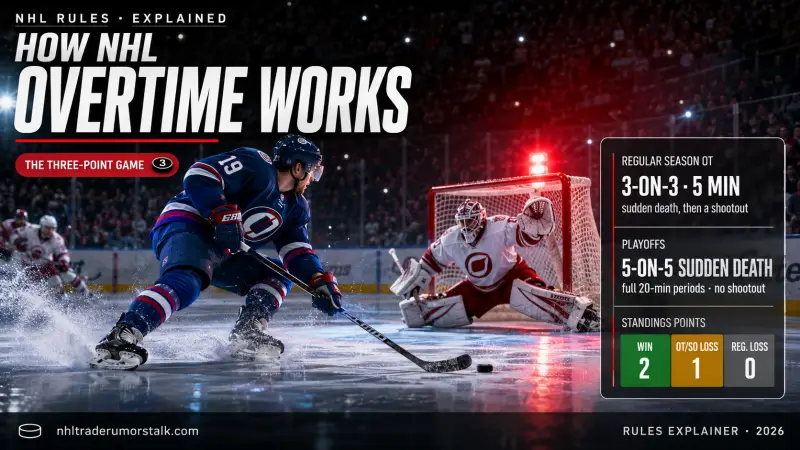
Three points. That is what suddenly sits on the table the moment an NHL game pushes past regulation, and it is the quiet wrinkle that decides playoff races every spring. Here is how NHL overtime works, start to finish: two points go to the winner, and one goes to the team that loses in overtime or a shootout, the famous loser point. A game settled in the third period hands out only two. So overtime does not just decide who wins, it changes how many points even exist. I call that the Three-Point Game.
In the regular season, NHL overtime is a five-minute, three-on-three sudden-death period; if nobody scores, the game goes to a shootout. In the playoffs, overtime is full 20-minute, five-on-five sudden-death periods that repeat until somebody scores, with no shootout ever. A win is worth two points, an overtime or shootout loss is worth one, and a regulation loss is worth zero.
| Figure | What it represents |
|---|---|
| 3 | Standings points an NHL game hands out once it goes past regulation: 2 to the winner, 1 to the overtime or shootout loser |
| 2 | Standings points a game decided in regulation hands out: 2 to the winner, 0 to the loser |
That one-point gap, paid out for losing after 60 minutes, is the whole quirk, and it is why two teams with the same number of wins can finish miles apart in the standings.
Key Takeaways
- Regular-season OT: a five-minute, three-on-three sudden-death period. First goal wins. No goal sends it to a shootout.
- The Three-Point Game: any game that escapes regulation puts three standings points in play instead of two, because the overtime loser still banks one.
- Playoff OT: full 20-minute, five-on-five sudden-death periods that keep going until a goal. No shootout, no limit.
- The shootout: three shooters per side, then sudden-death rounds. It only exists in the regular season.
- ROW is the tiebreaker: regulation plus overtime wins, with shootout wins stripped out, breaks ties in the standings.
How regular-season overtime works
If a regular-season game is tied after 60 minutes, the teams play a five-minute overtime at three skaters per side, plus goalies. It is sudden death, so the first goal ends it. And three-on-three is wild on purpose, all that open ice turns a tie game into a track meet, with odd-man rushes flying both directions.
Here is the part casual fans miss: both teams are guaranteed at least one point the second overtime starts, because nobody can drop to a regulation loss anymore. That safety net changes how teams play, and it is the root of every loser-point argument later in this guide. If the five minutes solve nothing, the game heads to a shootout. The full sudden-death drama plays out on a bigger stage in the playoffs, the kind of stakes our 16-win playoff map breaks down round by round.
| Setting | Format | Length | If still tied |
|---|---|---|---|
| Regular season | 3-on-3 sudden death | 5 minutes | Shootout |
| Playoffs | 5-on-5 sudden death | 20-minute periods, repeat | Keep playing |
How the shootout works
The shootout is a tiebreaker, not really hockey, and it only exists in the regular season. Each coach picks three shooters. They alternate, one skater alone against the goalie, and the home team chooses whether to shoot first or second. Most goals after three rounds wins.
Still tied after three? Then it becomes sudden death of its own, one shooter per side per round, until one team scores and the other does not. A team can roll the same sniper over and over once the named three are used. It is a coin flip dressed up as skill, which is exactly why the league keeps trying to make overtime end before it ever gets here.
How playoff overtime is different
Playoff overtime throws the regular-season rulebook out. There is no three-on-three and no shootout, ever. Instead, the teams play a full 20-minute period at five-on-five, sudden death, and if nobody scores they take a quick intermission and play another full period. They keep going until a puck crosses the line, even if that takes two, three, or more extra periods, the format every series in our playoff schedule and TV guide can swing on.
This is the sheet where legends get made. A single bounce in the second or third overtime ends a season, and a fourth-line winger can become a folk hero on one shift. We saw the purest version of it at the 2026 Olympics, where the gold medal came on a sudden-death winner, the moment our Olympic gold recap was built around. The clock anchored at zero, everyone bone-tired, one shot deciding everything, the barn at its loudest.
The points: where the Three-Point Game lives
Now the part that warps the standings. The NHL awards two points for any win, whether it comes in regulation, overtime, or a shootout. It awards one point for losing in overtime or a shootout. It awards zero for losing in regulation. Read those three lines back and the quirk jumps out: the same loss is worth one point or zero depending only on what time the winning goal goes in.
| Result | Points | Standings code |
|---|---|---|
| Win (regulation, OT, or shootout) | 2 | W |
| Overtime or shootout loss | 1 | OTL |
| Regulation loss | 0 | L |
That extra point for the overtime loser is why a game past regulation is worth three total points and a regulation game is worth two. When ties need breaking, the league reaches for ROW, which stands for regulation plus overtime wins. Shootout wins get stripped out of that number, because the NHL decided in 2010-11 that beating someone in a skills competition should not count as much as beating them while actual hockey is being played. Cap-strapped contenders chase every one of these points, and the math feeds straight into the playoff picture our standings and wild-card tracker follows all season.
Why the loser point is so divisive
The 2025-26 Los Angeles Kings made the whole argument flesh. They set an NHL single-season record for games that ran past regulation, and 20 of their losses came in overtime or a shootout. That is 20 standings points banked for not winning. They finished 35-27-20 for 90 points and slid into the Western playoff bracket on the back of that loser-point pile, the same survival math our look at Buffalo's long playoff exile keeps circling.
Critics hate it because it rewards failing to win and bunches the standings so tightly that bad teams look fine into March. Defenders, including the commissioner, love it for exactly that reason. Speaking in April 2026 as the playoff field firmed up, Gary Bettman said the league has no plans to change the points system, arguing it keeps races tight and games meaningful, per Daily Faceoff. The most-floated fix is a 3-2-1 system: three points for a regulation win, two for an overtime or shootout win, one for an overtime or shootout loss. The same tug-of-war hangs over trophy races too, the way it shadowed our Presidents' Trophy breakdown.
"I would prefer the games to get decided in the overtime, and there's evidence that when you go from 4-on-4 to 3-on-3, it increases the likelihood of a goal in the overtime." — Jarmo Kekalainen, then Columbus GM, via NHL.com (2015)
How the overtime rules got here
None of this arrived at once. Regular-season overtime came back in 1983-84 as a five-minute, five-on-five period, and games could still end in a tie. By the late 1990s too many nights were ending even, so in 1999-2000 the league switched overtime to four-on-four and handed the overtime loser a point to chase decisions. The 2004-05 lockout brought the biggest change: the shootout, introduced for 2005-06, which killed the tie outright. For a decade after that, teams played four-on-four and then shot it out.
The current look arrived in 2015-16, when the league dropped overtime to three-on-three to choke off the shootout it had created. That one had real buy-in around the room.
"This could be very exciting. It's another tweak to the game that could be very fan-friendly." — David Poile, then Nashville GM, via NHL.com (2015)
And they nailed it. Three-on-three made overtime appointment viewing, even if coaches have since learned to slow it down and hold the puck for the perfect look. Rules nerds who like this stuff will enjoy our other explainers on the salary cap, the difference between an NMC and an NTC, and the cap-recapture penalty.
This explainer was written by Mike Johnson, NHL Senior Editor, who has covered the league for 15-plus years. Every rule and date was checked against the NHL's official rulebook and records, ESPN, and contemporaneous NHL.com reporting; the Kings' 2025-26 record was confirmed against the league standings. The "Three-Point Game" is our own framing for the loser-point quirk, introduced in this piece. Published June 2026; last verified against live sources in June 2026. Editorial review: Sarah Chen, Hockey Operations Editor. Corrections: editorial@nhltraderumorstalk.com.
Sources and Reporting
- ESPN: regular-season and playoff overtime rules
- NHL.com: 2015 GM meetings and the 3-on-3 decision
- NHL Records: historical overtime and shootout rule changes
- Daily Faceoff: Bettman on the points system, April 2026
- The Hockey News: the case for and against the loser point
- 2025-26 Kings season record: overtime games and standings
The Verdict: The Three-Point Game
So how does NHL overtime work? Five-minute three-on-three then a shootout in the regular season, endless five-on-five sudden death in the playoffs, and a points system that quietly hands out three points whenever a game escapes regulation. The Three-Point Game is the part that matters most, because it is the reason a wild-card race can hinge on losing the right way. Expect the 3-2-1 system to roar back into the conversation the moment a 90-point team knocks a 95-point team out of a playoff spot. Would you scrap the loser point, or is a tight race worth the weird math?
Frequently Asked Questions
How does overtime work in the NHL?
In the regular season, NHL overtime is a five-minute, three-on-three sudden-death period; the first goal wins, and if nobody scores the game goes to a shootout. In the playoffs, overtime is full 20-minute, five-on-five sudden-death periods that repeat until a team scores, with no shootout.
How long is NHL overtime?
Regular-season overtime is a single five-minute period. Playoff overtime is played in full 20-minute periods that keep repeating until someone scores, so a playoff game can run two, three, or more extra periods with no time limit.
Is there a shootout in the NHL playoffs?
No. The shootout only exists in the regular season. Playoff games are decided by unlimited five-on-five sudden-death overtime, so the teams keep playing full periods until a goal ends it, no matter how long it takes.
What is the loser point in the NHL?
The loser point is the single standings point a team earns for losing in overtime or a shootout, compared with zero points for a regulation loss. It has been part of the NHL since the 1999-2000 season and is why a game past regulation hands out three total points instead of two.
What does ROW mean in NHL standings?
ROW stands for Regulation plus Overtime Wins. It counts a team's wins in regulation and overtime but strips out shootout wins, and it has served as the NHL's first tiebreaker in the standings since the 2010-11 season.
Do you get a point for losing in overtime?
Yes. An overtime or shootout loss earns a team one point, the loser point, while a loss in regulation earns zero. A win is always worth two points, whether it comes in regulation, overtime, or a shootout.
How many points do you get for a win, an overtime loss, and a regulation loss?
Two points for a win, one point for an overtime or shootout loss, and zero points for a regulation loss. That is why a game decided past regulation puts three total points into the standings instead of two.
What is 3-on-3 overtime in the NHL?
Three-on-three overtime is a five-minute, sudden-death period skated with three skaters per side plus goalies. The first goal wins, and if no one scores the game goes to a shootout. The NHL has used 3-on-3 overtime in the regular season since 2015-16.
Related Stories

Most Stanley Cups by Team
The Montreal Canadiens own the most Stanley Cups with 24, ahead of Toronto (13) and Detroit (11). Here is the full all-time list by NHL fran...
By Mike Johnson · 9 min read

NHL Free Agency 2026: Time & How to Watch
NHL free agency 2026 opens at noon ET on Wednesday, July 1. How to watch live on NHL Network and the trackers, who is actually available (Al...
By James Wright · 8 min read

2027 Winter Classic: How to Watch
How to watch the 2027 NHL Winter Classic: the Utah Mammoth host the Colorado Avalanche at Rice-Eccles Stadium on December 31, 2026, in the M...
By Mike Johnson · 8 min read

USA Wins 2026 Olympic Hockey Gold
The United States won the 2026 Olympic men's hockey gold, beating Canada 2-1 in overtime on Jack Hughes' golden goal. Connor Hellebuyck made...
By Mike Johnson · 7 min read
Comments
Be the first to share your take.
Get NHL trade rumors in your inbox
One email per week, zero spam, verified rumors only.