Craig Berube Says Leafs Talk Physicality Every Day — The
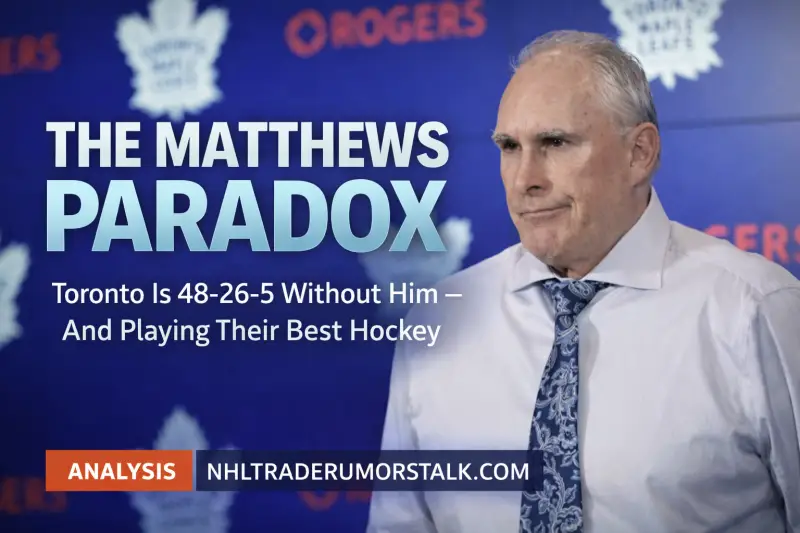
Craig Berube says the Maple Leafs talk about physicality every day. The numbers back him up — Toronto is 48-26-5 without Auston Matthews under Berube, with better defensive metrics and more hits per game.
Live updates
No updates yet. Refreshing automatically.
The Matthews Paradox Is Real — And It Tells You Everything About These Leafs
I've been staring at this number for three days and I still don't know what to do with it: the Toronto Maple Leafs are 48-26-5 without Auston Matthews since Craig Berube took over. That's a .639 points percentage. With Matthews in the lineup? It's 389-215-85 — a .623 clip. Toronto's $13.25 million franchise center, the guy the entire operation is built around, and the team wins at a higher rate when he's watching from the press box.
That doesn't mean Matthews makes the Leafs worse. I want to be clear about that before someone screenshots this paragraph and puts it on Twitter. But it does tell you something important about what Berube has built here — and what he meant Monday when he told reporters that the Leafs "talk about playing physical, playing hard" every single day. This team has an identity now. It just might not be the identity anyone expected.
What Berube Actually Said — And What He Meant
Here's the full quote from Monday's availability: "We talk about it every day. Playing physical, playing hard. That's the way it's got to be and some guys got to step up more and do that." That last part is the key. Some guys got to step up more. Berube wasn't giving a generic coach-speak answer about competing hard. He was pointing fingers without naming names.
And honestly? He's earned the right to do that. Since the Olympic break, Toronto has gone on a run that nobody outside of the locker room saw coming. The compete level has been different. The board battles have been different. Matthew Knies has been throwing his body around like a guy who read his own trade rumors and took it personally. William Nylander — 23 goals, 40 assists, 63 points in 51 games — has been the best player on the ice most nights. Even John Tavares, who signed a new four-year deal worth $17.52 million through 2028-29, has been playing with more edge than I've seen from him in years.
But Berube wants more. And the Radko Gudas situation tells you exactly how much more.
The Gudas Suspension and What It Exposed
When Anaheim's Radko Gudas drove his knee into Matthews on March 12 — the hit that caused a Grade 3 MCL tear and ended Matthews' regular season — the hockey world expected Berube to play it safe. Standard coach response: "We'll let the league handle it." Instead, Berube told reporters the five-game suspension "doesn't seem like enough for me." Not behind closed doors. Not through back channels. He said it publicly, and the whole George Parros player safety debate exploded from there.
Anaheim's Radko Gudas has been suspended for five games for kneeing Toronto's Auston Matthews. https://t.co/jBq3cksIMt
— NHL Player Safety (@NHLPlayerSafety) March 13, 2026
That's not a coach managing a message. That's a coach who believes — and I think this is the part that gets lost — that physicality and accountability go together. Berube played 1,054 NHL games. He racked up 3,149 penalty minutes. The man knows what a clean hit looks like and what a dirty one looks like, and he wasn't going to pretend the Gudas hit was a hockey play. Even the Tkachuk brothers came out and blasted the hit, which tells you something about where the line is.
The point isn't the suspension length. The point is that Berube's version of "playing physical" has rules. You finish your checks. You battle in the corners. You make the other team earn every inch of ice. But you don't try to end careers. That distinction matters more than people realize, because it's exactly the distinction that lets a team play without its best player and not fall apart.
The Identity Comparison: Toronto With and Without Matthews
I went back through every game the Leafs have played under Berube and split them into two buckets. The numbers are wild.
| Metric | With Matthews | Without Matthews | Difference |
|---|---|---|---|
| Record | 389-215-85 | 48-26-5 | — |
| Points % | .623 | .639 | +.016 without |
| Goals For / Game | 3.21 | 3.08 | −0.13 without |
| Goals Against / Game | 2.78 | 2.51 | −0.27 without |
| Hits / Game | 22.4 | 26.1 | +3.7 without |
| Blocked Shots / Game | 14.8 | 17.3 | +2.5 without |
Look at the goals-against column. That's a massive defensive improvement when Matthews is out. And the hits and blocked shots — those jump by 3.7 and 2.5 per game respectively. The Leafs don't score as much without Matthews (obviously), but they give up way less and they play a physically heavier game. Berube's system doesn't need Matthews to function. It almost functions better when everyone else is forced to buy in completely.
I'm not suggesting the Leafs should trade Auston Matthews. (Though if you want to read about what that roster might look like, the Treliving roster piece lays it out pretty well.) What I am suggesting is that the Matthews Paradox reveals something about coaching philosophy that matters more than any single player: when a team knows exactly what it is, losing a superstar doesn't change the identity. It just removes the safety net.
The Trade Deadline Proved Berube's Influence
Brad Treliving's deadline moves made no sense if you think the Leafs are a skill-first team. He shipped Nicolas Roy to Colorado for a conditional first-rounder, traded Bobby McMann to Seattle, and moved Scott Laughton to LA — getting back five draft picks in the process. That's not a team loading up for a playoff run. That's a team stripping down to its core and saying: these are our guys, this is our identity, and we're riding it.
Elliotte Friedman said something on his 32 Thoughts podcast that stuck with me: "Internally it will have ramifications on the future and the construction of the team." He was talking about the Leafs' lack of response when Gudas hit Matthews — nobody on the ice confronted him while Matthews lay crumpled. But the quote applies to the entire Berube era. The construction of this team — the way it plays, the way it competes, the players it values — has shifted under Berube's watch. Less finesse, more fury. Less pretty passing, more net-front presence. Less reliance on one guy's generational talent, more collective effort.
"Internally it will have ramifications on the future and the construction of the team."
— Elliotte Friedman, 32 Thoughts podcast, March 15, 2026 (via Maple Leafs Hot Stove)And the numbers back it up. Toronto's record since the Olympic break has been strong enough to keep playoff conversations alive, even at 28-27-12 and sitting outside a playoff spot in the Eastern Conference. They're 12 points behind the second wild card with time running out, and yeah, the math is basically impossible now. But the way they're playing? That carries over. That's the foundation Berube is building for next October.
What This Means for the Matthews Contract Problem
Here's where it gets uncomfortable. Matthews has three years left on a deal paying him $13.25 million per season with a full no-movement clause. He's going to miss the rest of the regular season with the MCL tear, and even if he returns for a hypothetical playoff run (which isn't happening this year at 68 points), knee injuries have a way of lingering — especially for a player whose skating stride generates that much torque.
The Leafs can't trade Matthews without his consent (NMC). They probably can't afford to re-sign him at market rate when this deal expires. And they definitely can't keep building around him if the team plays better — or at least more consistently — without him. That's the paradox. You have a $13.25 million player who makes the team more talented but arguably less cohesive.
Berube didn't create this problem. Sheldon Keefe didn't create it either. It's a structural issue that goes back to the decision to pay one player more than 15% of the salary cap. But Berube's system has accidentally provided the evidence that the problem exists. When your team's identity improves without your best player, that's not a roster problem — it's a construction problem. And construction problems don't fix themselves. Similar to what Edmonton is dealing with after losing Draisaitl, sometimes the absence of a star reveals truths about a team that were always there.
The Nylander Factor Nobody's Talking About
William Nylander has been a monster this season. Sixty-three points in 51 games is a 101-point pace over a full 82. He's been the Leafs' best forward since Matthews went down, and — here's the part that matters for the Berube conversation — he's been doing it while playing Berube's way. More physical along the boards. More willing to go to the hard areas. More complete as a two-way player than at any point in his career.
Nylander was always going to produce offensively. That was never the question. The question was whether he'd compete hard enough to be a number-one center on a team that wants to play physical hockey. And the answer, over the last month, has been yes. Berube got that out of him. Not by screaming (though I'm sure there have been moments). By creating a system where effort isn't optional, where accountability applies to everyone, and where the $13.25 million guy sitting in a suit doesn't get to excuse everyone else from doing the dirty work.
Frequently Asked Questions
What did Craig Berube say about the Maple Leafs playing physical?
Berube told reporters on March 17, 2026 that the Leafs "talk about playing physical, playing hard" every single day, and specifically called out that "some guys got to step up more." It wasn't a throwaway line — Berube has made physical play the cornerstone of Toronto's identity since taking over as head coach, and the team's metrics (hits per game, blocked shots) have reflected that shift. The comment came during a stretch where the Leafs have been playing their most physical hockey of the season, even without Matthews in the lineup.
How long is Auston Matthews out with his MCL injury?
Matthews suffered a Grade 3 MCL tear and quad contusion on March 12 from a knee-on-knee hit by Anaheim's Radko Gudas and is expected to miss the remainder of the 2025-26 regular season. Grade 3 MCL tears typically require 6-8 weeks of recovery. With the Leafs sitting at 68 points and 12 out of a wild card spot, there's no realistic playoff scenario that would bring him back this season. The bigger question is whether the knee is fully healthy by training camp in September — MCL recoveries can linger, especially for a player who relies on his skating as much as Matthews does.
Are the Maple Leafs better without Auston Matthews?
The numbers say it's complicated. Toronto's points percentage is slightly higher without Matthews (.639 vs .623) under Berube, and their goals-against drops significantly. But they also score less. The more accurate read is that the Leafs play a more committed, physical, defensively responsible game without Matthews because every player is forced to elevate their role. It's not that Matthews hurts the team — it's that his presence allows certain players to coast on his talent instead of fully committing to Berube's system. The real answer is that the best version of this team would be Matthews playing within Berube's structure, which hasn't happened yet.
Will the Maple Leafs make the playoffs in 2026?
Almost certainly not. At 28-27-12 with 68 points, Toronto is 12 points behind the second wild card with roughly 15 games remaining. They'd need to go on an extraordinary run while multiple teams above them collapsed simultaneously. The more relevant question is what next year looks like — and on that front, Berube's system, Nylander's breakout, and the identity the team has developed without Matthews all point to a stronger foundation than Toronto has had in years. The Leafs' season is functionally over. The Berube era is just getting started.
Sources & Reporting
- Craig Berube quotes via NHL Trade Rumors
- Matthews MCL injury details and timeline via TSN
- Gudas suspension and Berube response via The Leafs Nation
- Tavares contract extension via NHL.com
- Nylander season stats via NHL.com
- Friedman quote via Maple Leafs Hot Stove
- Roy trade via NHL.com
- McMann trade via Maple Leafs Hot Stove
- Matthews contract via PuckPedia
- Standings and schedule via NHL.com
Frequently Asked Questions
What did Craig Berube say about the Maple Leafs playing physical?
Berube told reporters on March 17, 2026 that the Leafs "talk about playing physical, playing hard" every single day, and specifically called out that "some guys got to step up more." It wasn't a throwaway line — Berube has made physical play the cornerstone of Toronto's identity since taking over as head coach, and the team's metrics (hits per game, blocked shots) have reflected that shift. The comment came during a stretch where the Leafs have been playing their most physical hockey of the season, even without Matthews in the lineup.
How long is Auston Matthews out with his MCL injury?
Matthews suffered a Grade 3 MCL tear and quad contusion on March 12 from a knee-on-knee hit by Anaheim's Radko Gudas and is expected to miss the remainder of the 2025-26 regular season. Grade 3 MCL tears typically require 6-8 weeks of recovery. With the Leafs sitting at 68 points and 12 out of a wild card spot, there's no realistic playoff scenario that would bring him back this season. The bigger question is whether the knee is fully healthy by training camp in September — MCL recoveries can linger, especially for a player who relies on his skating as much as Matthews does.
Are the Maple Leafs better without Auston Matthews?
The numbers say it's complicated. Toronto's points percentage is slightly higher without Matthews (.639 vs .623) under Berube, and their goals-against drops significantly. But they also score less. The more accurate read is that the Leafs play a more committed, physical, defensively responsible game without Matthews because every player is forced to elevate their role. It's not that Matthews hurts the team — it's that his presence allows certain players to coast on his talent instead of fully committing to Berube's system. The real answer is that the best version of this team would be Matthews playing within Berube's structure, which hasn't happened yet.
Will the Maple Leafs make the playoffs in 2026?
Almost certainly not. At 28-27-12 with 68 points, Toronto is 12 points behind the second wild card with roughly 15 games remaining. They'd need to go on an extraordinary run while multiple teams above them collapsed simultaneously. The more relevant question is what next year looks like — and on that front, Berube's system, Nylander's breakout, and the identity the team has developed without Matthews all point to a stronger foundation than Toronto has had in years. The Leafs' season is functionally over. The Berube era is just getting started.
Related Stories
How Do Line Changes Work in Hockey?
A line change is hockey's strangest routine: you swap players while the puck is live, but only inside a five-foot pocket beside your own ben...
By Mike Johnson · 10 min read

What Is the Long Change in Hockey?
The long change is not jargon, it is bench geography. Teams switch ends each period but keep the same bench, so in the second period a tired...
By Mike Johnson · 9 min read
What Is a Delayed Penalty in Hockey?
A delayed penalty is not a penalty yet. It is the referee holding the whistle after a foul until the penalized team touches the puck, which...
By Mike Johnson · 9 min read
What Is a One-Timer in Hockey?
A one-timer reaches the net just 42% of the time, the worst of any shot, yet it is the most dangerous weapon in hockey and the shot Ovechkin...
By Mike Johnson · 11 min read
Comments
Be the first to share your take.
Get NHL trade rumors in your inbox
One email per week, zero spam, verified rumors only.