Matthew Knies Trade: Why the Leafs' $7.75M Winger Is a Steal
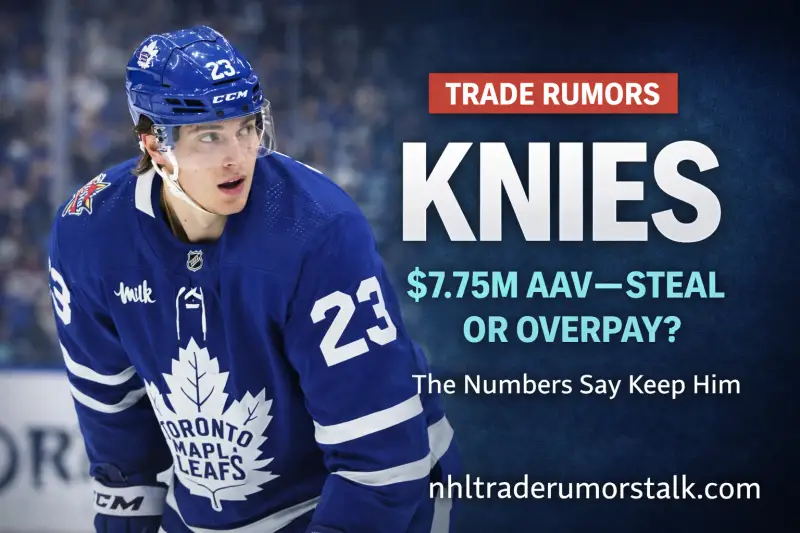
Matthew Knies trade talks were confirmed by Johnston, Pagnotta, and Seravalli. Toronto wanted three first-round calibre assets. At $7.75M AAV, Knies outproduces wingers earning $8.8M — making him one of the best-value contracts in the NHL.
Live updates
No updates yet. Refreshing automatically.
Toronto Listened on Knies — But the Price Says Everything
The Matthew Knies trade rumors aren't going away, and that's exactly what the Maple Leafs want. Toronto discussed trading their 23-year-old power forward at the March 6 deadline — multiple insiders confirmed it — but the asking price Brad Treliving set tells you he never actually intended to move the kid. David Pagnotta of The Fourth Period reported that Toronto wanted "three first-round calibre assets" in return. That's not a trade ask. That's a polite way of saying no.
Chris Johnston of The Athletic confirmed on TSN's OverDrive that Toronto "100% discussed" trading Knies, though it "didn't seem to get to final stages." Frank Seravalli added the same — conversations happened, but he was "not entirely sold" they ever got close.
"Toronto was never shopping Matthew Knies." @DarrenDreger and @reporterchris on Knies being in trade talks with the Maple Leafs #LeafsForever
— OverDrive (@OverDrive1050) March 12, 2026
And Knies himself? He handled it like a guy who understands playing in Toronto.
"I didn't really look into it too much. I feel like, with this market, everyone's kind of almost a target," Knies told reporters. "It's a business."
"Everyone's kind of almost a target. It's a business."
— Matthew Knies, March 2026 (via The Hockey News)Here's the thing nobody's actually asking: is $7.75 million for Matthew Knies even a bad contract? Because I ran the numbers, and the answer might surprise you.
- Knies is on pace for 57+ points as a 23-year-old power forward playing 18:45 per night — and he's been dealing with a nagging injury that's suppressed his production since January
- The Leafs floated his name because they had almost nothing else to offer at the deadline. Nicolas Roy, Bobby McMann, and Scott Laughton were the actual deadline chips — Knies was the "what if" conversation
- Three first-round calibre assets is what Treliving demanded. Not one team came close to meeting that, which is probably the point
- Montreal's "significant deal" that Kent Hughes was working on? Pierre LeBrun says it likely wasn't Knies at all — despite what Nick Kypreos reported. The two insiders directly contradict each other on this
- Toronto sits at 29-27-12 with their season effectively over. But $46.4 million in projected 2026-27 cap space means they don't need to sell core pieces to rebuild
What $7.75M Actually Buys You Right Now
I keep seeing people call the Knies contract an overpay. So I pulled comparable winger deals from around the league to see what $7-9 million per year actually gets you in 2025-26.
| Player | AAV | 2025-26 Stats | Pts/Game |
|---|---|---|---|
| Jake Guentzel (TBL) | $9.0M | 67 pts in 63 GP | 1.06 |
| Matthew Knies (TOR) | $7.75M | 57 pts in 65 GP | 0.88 |
| Nikolaj Ehlers (CAR) | $8.5M | 52 pts in 66 GP | 0.79 |
| Timo Meier (NJD) | $8.8M | 31 pts in 57 GP | 0.54 |
| Brock Boeser (VAN) | $7.3M | 32 pts in 59 GP | 0.54 |
Read that table again. Knies at $7.75M is outproducing Ehlers ($8.5M), absolutely crushing Meier ($8.8M), and lapping Boeser ($7.3M). The only winger clearly ahead of him is Guentzel, who makes $1.25 million more per year. And Guentzel is 31. Knies is 23 with five years of team control remaining.
What kills me is the framing. Everybody's debating whether Toronto should trade Knies without stopping to ask whether his deal is actually good. It is. A 6'3" power forward putting up nearly 60 points at 23, locked in through 2031 at south of $8 million? In a league where Meier gets $8.8M for 31 points? That's not an overpay. That's a bargain that looks better every year the cap goes up.
The Montreal Connection Doesn't Add Up
Kent Hughes went on record after the deadline saying he'd been working on a "significant" deal that fell through — and that it could be revisited this summer. Naturally, half of Toronto assumed it was Knies. Nick Kypreos reported that "the belief around the league" pointed to Knies as the centerpiece.
But LeBrun threw cold water on the whole thing. His reporting suggests Montreal's front office reached out about Knies, but the conversation never advanced very far — and that Hughes's mystery target was likely a different player entirely. Possibly a defenseman, given that Hughes reportedly had his sights set on a blueliner who wasn't available.
If Montreal does circle back this summer, what would the package even look like? Speculation has centered on Kaiden Guhle headlining a return — a 24-year-old right-shot defenseman who addresses Toronto's biggest need. But Guhle alone isn't close to "three first-round calibre assets." You'd need Guhle plus a first-rounder plus a prospect, and I'm not convinced Hughes pays that price for a winger when his own rebuild is still taking shape.
Chicago makes more sense as a trade partner on paper. The Blackhawks have the picks, the prospect capital, and they're years from contending, which means they can absorb Knies's full term. But Kyle Davidson has shown zero interest in paying premium prices for anyone — his entire philosophy is draft-and-develop patience.
Treliving's Real Problem Isn't Knies
Here's where I land on this: the Leafs don't have a Matthew Knies problem. They have a Morgan Rielly problem, a goaltending question mark, and a defense corps that ranked 24th in defenseman scoring this season. Trading a 23-year-old ascending power forward to fix a blue line you neglected for five years is backwards roster construction.
Toronto has $46.4 million in projected 2026-27 cap space. With Matthews coming off LTIR, Nylander locked in, and Knies under contract, the Leafs can sign two quality defensemen AND a goalie this summer without moving a single roster player. The cap space exists. Using Knies as trade bait when you have $46 million to spend in free agency is solving a problem that doesn't require solving.
From where I sit, Treliving floated Knies's name at the deadline for one reason: leverage. If teams think you're willing to move your best young asset, they take your other calls more seriously. The Leafs traded Roy, McMann, and Laughton — the actual expendable pieces — while keeping Knies exactly where he belongs. That's not a GM who wanted to trade his power forward. That's a GM who knows how to work a phone.
Frequently Asked Questions
Is Matthew Knies being traded by the Maple Leafs this summer?
Nothing suggests a Knies trade is imminent. Toronto's asking price of three first-round calibre assets scared off every deadline suitor, and the Leafs' $46.4 million in projected 2026-27 cap space means they don't need to sell core pieces. Knies has five years remaining on his deal at a cap-friendly $7.75M AAV. The only scenario where this changes is if a team like Montreal or Chicago makes a legitimately overwhelming offer — and based on deadline conversations, nobody was willing to go there. One detail worth adding: Nick Robertson is likely walking as an RFA this July, which actually makes Knies more important to Toronto's forward depth, not less.
What would the Maple Leafs want in return for Matthew Knies?
Per David Pagnotta, the price is "three first-round calibre assets — not all first-round picks." That means a combination of a young roster player, a first-round pick, and a high-end prospect. Specifically, Toronto's two biggest needs are a top-four defenseman and forward depth, so any return would need to include a young blueliner of equal promise. Kaiden Guhle (Montreal) has been mentioned as speculative headliner, but even Guhle alone wouldn't be enough.
Which NHL teams have shown interest in Matthew Knies?
Montreal and Chicago have been the most frequently linked destinations. Kent Hughes confirmed working on a "significant deal" at the deadline, though Pierre LeBrun believes that target was likely a different player. The Blackhawks have the draft capital and prospect depth to meet Toronto's asking price but haven't shown urgency to acquire established talent during their rebuild.
How does Knies's contract compare to other NHL wingers?
Knies's six-year, $7.75M AAV deal signed in June 2025 looks increasingly team-friendly. His 0.88 points-per-game pace this season outperforms Nikolaj Ehlers ($8.5M, 0.79 PPG), Timo Meier ($8.8M, 0.54 PPG), and Brock Boeser ($7.3M, 0.54 PPG). Among wingers earning $7-9M, only Jake Guentzel ($9.0M, 1.06 PPG) has been clearly more productive — and Guentzel is eight years older. The 2026 UFA market doesn't have a comparable young power forward available at that price point.
Frequently Asked Questions
Is Matthew Knies being traded by the Maple Leafs this summer?
Nothing suggests a Knies trade is imminent. Toronto's asking price of three first-round calibre assets scared off every deadline suitor, and the Leafs' $46.4 million in projected 2026-27 cap space means they don't need to sell core pieces. Knies has five years remaining on his deal at a cap-friendly $7.75M AAV. The only scenario where this changes is if a team like Montreal or Chicago makes a legitimately overwhelming offer — and based on deadline conversations, nobody was willing to go there. One detail worth adding: Nick Robertson is likely walking as an RFA this July, which actually makes Knies more important to Toronto's forward depth, not less.
What would the Maple Leafs want in return for Matthew Knies?
Per David Pagnotta, the price is "three first-round calibre assets — not all first-round picks." That means a combination of a young roster player, a first-round pick, and a high-end prospect. Specifically, Toronto's two biggest needs are a top-four defenseman and forward depth, so any return would need to include a young blueliner of equal promise. Kaiden Guhle (Montreal) has been mentioned as speculative headliner, but even Guhle alone wouldn't be enough.
Which NHL teams have shown interest in Matthew Knies?
Montreal and Chicago have been the most frequently linked destinations. Kent Hughes confirmed working on a "significant deal" at the deadline, though Pierre LeBrun believes that target was likely a different player. The Blackhawks have the draft capital and prospect depth to meet Toronto's asking price but haven't shown urgency to acquire established talent during their rebuild.
How does Knies's contract compare to other NHL wingers?
Knies's six-year, $7.75M AAV deal signed in June 2025 looks increasingly team-friendly. His 0.88 points-per-game pace this season outperforms Nikolaj Ehlers ($8.5M, 0.79 PPG), Timo Meier ($8.8M, 0.54 PPG), and Brock Boeser ($7.3M, 0.54 PPG). Among wingers earning $7-9M, only Jake Guentzel ($9.0M, 1.06 PPG) has been clearly more productive — and Guentzel is eight years older. The 2026 UFA market doesn't have a comparable young power forward available at that price point.
Related Stories

Hischier Trade Clock Hits July 1
Nico Hischier trade rumors are rising: extension talks with new GM Sunny Mehta are in their infancy, Montreal, LA and Minnesota are circling...
By Mike Johnson · 9 min read

Larkin-Robertson Swap: Who Says No?
Dallas has checked in on Dylan Larkin, but the Stars cannot fit his $8.7M until Jason Robertson and his unsigned $14M ask move out. Inside t...
By Mike Johnson · 11 min read

Darnell Nurse Trade: 4 Suitors
Edmonton wants Darnell Nurse's $9.25M off the books, but a buyout saves barely $1.53M and his no-move clause hands him the pen. The Bonus Sh...
By Mike Johnson · 12 min read

Darren Raddysh Free Agent 2026: 4 Teams
Darren Raddysh's 70-point breakout turned his $975K cap hit into a four-team bidding war. The Athletic linked him to Philadelphia, San Jose,...
By Mike Johnson · 13 min read
Comments
Be the first to share your take.
Get NHL trade rumors in your inbox
One email per week. Zero spam. Verified rumors only.