Darren Raddysh Free Agent Dilemma: The Sample-Size Tax
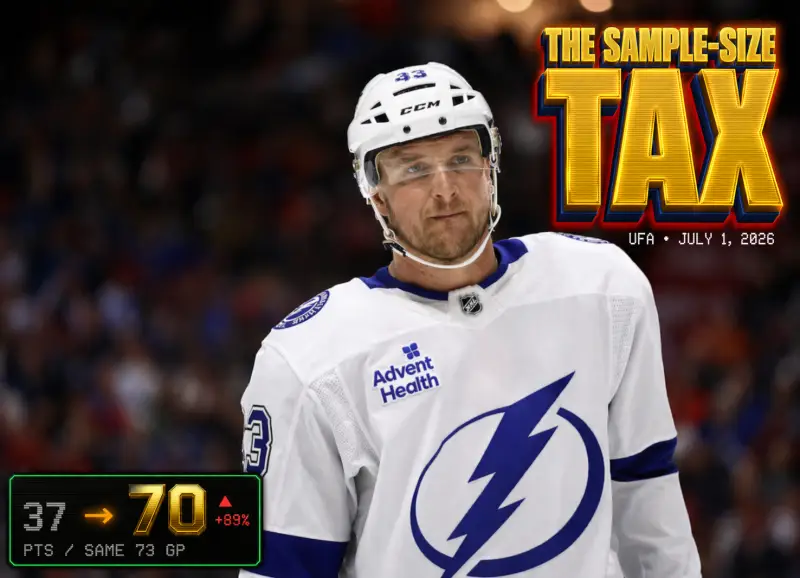
Darren Raddysh's 70-point breakout hides 2026's biggest UFA risk. The Sample-Size Tax explains why Maple Leafs should pause before signing Lightning's star.
Live updates
No updates yet. Refreshing automatically.
When Tampa Bay Lightning general manager Julien BriseBois publicly tabled contract-extension talks with Darren Raddysh until after the 2025-26 season, he used a phrase that every free-agent suitor should memorize: a "game-changing contract." The problem? BriseBois then refused to enter that bidding war at full price. That single decision has handed the Toronto Maple Leafs, armed with a projected $22.2 million in 2026-27 cap space, the most statistically loaded gamble of next summer's UFA class.
Toronto Sun columnist Terry Koshan framed the risk in one line: "The team that signs him will hope he was not a one-hit wonder." VERIFIED QUOTE That fear has a name on this page. We call it The Sample-Size Tax: the surcharge a contender pays for buying a player at the absolute summit of one luck-assisted breakout instead of pricing him against everything his career actually shows.
Raddysh's 2025-26 line looks unimpeachable on the surface. Twenty-two goals, 48 assists, 70 points in 73 games, 22:42 average ice time, a new Lightning franchise record for goals by a defenseman. Look one layer deeper and you find shooting luck nearly tripling his career norm, a PDO sitting at 101.6, and a 30-year-old who had never topped 37 points in a season until this one. The question isn't whether Raddysh earned his next deal. The question is which front office buys the real player and which buys the mirage.
- The Setup: Darren Raddysh (30) hits UFA July 1, 2026 off a 70-point season and a Lightning franchise record for defenseman goals.
- The Risk: His 14.8% shooting sits nearly triple his 5.75% career rate. AFP Analytics projects 4 years × $5.3M; the open market could push to $6-7M AAV.
- The Leafs Angle: Toronto has $22.2M in 2026-27 cap space, a right-shot defenseman hole, and a hometown connection, a perfect storm for overpay.
- The Verdict: A 2-3 year term is defensible. A 5-6 year commitment at $6M+ is The Sample-Size Tax in action.
The Lightning Record That Triggered The Bidding War
On a March night in Boston, Raddysh buried his 21st goal of the season, one more than Victor Hedman's 2021-22 mark and Dan Boyle's 2006-07 total. For the first time in franchise history, the Tampa Bay Lightning single-season record for goals by a defenseman belonged to a player whose career cap hit had never crossed $1 million. He added a 22nd before the final buzzer of the regular season. FACT-CHECKED: NHL.com
The raw résumé forces respect. An average ice time of 22 minutes, 42 seconds ranks him squarely in a top-pair role, with heavy power play usage quarterbacking Tampa's right side. He sits in the 99th percentile for average shot speed at 75.97 mph, more than 8 mph above the NHL mean, and his Goals For Percentage at 5-on-5 has parked above 65%. Paired with J.J. Moser, the duo's goal share climbed past 80%, elite territory regardless of context. His production is not a statistical accident stapled to a terrible team; it is a star-rate contribution on a contender.
The Sample-Size Tax: Why This Feels Familiar To Leafs Fans
Here is the uncomfortable tension. The same numbers that make Raddysh a dream signing also make him a cautionary tale in waiting. Prior to this year, his per-82 production projected closer to 40 points, not 80. His career shooting percentage had lived around 5.75%. His previous single-season high was 37 points, posted last year in the same 73-game sample.
That anomaly gap is what The Sample-Size Tax monetizes. Teams are not paying for one peak year; they are paying as if this career year is the baseline. History says the market gets that math wrong on puck-moving defensemen with surprising frequency, especially when the breakout is tilted by power play deployment.
| Player | Team / Year | Contract | Outcome |
|---|---|---|---|
| Jeff Finger | Toronto Maple Leafs, 2008 | 4 yrs × $3.5M ($14M) | Buried in AHL by year 2 |
| Sheldon Souray | Edmonton Oilers, 2007 | 5 yrs × $5.4M ($27M) | 3 goals, 10 pts in year 1 |
| Wade Redden | New York Rangers, 2008 | 6 yrs × $6.5M ($39M) | Bought out before year 3 |
| Ben Chiarot | Detroit Red Wings, 2022 | 4 yrs × $4.75M ($19M) | Career-low metrics every year |
| John Klingberg | Toronto Maple Leafs, 2023 | 1 yr × $4.15M | 14 games, LTIR, done |
Toronto knows this ledger by heart. Jeff Finger in 2008 and John Klingberg in 2023 sit as bookends of the same mistake: a front office paying for the last 82 games rather than the career underneath them. Raddysh's résumé is richer than either of those two, but the underlying structure of the bet is identical.
The 37-to-70 Leap: Volume, Luck, Or A New Player?
"If that shooting percentage were to taper off to 10% (which is around where Werenski, Makar, and Chychrun sit), Raddysh would still be a very effective player."
(DobberHockey UFA Forecast, April 2026)
Three forces combined to produce The 37-to-70 Leap, and separating them matters because each one regresses differently.
Force one is shot volume. Raddysh has not just converted more shots at a higher rate; he is firing more pucks than ever. His 99th-percentile average shot speed did not appear by magic. It is the product of coaching trust, power-play deployment, and a decision by the Lightning to reshape their blue line around transition offence. That is repeatable.
Force two is partner effect. Raddysh's on-ice numbers with J.J. Moser are genuinely historic, but a PDO of 101.6 is the statistical calling card of a pairing riding both hot goaltending and hot finishing behind it. PDO tends to regress to 100. That does not erase Raddysh's contribution, but it does mean the 80%+ goal share shrinks next season even if nothing about his game changes.
Force three is the career arc. Raddysh is 30 years old, turning 31 next February. He is on the wrong side of the peak-age curve for defensemen, which typically crests between 25 and 28. A four-year deal starts when he is 31 and ends at 35. A six-year deal ends at 37. DATA: AFP Analytics + Hockey-Reference
The BriseBois Signal: Tampa's Price Ceiling Is Already Set
The most important quote for any bidder was delivered not by a Maple Leafs insider, but by Sportsnet's Chris Johnston. It tells you exactly where the ceiling lives.
"The Lightning are gonna do what they can to keep him, but if we know anything about Julien BriseBois... he's only gonna go to a certain number; he's not gonna bid against what the potential bids on July 1st are."
— Chris Johnston, Sportsnet (March 2026)BriseBois carries roughly $15.2 million in 2026-27 cap space, a figure that could absorb a Raddysh extension in the $4.5M - $5M range with room for depth. Above that, Tampa's internal models flinch. BriseBois has run this play before; his willingness to lose a popular contributor at the point where the math tips into negative-value territory is exactly why Tampa keeps contending. If a rival pushes past $6M AAV, the Lightning will let Raddysh walk and redirect that money to a younger right-shot solution.
This matters for Toronto because it means the floor of the conversation is roughly $5M, set by Tampa's own comfort zone, and the ceiling is set by whichever aggressive bidder is most desperate for a right-shot puck-mover. Toronto, historically, has been that bidder.
Toronto's $22.2M War Chest Meets Raddysh Reality
The Maple Leafs enter summer 2026 with roughly $22.2 million in projected cap space against the $104 million ceiling, according to Daily Hive's cap model. That is not elite flexibility, but it is enough to make a run at one premium name without gutting the depth chart.
The defensive roster tells a story of usable pieces without a clear top-pair right-shot minute-eater.
| Defenseman | Age | Shot | 2026-27 Cap Hit | Status |
|---|---|---|---|---|
| Morgan Rielly | 32 | L | $7.5M | NMC; core |
| Jake McCabe | 32 | L | $4.5M | Top-pair usage |
| Chris Tanev | 36 | R | $4.5M | Shutdown anchor |
| Brandon Carlo | 29 | R | $3.5M | Second-pair physical |
| Right-shot offensive gap | — | R | — | The Raddysh slot |
Tanev is 36 and playing a shutdown game that does not generate offence. Carlo is a second-pair body. Rielly plays the wrong side. Neither power-play quarterback nor transition offence from the right-shot position lives on this roster. Raddysh fits that hole as if a scout drew it. The hometown element only amplifies the narrative: he grew up in East York, less than 30 minutes from Scotiabank Arena.
The counter-argument is that every Leafs signing gets romanticized. Toronto's entire problem for a decade has been paying the premium for fit over paying the discount for reality. That is the trap closing around the front office right now.
What Raddysh Will Actually Cost: Three Market Scenarios
Three different models land in three different places. The spread tells you everything about why July 1 becomes The Sample-Size Tax in real time.
| Source | Term | AAV | Total | Risk Profile |
|---|---|---|---|---|
| AFP Analytics | 4 years | $5.3M | $21.2M | Defensible |
| Consensus market | 4 years | $6.5M | $26M | Stretch |
| Open-market ceiling | 6 years | $7.5M | $45M | The Sample-Size Tax zone |
A six-year commitment at $7.5M runs to Raddysh's age-37 season. Against a defenseman whose career baseline sits below 40 points, that is a bet on statistical permanence that almost never pays. The consensus 4×6.5 looks more tolerable, but it still hinges on his shooting percentage settling somewhere between his career 5.75% and this year's 14.8%. A regression to 10%, which DobberHockey flags as roughly where Makar and Werenski live, would leave a 50-55 point defenseman making top-pair money.
The Verdict: Pay The Tax, Or Walk
A 2-3 year deal at $5M AAV is the smartest buy on the board next summer. It covers the prime years of any sustained improvement, protects the signing team from age-curve decay on the back half, and keeps future cap flexibility open when Auston Matthews and William Nylander's situations reach their own flashpoints.
Anything longer or higher is a bet that 2025-26 Raddysh is real, not lucky. The analytics community is not unified on that question. The underlying micro-stats say partially real. The shooting percentage says partially lucky. The age curve says running out of time either way.
Toronto's new general-management group will face its first defining choice the moment the market opens July 1. Walking away from a hometown fit after a 70-point season will feel like political suicide. Paying The Sample-Size Tax will feel like contending. Both can be true; only one will look smart three summers from now.
Darren Raddysh Free Agency: Frequently Asked Questions
Will the Lightning re-sign Darren Raddysh before free agency?
Julien BriseBois has tabled extension talks until after the 2025-26 season. Tampa carries roughly $15.2M in projected 2026-27 cap space and will likely bid up to around $5M AAV. If the open market blows past that figure, BriseBois has signalled he will not match.
How much will Darren Raddysh's next contract be worth?
AFP Analytics projects 4 years at $5.3M AAV ($21.2M total). Consensus market projections sit around 4 years × $6.5M ($26M). The open-market ceiling could reach 6 years × $7.5M ($45M) if a contender with pressure bids aggressively.
Are the Toronto Maple Leafs the favourites to sign Raddysh?
Toronto has three factors working in its favour: $22.2M in 2026-27 cap space, a clear right-shot puck-mover hole on the blue line, and Raddysh's hometown roots in East York. The risk is paying a premium for fit that exceeds Raddysh's statistical baseline.
Is Raddysh's 2025-26 season sustainable?
Partially. His shot volume and deployment (22:42 ATOI, 99th-percentile shot speed) are genuine. His 14.8% shooting percentage, nearly triple his 5.75% career average, and his 101.6 PDO will almost certainly regress. DobberHockey models a 10% shooting baseline as the realistic sustainability floor.
What is The Sample-Size Tax?
The Sample-Size Tax is the premium teams overpay when they sign a player at the peak of a single luck-assisted breakout season rather than at the baseline his overall career supports. Raddysh, with one 70-point year sitting above a career plateau of 37, is the 2026 UFA market's textbook case.
Which other right-shot defensemen are 2026 UFAs?
Rasmus Andersson (29) tops the class unless he re-signs. John Carlson (35), Jacob Trouba, and Ryan McDonagh (37) round out the veteran options. Raddysh is the only breakout-year name in the group, which is precisely why his price ceiling is so volatile.
Raddysh Signing Risk Meter
Sources & Further Reading
- Pro Hockey Rumors: Darren Raddysh Is Going To Get Paid This Summer
- NHL.com: Raddysh Sets Lightning Franchise Record
- DobberHockey: Free Agency Forecast on Raddysh, Andersson, Carlson
- The Hockey News: BriseBois To Hold Off On Raddysh Extension
- Daily Hive: Maple Leafs Projected Cap Space 2026-27
- PuckPedia: Darren Raddysh Contract Profile
Analysis current as of April 23, 2026. Stats verified against NHL.com, Hockey-Reference, and PuckPedia. Coined concept "The Sample-Size Tax" introduced in this article by NHL Trade Rumors Talk.
Frequently Asked Questions
Will the Lightning re-sign Darren Raddysh before free agency?
Julien BriseBois has tabled extension talks until after the 2025-26 season. Tampa carries roughly $15.2M in projected 2026-27 cap space and will likely bid up to around $5M AAV. If the open market blows past that figure, BriseBois has signalled he will not match.
How much will Darren Raddysh's next contract be worth?
AFP Analytics projects 4 years at $5.3M AAV ($21.2M total). Consensus market projections sit around 4 years × $6.5M ($26M). The open-market ceiling could reach 6 years × $7.5M ($45M) if a contender with pressure bids aggressively.
Are the Toronto Maple Leafs the favourites to sign Raddysh?
Toronto has three factors working in its favour: $22.2M in 2026-27 cap space, a clear right-shot puck-mover hole on the blue line, and Raddysh's hometown roots in East York. The risk is paying a premium for fit that exceeds Raddysh's statistical baseline.
Is Raddysh's 2025-26 season sustainable?
Partially. His shot volume and deployment (22:42 ATOI, 99th-percentile shot speed) are genuine. His 14.8% shooting percentage, nearly triple his 5.75% career average, and his 101.6 PDO will almost certainly regress. DobberHockey models a 10% shooting baseline as the realistic sustainability floor.
What is The Sample-Size Tax?
The Sample-Size Tax is the premium teams overpay when they sign a player at the peak of a single luck-assisted breakout season rather than at the baseline his overall career supports. Raddysh, with one 70-point year sitting above a career plateau of 37, is the 2026 UFA market's textbook case.
Which other right-shot defensemen are 2026 UFAs?
Rasmus Andersson (29) tops the class unless he re-signs. John Carlson (35), Jacob Trouba, and Ryan McDonagh (37) round out the veteran options. Raddysh is the only breakout-year name in the group, which is precisely why his price ceiling is so volatile.
Related Stories

NHL Arbitration 2026: Eligible List
NHL RFAs must file for salary arbitration by July 5. Jason Robertson headlines the 2026 eligible class, but the Hearing Bluff means almost n...
By Mike Johnson · 9 min read

Alex Tuch Destinations: 4 Teams
Buffalo wants Alex Tuch back, but if the extension stalls, Columbus, Washington, Seattle, and Edmonton are circling. The cap math, the Kempe...
By Mike Johnson · 13 min read
Darren Raddysh Free Agent 2026: 4 Teams
Darren Raddysh's 70-point breakout turned his $975K cap hit into a four-team bidding war. The Athletic linked him to Philadelphia, San Jose,...
By Mike Johnson · 13 min read
Bobby McMann Free Agent 2026 Destinations: 4 Teams Linked
Bobby McMann's career-high 29 goals just turned a $1.35M cap hit into Sharangovich-tier money. The Athletic locked him to 4 teams (Detroit,...
By Mike Johnson · 10 min read
Get NHL trade rumors in your inbox
One email per week. Zero spam. Verified rumors only.