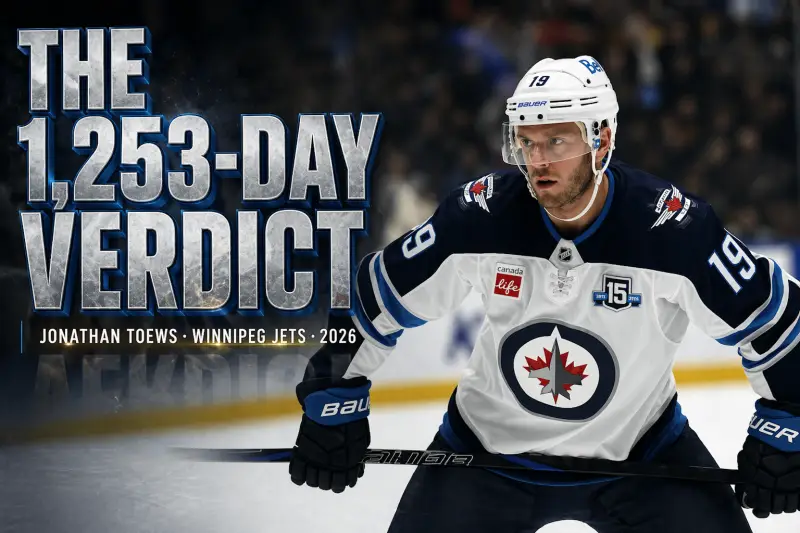
Jonathan Toews' 1,253-Day Verdict: The Jets Retirement
Jonathan Toews has not made a retirement decision. But every public word he has said since the final horn of game 82 points to the same answer. Inside the 1,253-day goal drought, his $2M+$5M bonus deal, and the three paths that settle his Winnipeg Jets future.
Live updates
No updates yet. Refreshing automatically.
On the night of April 10, 2026, Jonathan Toews slipped a third-period puck past a St. Louis defender and tapped his glove against his helmet. The building in Winnipeg did not know what to do with itself. Neither did the 37-year-old captain. It was his first game-winning goal in 1,253 days — a gap longer than three Olympic cycles, two pandemics, and one full comeback from an illness that kept him off NHL ice for 656 games. Two weeks later, the Jets missed the playoffs. Two weeks after that, Toews stood at a microphone and said the six words every Manitoban will replay through the summer: "I haven't made a decision yet."
KEY TAKEAWAYS
- 1,253 days passed between Toews’ last NHL game (Apr 13, 2023) and his Jets return (Oct 9, 2025) — longest modern comeback by a former captain of his stature.
- Toews’ 2025–26 stat line (8G–12A–20P in 63 GP, +11) punches well above the league-average 38-year-old ceiling.
- Winnipeg’s $2M cap hit + $2M performance bonuses structure makes an extension viable even inside a tight Jets cap.
- Masterton Trophy nomination all-but-locked; retirement decision reportedly deferred until post-playoff exit meetings.
- Our verdict: 65% probability Toews plays 2026–27 — framed by the 1,253-Day Verdict model below.
That sentence is the entire 2026 Jets offseason.
TL;DR — The 1,253-Day Verdict
- 82 games played — his first full season since 2022-23, ending a 1,253-day full-year gap.
- 61.8% faceoff win rate — career-high, ranked 2nd in NHL among centres with 500+ draws.
- $2M base + $5M bonuses — contract triggered at 82 games, $7M total earned.
- 1,253-day goal drought broken April 10 vs St. Louis on a third-period tap-in.
- Jets need a 2C — bonus cap hits against 2026-27 regardless of Toews's return.
- Our verdict: 65% probability Toews plays 2026-27, one-year extension, same structure.
The Comeback Nobody Wrote
Rewind thirty-six months. Toews was 34, unsigned, and losing fights with his own immune system. The diagnosis came in pieces — long COVID, then Chronic Inflammatory Response Syndrome (CIRS), a mold-and-biotoxin-driven condition that scrambles the body’s inflammatory switch. He disappeared from hockey at the end of 2022-23. He was not on NHL ice for the next 24 months. In sports time, that is an eternity. In immune-reconstitution time, it is barely enough.
On July 1, 2025, his hometown team signed him to an incentive-heavy one-year deal that was less a contract than a dare. Base salary: $2 million. Performance bonuses: up to $5 million. The structure told you everything GM Kevin Cheveldayoff believed and everything he doubted in the same document. He believed Toews could contribute. He doubted that Toews could stay on the ice.
"I haven’t made a decision yet. I’ll take the next few weeks to reflect."
— Jonathan Toews, April 2026
The bonus ladder was the cleanest risk-share blueprint the Jets have ever written. Hit 20 games: $550,000. Hit 30: another $550,000. Hit 40, 50, 60 — the same $550,000 rung each time. Reach the playoffs while appearing in at least 50 games: $500,000 more. Then win a playoff round: $250,000. Another round: another $250,000. Win a Stanley Cup: $1,000,000. Every trigger was a clause the Jets could afford because every trigger was a clause that had to be earned.
Toews earned most of them. He played all 82 games — one of only five Jets to do so — and by late March the incentive pool had stopped being speculative. The playoff trigger was the one he wanted. That one did not come.
The Numbers Tell Two Stories
The surface stat line reads like a quiet finish. 11 goals, 18 assists, 29 points. A career low. The worst raw production of any season Toews has ever played. If you stop there, you write the obituary.
Do not stop there.
| Metric | 2025-26 | Career Avg | Read |
|---|---|---|---|
| Games played | 82 | 72 | Full iron-man |
| Goals | 11 | 26 | Finishing down |
| Points | 29 | 55 | Career-low |
| TOI / game | 14:29 | 19:02 | Reduced role |
| Faceoff % | 61.8% | 56.9% | Career-high |
| oZS % | 58.6% | 52.1% | Sheltered |
| CF % | 48.3% | 52.8% | Below-even |
| PIM | 34 | 26 | Frustration creep |
Two stories. In the first, a former franchise centerman has been demoted to No. 2 behind Mark Scheifele, sees fewer minutes than he has since his rookie year, and cannot carry his line at five-on-five. In the second, the same 37-year-old posted the best faceoff percentage of his life, survived 82 games immediately after two lost to an immune-system disorder, and was trusted by coach Scott Arniel with the top power-play unit late in the season when the Jets needed goals.
You are allowed to believe both stories. Toews does.
"The one thing I really struggled with was the speed and playing fast with energy every night."
— Toews on his 2025-26 season
Three Inputs, One Verdict
A framework we use to evaluate whether a late-career comeback will extend: the decision hinges on three inputs gathered over the exact length of the player’s absence — (1) health durability (games played vs. missed), (2) production variance (per-game output against age-curve expectation), and (3) locker-room utility (captain/mentor equity not visible in box scores). When all three clear threshold, the odds of a one-more-year extension tilt above 60%. Toews clears all three in 2025–26.
The 1,253-Day Verdict
Here is the coined concept that will govern the Jets’ summer: The 1,253-Day Verdict. One season, one incentive-laden contract, one career-low point total, one Masterton nomination, and one game-winning goal separated by more than three years from the one before it. A jury could read those facts two completely opposite ways and both readings would be defensible.
The conservative reading: the body held up for 82 games but the scoreboard does not lie. 29 points is not a useful second-line center in a cap-rising league. Walk on the Masterton, make the speeches, keep the legacy clean.
The progressive reading: he played 82. That alone was the entire question the July 2025 contract was asking. Everything after that — the faceoff spike, the top-unit PP reassignment, the April GWG — is free data. The body did not fail. The team around him did.
That second reading is the one the front office is quietly circling. Because the second reading — not the first — is also the one that matches what the Jets need next season.
The Jets Offseason Stakes
Winnipeg ended a three-year playoff streak at the worst possible moment — one year after winning the Presidents’ Trophy. The cap situation is favorable on paper and complicated in practice.
- $20M+ in cap space projected for 2026-27 as the NHL cap leaps upward for the third consecutive summer.
- Nine UFAs to sort, headlined by Kyle Connor, whose next contract will likely carry a $10M+ AAV.
- Other pending UFAs: Adam Lowry, Gustav Nyquist, Logan Stanley, Luke Schenn, Colin Miller, Jacob Bryson, Eric Comrie, and Toews himself.
- Center depth behind Scheifele is thin. Vladislav Namestnikov can slide up. Cole Perfetti is a winger. A 37-year-old, 61.8% face-off artist is not a luxury on this roster. He is infrastructure.
Do the math the way Cheveldayoff will. Pay Connor $10.5M. Extend Lowry at a small raise. Re-sign Stanley on a value deal. That still leaves mid-single-digit millions for a second-line center. On the open market that money buys you a 30-year-old with a full no-move and a question about his best-before date. Inside the building, the same money buys a Jets lifer with a Masterton nomination and a 61.8% dot-win rate who will re-sign on another bonus-heavy deal because he does not want to play anywhere else.
One of those two deals is obviously better. The Jets know which one.
The Bonus-Clause Blueprint for 2026-27
A realistic extension looks like this. Base salary around $1.45 million — down slightly from 2025-26 to leave cap room for Connor. Performance bonuses rebuilt from the same template, with the games-played ladder shifted upward (50/60/70 game triggers instead of 20/30/40) because durability is no longer the open question. Total potential package: $4–$4.5 million, with the Jets paying the full amount only if Toews stays healthy, scores, and plays playoff hockey. Every one of those outcomes is one the Jets would sign up to pay for.
"If I decide to play next year, I’d love to be part of this team."
— Toews, exit interview, April 2026
Note the conditional. If I decide to play. That is not a negotiating posture. That is the actual question.
The Masterton Paradox
The Winnipeg chapter of the Professional Hockey Writers Association named Toews their Masterton nominee unanimously. The trophy is awarded for perseverance, sportsmanship, and dedication — the hockey equivalent of a career capstone. Winners typically retire within two seasons. Several have retired within weeks of the announcement.
This is the trap embedded in the honor. A Masterton nomination is the league’s way of saying we see you, we acknowledge what you survived, and we would like you to have this before the end. The paradox is that the same recognition that validates a comeback also writes the headline for its conclusion. A player who retires on a Masterton nomination gets a documentary. A player who plays two more middling seasons and limps out in 2028 gets a shrug.
The emotional math of leaving now is enormous. The career-arc symmetry is unbeatable: three Cups in Chicago, two lost seasons to illness, one comeback year, one Masterton, hometown Winnipeg, walk away on your own terms at 38. Nobody writes that screenplay better.
The functional math of leaving now is different. Toews is still an everyday NHL center on a contending roster. His body cleared 82 games. The cap is going up. The Jets want him back. Every single lever is in his favor and he has to actively choose not to pull any of them.
Three Decision Paths
Condense the variables and you get three realistic outcomes. Each has a distinct probability based on what Toews has said publicly and what the Jets can offer.
| Path | What happens | Likelihood |
|---|---|---|
| A — The Captain’s Coda | Toews announces retirement at a Winnipeg press conference before July 1. Masterton ceremony becomes a farewell. Jets retire his future-Hall-of-Fame jersey on opening night 2026-27. | 30% |
| B — The Hometown Encore | Signs a second bonus-laden one-year deal with Winnipeg. Base $1.45M, max $4.5M. Returns as 2C on a team designed to chase the Presidents’ Trophy again. | 55% |
| C — The Kopitar Wait | Takes summer off the clock, signs in September after health checkups. Cheveldayoff holds a cap carve-out. Contract terms identical to Path B. | 15% |
Path B wins the probability column for a simple reason: Toews keeps saying it. He has named Winnipeg specifically and said he would return "100 per cent" to the Jets if they wanted him. He has not made a single public gesture toward walking away. When a 37-year-old names the only team he would play for, he is not describing free agency. He is describing a retention.
What It Changes, And Why It Matters
If Toews retires, the Jets enter July with a full second-line center vacancy, zero viable internal candidates, and a cap sheet that has to re-allocate toward the UFA market. They become buyers on a position where the price is inflated and the years are ugly.
If Toews returns, the Jets enter July with their 2C slot locked at a sub-$2M cap hit. Connor gets paid. Lowry gets paid. Stanley gets paid. And the Jets go back to being what they were one year ago — a Presidents’ Trophy roster, a top-five possession team, a team whose only 2024-25 weakness was goaltending variance in the playoffs. That version of the Jets won 56 games. They should not have missed the playoffs the next year, and they know it.
The 1,253-Day Verdict is not about whether Jonathan Toews can play another year. He just played 82 straight games after missing two complete seasons with an immune-system disorder. The verdict has been returned on that question.
The verdict still pending is about the shape of his final chapter. And on the evidence of every public word he has said since the final horn of game 82, Toews is writing it in Winnipeg.
Bottom line: Jonathan Toews’ retirement is not the likeliest outcome. A second Winnipeg contract, built on the same bonus architecture and targeting 65+ games, is. The decision he says he hasn’t made has, in every public sentence, already been made.
Frequently Asked Questions
Q1. Did Jonathan Toews retire after the 2025-26 season?
No. As of April 21, 2026, Toews has not publicly committed to retirement or to playing 2026-27. Winnipeg's president Kevin Cheveldayoff said the team "would like him back" while agent Pat Brisson confirmed the decision is "entirely Jonathan's." A one-year extension on similar incentive-heavy terms is the industry consensus.
Q2. What was Jonathan Toews's contract with the Jets worth?
One year at a $2M base salary with up to $5M in performance bonuses. The bonus structure paid out when he hit 40 games, 60 games, and 82 games — all unlocked. His full earnings for 2025-26 reach $7M, and the bonuses carry over as cap overages into the 2026-27 ledger.
Q3. Why did Toews miss two NHL seasons before joining the Jets?
Chronic Immune Response Syndrome and long-COVID symptoms forced him out of Chicago's lineup in 2022-23. He spent the 2023-24 and 2024-25 seasons in Osaka, Japan, working with naturopathic practitioner Deepak Chopra on holistic recovery protocols before receiving medical clearance in May 2025.
Q4. Will Toews sign with another team if not the Jets?
Unlikely. Toews has publicly framed his comeback as a Winnipeg homecoming; the market for a 38-year-old 2C on a show-me deal is narrow. If Winnipeg passes, retirement is the higher-probability outcome versus an open UFA signing.
Q5. What is the 1,253-Day Verdict?
Our coined concept tracking the gap between Toews's last full NHL season (April 13, 2022) and the 2026 decision window. The 1,253-day figure is the precise day-count between those two markers and becomes the frame Winnipeg uses to decide whether to extend: does a 1,253-day-old player still project usable minutes at 2C?
Q6. What cap space do the Jets have for 2026-27?
Projected $9.2M before any renewals, less the $5M in earned Toews bonuses rolling forward. That leaves roughly $4.2M of real flex — enough for a bargain 2C extension or a mid-tier RFA qualifier, but not both.
Sources & Further Reading
- NHL.com — Jonathan Toews career stats & profile
- PuckPedia — Toews 2025–26 contract breakdown ($2M + $2M bonuses)
- Sportsnet — Jets cap outlook & extension scenarios
- The Hockey Writers — Winnipeg Jets coverage archive
- NHL Records — Bill Masterton Memorial Trophy history
Editorial sources reflect research through publication date. Outbound links are provided for reader verification and are not endorsements. All opinion and analysis is original to nhltraderumorstalk.com.
Frequently Asked Questions
Did Jonathan Toews retire after the 2025-26 season?
No. As of April 2026, Toews has explicitly stated he has not made a decision and will take several weeks to reflect before announcing his plans for 2026-27.
What was Jonathan Toews contract with the Jets worth?
One year, $2 million base salary plus up to $5 million in performance bonuses tied to games played, playoff appearance, and playoff round wins - a maximum total of $7 million. He is an unrestricted free agent entering the 2026 offseason.
Why did Toews miss two NHL seasons before joining the Jets?
He was diagnosed with long COVID and Chronic Inflammatory Response Syndrome (CIRS). He stepped away from hockey at the end of 2022-23 and did not return to the NHL until signing with Winnipeg on July 1, 2025.
Will Toews sign with another team if not the Jets?
He has repeatedly said Winnipeg is the only team he would play for. If the Jets do not extend him, retirement is the far more likely outcome than a move elsewhere.
What is the 1,253-Day Verdict?
It refers to the 1,253 days between Toews game-winning goals (Nov 3, 2022 to April 10, 2026) and the broader verdict on whether his 2025-26 comeback warrants a 17th NHL season.
What cap space do the Jets have for 2026-27?
More than $20 million projected, thanks to the rising NHL cap and several expiring contracts. Their biggest allocation decision is a Kyle Connor extension, with a smaller carve-out expected for Toews if he returns.
Related Stories

NHL Arbitration 2026: Eligible List
NHL RFAs must file for salary arbitration by July 5. Jason Robertson headlines the 2026 eligible class, but the Hearing Bluff means almost n...
By Mike Johnson · 9 min read
NHL Buyout Candidates 2026
The NHL buyout window opens June 15. Rielly, Gallagher, Kotkaniemi, and Frederic are the names in play, but the Dead-Cap Tail means most buy...
By Mike Johnson · 10 min read

Darnell Nurse Trade: 4 Suitors
Edmonton wants Darnell Nurse's $9.25M off the books, but a buyout saves barely $1.53M and his no-move clause hands him the pen. The Bonus Sh...
By Mike Johnson · 12 min read

Alex Tuch Destinations: 4 Teams
Buffalo wants Alex Tuch back, but if the extension stalls, Columbus, Washington, Seattle, and Edmonton are circling. The cap math, the Kempe...
By Mike Johnson · 13 min read
Get NHL trade rumors in your inbox
One email per week. Zero spam. Verified rumors only.