Panthers Bobrovsky Replacement Options 2026: Binnington,
Bobrovsky wants 6 years at $5.25M AAV. Panthers will go three, max. The $19M gap between those offers is the moment Florida's offseason splits — and seven goalies are on the replacement board.
Live updates
No updates yet. Refreshing automatically.
TL;DR — The $5.25M Wall
- Sergei Bobrovsky wants a six-year contract at $5.25M AAV — same shape as the Brad Marchand deal. Panthers will go two to three years, maximum.
- That $19M gap is "The $5.25M Wall" — on one side, retention; on the other, a seven-name replacement board.
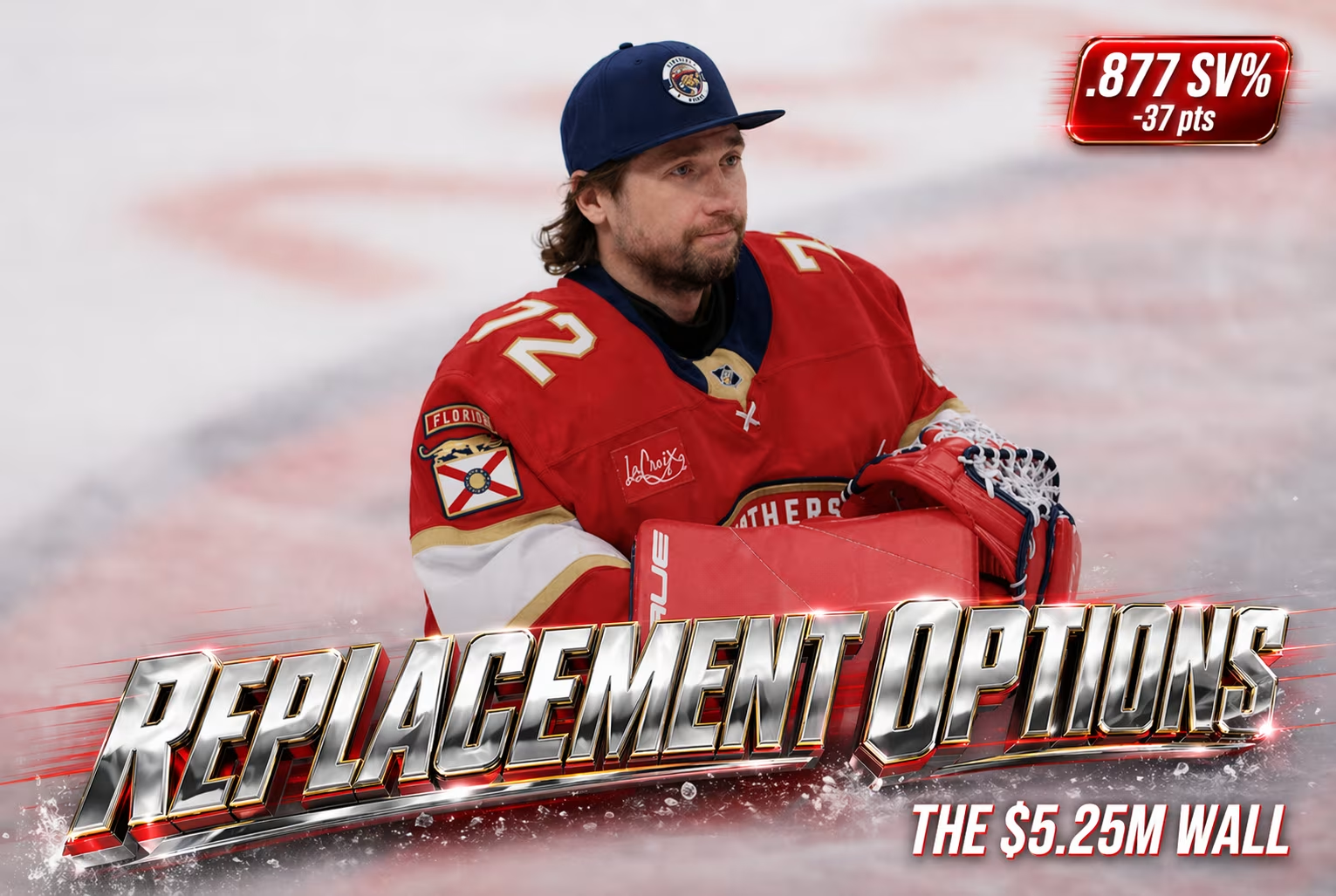
- Bobrovsky's 2025-26 was his worst season ever: .877 SV%, 3.07 GAA. He'll be 38 when the next deal starts.
- Panthers' realistic replacements, tiered: Stolarz (cleanest trade fit), Binnington (rental), Montembeault (cheap hedge), Skinner/Andersen (UFA), Wallstedt/Greaves (wildcard upside).
- Our call: 2-year bridge offer first. If refused, trade for Stolarz. If Toronto won't move, pay the first-rounder for Wallstedt.
The Florida Panthers spent the last 48 hours watching the most important relationship in their franchise move from complicated to pretty bad. That's the phrase Greg Wyshynski used on The Sheet with Jeff Marek when he described Sergei Bobrovsky's contract negotiation — and it sent every front office in the league flipping to the same page of the offseason binder: who replaces him?
Bobrovsky's seven-year, $70 million deal expired with a career-worst .877 save percentage and a 3.07 GAA attached to it. He wants a six-year extension shaped like Brad Marchand's $5.25M-AAV pact. Bill Zito's front office has quietly told agents it won't go past three years. That gap — call it The $5.25M Wall — is the moment Florida's offseason splits in two. Below is the replacement market the Panthers are now mapping, ranked by realism, cost, and cap fit. For the other half of the ledger, see our companion piece on Bobrovsky's extension and pay-cut math.
What Actually Went Wrong With Bobrovsky in 2025-26
Bobrovsky's season was the rarest thing in his career: a bottoming-out. A .877 save percentage is not merely a bad year — it's a 37-point drop from his .914 career mark in a single season, a decline curve almost never seen from a goalie with 400+ wins still on a starter's workload. He played 52 games behind a Panthers team that lost captain Aleksander Barkov to ACL/MCL surgery, watched Matthew Tkachuk miss 47 games, and still managed to grind to the final weekend before elimination.
Context helps — but it doesn't erase the two things the front office now weighs against a six-year commitment:
| Season | GP | SV% | GAA | Age | Result |
|---|---|---|---|---|---|
| 2023-24 (SC run) | 58 | .915 | 2.37 | 35 | Stanley Cup |
| 2024-25 (SC repeat) | 50 | .906 | 2.68 | 36 | Stanley Cup |
| 2025-26 | 52 | .877 | 3.07 | 37 | Missed playoffs |
The counter-argument is his playoff résumé: 44-21 with a .912 SV% across his last 65 postseason starts, two Conn Smythe-level runs, and zero Cup-Final moments where his team lost because of him. But Florida missed the playoffs this year. The playoff résumé wasn't on the table. The regular-season floor was.
Why the Panthers Refuse to Scale The $5.25M Wall
The $5.25M Wall (noun)
The AAV ceiling the Florida Panthers refuse to cross on a long-term contract for Sergei Bobrovsky. Named after the $5.25 million cap hit Brad Marchand earned on his six-year, $31.5 million extension — the exact deal shape Bobrovsky's camp has requested. The "wall" splits Florida's 2026 offseason in two: retain Bobrovsky on a shorter term, or walk through it into the replacement market.
The Marchand contract is a cautionary comp, not a template. Brad Marchand signed his six-year, $31.5 million deal at age 37 — but Marchand is a forward whose $5.25M AAV lands him in the middle-six all the way down to age 42. A forward with 60-point upside has a floor Florida can live with.
A 38-year-old goalie on a six-year term does not have that floor. The Panthers ran the historical table and found the same pattern every capped team finds: no goalie who signed a six-year contract past age 37 has averaged above .910 save percentage across the term. That includes Hall-of-Fame-level names. It's why Zito is reportedly capping term at two-to-three years — and why the only Bobrovsky re-sign that actually works, per the math, is a two-year bridge with performance bonuses.
Florida enters the offseason with $15.5 million in cap space and 18 of 23 roster spots accounted for. The upper limit jumps to $104 million next season (potentially $107M after adjustments). Any goalie deal north of $5M on a long term crowds out the forward depth this team admits — on the record — it needs to rebuild after an injury-ravaged year. For the broader picture, see our 2026 NHL salary-cap explainer.
"We cannot lose him. He is our guy. He is the backbone of this team. I don't care what age he is." Matthew Tkachuk, April 2026 exit interviews (via Yahoo Sports)
The locker room voted. The cap spreadsheet hasn't.
The Replacement Tier Board: How Florida Is Mapping the Market
If Bobrovsky walks, there is no single replacement. There is a tiered board that every front office in this situation builds, and Florida's is no exception. Three tiers, six primary names, one offer-sheet wildcard. The selection criteria isn't just talent — it's term length, cap hit under $4M, and the Panthers' willingness to trade picks vs. prospects.
Here is the board, as it almost certainly sits on Zito's desk this week:
| Tier | Target | Age | 2025-26 SV% | Cost Type | Term Risk |
|---|---|---|---|---|---|
| 1 | Jordan Binnington | 32 | .873 | Trade + $6M cap | Medium |
| 1 | Anthony Stolarz | 32 | .893 | Trade + $3.75M | Low |
| 1 | Samuel Montembeault | 29 | .872 | Trade + $3.15M | Low |
| 2 | Stuart Skinner | 27 | .888 | UFA | Medium |
| 2 | Frederik Andersen | 36 | .892 | UFA bridge | High (injury) |
| 3 | Jesper Wallstedt | 23 | .915 | Trade (premium) | Upside play |
| 3* | Jet Greaves (offer sheet) | 25 | .905+ (GSAx #9) | Offer sheet | Cap-controlled |
Tier 1: The Veteran Trade Targets
Jordan Binnington is the headline. NHL Network's Brian Lawton called his departure a "foregone conclusion", and Florida is one of the publicly named suitors. His 2025-26 line (13-20-7, 3.33 GAA, .873 SV%) is ugly — but two numbers flip the calculus: a .917 / 1.78 Olympic performance in Milan, and a contract that runs through 2026-27 at $6M AAV. The St. Louis Blues are paying, Florida inherits a one-year rental with Cup pedigree. The 16-team no-trade list is the only thing slowing a deal.
Anthony Stolarz is the quiet Maple Leafs Plan A. His 2025-26 season was wrecked by a lower-body injury that ended it prematurely, and his 3.28/.893 line reflects that. But the Maple Leafs signed him to a four-year, $15 million extension that begins July 1 precisely because the season before, he led the NHL in save percentage at .926 with a 2.14 GAA. If Toronto pivots to Joseph Woll as the full-time starter, Stolarz at $3.75M is the cleanest 1A in the market — and Florida would only need to surrender a second-round pick plus a middle-tier forward.
Samuel Montembeault is the dark-horse Tier 1. The Montreal Canadiens' decision to develop Jakub Dobes and prospect Jacob Fowler has made him an expected trade candidate. His numbers this year were bad (3.43 / .872 on a defensive mess of a Canadiens team), but his contract — $3.15M through 2026-27 — is the most manageable in the market. Projected trade value sits at a third-round pick. That's low-leverage retention insurance, not a starter upgrade.
Tier 2: The UFA Fallbacks
Stuart Skinner becomes available July 1 at 27 years old after a midseason trade from the Edmonton Oilers to Pittsburgh. A 2.92 GAA and .888 SV% across 50 games isn't elite, but it's a starter's workload delivered consistently at an age where his next contract is his prime-years deal. He'll command more than Florida wants to pay (call it $4.5–5M), which is why he sits in Tier 2, not Tier 1.
Frederik Andersen, 36, is a bridge play if Florida believes the 2024 playoff version was real and 2025-26's nine-game injury-riddled season was an aberration. A one-year, incentive-laden deal at $2.5M is the shape this takes. It is not a Cup-window contract. It is a steady-hand while a longer-term answer develops.
The rest of the UFA class — Cam Talbot, James Reimer, Petr Mrazek, Vitek Vanecek, Eric Comrie, David Rittich, Connor Ingram — belongs on the backup page, not the starter page. None of them is a credible replacement for Bobrovsky's Cup-era role; several are functional 1Bs who would platoon with a Tier 1 trade acquisition. For the full market picture, see our complete 2026 free-agents list by position.
Tier 3: The Wallstedt Pivot and the Greaves Offer-Sheet Wildcard
The boldest play on Zito's board is Jesper Wallstedt. The 23-year-old Swede — 20th overall in 2021 — posted an 18-9-6 line with a 2.61 GAA and .915 SV% in his first real NHL run, including an NHL rookie-of-the-month nod in November (1.14 GAA, .967 SV%, three shutouts in six games). The Minnesota Wild have Filip Gustavsson locked in as its starter through 2028, which creates a one-in-a-decade window for a team like Florida to negotiate a trade for a goalie who might be 1A-starter material for the rest of the decade. The cost is punitive — likely a first-round pick plus a top prospect plus a roster forward — but the return is eight years of $2M-range cap control.
The dark-horse move is an offer sheet to Jet Greaves. The 25-year-old Columbus Blue Jackets RFA finished ninth among NHL goalies in goals-saved-above-expected at a cap hit of just $812,500. Columbus has a starter logjam with Elvis Merzlikins, and the 2025-26 compensation tiers mean Florida could sign Greaves to a two-year, $4.4M AAV deal and owe Columbus only a second-round pick if the Blue Jackets decline to match. It is the purest asset-over-player move available. Zito has never used an offer sheet. This is the year he might.
So What Actually Happens?
Strip away the noise and the Panthers arrive at a three-step decision tree:
- Offer Bobrovsky 2 years × $5.5M with bonus triggers. If accepted, Tkachuk gets his backbone, Zito gets a short-term hedge against the age-38 cliff, and the front office has runway to develop a replacement in 2027.
- If rejected, pivot to Stolarz via trade — he's the cleanest AAV-to-upside ratio in the market, and Toronto's cap crunch makes a deal possible.
- If Toronto won't move Stolarz, trade for Wallstedt. Pay the first-rounder, absorb the one-year transition pain, and come out the other side with the starter for the rest of this decade.
The internal option — Daniil Tarasov — is not on this list for a reason. His .895 SV% in 33 games was respectable for a backup, but he's a pending UFA himself with no starter track record. Promoting him is how teams go from missing the playoffs to picking in the top five.
Bobrovsky has until July 1 to accept the Panthers' number or test the market. Florida has until then to decide whether The $5.25M Wall is a line it holds or a door it walks through. The backbone of back-to-back Cups is on the other side of that decision — and so is the 2027 season.
Key Takeaways — The Panthers' Decision Tree
- The $19M gap is structural, not posture. Florida's refusal to cross $5.25M on a 6-year term is tied to historical goalie-contract failure rates past age 37, not a negotiating tactic.
- Stolarz grades as the cleanest replacement at $3.75M AAV × 4 years — the only name that matches Florida's cap constraints AND delivers a starter profile.
- Greaves is the asymmetric bet. Offer-sheet compensation caps Florida's downside at a 2nd-round pick; upside is a 25-year-old RFA with top-10 GSAx numbers under team control for 8 years.
- Wallstedt is the high-cost, high-conviction play — only worth it if Florida is willing to trade a 1st + top prospect to secure cap-controlled elite goaltending through 2034.
- Internal promotion (Tarasov) is the worst-case path — his .895 SV% and UFA status make him a backup, not an answer.
Frequently Asked Questions
Will the Panthers actually let Bobrovsky leave?
Players and GM Bill Zito have publicly said they want him back, but the reported gap between his six-year ask and Florida's two-to-three-year cap is roughly $19 million. Unless Bobrovsky accepts a shorter term with performance bonuses, he will test free agency on July 1, 2026.
Who is the most realistic Bobrovsky replacement?
Anthony Stolarz is the cleanest fit. His 4-year, $15 million extension at a $3.75M AAV begins July 1, 2026, and if Toronto pivots to Joseph Woll as its full-time starter, Stolarz could be available for a second-round pick and a middle-six forward — a far cleaner deal than Jordan Binnington's $6M cap hit and 16-team no-trade list.
Can the Panthers offer-sheet Jet Greaves?
Yes. Greaves is an eligible RFA, finished ninth among NHL goalies in goals-saved-above-expected, and a two-year offer sheet around $4.4M AAV would cost Florida only a second-round pick if Columbus declines to match. It would be the first offer sheet of Bill Zito's tenure and the cap-cheapest path to a long-term starter.
What is "The $5.25M Wall"?
It is the AAV ceiling the Panthers refuse to cross on a long-term goalie contract for Bobrovsky — named after Brad Marchand's six-year, $31.5M extension at $5.25M AAV. Florida is willing to pay the AAV, but not for six years on a goalie who turns 38 before the deal starts. The wall splits the offseason into retain (shorter term) or replace (tier board).
Why isn't Daniil Tarasov the answer?
Tarasov posted a .895 save percentage in 33 games as the Panthers' backup in 2025-26 — respectable for a backup but below the league average for a starter. He is also a pending UFA himself with no starter track record. Promoting him to the 1A role is the fastest path from missing the playoffs to picking in the top five of the 2027 draft.
Sources & Further Reading
- The Hockey News — Bobrovsky situation "pretty bad"
- TSN — Bill Zito offseason outlook
- ClutchPoints — Binnington trade "foregone conclusion"
- Daily Faceoff — Wallstedt 2025-26 breakout
- NHL.com — Marchand 6-year, $31.5M signing
- Daily Faceoff — NHL 2026-27 cap projection
- ESPN — NHL goalie SV% lowest since 1994
Frequently Asked Questions
Will the Panthers actually let Bobrovsky leave?
Players and GM Bill Zito have publicly said they want him back, but the reported gap between his six-year ask and Florida's two-to-three-year cap is roughly $19 million. Unless Bobrovsky accepts a shorter term with performance bonuses, he will test free agency on July 1, 2026.
Who is the most realistic Bobrovsky replacement?
Anthony Stolarz is the cleanest fit. His 4-year, $15 million extension at a $3.75M AAV begins July 1, 2026, and if Toronto pivots to Joseph Woll as its full-time starter, Stolarz could be available for a second-round pick and a middle-six forward — a far cleaner deal than Jordan Binnington's $6M cap hit and 16-team no-trade list.
Can the Panthers offer-sheet Jet Greaves?
Yes. Greaves is an eligible RFA, finished ninth among NHL goalies in goals-saved-above-expected, and a two-year offer sheet around $4.4M AAV would cost Florida only a second-round pick if Columbus declines to match. It would be the first offer sheet of Bill Zito's tenure and the cap-cheapest path to a long-term starter.
What is 'The $5.25M Wall'?
It is the AAV ceiling the Panthers refuse to cross on a long-term goalie contract for Bobrovsky — named after Brad Marchand's six-year, $31.5M extension at $5.25M AAV. Florida is willing to pay the AAV, but not for six years on a goalie who turns 38 before the deal starts. The wall splits the offseason into retain (shorter term) or replace (tier board).
Why isn't Daniil Tarasov the answer?
Tarasov posted a .895 save percentage in 33 games as the Panthers' backup in 2025-26 — respectable for a backup but below the league average for a starter. He is also a pending UFA himself with no starter track record. Promoting him to the 1A role is the fastest path from missing the playoffs to picking in the top five of the 2027 draft.
Related Stories

NHL Arbitration 2026: Eligible List
NHL RFAs must file for salary arbitration by July 5. Jason Robertson headlines the 2026 eligible class, but the Hearing Bluff means almost n...
By Mike Johnson · 9 min read
NHL Buyout Candidates 2026
The NHL buyout window opens June 15. Rielly, Gallagher, Kotkaniemi, and Frederic are the names in play, but the Dead-Cap Tail means most buy...
By Mike Johnson · 10 min read

Darnell Nurse Trade: 4 Suitors
Edmonton wants Darnell Nurse's $9.25M off the books, but a buyout saves barely $1.53M and his no-move clause hands him the pen. The Bonus Sh...
By Mike Johnson · 12 min read

Alex Tuch Destinations: 4 Teams
Buffalo wants Alex Tuch back, but if the extension stalls, Columbus, Washington, Seattle, and Edmonton are circling. The cap math, the Kempe...
By Mike Johnson · 13 min read
Get NHL trade rumors in your inbox
One email per week. Zero spam. Verified rumors only.