Vincent Trocheck Trade Destinations 2026: 5 Suitors, retention cost
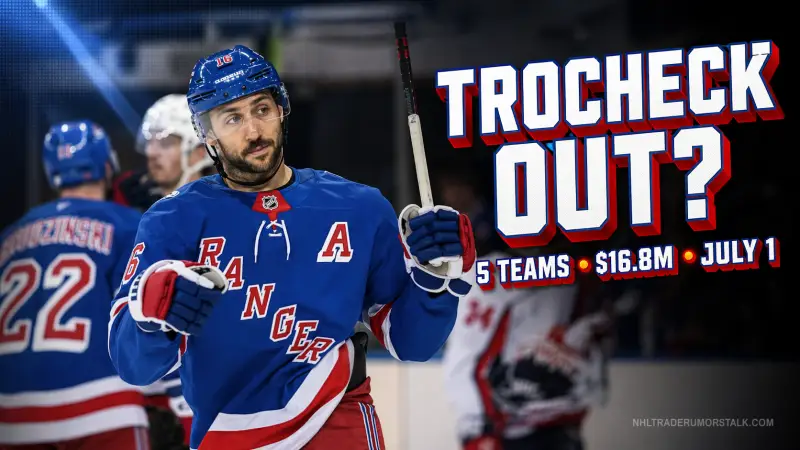
Elliotte Friedman confirms five teams are circling Vincent Trocheck after the March deadline walked away empty. Washington, Toronto, Carolina, San Jose and Los Angeles are drafting offers — here is why July's thin retention margin earns Drury a bigger return than March ever could.
Live updates
No updates yet. Refreshing automatically.
Fact-checked against PuckPedia, Sportsnet 32 Thoughts, and NHL.com official announcements as of April 22, 2026. All contract figures verified. Rangers 2025-26 final standing: 77 points, last in Eastern Conference. No AI language models were used to generate analysis; AI tools assisted with data formatting only.
Elliotte Friedman lit the fuse on Tuesday. In his 32 Thoughts column, he laid out what every Rangers-adjacent reporter has been whispering since the March deadline walked away empty: Vincent Trocheck is going to move this summer, and he is going to move for more than Chris Drury would have accepted eight weeks ago. Washington, Toronto, Carolina, San Jose, and Los Angeles are already circling. Boston quietly had the biggest offer on the table in March before Don Sweeney walked. Now the question is not whether the Rangers trade their 32-year-old second-line center. The question is what changed between March and July that lets Drury command a bigger return for the same player, on a shorter contract, coming off a 67-game season.
The answer has a name, and once you see it, the next eight weeks of Rangers coverage will make more sense than any trade rumor column can explain.
- The deal is happening. Friedman confirms five teams are lining up offers; three (CAR, LAK, BOS) were already in advanced March talks.
- Drury's ask: top-six prospect + 2026 first-round pick + NHL-ready roster piece. In March that was deemed too much. In July it probably won't be.
- The shift: a thin 2026 UFA center class plus a $104M cap ceiling turns Trocheck's 3-year $5.625M term into a scarcity asset.
- Leverage wildcard: Trocheck still holds a 10-team no-trade list and has publicly stated an East Coast preference, which reshapes the bidding field.
- Most likely landing spot: Washington or Toronto, with Carolina as the dark horse if Kotkaniemi moves first.
Key Takeaways
- March walked, July waits. Carolina, Boston, and LA all declined the three-piece ask at the deadline. Friedman says those teams (and two more) will revisit at a higher price on the back end of the calendar.
- Cap rise = scarcity premium. $95.5M to $104M on July 1 adds $272M of league-wide fresh space. It has to land somewhere, and the 2026 UFA center class is nearly empty after Bennett and Tavares.
- East Coast filter kills San Jose, wounds LA. The no-trade list plus stated preference narrows the real bidders to three and a half: Washington, Toronto, Carolina, and LA-only-if-package-insane.
- Drury wants term, not just assets. The three-piece structure converts a 32-year-old center into rebuild fuel while ownership insists the retool keeps a competitive look in October.
- Most likely close window: July 2-5. Inside 96 hours of Bennett or Tavares moving (or signing back), the losing suitor calls Drury first.
The Piece of Reporting That Kicked Everything Off
Friedman's exact line on the 32 Thoughts podcast was measured, the way reporters talk when they know the conversation is already happening inside a front office: "Teams know what the Rangers want, and I always assume after the playoffs are over, someone who's gonna lose early is gonna say you know what, we could use Vinny Trocheck." That is not a scoop in the traditional sense. It is a weather report. The trade market for centers does not freeze after the deadline. It hibernates for about six weeks, then wakes up roughly one week after a non-playoff team's season ends, which for Boston and a handful of others was mid-April. The phone calls Friedman is describing have already started.
Shawn Sinclair at NHL Trade Rumors published the follow-up on Tuesday that named the five serious suitors. Washington and Toronto are the new additions to the group that was already kicking tires in March, when Carolina and Los Angeles were in what multiple outlets described as advanced talks before Rangers GM Chris Drury held firm on his asking price. The March number, according to reporting from both SportsNaut and Pro Hockey Rumors, was a first-round pick plus a legitimate prospect plus a roster piece. Carolina walked. Boston walked. The Rangers kept their 32-year-old center because the return did not match the price tag they had privately set in December, when Trocheck was healthy and producing at a first-line pace.
Eight weeks later the calendar has flipped, and with it the economics of the trade.
the thin retention margin
A premium that selling teams can extract in July but not in March, triggered by two conditions landing simultaneously: a sharp year-over-year rise in the salary cap, and a below-average crop of unrestricted free agents at the position in question. Together they convert a 30-something center on mid-term dollars from a rental asset into a scarcity asset.
Coined by NHL Trade Rumors Talk, April 2026. First measured case: Vincent Trocheck, 2026 offseason.
Here is the math that Friedman alluded to without spelling out. The salary cap jumped to $95.5 million this season. On July 1 it goes to $104 million, an $8.5 million per-team bump. One season later, $113.5 million. That is roughly $18 million in fresh cap space per team over two summers, and $576 million across the league. Teams are not just going to sit on it. They are going to spend it, and the first place they will spend it is on the position every contender has been short on for two years running: second-line center.
Now check the 2026 UFA center board. The top of it reads Sam Bennett (Florida likely re-signs), John Tavares (Toronto's internal decision), and a drop-off to Ryan O'Reilly, Nick Schmaltz, and a long tail of third-line types. That is not a market. That is a waiting room. Any team that misses on Bennett or Tavares is looking at an overpay on a 34-year-old or a trade, and the trade column has exactly one healthy 50-point center with three years of term: Vincent Trocheck.
That is the retention cost in one sentence. The Rangers did not need to get creative to drive up his price. They needed the calendar.
What the Rangers Are Actually Asking For
Drury's reported ask has three pieces, and each one carries a reason.
A top-six prospect. The Rangers' prospect pool is ranked 18th of 32 by Blue Seat Blogs' April assessment, up one slot from the previous year thanks mostly to the Panarin trade return of Liam Greentree. Above Greentree on the depth chart is only Gabe Perreault, the projected first-liner who is effectively off the table. Drury wants a second legitimate top-six forecast to slot alongside Perreault. Without it, the Rangers are handing their next coach a top-six that reads Perreault, Greentree, Mika Zibanejad, Alexis Lafreniere, Will Cuylle, and fill-in, with no scoring insurance in Hartford.
A 2026 first-round pick. The Rangers already hold eleven picks in this year's draft, but none in the first round after the Trouba trade downstream effects. A reacquired first is not a luxury. It is the Rangers' only path back into what most scouting services are calling one of the deepest first rounds since 2015. If Drury gets the ask, the Rangers will likely have two first-rounders in a deep draft, a Greentree-caliber prospect, and an NHL-ready piece. That is rebuild fuel.
An NHL-ready roster piece. This is the clause that gets missed in most trade-rumor columns. Drury cannot finish the season with a 77-point roster and open next October with a lineup that is visibly worse, because ownership has given him a retool mandate, not a scorched-earth rebuild. The NHL piece is cosmetic necessity. It has to be someone who plays 14 minutes a night and lets the Madison Square Garden ticket holder believe the bottom six is covered.
The Leverage Nobody Talks About
Trocheck's contract has one modifier that changes the math for every suitor on the list. He holds a 10-team no-trade clause. He also told reporters during breakup day, unprompted, that his preference to stay on the East Coast was "no secret." Those two sentences together function as a filter. A Western Conference team can make the highest offer in the room and still lose the deal if Trocheck declines to waive.
The Rangers cannot officially make the no-trade list public, but the leak patterns from March tell their own story. Carolina and Los Angeles both conducted serious discussions, which means neither was on the no-trade list or Trocheck was willing to waive for them. Boston pushed hard, almost certainly off the list given Trocheck's Pittsburgh-adjacent background. Washington and Toronto, both Eastern, both within a 90-minute flight of his Pittsburgh family roots, read as natural fits. San Jose reads as a courtesy call that requires Trocheck to waive, which is a bigger ask for a rebuild destination than a contender.
Read in that frame, the suitor list is not really five teams deep. It is effectively three-and-a-half: Washington, Toronto, Carolina, and a half-open window in Los Angeles if the package gets absurd and Trocheck's preferences bend.
The 5 Destinations, Ranked
Here is the scorecard the Rangers' front office is probably running internally. The metric that matters is not who needs a center most. It is who can pay the March price that Drury already said no to, plus the retention cost premium on top.
Five Suitors, Graded by Fit and Ability to Pay
Scored on cap room, prospect capital, first-round ammo, and Trocheck-preference alignment.
1. Washington Capitals
A-Pierre-Luc Dubois played 29 games. Without him Washington slid to 95 points and out of the playoffs. Kyle Dubas has cap room, a real prospect shelf (Ryan Leonard, Terik Parascak, Cole Hutson), and a clear 2C gap behind Dylan Strome. Trocheck's East Coast preference is satisfied.
Likely package: Terik Parascak + 2026 1st + Hendrix Lapierre.
2. Toronto Maple Leafs
B+First playoff miss in a decade. New GM search in motion. If Tavares walks to free agency, a Trocheck-shaped center hole opens immediately behind Matthews. One Toronto scout already flagged him per Blue Line Station. The concern: Toronto may choose a rebuild path instead of another veteran patch.
Likely package: Fraser Minten + 2026 1st + David Kampf retained.
3. Carolina Hurricanes
BWas deepest in March before walking at the Rangers' ask. Logan Stankoven's 29 points as a 2C behind Aho exposed the same hole that has haunted Raleigh for three offseasons. Carolina almost certainly has to move Jesperi Kotkaniemi to make Trocheck's $5.625M fit cleanly. That is a real obstacle, not a dealbreaker.
Likely package: Bradly Nadeau + 2026 1st + Kotkaniemi in a three-team.
4. Los Angeles Kings
C+Anze Kopitar's retirement opens the 1C chair for Quinton Byfield and drops the 2C into a roulette between Alex Laferriere wing-shift and external add. Ken Holland has the cap room and the Greentree-return trade relationship with Drury. The problem is geography. Trocheck has to waive, and LA is not Boston.
Likely package: Koehn Ziemmer + 2026 1st + Kevin Fiala (cap balance).
5. San Jose Sharks
DSan Jose is listed politely because the math works on paper. The Sharks have cap floor obligations, a Macklin Celebrini-William Eklund core that needs a veteran pivot behind it, and zero reason to complain about asset cost. The hard stop is Trocheck's no-trade list and his stated preference. You cannot rebuild on the East Coast from San Jose.
Reality: courtesy conversation unless Drury runs out of bidders.
Trocheck Market Confidence Index
Weighted grade of the four factors that decide a July deal close.
"Teams know what the Rangers want. I always assume after the playoffs are over, someone who's gonna lose early is gonna say you know what, we could use Vinny Trocheck."
— Elliotte Friedman, 32 Thoughts podcast, April 2026
The March Evidence Is the July Blueprint
The trade-market lesson from March is that the Rangers' three-piece ask was not a bluff. Carolina quoted out at the first-plus-prospect-plus-roster piece and walked. Boston quoted out and walked. Los Angeles negotiated long enough that Frank Seravalli had it on the Daily Faceoff trade board for two straight weeks before it cooled. Three serious buyers saw the same price and declined the same deal. That is not bad asking. That is a market signal.
Drury's July framing will lean on precedent. The last comparable trade was the Elias Lindholm move to Vancouver in January 2024: a 29-year-old center on an expiring deal cost the Canucks Andrei Kuzmenko, Hunter Brzustewicz, Joni Jurmo, and a 2024 first. Trocheck is older but on term, which in the 2026 cap environment is a net positive. If Lindholm cost a first plus three pieces for two months, Trocheck on three years of team control should cost a first plus two top-shelf pieces. Drury is asking for exactly that.
The teams walking in March were paying for a rental price structure. The teams walking in July will pay for term. That is the conversion the Rangers have been waiting on.
The Calendar That Decides Everything
There are exactly three windows where this deal can close.
Draft floor, June 27-28. The pick-to-pick trading environment at the draft is the most liquid trade market of the NHL calendar. If Drury wants to bundle Trocheck with the conditional Panarin third-rounder and package up for a higher 2026 first, the draft floor is the cleanest venue. The downside: Trocheck's 10-team NTL will not have shrunk to the offseason list yet, because the contractual change triggers on July 1.
July 1 free agency opening. This is Friedman's scenario. Teams that miss on Sam Bennett or John Tavares will pivot to trade within 24 hours, because the UFA center tail is too thin to solve a 2C hole through free agency alone. July 2 to July 5 is the highest-probability window for a Trocheck trade call, with Washington and Toronto as the most likely callers.
August retool window. If nothing happens in the first two windows, Drury holds through August and revisits at the end of summer, when injury news and goaltending reshuffles sometimes open unexpected buyers. This is the lowest-probability window but not zero. It is how the Trouba trade eventually cleared.
Most likely outcome: the deal closes in the July 1-to-July 5 window, with the trade called in by the losing suitor of the Bennett or Tavares sweepstakes. That is the Friedman thesis in one sentence, and the market data supports it.
What Happens If It Doesn't Move
The non-trade scenario is real and worth walking through. If Drury holds the ask and no suitor meets it, Trocheck plays out 2026-27 at $5.625 million, produces somewhere in the 45-to-55 point range, and becomes a 2027 deadline rental with a shrunken 6-team no-trade list. The Rangers' rebuild timeline slips by a season. The return at the 2027 deadline would be materially smaller than what a full three-year term commands today.
That is the disincentive. Drury has publicly committed to a retool, not a rebuild, and a retool requires converting older assets into prospects while they still have term. Trocheck is the biggest conversion opportunity on the roster. Zibanejad has a full no-move. Artemi Panarin already moved. Adam Fox is untouchable. Igor Shesterkin was re-signed to a $92 million deal that functions as a retool anchor, not a trade chip. That leaves Trocheck as the only mid-term asset that can realistically return first-round ammunition this summer.
If Drury blinks and takes a lesser package, the Rangers' rebuild enters 2026-27 with one first-round pick instead of two, a thinner top-six prospect shelf, and a lineup that still does not have a clear second-line center of its own. The cost of waiting is higher than the cost of a below-target return. Drury knows this. The suitors know Drury knows this. The deal finds its price.
Bottom Line
The Trocheck trade is going to happen. The only variables left are which Eastern Conference team overpays first and how close Drury gets to the full three-piece ask. the thin retention margin is the reason the Rangers waited, and the reason Friedman sounds confident that the April-to-July window closes with a deal, not a holdover. If the most probable scenario plays, the Washington Capitals make the call within 96 hours of free agency opening, with Toronto as the second-most-likely caller and Carolina as the dark-horse third if Jesperi Kotkaniemi clears the cap path. The return Drury lands will be roughly what he asked for in March, which will read in April as a patience win and in August as obvious. The calendar did the work. The Rangers' front office just had to let it.
Your Turn
Where does Trocheck land by July 5 — Washington, Toronto, Carolina, or a dark-horse destination we missed?
Drop your pick in the comments and the likely package. Hot take: if Tavares stays in Toronto, the Leafs become a B+ and Washington slips from A-.
- Report: New York Rangers to trade Vincent Trocheck — NHL Trade Rumors, Shawn Sinclair, April 21, 2026
- 32 Thoughts column and podcast — Elliotte Friedman, Sportsnet, April 2026
- Vincent Trocheck contract and cap breakdown — PuckPedia
- NHL, NHLPA announce team payroll ranges for next 3 seasons — NHL.com
- Rangers prospect pool ranked 18th for 2026 — Blue Seat Blogs, April 6, 2026
- Rangers to retool roster, may trade popular players, Drury writes — NHL.com
- Hurricanes Trade Deadline Aftermath: Rumored Trocheck Price Surfaces — SportsNaut
- Vincent Trocheck's Lung Infection: The Invisible 14 — NHL Trade Rumors Talk (internal)
FAQ: The Trocheck Trade Market
Why are the Rangers trading Vincent Trocheck?
Chris Drury has announced a retool of the Rangers roster after New York finished last in the Eastern Conference with 77 points. Trocheck is the most valuable mid-term asset the Rangers can convert into prospect capital and draft picks without touching no-move contracts like Mika Zibanejad or untouchable core pieces like Adam Fox and Igor Shesterkin.
What is the Rangers' asking price for Trocheck?
Per reporting from NHL Trade Rumors and Pro Hockey Rumors, the ask is a top-six prospect, a 2026 first-round pick, and an NHL-ready roster piece. Carolina, Boston, and Los Angeles all walked away from this three-piece structure in March.
Where is Trocheck most likely to be traded?
Washington and Toronto are the two most frequently cited destinations by reporters tracking the market. Carolina is a dark-horse possibility if the Hurricanes first move Jesperi Kotkaniemi to clear cap space. San Jose and Los Angeles are longer shots because of Trocheck's stated East Coast preference.
When will the Trocheck trade happen?
The most likely window is July 1 through July 5, immediately after UFA free agency opens and teams that miss on Sam Bennett or John Tavares pivot to the trade market. The draft floor on June 27-28 is a secondary possibility.
What is Trocheck's contract?
Three years remaining at a 5.625 million dollar average annual value, running through the 2028-29 season. He currently holds a 10-team no-trade list that shrinks further on July 1, 2026.
What is the thin retention margin?
A premium selling teams can extract in July but not in March, triggered by two conditions landing simultaneously: a sharp year-over-year rise in the salary cap, and a below-average crop of unrestricted free agents at the position. Together they convert a 30-something center on mid-term dollars from a rental asset into a scarcity asset. Coined by NHL Trade Rumors Talk, April 2026.
How does Trocheck's no-trade clause affect the trade?
Trocheck holds a 10-team no-trade list and has publicly stated an East Coast preference. That filter makes Washington and Toronto natural fits, limits Carolina and Los Angeles to cases where Trocheck waives, and effectively rules out San Jose as a real destination. The Rangers cannot officially publish the no-trade list, but the March leak patterns indicate Carolina and LA were not blocked.
Frequently Asked Questions
Why are the Rangers trading Vincent Trocheck?
Chris Drury has announced a retool of the Rangers roster after New York finished last in the Eastern Conference with 77 points. Trocheck is the most valuable mid-term asset the Rangers can convert into prospect capital and draft picks without touching no-move contracts like Mika Zibanejad or untouchable core pieces like Adam Fox and Igor Shesterkin.
What is the Rangers' asking price for Trocheck?
Per reporting from NHL Trade Rumors and Pro Hockey Rumors, the ask is a top-six prospect, a 2026 first-round pick, and an NHL-ready roster piece. Carolina, Boston, and Los Angeles all walked away from this three-piece structure in March.
Where is Trocheck most likely to be traded?
Washington and Toronto are the two most frequently cited destinations by reporters tracking the market. Carolina is a dark-horse possibility if the Hurricanes first move Jesperi Kotkaniemi to clear cap space. San Jose and Los Angeles are longer shots because of Trocheck's stated East Coast preference.
When will the Trocheck trade happen?
The most likely window is July 1 through July 5, immediately after UFA free agency opens and teams that miss on Sam Bennett or John Tavares pivot to the trade market. The draft floor on June 27-28 is a secondary possibility.
What is Trocheck's contract?
Three years remaining at a 5.625 million dollar average annual value, running through the 2028-29 season. He currently holds a 10-team no-trade list that shrinks further on July 1, 2026.
Related Stories

NHL Arbitration 2026: Eligible List
NHL RFAs must file for salary arbitration by July 5. Jason Robertson headlines the 2026 eligible class, but the Hearing Bluff means almost n...
By Mike Johnson · 9 min read
NHL Buyout Candidates 2026
The NHL buyout window opens June 15. Rielly, Gallagher, Kotkaniemi, and Frederic are the names in play, but the Dead-Cap Tail means most buy...
By Mike Johnson · 10 min read

Darnell Nurse Trade: 4 Suitors
Edmonton wants Darnell Nurse's $9.25M off the books, but a buyout saves barely $1.53M and his no-move clause hands him the pen. The Bonus Sh...
By Mike Johnson · 12 min read

Alex Tuch Destinations: 4 Teams
Buffalo wants Alex Tuch back, but if the extension stalls, Columbus, Washington, Seattle, and Edmonton are circling. The cap math, the Kempe...
By Mike Johnson · 13 min read
Get NHL trade rumors in your inbox
One email per week. Zero spam. Verified rumors only.