How Do Faceoffs Work in Hockey?
A faceoff looks like a coin flip, but it is a governed 50/50 battle: nine exact spots, a center on the dot, and a rule that ejects him when a teammate cheats. Here is how faceoffs actually work.
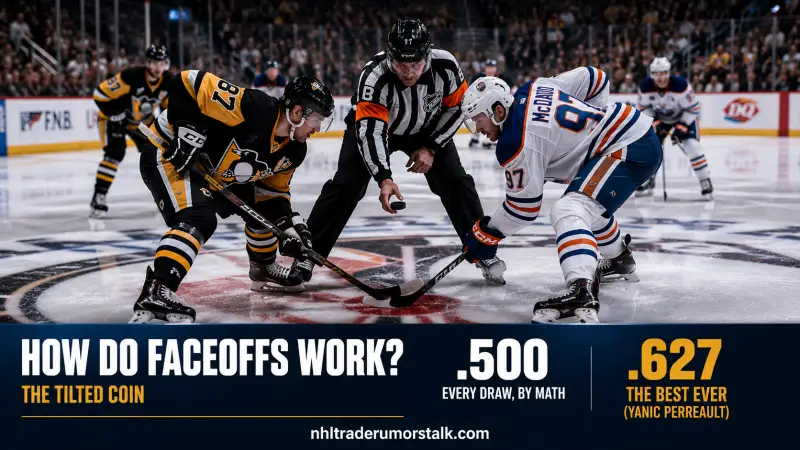
Drop the puck between two players, let them fight for it, and you have a faceoff, the way every hockey game starts and restarts. It looks like a coin flip. It is not. A faceoff is a tightly governed 50/50 battle with nine exact spots on the ice, a rulebook all its own, and one quirk that trips up every new fan: when a player cheats, it is often the center who gets thrown out of the circle, not the guy who cheated.
So how do faceoffs work, who takes them, where do they happen, and why does a player get kicked out of the dot? Here is the whole draw, start to finish.
| Figure | What it represents |
|---|---|
| 50.0% | The league-wide faceoff win rate, every season. Each draw has one winner and one loser, so it cannot be anything else. |
| 62.7% | Yanic Perreault's career faceoff win rate, the best in NHL history. The coin is 50/50 until a great one tilts it. |
Key Takeaways
- What it is: a faceoff (NHL Rule 76) restarts play when an official drops the puck between two opposing players. The referee handles center ice to start periods and after goals; a linesman handles the rest.
- Where: there are nine faceoff spots, five with circles (center plus four in the end zones) and four plain dots in the neutral zone. Where the next draw happens depends on how play stopped.
- Who: usually the center, though any skater except the goalie can take one. Win it cleanly and your team has the puck.
- Why players get tossed: if a teammate jumps into the circle early, the rule ejects the center, not the teammate. A second violation by the same team is a delay-of-game penalty. That is the Tilted Coin's nastiest twist.
- What's good: the league average is 50% by math; 52-55% is solid, 55-60%+ is elite, and only the best in history clear 60% over a full career.
What Is a Faceoff? (Rule 76)
A faceoff is how play begins and resumes in hockey. Under NHL Rule 76, "Face-offs," an official drops the puck on the ice between the sticks of two opposing players, who then battle to win possession for their team. Every period starts with one, and so does play after every whistle.
Who drops the puck depends on the spot. The referee handles the faceoff at center ice to open each period and after every goal. A linesman handles all the others, which is most of the night. The players cannot touch the puck until the official releases it, and the draw only happens at a designated spot, never wherever the puck happened to stop.
The Nine Faceoff Spots
Look down at an NHL sheet and you will count nine red faceoff spots, and they are not all the same.
| Location | Count | Marking |
|---|---|---|
| Center ice | 1 | Blue spot inside a circle |
| End zones (offensive/defensive) | 4 | Red spots inside circles (two per end) |
| Neutral zone | 4 | Plain red dots, no circles (two per blue line) |
So five of the nine spots have full circles painted around them, the center dot and the four in the ends near each goalie's crease. The four neutral-zone spots are just dots. The circles matter because they double as restraining lines: only the two players taking the draw may stand inside, and everyone else has to stay out until the puck drops.
Where the Next Faceoff Happens
The spot is never random, and it is never allowed to reward the team that caused the stoppage. The location follows the play.
| What happened | Faceoff location |
|---|---|
| Start of a period, or after a goal | Center ice |
| Icing | In the offending team's own end zone (they cannot change players) |
| Offside | The nearest neutral-zone dot, just outside the blue line |
| A penalty is called | In the penalized team's end zone |
That last column is the whole logic of faceoff placement. Ice the puck to relieve pressure and you get the draw right back in your own end, pinned in, your tired five stuck on the ice. It is a built-in punishment, and it is why a clean defensive-zone draw can be worth as much as a save.
Who Takes Faceoffs, and How They Win Them
The center almost always takes the draw, which is why faceoffs are a core part of the job if you read up on hockey positions. But the rule does not require a center. Any skater can step in, and teammates often do after a violation. The only player who never takes one is the goalie.
Winning a draw is a craft of small edges. The player on the defending side has to put his stick on the ice first at every spot except center, where the visiting player goes first, so the other guy gets a half-second to read the blade and counter. Hand position, stick angle, body weight, and a quick first move all decide who comes out with the puck, while the wingers crash in to grab anything the center kicks loose. The best at it make a coin flip look like a skill.
"It's my game. It's something I take a lot of pride in. The defensive part is a big part of it." — Patrice Bergeron, Boston Bruins center, Yahoo Puck Daddy (June 2013)
It is no accident that the same names dominate faceoffs season after season, and that they tend to be the centers a coach trusts on the penalty kill and for a defensive-zone draw with a lead to protect.
Why Players Get Kicked Out: The Wrong-Man Twist
Here is the part that confuses everyone. A player gets tossed from the dot for a faceoff violation, and the violation usually is not his. The most common one is encroachment: a teammate slides into the circle, or across the hash marks, before the puck drops. The rule's response is to eject the player taking the faceoff, the center, and order a teammate to come take it instead. Your guy cheated, and you are the one who gets sent off the dot.
Other violations get the center pulled too: moving the stick or body early, refusing to set up square to the spot, or making contact with the opponent before the drop. On a normal faceoff, that first violation simply replaces the center. A second violation by the same team on the same draw escalates to a bench minor for delay of game, a two-minute penalty that can hand the other side a power play, which is why repeat offenders show up in the penalty-minute column.
One important exception keeps the rule honest. After an icing, the first violation is only a warning, not an ejection, because the team that iced the puck is not allowed to change players. Reading the setup, and knowing when you can push the edge, is half the battle.
"You have to go in there willing to compete — that's what it really comes down to." — Sidney Crosby, Pittsburgh Penguins center, Tribune-Review (January 2025)
What Counts as a Good Faceoff Percentage
Because every draw produces one winner and one loser, the entire league averages exactly 50% every year. That is the Tilted Coin in one number. A player who sits right at 50 is perfectly average. Climb from there and the tiers go quickly:
A win rate of 52 to 55% is solidly above average and makes a center useful. Sustain 55 to 60% over a full season and you are among the league leaders. Only a handful of players in history have cleared 60% across thousands of draws. In 2025-26, Claude Giroux led the NHL at about 63%, the kind of mark that wins games at the margins.
The all-time list belongs to the specialists. Yanic Perreault sits first in career faceoff percentage at 62.7%, a number nobody else has touched. Patrice Bergeron, a six-time Selke winner and the gold standard of the modern era, finished at 57.9% over more than 26,000 draws and led the league in faceoff percentage five times. And Sidney Crosby owns the all-time record for faceoff wins, passing Bergeron in January 2025, proof that volume and percentage are two different kinds of great. Perreault tilted the coin highest; Crosby has flipped it the most times.
The Verdict: The Tilted Coin
A faceoff is the most-repeated play in hockey and the most underrated. It looks like luck, a puck dropped between two sticks, but it is governed down to the inch: nine marked spots, a strict order for who sets up first, and a violation rule that will toss your center for a teammate's itchy skate. Most draws really are close to a coin flip. The difference is that a great center, over a full season, quietly tilts the coin toward his bench a few extra times a night. Watch the next defensive-zone draw with a one-goal lead, and you will see why coaches treat 55% like gold.
Written by Mike Johnson, NHL Senior Editor. The mechanics and violation rules were checked against NHL Rule 76 and the league's video rulebook; the faceoff-percentage records and career figures against StatMuse and Guinness World Records; and both player quotes were traced to their original published interviews with the dates shown. Where a figure shifts year to year, it is tagged with its season. Published June 29, 2026. Corrections: editorial@nhltraderumorstalk.com.
Sources and Reporting
- Wikipedia: Face-off: NHL Rule 76 mechanics, the nine spots, and placement rules.
- NHL.com Video Rulebook: faceoff violations and the ejection procedure.
- StatMuse: all-time and career faceoff win-percentage leaders.
- Guinness World Records: Yanic Perreault's career faceoff record.
- Yahoo Puck Daddy: Patrice Bergeron on the craft of the draw.
- Tribune-Review: Sidney Crosby on winning faceoffs.
Frequently Asked Questions
How does a faceoff work in hockey?
A faceoff restarts play. An official drops the puck on the ice between two opposing players, who battle to win it for their team. The referee handles the draw at center ice to start each period and after goals; a linesman handles the rest. Every faceoff happens at one of nine marked spots, and players cannot touch the puck until it is dropped.
Why do players get kicked out of a faceoff?
Usually for a violation a teammate commits. If another player enters the faceoff circle early, the rule ejects the center taking the draw, not the player who encroached, and a teammate must replace him. A second violation by the same team is a bench minor for delay of game. The exception is after an icing, when the first violation is only a warning.
Who takes faceoffs in hockey?
Almost always the center, which is why faceoffs are a core part of that position. But the rules do not require a center; any skater on the ice can take a draw, and teammates often step in after a violation. The only player who never takes a faceoff is the goaltender.
How many faceoff spots are on the ice?
Nine. There is one at center ice, four in the end zones (two in each), and four in the neutral zone (two near each blue line). Five of them, the center spot and the four end-zone spots, have full circles painted around them. The four neutral-zone spots are plain red dots with no circle.
What is a good faceoff win percentage?
The league always averages exactly 50%, because every draw has one winner and one loser. From there, 52 to 55% is solidly above average, and a sustained 55 to 60% makes a center one of the league best. Only a few players in history have cleared 60% over a career; Yanic Perreault leads everyone at 62.7%.
Related Stories

What Is a Zamboni? How It Works
A Zamboni shaves, sweeps, washes, and floods a rink with hot water in one slow 9.7 mph pass. Here is how the ice resurfacer actually works,...
By Mike Johnson · 10 min read
What Is Save Percentage in Hockey?
Save percentage is hockey's go-to goalie stat, but it counts a point-blank chance and a 55-foot floater as the same shot. Here's the SV% for...
By Mike Johnson · 9 min read
What Is GAA in Hockey?
What is GAA in hockey? Goals against average is goals per 60 minutes, the oldest goalie stat and the most misleading. How it is calculated,...
By Mike Johnson · 7 min read
Hockey Positions Explained
Hockey positions explained: six players per side, five skaters and a goalie. What the center, wingers, defensemen, and goalie each do, how l...
By Mike Johnson · 6 min read
Comments
Be the first to share your take.
Get NHL trade rumors in your inbox
One email per week, zero spam, verified rumors only.