NHL Buyout Candidates 2026
The NHL buyout window opens June 15. Rielly, Gallagher, Kotkaniemi, and Frederic are the names in play, but the Dead-Cap Tail means most buyouts are traps. The cap math, the CBA rules, and who actually gets cut.
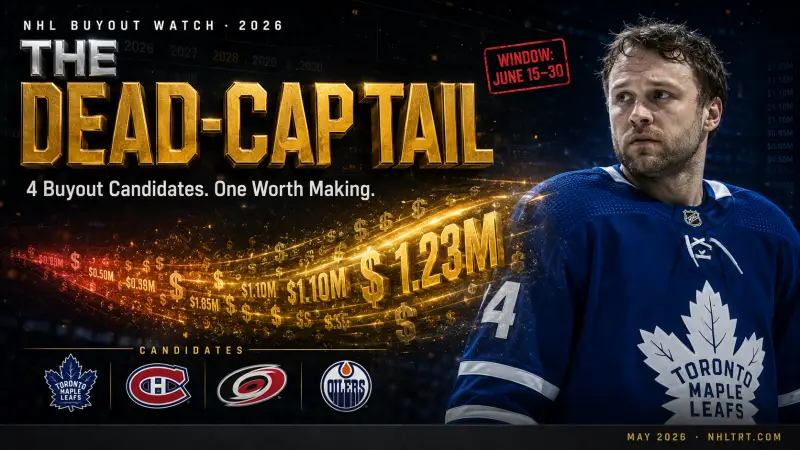
The NHL buyout window opens June 15, and with the salary cap jumping $8.5M to $104M for 2026-27, you would think general managers are about to cut bad contracts loose. Most will not. A buyout almost never erases a mistake; it stretches the dead money across twice the remaining term, and that drag is what we call The Dead-Cap Tail. The length of that tail, not the savings up front, decides whether a buyout is smart or a trap. Here are the four names most likely to be discussed, ranked by how ugly the tail looks.
How an NHL Buyout Actually Works
A buyout looks like a delete button, but the CBA rules say otherwise. Per the CBA buyout rules outlined by PuckPedia, a team first places the player on unconditional waivers for 24 hours, then pays out a fraction of the money still owed: two-thirds for a player 26 or older, one-third for a player under 26. That total is spread evenly across twice the number of years remaining on the contract.
The window opens on the later of June 15 or 48 hours after the Stanley Cup Final ends, and it closes June 30 at 5 p.m. ET. A second 48-hour window can open later for teams whose arbitration cases settle. If you want the full mechanics of cap hits, retention, and dead money, our NHL salary cap guide walks through every lever. The one rule that matters most here: signing bonuses are guaranteed, so they cannot be bought out and keep counting in full.
| Figure | What it means |
|---|---|
| 2/3 | Payout if the player is 26 or older |
| 1/3 | Payout if the player is under 26 |
| 2× | Years the dead cap spreads (the tail) |
The Dead-Cap Tail: Why Most Buyouts Are Traps
The catch lives in that spread-over-double-the-years rule: buy out a player with four years left and you carry dead money for eight. We call that stretch the Dead-Cap Tail, and it is the reason buyouts stay rare even when the cap is climbing fast.
The cap ceiling rises "$8.5 million to $104 million ahead of the 2026-27 season," the largest single-season jump since 2007-08, per Elliotte Friedman of Sportsnet, via Bleacher Report.
A rising cap makes the up-front savings easier to stomach, but it does nothing about the tail. A team can only carry so many dead-money charges before the rising cap it was supposed to enjoy is already spoken for. The mechanic sorts the candidates below into three buckets: short tails worth eating, discounted tails worth a look, and monstrous tails no GM should sign up for.
The Four Candidates at a Glance
These are the four names that surface most in offseason buyout talk. They line up neatly from worst idea to most defensible once you measure the tail rather than the headline savings.
| Player (Team) | Cap hit | Year-1 cap saved | The tail |
|---|---|---|---|
| Morgan Rielly (TOR) | $7.5M | ~$1.6M | Long, and saves too little |
| Brendan Gallagher (MTL) | $6.5M | ~$2.67M | Just 2 years, cleanest |
| Jesperi Kotkaniemi (CAR) | $4.82M | ~$4M | 8 years, but under-26 discount |
| Trent Frederic (EDM) | $3.85M | ~$1.85M | Dead money until 2040 |
Morgan Rielly: The Buyout Nobody Wants to Make
Toronto wants Morgan Rielly gone, but a buyout is the worst way to do it. He carries a $7.5M cap hit through 2029-30 with a full no-movement clause for two more years. Buying him out clears only about $1.6M next season, per PuckPedia's buyout calculator. You would pay a $7.5M player to leave and barely move your cap sheet.
David Pagnotta of The Fourth Period, on the Leafs' plans, per The Hockey Writers: "Toronto's gonna explore a variety of different options this summer and I think it includes the possibility of trading Rielly."
The real path runs through the trade market, where a deal with retention around $5M to $5.5M moves more of the hit than a buyout would, which is why Toronto's front office has chased that route first. Pagnotta also noted the Leafs already said no to an Edmonton package built around Rielly, Darnell Nurse, and Nicolas Roy, the same standoff we covered in our Nurse trade breakdown. The buyout only happens if Rielly refuses to waive and no trade exists, and our Leafs front-office coverage explains why the new management group is motivated to force the issue, part of the broader subtraction spiral reshaping the roster.
Brendan Gallagher: The Cleanest Tail
Brendan Gallagher is the one name here where the math actually works. His $6.5M deal expires after 2026-27, so only one year remains, which means the tail is just two seasons long. A buyout would save Montreal roughly $2.67M next year and leave only a $1.33M charge in 2027-28. After a 6-goal, 16-assist season at age 33 with healthy scratches down the stretch, the production no longer fits the price.
Here is the catch on Gallagher: Montreal does not need the room. The Canadiens have more than $12M in projected cap space and a mostly-signed core, so there is no urgency to eat even a small tail unless they are clearing a path for a bigger addition. This is the rare buyout that makes sense on paper and may still not happen, simply because the team can afford to let the contract run out.
Jesperi Kotkaniemi: The Under-26 Discount
Jesperi Kotkaniemi is the most interesting case because of his age. He turns 26 only after the buyout window, so a 2026 buyout uses the one-third multiplier instead of two-thirds. On his eight-year, $38.56M contract ($4.82M cap hit through 2029-30), that discount matters: the buyout charge lands near $850K per season while freeing roughly $4M.
Carolina soured on his deployment down the stretch, leaving the 25-year-old in and out of the lineup, so the fit no longer looks permanent. The eight-year spread is long, but the under-26 discount makes this the rare case where the savings clearly beat the tail. If any name on this list gets bought out, the cap math says it should be this one, though a 10-team no-trade list gives Carolina a trade route to explore first.
Trent Frederic: The One You Never Touch
Frederic's contract sits in the cautionary-tale slot of this list, because Edmonton signed the bottom-six forward to an eight-year, $30.8M extension ($3.85M AAV) that has not aged well a year in. A buyout would trim his cap hit to around $2M, but because the deal is so long and he is young enough for the full spread, the dead money would sit on Edmonton's books until 2040.
No team eats a 14-year tail on a depth forward. The fans want it, the math forbids it, and Edmonton's cap crunch, the same one driving the Nurse trade talks, has to be solved another way. Frederic almost certainly stays, which is exactly why GMs hand out fewer of these contracts than fans assume.
The Contracts Too Big to Buy Out
The biggest names fans want gone are often the ones a buyout cannot help, because their deals are loaded with signing bonuses that are guaranteed and excluded from the buyout calculation. Darnell Nurse is the textbook case: his contract is so bonus-heavy that a buyout saves Edmonton barely $1.5M, which is the entire premise of the Bonus Shield that forces a trade instead.
We have run the same math on other expensive deals before, from the Ondrej Palat buyout on Long Island to the Juuse Saros situation in Nashville. The pattern repeats: the worse the contract feels, the more likely it is structured so a buyout does almost nothing. Teams stuck with those deals lean on trades and retention, the same retention-ladder mechanics that move money the buyout framework cannot.
How the Window Plays Out
Here is the order we expect events to unfold, in chronological sequence.
- June 15: the buyout window opens, the later of this date or 48 hours after the Cup Final. Teams place any buyout target on unconditional waivers for 24 hours first.
- June 26-27: the NHL Draft, where most cap problems get traded rather than bought out, because a trade with retention usually moves more money than eating a tail.
- June 30, 5 p.m. ET: the primary window closes. Expect very few headline buyouts, with Gallagher and Kotkaniemi the likeliest of these four if any happen.
- Early July: a second 48-hour window can open for any team whose arbitration case is settled or awarded, the last chance to use the tool before free agency settles.
The Verdict: the Dead-Cap Tail is why this list is shorter in practice than it looks on paper. Kotkaniemi is the cleanest fit for the tool because the under-26 discount shrinks the tail, Gallagher works only if Montreal wants the room for something bigger, Rielly is a trade-first problem the buyout barely helps, and Frederic is untouchable until 2040. My read: at most one of these four is actually bought out, and the rest get moved, retained, or simply ride out their deals.
Sources And Further Reading
- PuckPedia, NHL buyout rules, window dates, and CBA mechanics
- PuckPedia Buyout Calculator, per-player buyout cost and cap savings
- Pro Hockey Rumors, "Assessing This Summer's Buyout Candidates"
- Bleacher Report, 2026-27 salary cap set at $104M (Friedman/Sportsnet)
- The Hockey Writers, David Pagnotta on the Maple Leafs and Morgan Rielly
- Hockey-Reference, Brendan Gallagher career and 2025-26 statistics
- Spotrac, Montreal Canadiens 2026-27 cap space
- PuckPedia, Jesperi Kotkaniemi contract and under-26 buyout detail
- NHL.com, Trent Frederic eight-year, $30.8M extension
Frequently Asked Questions
When is the 2026 NHL buyout window?
The buyout window opens on the later of June 15 or 48 hours after the Stanley Cup Final ends, and it closes on June 30 at 5 p.m. ET. A team must place a player on unconditional waivers for 24 hours before completing a buyout. A second 48-hour window can open later for any team whose salary-arbitration case is settled or awarded.
Who are the top NHL buyout candidates in 2026?
The four names most discussed are Morgan Rielly (Toronto, $7.5M), Brendan Gallagher (Montreal, $6.5M), Jesperi Kotkaniemi (Carolina, $4.82M), and Trent Frederic (Edmonton, $3.85M). Ranked by how clean the buyout is, Kotkaniemi (under-26 discount) and Gallagher (only one year left) make the most sense, while Rielly saves too little and Frederic would carry dead money until 2040.
How is an NHL buyout calculated?
A buyout pays two-thirds of the salary still owed for a player who is 26 or older, and one-third for a player under 26. That total is then spread evenly across twice the number of years left on the contract. Signing bonuses are guaranteed and excluded from the calculation, so they continue to count against the cap in full even after a buyout.
Will the Maple Leafs buy out Morgan Rielly?
It is unlikely to be the first choice. A Rielly buyout would clear only about $1.6M next season despite his $7.5M cap hit, so Toronto prefers a trade with salary retention around $5M to $5.5M. Rielly also holds a full no-movement clause, so a buyout only happens if he refuses to waive it and no trade materializes.
Why don't NHL teams buy out more bad contracts?
Because of the Dead-Cap Tail. A buyout spreads dead money across twice the remaining term, so cutting a player with four years left leaves a charge for eight. Even with the cap rising to $104M for 2026-27, that future drag eats the new room a team was supposed to gain, which is why general managers use buyouts sparingly.
Can a team buy out a contract loaded with signing bonuses?
Not effectively. Signing bonuses are guaranteed money and are excluded from the buyout calculation, so they keep counting against the cap in full. That is why heavily bonus-structured deals, such as Darnell Nurse's in Edmonton, are essentially buyout-proof and force teams to pursue a trade instead.
Related Stories

Darnell Nurse Trade: 4 Suitors
Edmonton wants Darnell Nurse's $9.25M off the books, but a buyout saves barely $1.53M and his no-move clause hands him the pen. The Bonus Sh...
By Mike Johnson · 12 min read

Alex Tuch Destinations: 4 Teams
Buffalo wants Alex Tuch back, but if the extension stalls, Columbus, Washington, Seattle, and Edmonton are circling. The cap math, the Kempe...
By Mike Johnson · 13 min read

Sabres Tuch Squeeze: 3 Players Departing
Buffalo broke a 14-year drought, then lost Game 7 in OT to Montreal. Now the Tuch Squeeze forces out Stanley, Malenstyn, and Levi. Cap math...
By Mike Johnson · 11 min read

Bill Guerin Wild Window Paradox: $17M Meets $1.18M
Wild GM Bill Guerin said 'we're in a window now' and 'you can't trade your way out of problems' five days after a Game 5 collapse. Then Kapr...
By Mike Johnson · 11 min read
Get NHL trade rumors in your inbox
One email per week. Zero spam. Verified rumors only.