NHL Arbitration 2026: Eligible List
NHL RFAs must file for salary arbitration by July 5. Jason Robertson headlines the 2026 eligible class, but the Hearing Bluff means almost nobody reaches a hearing. The rules, the names, and the walk-away threshold.
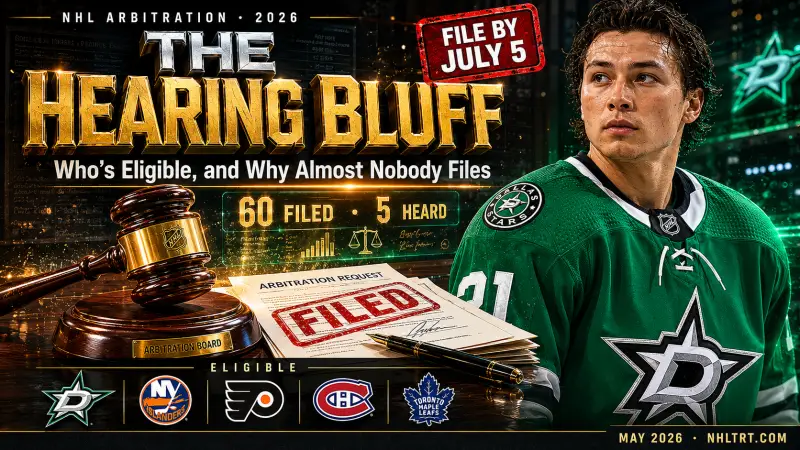
NHL restricted free agents have until July 5 to file for salary arbitration in 2026, and the headline name eligible to do it is Dallas star Jason Robertson. Arbitration sounds like a courtroom showdown, but it almost never reaches one. It is a negotiating lever that forces a settlement, and the actual hearing is a threat both sides work hard to avoid. We call that dynamic The Hearing Bluff. Here is who is eligible in 2026, how the process works, and why the filing matters far more than the verdict.
How NHL Salary Arbitration Works
Arbitration is a tool for restricted free agents only, and not even all of them qualify. Eligibility depends on the age a player signed his first NHL contract and how much pro experience he has since, per theScore's breakdown of the rules. A player who signed at 18 or 19 needs four seasons of 10-plus NHL games; one who signed at 20 needs four pro seasons; and one who signed at 21 or older becomes eligible when his first contract expires.
The deadlines come fast once the RFA period opens: players file by July 5, a team can file club-elected arbitration within 48 hours of the Stanley Cup Final ending, and a second club-elected window closes July 6 at 5 p.m. ET, per the arbitration rules tracked by PuckPedia. Hearings run July 20 to August 4. Each side submits a salary figure, an independent arbitrator hears the case, and a binding award, one or two years long, comes back within 48 hours. For the full money mechanics, our NHL salary cap guide covers how the hit lands.
The single most important rule is the walk-away right. If a player elects arbitration and the award lands above the threshold, the team gets 48 hours to decline it and make him a UFA. The benchmark was $4,538,958 under the prior CBA and is adjusted upward each year, so the 2026 number sits near $5M. A team that files its own case, by contrast, is stuck with whatever the arbitrator decides.
The Hearing Bluff: Why Almost Nobody Goes
For all the noise around arbitration filings, the hearings barely happen. Since Seattle joined the league in 2021-22, only five cases out of roughly 60 filings have reached an actual hearing, per Bleacher Report's look at how rare they are. The rest settled, often hours before the room opened. That gap between filing and hearing is the Hearing Bluff in one number.
| Figure | What it represents |
|---|---|
| ~60 | Player-elected filings since 2021-22 |
| 5 | That actually reached a hearing |
| ~$5M | Walk-away threshold on a player-elected award |
Two forces push both sides toward a settlement: teams hate being locked into a club-elected award they cannot escape, and players hate the hearing itself, where the team has to stand up and argue why the player is worth less than he thinks. That process leaves scars: a Hockey News piece, citing earlier Athletic analysis, found that of 27 players who went to hearings since 2009, 21 were on a different team within three years, 14 of them inside a single year. In 2025, Nashville defenseman Spencer Stastney was the only filer whose case actually produced an arbitrator's award.
The 2026 Eligible Class
Per Pro Hockey Rumors' 2026 eligibility list, several contenders are loaded with eligible names. The Stars and Islanders each carry 10, Toronto and Florida sit at eight, and Philadelphia and Montreal round it out at seven. The headline names by team line up below.
| Team | Eligible | Headline names |
|---|---|---|
| Dallas Stars | 10 | Jason Robertson, Mavrik Bourque |
| NY Islanders | 10 | Adam Boqvist |
| Toronto Maple Leafs | 8 | Matias Maccelli, Nicholas Robertson |
| Florida Panthers | 8 | Mackie Samoskevich, Donovan Sebrango |
| Philadelphia Flyers | 7 | Trevor Zegras, Jamie Drysdale |
| Montreal Canadiens | 7 | Kirby Dach, Arber Xhekaj |
Most of these are mid-tier RFAs for whom arbitration is a genuine option, because a one or two-year award at a fair number suits both sides. Trevor Zegras and Jamie Drysdale in Philadelphia, Kirby Dach in Montreal, Mackie Samoskevich in Florida, and Mavrik Bourque in Dallas all fit that profile. Toronto's Nicholas Robertson is a familiar case here, since we covered why the Leafs were willing to let him walk a year ago. The bigger the name, though, the less arbitration actually fits, which brings us to Dallas.
Jason Robertson: The Star Who Probably Won't File
Jason Robertson is the most prominent name on the eligible list, and the least likely to use it. He just led Dallas with 96 points and 45 goals in the final year of a four-year, $31M deal that carried a $7.75M cap hit. A player at that level does not want a one or two-year arbitration award. He wants term, and arbitration cannot give it.
Jeff Marek has framed the Robertson standoff as binary, per Russian Machine Never Breaks: either a long-term deal gets done, or Robertson gets traded.
That is why a star's arbitration eligibility is really leverage. Robertson could file, take a short award, and march toward unrestricted free agency on his own terms, a path that echoes the Mitch Marner standoff. The Stars want no part of that, which is where the negotiation actually lives.
Stars GM Jim Nill on the Robertson talks, per ClutchPoints: "That's our focus, to get him signed. We drafted him and developed him. We think he will be a Dallas Star for the rest of his career."
Behind that optimism, the money is the sticking point, and per NHL.com Nill's reported red line sits below the $12M Mikko Rantanen makes and nearer the $10.6M cap hit defenseman Thomas Harley carries. The contract-gap math behind that standoff is its own story, which we broke down in our Robertson RFA piece. The arbitration angle simply adds a deadline and a fallback. If the two sides cannot bridge the gap, the same RFA pressure that drives offer-sheet season and the buyout market pushes Dallas toward a trade, the route the Robert Thomas standoff in St. Louis and the Devils' retention-ladder deals both followed.
How the Arbitration Window Plays Out
Here is the order we expect events to unfold, in chronological sequence.
- July 1: the RFA market opens. Qualifying offers are in, and the eligible class is locked for the summer.
- July 5: the player-elected filing deadline. Expect a dozen or so names, mostly mid-tier RFAs using the tool as leverage rather than a destination.
- July 6, 5 p.m. ET: the second club-elected window closes. Teams rarely file on their own players, because they cannot walk away from the award.
- July 20 to August 4: hearings are scheduled, and almost all of them dissolve into signed deals first. History says only a case or two survives to an actual award.
The Verdict: the Hearing Bluff is the whole point of arbitration. The filing creates a deadline and a number both sides can argue from, and the threat of a binding award or a walk-away does the rest. For the mid-tier names like Zegras, Drysdale, and Dach, expect quiet one or two-year settlements. For Jason Robertson, arbitration is the smallest part of the story. My read is that Dallas signs him long-term or trades him before the hearing calendar ever matters, because a 96-point winger has no use for a two-year award.
Sources And Further Reading
- Pro Hockey Rumors, "Players Eligible For Salary Arbitration In 2026"
- PuckPedia, salary arbitration rules, deadlines, and walk-away threshold
- theScore, three things to know about NHL salary arbitration
- NHLPA, players elect salary arbitration (process reference)
- Bleacher Report, why actual arbitration hearings are rare
- The Hockey News, what happens before and after arbitration hearings
- PuckPedia, Jason Robertson contract and 2025-26 statistics
- NHL.com, the Jason Robertson contract dilemma in Dallas
Frequently Asked Questions
When is the NHL salary arbitration deadline in 2026?
Restricted free agents must file for player-elected arbitration by July 5. A team can file club-elected arbitration within 48 hours of the Stanley Cup Final ending, and a second club-elected window closes July 6 at 5 p.m. ET. Hearings are scheduled from July 20 to August 4, with the arbitrator's award delivered within 48 hours of each hearing.
Who is eligible for NHL salary arbitration in 2026?
Only restricted free agents who clear an experience threshold tied to the age they signed their first contract. Per Pro Hockey Rumors, the 2026 class is headlined by Dallas star Jason Robertson, with the Stars and Islanders carrying 10 eligible players each. Other notable names include Trevor Zegras and Jamie Drysdale (Philadelphia), Kirby Dach (Montreal), Matias Maccelli and Nicholas Robertson (Toronto), and Mavrik Bourque (Dallas).
How does NHL salary arbitration work?
After a qualifying offer, the player or the team files for arbitration. Each side submits a salary figure, an independent arbitrator hears the case, and a binding one or two-year award is issued within 48 hours. A player may elect arbitration multiple times in his career, but a team can elect it on a given player only once.
What is the NHL arbitration walk-away threshold?
If a player elects arbitration and the award lands above the threshold, the team has 48 hours to walk away and the player becomes an unrestricted free agent. The benchmark was $4,538,958 under the prior CBA and is adjusted upward each year, so the 2026 figure sits near $5M. A team cannot walk away from an award in a case it elected itself.
Will Jason Robertson file for arbitration in 2026?
It is unlikely. Robertson just put up 96 points, and arbitration only produces a one or two-year award, which a star coming off a $7.75M cap hit does not want. For him, eligibility is leverage. The realistic outcomes are a long-term Dallas extension or a trade, not an actual hearing.
Why do so few NHL arbitration cases reach a hearing?
We call it the Hearing Bluff. Since 2021-22 only about five of roughly 60 player-elected filings have reached a hearing. Both sides settle to avoid a binding award and the relationship damage of the process. A widely cited Athletic study found 21 of 27 players who went to hearings since 2009 were on a different team within three years.
What happens if a team walks away from an arbitration award?
The player becomes an unrestricted free agent immediately, not on July 1, and is free to sign anywhere. Teams use the walk-away sparingly because the open market can end up paying the player more than the arbitrator awarded, so declining a hearing win can backfire.
Related Stories

Alex Tuch Destinations: 4 Teams
Buffalo wants Alex Tuch back, but if the extension stalls, Columbus, Washington, Seattle, and Edmonton are circling. The cap math, the Kempe...
By Mike Johnson · 13 min read
Darren Raddysh Free Agent 2026: 4 Teams
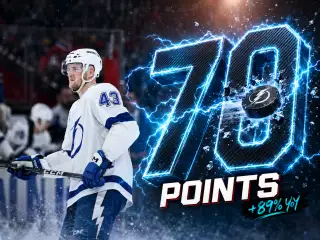
Darren Raddysh's 70-point breakout turned his $975K cap hit into a four-team bidding war. The Athletic linked him to Philadelphia, San Jose,...
By Mike Johnson · 13 min read
Bobby McMann Free Agent 2026 Destinations: 4 Teams Linked
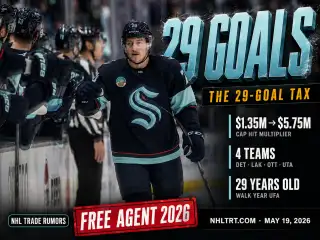
Bobby McMann's career-high 29 goals just turned a $1.35M cap hit into Sharangovich-tier money. The Athletic locked him to 4 teams (Detroit,...
By Mike Johnson · 10 min read
NHL Free Agency 2026: The Survivor Market
The 2026 UFA pool is defined by who escaped extensions — meet the Survivor Market.
By Sarah Chen · 1 min read
Get NHL trade rumors in your inbox
One email per week. Zero spam. Verified rumors only.