Jordan Binnington Trade: The Two-Jersey Goalie St. Louis Can't Keep
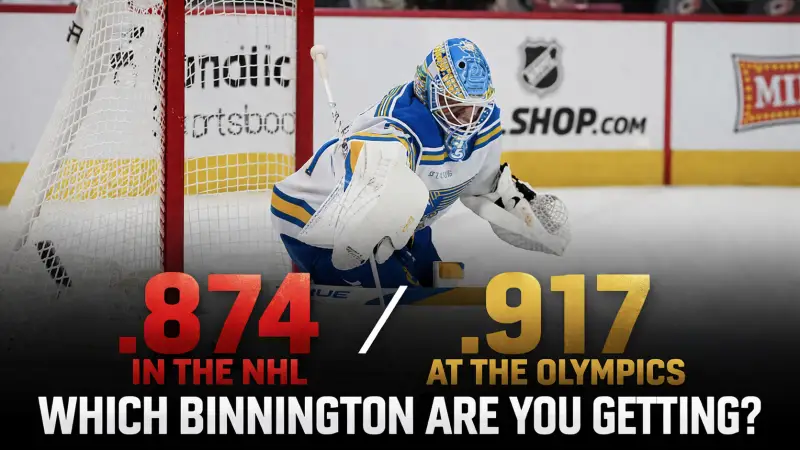
Jordan Binnington's .874 save percentage makes him one of the NHL's worst starters. His .917 at the Olympics makes him one of the best tournament goalies alive. That's The Two-Jersey Goalie problem — and three teams are betting on which version shows up.
Live updates
No updates yet. Refreshing automatically.
Jordan Binnington posted a .874 save percentage with the St. Louis Blues this season — 56th out of 60 qualified goaltenders in the NHL. Then he flew to Milan, started five games for Team Canada at the Olympics, put up a .917 save percentage and a 1.78 goals-against average, and nearly won gold. That .043 gap between his NHL save percentage and his international save percentage is the entire Jordan Binnington trade market in a single number. Every team calling the Blues this summer is making the same bet: that the goalie who shows up when you hand him a maple leaf will show up when you hand him their sweater. That's The Two-Jersey Goalie problem, and it's going to define the most fascinating offseason deal in the NHL.
NHL Network's Brian Lawton reported in March that the Blues moving Binnington is a "forgone conclusion." The Athletic's Jeremy Rutherford countered that a deadline deal didn't seem likely, but a summer move was expected. Both were right — the deadline passed, Binnington stayed, and now the offseason is where this plays out. One year left at $6 million. A no-trade list that drops from 14 teams to 10. A 32-year-old with the worst regular-season numbers of his career and the best international tournament run by any goaltender since Carey Price at the 2014 Olympics.
Key Takeaways
- The Two-Jersey Goalie: Binnington's .874 SV% in the NHL sits .043 points below his .917 SV% at the Olympics — the widest gap between regular-season and tournament production for any active goaltender
- Contract sweet spot: One year remaining at $6M AAV with a no-trade list that drops from 14 to 10 teams — the ideal rental window for a contender
- Hofer has the crease: Joel Hofer's 19-11-5 record with a .911 SV% and six shutouts makes Binnington expendable in St. Louis
- Blues in full teardown: 31st in the standings, Robert Thomas and Jordan Kyrou also available, Doug Armstrong transitioning to Alexander Steen as GM
- Edmonton is the dark horse: The Oilers' Tristan Jarry disaster (.855 SV%, 4.17 GAA, locker room friction) creates the most desperate goaltending need in the league
The .043 Gap: Two Jerseys, Two Goaltenders
I've covered goaltender trades for years, and I can't remember a case where the regular-season and tournament stats diverged this violently. This isn't a slump followed by a hot streak — this is two completely different players wearing the same pads.
| Setting | Record | GAA | SV% |
|---|---|---|---|
| 2025-26 NHL (STL) | 12-19-7 | 3.29 | .874 |
| 4 Nations Face-Off | 3-1-0 | 2.37 | .907 |
| 2026 Olympics | 4-1-0 | 1.78 | .917 |
| 2019 Cup Playoffs | 16-10 | 2.46 | .914 |
Look at that table. When something is on the line — a championship, a gold medal, a legacy moment — Binnington's save percentage jumps 40 to 50 points. His 4 Nations run wasn't a fluke: he stopped 29 of 32 high-danger shots (.906), second only to Connor Hellebuyck. At the Olympics, he shut out Czechia in the opener, backstopped Canada through the bracket, and made 26 saves on 28 shots in the gold medal game before Jack Hughes ended it in overtime.
Nathan MacKinnon, who won tournament MVP, didn't mince words after the 4 Nations title.
"We don't do this without Jordan Binnington."
— Nathan MacKinnon, 4 Nations Face-Off MVP (via TSN)Binnington himself seemed to understand the moment. After Canada's gold medal game loss to the U.S., he spoke to TSN with the kind of clarity you don't hear from a guy sleepwalking through a last-place season.
"It felt like it was already written."
— Jordan Binnington, on the Olympic gold medal game (via TSN)Then he flew back to St. Louis and kept losing. The career trajectory tells the story: a .927 save percentage in his breakout 2018-19, a .913 in 2023-24, and a .874 this year. His goals-against average has inflated from 1.89 in his debut half-season to 3.29 this year. The decline isn't sudden — it's been a four-year slide, interrupted twice a year by international tournaments where something in Binnington's wiring flips on and he becomes the best goalie on the planet for three weeks.
The historical precedent here is Edmonton's own recent disaster. The Oilers traded Stuart Skinner to Pittsburgh in December for Tristan Jarry, betting that a goalie with playoff experience and a bigger reputation would stabilize the position. Instead, Jarry posted a .855 save percentage — the worst among qualified goaltenders — and created locker room friction that Elliotte Friedman detailed on his 32 Thoughts podcast. Any team trading for Binnington should have that cautionary tale tattooed on the offer sheet.
Three Destinations That Make Structural Sense
Moving Binnington requires three things: he approves the destination (his 14-team NTL gives him veto power over nearly half the league this summer, though it drops to 10 teams for 2026-27), the acquiring team has cap room for a $6 million hit, and the return justifies the Blues letting a franchise icon walk to a rival. Doug Armstrong's successor Alexander Steen inherits the decision — and unlike Nashville's Marchessault situation, Binnington's expiring contract actually helps St. Louis here.
1. Montreal Canadiens — The Montembeault Swap
Montreal has the clearest path. Jakub Dobes seized the starting job this season — 26 wins in 37 starts, a .70 win percentage that removed all doubt. Samuel Montembeault, who was demoted to Laval for conditioning in December and never fully recovered his standing, will be traded this summer. Binnington is the obvious replacement as a veteran complement to Dobes.
The deal writes itself: Montembeault ($3.15M AAV, one year left) plus a third-round pick to St. Louis for Binnington ($6M). Montreal absorbs $2.85 million in additional cap space — manageable for a team that has room. Kent Hughes gets a Stanley Cup champion and two-time international tournament star in the dressing room with Nick Suzuki, Cole Caufield, and Juraj Slafkovsky as they push toward a playoff berth. The intangibles are real.
My concern: Hughes has been disciplined about his rebuild timeline. A 32-year-old on a one-year deal doesn't move the needle long-term, and if Binnington gives Montreal his NHL numbers instead of his tournament numbers, they've downgraded from Montembeault for nothing.
2. Ottawa Senators — The Ullmark Insurance
Linus Ullmark's season has been a mess. A mental health leave early in the year disrupted his rhythm, and his numbers since returning — .886 save percentage, 2.85 GAA — aren't starter quality for a team trying to lock down a playoff spot. Ottawa needs a contingency plan, and Binnington's one-year deal is the definition of low-commitment upside.
The Senators have cap flexibility that Montreal and other goaltender-hungry teams don't. They could absorb the full $6 million without requiring retention from St. Louis, which gives the Blues a cleaner deal and potentially a better pick in return. A second-rounder plus a prospect is realistic.
The risk is the no-trade list. We don't know Ottawa's status on it — Binnington's list is unpublished. And there's the same Two-Jersey question: does he give Ottawa the Olympic version or the Blues version? For a team that already has goaltending instability, adding another question mark in net feels like doubling down on uncertainty.
3. Edmonton Oilers — The Jarry Correction
This is the destination that makes the most sense and requires the most gymnastics to execute. Edmonton's goaltending is a five-alarm fire. Jarry — acquired for Skinner, Brett Kulak, and a second-round pick in December — has been catastrophic: a 4.17 GAA and .855 save percentage, worst among all qualified goaltenders. Head coach Kris Knoblauch officially demoted him in March, naming Connor Ingram the starter. Friedman reported the Oilers were "trapped" by Jarry's $5.375 million cap hit at the deadline, unable to make a second goaltender move.
The offseason removes that constraint. Edmonton needs to dump Jarry first — likely to a rebuilding team willing to absorb his two remaining years for draft compensation — then acquire Binnington. The connection already exists: Binnington was Canada's goalie when Connor McDavid scored the overtime winner at the 4 Nations Face-Off. Chemistry between a goalie and a team's franchise player matters more than people think.
I'd bet this is where Binnington ends up. Edmonton is desperate, McDavid's window is now, and Binnington has proven — repeatedly — that he shows up for the games that matter most. The Oilers just can't afford another Jarry. They need the tournament Binnington. The question is whether they get him for 82 games or just 16.
The Blues appear ready to move on from Jordan Binnington. 16 team no trade list is in play but feels like a move is a forgone conclusion at this stage with where @StLouisBlues heading in the near term.
— Brian Lawton (@brianlawton9) March 3, 2026
Why Carolina Doesn't Work
The Hurricanes get mentioned in every goaltender trade conversation, but Pierre LeBrun reported they "never got serious" with the Blues about Binnington before the deadline. New GM Eric Tulsky runs Carolina's front office with an analytics-first approach. A .874 save percentage doesn't survive a single meeting in that building, regardless of what happened at the Olympics. Tulsky would rather bet on his internal options than pay for the Two-Jersey Goalie and hope the right one shows up.
What St. Louis Actually Gets Back
The Blues don't need Binnington anymore, and that's not an insult — it's Joel Hofer's crease now. The 25-year-old has posted a 19-11-5 record with a 2.52 GAA, a .911 save percentage, and six shutouts this season. During one stretch in March, Hofer went 4-0-1 with a .948 save percentage. He's young, he's cheap (RFA this summer), and he's the kind of goaltender you build a rebuild around.
Armstrong's succession plan reinforces the timeline. Alexander Steen takes over as GM this summer, inheriting a roster that will look dramatically different. Jordan Kyrou's $8.125 million deal is being shopped. Robert Thomas commands a king's ransom. Binnington at $6 million for one year is the easiest contract on the roster to move — the term is actually an asset, not a liability, because the acquiring team gets playoff insurance without a long-term commitment.
Projected returns vary by destination. Montreal offers Montembeault plus a mid-round pick — decent but unspectacular. Ottawa can offer a straight second-rounder without requiring salary retention, which is cleaner. Edmonton, if desperate enough after dumping Jarry, might overpay with a second-round pick and a B-level prospect. Compare that to what Stamkos might command in a similar one-year rental scenario — Binnington's return will be roughly equivalent, maybe slightly lower given the positional market.
Sources and Reporting
- Brian Lawton (NHL Network) — "Forgone conclusion" reporting, trade probability
- Jeremy Rutherford (The Athletic) — Summer timeline reporting, contract context
- TSN — MacKinnon quote, 4 Nations coverage
- NHL.com — Olympic performance stats, EDGE analytics
- The Oil Rig / Elliotte Friedman — Oilers "trapped" by Jarry contract at deadline
- Pro Hockey Rumors — Blues leaning toward trade, market analysis
- The Hockey News — Joel Hofer emergence, crease succession
My projection: Edmonton, sometime between the draft and July 1. The Oilers dump Jarry to a cap-floor team with draft pick compensation, then send a 2027 second-round pick and a mid-tier prospect to St. Louis for Binnington. The Blues retain nothing — the one-year term means they don't have to. Steen gets the pick, clears the cap space, and hands the crease to Hofer. Edmonton bets on the tournament goalie for one last McDavid playoff run. The Two-Jersey Goalie finds out if a third jersey — the one with the oil drop on the chest — flips the same switch that the maple leaf always does. Every team in this conversation is making the same gamble. The regular-season numbers say Binnington is cooked. The gold medal game tape says otherwise. Somewhere between .874 and .917, there's a goaltender worth trading for. The question nobody can answer is which one shows up in October.
Frequently Asked Questions
Why wasn't Jordan Binnington traded at the 2026 deadline?
His 14-team no-trade list eliminated most contenders, and the Blues couldn't find a deal that met their return expectations by March 6. Jeremy Rutherford reported a source said the deadline wasn't realistic but a summer trade was expected. Lawton gave it 60/40 odds on deadline day — it didn't happen.
What is Jordan Binnington's current contract?
Six years, $36 million ($6M AAV), signed in March 2021 with St. Louis. One season remains (2026-27) before he becomes an unrestricted free agent. His no-trade list drops from 14 teams to 10 in the final year, opening more destinations for a summer deal.
How did Binnington perform at the 2026 Olympics?
He started all five games for Canada in Milan: four wins, a 1.78 GAA, .917 save percentage, and one shutout. He made 26 saves in the gold medal game — a .929 performance — before Jack Hughes scored in overtime for Team USA. Canada took silver.
Who replaces Binnington in St. Louis?
Joel Hofer, 25, has already taken the starting role. His 2025-26 line: 19-11-5, 2.52 GAA, .911 save percentage, six shutouts. The Hockey News declared it "Hofer's crease now." He's an RFA this summer and the clear future in net for the Blues' rebuild.
What could the Blues get in return for Binnington?
A second-round pick and a prospect is the baseline. Edmonton could overpay if they successfully dump Jarry first. Montreal might offer Montembeault ($3.15M) as a salary offset plus a mid-round pick. The one-year term actually helps — acquiring teams aren't locked into a long commitment.
Frequently Asked Questions
Why wasn't Jordan Binnington traded at the 2026 deadline?
His 14-team no-trade list eliminated most contenders, and the Blues couldn't find a deal that met their return expectations by March 6. Jeremy Rutherford reported a source said the deadline wasn't realistic but a summer trade was expected. Lawton gave it 60/40 odds on deadline day — it didn't happen.
What is Jordan Binnington's current contract?
Six years, $36 million ($6M AAV), signed in March 2021 with St. Louis. One season remains (2026-27) before he becomes an unrestricted free agent. His no-trade list drops from 14 teams to 10 in the final year, opening more destinations for a summer deal.
How did Binnington perform at the 2026 Olympics?
He started all five games for Canada in Milan: four wins, a 1.78 GAA, .917 save percentage, and one shutout. He made 26 saves in the gold medal game — a .929 performance — before Jack Hughes scored in overtime for Team USA. Canada took silver.
Who replaces Binnington in St. Louis?
Joel Hofer, 25, has already taken the starting role. His 2025-26 line: 19-11-5, 2.52 GAA, .911 save percentage, six shutouts. The Hockey News declared it "Hofer's crease now." He's an RFA this summer and the clear future in net for the Blues' rebuild.
What could the Blues get in return for Binnington?
A second-round pick and a prospect is the baseline. Edmonton could overpay if they successfully dump Jarry first. Montreal might offer Montembeault ($3.15M) as a salary offset plus a mid-round pick. The one-year term actually helps — acquiring teams aren't locked into a long commitment.
Related Stories
NHL Buyout Candidates 2026
The NHL buyout window opens June 15. Rielly, Gallagher, Kotkaniemi, and Frederic are the names in play, but the Dead-Cap Tail means most buy...
By Mike Johnson · 10 min read

Darnell Nurse Trade: 4 Suitors
Edmonton wants Darnell Nurse's $9.25M off the books, but a buyout saves barely $1.53M and his no-move clause hands him the pen. The Bonus Sh...
By Mike Johnson · 12 min read

Bill Guerin Wild Window Paradox: $17M Meets $1.18M
Wild GM Bill Guerin said 'we're in a window now' and 'you can't trade your way out of problems' five days after a Game 5 collapse. Then Kapr...
By Mike Johnson · 11 min read
Darren Raddysh Free Agent 2026: 4 Teams
Darren Raddysh's 70-point breakout turned his $975K cap hit into a four-team bidding war. The Athletic linked him to Philadelphia, San Jose,...
By Mike Johnson · 13 min read
Get NHL trade rumors in your inbox
One email per week. Zero spam. Verified rumors only.