Jordan Kyrou Trade: Why the $8.125M Gamble Scares GMs
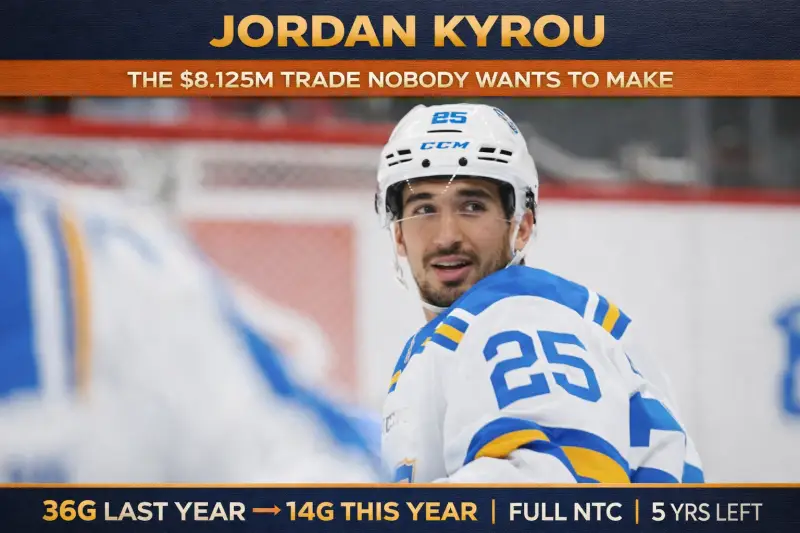
The Jordan Kyrou trade is coming this summer, but his production collapse from 36 goals to 14 changes everything. Full NTC, $8.125M AAV, and a shrinking market.
Live updates
No updates yet. Refreshing automatically.
The Jordan Kyrou trade that everyone expected at the deadline never happened. Five years and $40 million remain on his contract. He has a full no-trade clause. And the 27-year-old who scored 36 goals last season is on pace for 24 this year — with a shooting percentage that's cratered to 10.6%, well below his 13.3% career average. The Blues are going to move him this summer, but the player they're selling isn't the one teams thought they were buying.
That disconnect between Kyrou's contract value and his current production is the single biggest obstacle standing between St. Louis and a clean rebuild. Insider David Pagnotta put it bluntly: he'd "be surprised if Kyrou was a member of the Blues next season."
Key Takeaways
- Production collapse is real: Kyrou's gone from 36 goals and 70 points last season to 14 goals and 33 points through 48 games — his shooting percentage has dropped from 15.8% to 10.6%
- The NTC gives Kyrou all the power: His full no-trade clause means he picks where he goes, which shrinks the market to 3-4 teams and gives the Blues almost zero bargaining power on price
- $8.125M AAV is expensive for a down year: Five teams in the $7-9M range for wingers are producing 65+ points this season — Kyrou is on pace for 56. Acquiring teams are paying for the track record, not the current output
- Seattle came closest: The Blues had a deal in place last June sending Kyrou to the Kraken for the 8th overall pick — it fell apart. Seattle still has six first-rounders across the next four drafts
- Blues get $8.125M in cap relief: With incoming GM Alex Steen taking over this summer, moving Kyrou frees space to reshape the roster around Robert Thomas and the next core
From 36 Goals to 14 — What Went Wrong
Kyrou scored 36 goals in 2024-25. Led the Blues. Hit 70 points for the second time in three years. Before that: 31 goals in 2023-24, 37 in 2022-23. Three consecutive 30-goal seasons from a winger on a reasonable contract. That's the player teams are picturing when they hear "Jordan Kyrou is available."
That player hasn't shown up this season.
Through 48 games, Kyrou has 14 goals and 33 points. His shooting percentage sits at 10.6% — down from 15.8% last season and below his 13.3% career average. He's on pace for 24 goals and 56 points over a full 82-game season. For a guy making AAV salary cap calculations, those numbers don't get you top-of-market value in a trade.
Some of this is bad luck. Kyrou's shot volume hasn't dropped dramatically — he's still generating chances. But the finishing has gone cold, and his 5-on-5 production has fallen off a cliff. Part of the problem is systemic. The Blues are a bad team this year, and even skilled players look worse when the system around them breaks down.
But scouts I've read are flagging something else: engagement. The defensive effort that was always inconsistent has gotten worse. The backcheck that was never a strength has become a liability. When a player publicly signals he's "open to a change of scenery" — as Sportsnet's Nick Kypreos reported — that mental checkout tends to show up in the numbers.
The Full NTC Problem Nobody's Explaining
Most trade speculation treats Kyrou's no-trade clause as a footnote. It's not. It's the entire story.
A full NTC means Kyrou has to approve any trade destination. He doesn't submit a list of 10 teams he'd accept — he gets to say yes or no to every single offer. That gives him complete control over where he ends up, which sounds great for the player but is a nightmare for the Blues.
Why? Because it shrinks the market. If Kyrou will only waive for 3-4 teams, the Blues can't create a bidding war. They can't pit Seattle against Montreal against Boston and drive the price up. They take whatever the approved team offers, or they keep a player who doesn't want to be there. That's not a negotiating position — that's a hostage situation where the hostage picks the ransom.
The Parayko situation is instructive. NTC trades consistently return less value than equivalent players without trade protection. Look at what happened when other Blues players with protection clauses hit the market — the return was always less than the asset's actual value. Teams know the seller has no alternatives once the player names his destination. The acquiring team can lowball because the Blues either accept that offer or keep an unhappy player making $8 million.
There's also a timing issue. The longer this drags into the summer, the weaker the Blues' position gets. Every week closer to training camp is another week Kyrou spends disengaged. Teams smell desperation. The ideal scenario for St. Louis is getting a deal done by the draft in late June — but that requires Kyrou to have his preferred destination list ready early.
What $8.125M Actually Buys in 2026
This is the part nobody else is running. Kyrou's cap hit is $8.125 million through 2030-31. What does that money get you on the open market or via trade for other wingers right now?
| Player | AAV | 2025-26 Pace | Age |
|---|---|---|---|
| Nikolaj Ehlers (CAR) | $8.5M | 75 pts pace | 30 |
| Mark Scheifele (WPG) | $8.5M | 80 pts pace | 33 |
| Mitch Marner (FA) | $10.9M | 85 pts pace | 29 |
| Brock Boeser (VAN) | $6.65M | 60 pts pace | 29 |
| Jordan Kyrou (STL) | $8.125M | 56 pts pace | 27 |
Kyrou's pace this season puts him at the bottom of that group by production — but he's the youngest. That's the argument for buying: age curve. Kyrou is 27. If this season is the outlier and he bounces back to 30-goal form, you're getting a $8.125M winger through age 31 who produces at a 70-point pace. That's good value.
If this season is the new normal, you just took on a $40 million anchor for a third-line winger. That's the gamble every acquiring GM has to make, and it's why the Blues couldn't move him at the deadline — nobody was willing to bet $40 million on a hunch.
Three Teams That Make Sense
Seattle Kraken — The Deal That Almost Was
Seattle nearly got Kyrou last June. The Blues had a deal in place sending him to the Kraken for the 8th overall pick in the 2025 draft — it collapsed at the finish line. The fit hasn't changed. Seattle has six first-round picks across the next four drafts, aggressively pursued trades at the deadline (including a run at Panarin), and desperately needs a top-six scoring winger. GM Jason Botterill has publicly said he prefers trades over free agency.
Projected package: a 2026 first-rounder plus a roster player (likely a young forward or defenseman). The Kraken have the draft capital. The question is whether Kyrou waives his NTC for Seattle — a non-traditional market with no playoff appearance since their inaugural season.
Montreal Canadiens — The Caufield-Suzuki Missing Piece
Montreal needs a first-line right wing. Pro Hockey Rumors confirmed the Canadiens are shopping for exactly that role. Kyrou alongside Cole Caufield and Nick Suzuki is a genuinely dangerous top line — three players who can all shoot and create.
The cap math works if Montreal moves Patrik Laine ($8.7M) in the same deal or as a separate transaction. And the Canadiens have significant 2026 draft capital to offer. A Canadian market, a young team trending up, a chance to play first-line minutes — Kyrou would likely waive for Montreal.
Boston Bruins — $28M in Space and a Winger-Sized Hole
Boston has an estimated $28 million in projected cap space for 2026-27. They need a top-six winger badly — Pastrnak can't carry the offense alone. Kyrou slots in perfectly beside whoever centers the second line, and Boston's defensive structure could mask the weaknesses in Kyrou's two-way game.
The Bruins are also eyeing the 2026 UFA class, so a trade for a controlled asset like Kyrou (five years remaining) might appeal more than a bidding war for Jason Robertson or other free agents.
Why the Islanders Don't Work
New York was the most aggressive suitor before the deadline. GM Mathieu Darche explored a deal but the sticking point was clear: the Blues wanted defenseman Kashawn Aitcheson included, and the Islanders said no. That impasse isn't going away this summer. Darche has shown he'll protect his prospects, and the Blues aren't dropping their ask.
"There is a sense from both Kyrou's side and the team's that a change in scenery might be best for everyone."
— Nick Kypreos, Sportsnet (via ClutchPoints)The most likely outcome: Kyrou goes to Seattle or Montreal for a first-round pick and a prospect. The Blues get cap relief, incoming GM Alex Steen gets a clean slate, and Kyrou gets to prove this season was the outlier — not the trajectory. Whether he can actually do that is a $40 million question nobody can answer until he's wearing a different jersey.
One thing is certain: the Jordan Kyrou trade will define Alex Steen's first move as GM. Get it right — a first-rounder and a real prospect — and the rebuild has its foundation. Get it wrong, and the Blues are stuck watching Kyrou score 30 goals somewhere else while they hold a bag of mid-round picks. The clock starts the day the season ends.
Sources and Reporting
- The Fourth Period — David Pagnotta insider reporting on Kyrou's trade status
- ClutchPoints / Sportsnet — Nick Kypreos quote on Kyrou being open to trade
- ESPN — Jordan Kyrou 2025-26 season statistics
- PuckPedia — Contract details, cap hit, NTC verification
- Pro Hockey Rumors — Canadiens shopping for first-line right wing
- The Hockey News — Insider belief Kyrou won't be with Blues in 2026-27
- Hockey-Reference — Career statistics and shooting percentage history
Frequently Asked Questions
What is Jordan Kyrou's contract and trade clause?
Eight years, $65 million ($8.125M AAV) through 2030-31 with a full no-trade clause. He has to approve any deal — the Blues can't move him without his consent. Five years and $40 million remain.
Why are the Blues trading Jordan Kyrou?
St. Louis is rebuilding with incoming GM Alex Steen taking over this summer. Kyrou's production dropped from 36 goals to 14 through 48 games, and both sides agree a fresh start makes sense. The $8.125M in cap relief lets Steen reshape the roster.
What will the Blues get back for Kyrou?
Expect a first-round pick and a prospect. Last June, Seattle nearly sent the 8th overall pick for Kyrou. The NTC limits the market to 3-4 teams, which suppresses the return — the Blues won't get full market value.
Which team is the best fit for Jordan Kyrou?
Seattle has the draft capital and the need. Montreal has the roster hole and the cap flexibility. Boston has $28M in space. My bet is Seattle or Montreal — both offer first-line roles that could unlock a Kyrou bounce-back season.
Frequently Asked Questions
What is Jordan Kyrou's contract and trade clause?
Eight years, $65 million ($8.125M AAV) through 2030-31 with a full no-trade clause. He has to approve any deal — the Blues can't move him without his consent. Five years and $40 million remain.
Why are the Blues trading Jordan Kyrou?
St. Louis is rebuilding with incoming GM Alex Steen taking over this summer. Kyrou's production dropped from 36 goals to 14 through 48 games, and both sides agree a fresh start makes sense. The $8.125M in cap relief lets Steen reshape the roster.
What will the Blues get back for Kyrou?
Expect a first-round pick and a prospect. Last June, Seattle nearly sent the 8th overall pick for Kyrou. The NTC limits the market to 3-4 teams, which suppresses the return — the Blues won't get full market value.
Which team is the best fit for Jordan Kyrou?
Seattle has the draft capital and the need. Montreal has the roster hole and the cap flexibility. Boston has $28M in space. My bet is Seattle or Montreal — both offer first-line roles that could unlock a Kyrou bounce-back season.
Related Stories

Golden Knights Offseason Squeeze
Vegas reached Game 6 of the 2026 Cup Final, then handed itself a summer with about $4.6M in cap space to re-sign Pavel Dorofeyev, replace a...
By Mike Johnson · 9 min read
Hischier Trade Clock Hits July 1
Nico Hischier trade rumors are rising: extension talks with new GM Sunny Mehta are in their infancy, Montreal, LA and Minnesota are circling...
By Mike Johnson · 9 min read

Larkin-Robertson Swap: Who Says No?
Dallas has checked in on Dylan Larkin, but the Stars cannot fit his $8.7M until Jason Robertson and his unsigned $14M ask move out. Inside t...
By Mike Johnson · 11 min read

Darnell Nurse Trade: 4 Suitors
Edmonton wants Darnell Nurse's $9.25M off the books, but a buyout saves barely $1.53M and his no-move clause hands him the pen. The Bonus Sh...
By Mike Johnson · 12 min read
Comments
Be the first to share your take.
Get NHL trade rumors in your inbox
One email per week, zero spam, verified rumors only.