Maple Leafs GM Candidates: The 24-Month Ultimatum That
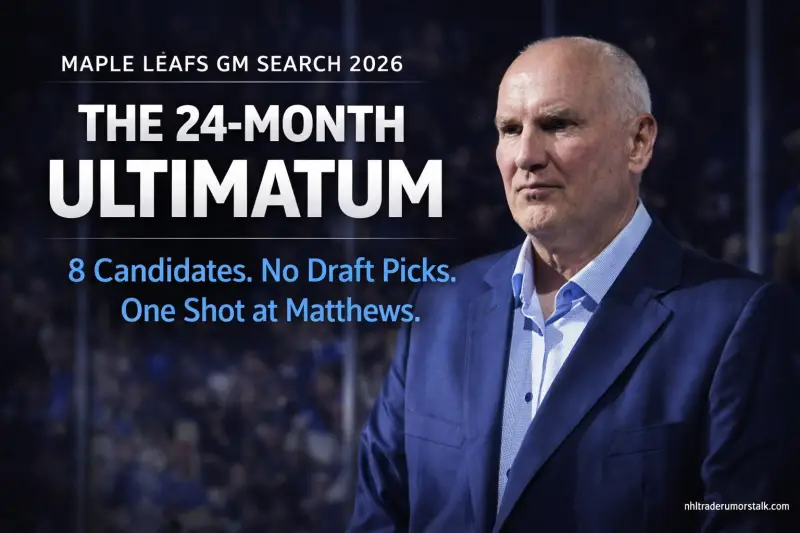
Toronto fired Brad Treliving. Now comes the hard part — hiring a GM who can build a contender before Auston Matthews hits free agency in July 2028. We break down all 8 candidates and score them on what actually matters.
Live updates
No updates yet. Refreshing automatically.
The Toronto Maple Leafs fired Brad Treliving on March 30. Every outlet printed the same list of names: Armstrong, Chayka, Pronger. The usual suspects, the usual speculation, the usual "who's available?" framing.
They're all missing the real story. The conversation about Maple Leafs GM candidates shouldn't start with names — it should start with a deadline.
This isn't a typical GM search. Toronto's next general manager doesn't just need to build a competitive roster — they need to do it before Auston Matthews hits unrestricted free agency on July 1, 2028. No first-round picks in 2026 or 2027. A roster that just went 32-30-13. And a CEO who's publicly demanding a "data-centric" revolution in the front office. I'm calling it The 24-Month Ultimatum — the most consequential GM hire in Maple Leafs history since the salary cap era began, with a built-in expiration date that no amount of corporate buzzwords can extend.
🔑 Key Takeaways
- Brad Treliving fired March 30 after a 32-30-13 season — Toronto's first playoff miss in a decade
- MLSE CEO Keith Pelley demands a "data-centric" leader — the new title is Head of Hockey Operations, not just GM
- 8 candidates across two tiers: front-runners (Armstrong, Chayka, Pronger, Wilson) and dark horses (Pridham, Hardy, Wickenheiser, Spezza)
- The 24-Month Ultimatum: Matthews hits UFA July 2028, and Toronto has no 1st-round picks in 2026 or 2027 — the next GM can't rebuild through the draft
- Pelley wants a hire by mid-May (before the Scouting Combine) — seven people contacted the organization within 24 hours of the firing
The Firing — Why Toronto Had to Move Now
Three days before the end of March, Keith Pelley made the call. With eight games left in a season that was already functionally over, the MLSE president and CEO fired Brad Treliving as general manager of the Toronto Maple Leafs — at Treliving's own request, the news went public immediately before Toronto's Monday night game against the Anaheim Ducks.
The numbers told the story before Pelley did. Toronto sat at 32-30-13 — 77 points, seventh in the Atlantic Division, fourteenth in the Eastern Conference. For a franchise that hadn't missed the playoffs since 2016-17, this wasn't just a bad season. It was an organizational crisis that had been building since October.
Pelley's press conference the following morning was remarkable for its specificity. He didn't hide behind vague corporate language. "I honestly believe that we didn't have the alignment, we didn't have the culture, we didn't have the structure that we needed to be successful," he told reporters. Then came the mandate that will define this entire search: the next leader must be "data-centric."
"Every single decision that we make will be evidence-based," Pelley declared. "Evidence-based decisions are never wrong."
The timeline is aggressive. Pelley wants a candidate in place by mid-May — before the 2026 NHL Scouting Combine in Buffalo — or at the latest, early June ahead of the Draft. In the interim, assistant GMs Brandon Pridham and Ryan Hardy are sharing the day-to-day operations. Seven people had already contacted the organization about the job within 24 hours of the announcement. The Maple Leafs haven't proactively approached anyone yet.
One detail that went underreported: Pelley isn't looking for a "general manager." He's looking for a Head of Hockey Operations — a broader title that signals a structural overhaul, not just a personnel swap. That distinction matters. It means whoever gets hired will have authority over scouting, analytics, player development, and the coaching staff. It's a power consolidation that only makes sense if Pelley genuinely believes the previous structure was broken at every level.
The 24-Month Ultimatum — Why This Isn't Just Another GM Hire
Here's what separates this search from every other GM vacancy in the NHL right now: the clock.
Auston Matthews' four-year, $53 million contract expires on July 1, 2028. That gives Toronto's next GM approximately 24 months from the day they take the job to convince a generational franchise player — one who just watched his team miss the playoffs for the first time in his career — that staying in Toronto is worth more than testing the open market.
I've covered enough GM searches to know that every franchise says "win now." But Toronto's math is uniquely punishing. Treliving traded the 2026 first-round pick to San Jose in the Jake Walman deal. The 2027 first-rounder is also gone. The traditional rebuild path — stockpile draft capital, develop prospects, grow organically — simply isn't available. Whoever walks through the doors at MLSE headquarters is inheriting a roster that needs to be fixed through trades and free agency, with limited draft ammunition, under the most intense media scrutiny in professional hockey.
"Evidence-based decisions are never wrong, right? That's not to say that there's not room for heart. But it's evidence-based."
The historical precedent isn't encouraging. When Pittsburgh hired Jim Rutherford in 2014, they had Sidney Crosby and Evgeni Malkin in their primes, a loaded prospect pipeline, and draft picks to work with. Rutherford won two Cups. When Colorado elevated Joe Sakic to the GM chair, he had Nathan MacKinnon plus a deep system that produced Cale Makar. Both franchises had the star and the supporting infrastructure.
Toronto has the star. The supporting infrastructure is a question mark. And unlike Pittsburgh or Colorado, the Maple Leafs don't have the luxury of a patient rebuild if Plan A fails — because Plan A has a 24-month expiration date stapled to Auston Matthews' contract.
That's The 24-Month Ultimatum. Get it right, and you're the architect of Toronto's first Stanley Cup since 1967. Get it wrong, and you're the GM who lost Auston Matthews for nothing.
The Front-Runners — Armstrong, Chayka, Pronger, Wilson
Doug Armstrong: The Proven Winner
Armstrong is the name at the top of every insider's list, and I understand why. The man built a Stanley Cup champion in St. Louis in 2019 with the kind of mid-season audible — acquiring Ryan O'Reilly from Buffalo — that defines franchise-altering general management. He's set to hand the Blues' GM title to Alexander Steen on July 1, while remaining as president of hockey operations.
The fit with Pelley's "data-centric" mandate isn't immediately obvious. Armstrong is known as a gut-instinct operator who supplements with analytics rather than leading with them. But his track record of aggressive, calculated trades and his ability to manage a championship window through the salary cap is exactly the kind of practical experience Toronto needs right now.
The complication: reports suggest Blues ownership has grown tired of the Toronto speculation, and it's genuinely unclear whether Armstrong has a clean exit window this summer. If St. Louis decides to hold him to his contract, the Leafs' top target becomes unavailable before the search even begins.
John Chayka: The Data Play
If Pelley wants "data-centric," Chayka is the walking embodiment of it. He became the NHL's youngest GM at 26 with the Arizona Coyotes and immediately built one of the league's most advanced analytics departments. He reportedly interviewed with the Maple Leafs as recently as February 2026 — a timeline that suggests Toronto's interest in a new direction predated Treliving's firing by weeks.
The red flags are impossible to ignore. Chayka abruptly resigned from Arizona in 2020, was subsequently suspended by the NHL, and his departure remains one of the more controversial front-office episodes in recent league history. For an organization that just fired its GM over "culture" and "alignment" issues, hiring someone with Chayka's baggage is a calculated gamble.
But the upside is massive. In the years since leaving hockey, Chayka has built a successful business career and, by most accounts, matured considerably. If Pelley truly means what he says about evidence-based decision-making, Chayka's name belongs at the top of the call sheet.
Chris Pronger: The Culture Reset
The Hall of Fame defenseman isn't the traditional candidate, and that might be exactly the point. Pronger has been linked to the vacancy after serving as a senior advisor with the Florida Panthers, bringing an on-ice credibility that no other candidate can match. He's won a Cup as a player, he's been in front-office environments, and — perhaps most importantly — his strong opinions would leave zero doubt about where the buck stops.
The concern is straightforward: Pronger has never built a team from the executive chair. But Pelley isn't looking for traditional. He's looking for transformation. And few people in hockey command a room the way Pronger does.
Doug Wilson: The Quiet Veteran
Wilson spent 19 years as GM of the San Jose Sharks (2003-2022), acquiring Joe Thornton, Brent Burns, Dan Boyle, and Erik Karlsson along the way. He's currently a senior advisor with the Pittsburgh Penguins. Wilson knows how to operate in a win-now environment, and his extensive trade network would be invaluable for a franchise that needs to make moves immediately.
The question mark: Wilson's Sharks teams were consistently competitive but never won the Cup — a pattern that echoes Steve Yzerman's recent struggles in Detroit. At 68, there are legitimate questions about whether this represents a forward-looking hire or a regression to the old guard — and whether "data-centric" is a phrase Wilson would use to describe his own approach.
The Dark Horses — Pridham, Wickenheiser, Spezza, Hardy
Brandon Pridham: The Cap Guru
Every NHL front office needs someone who can navigate the salary cap like a chess grandmaster. For Toronto, that person has been Pridham for years. His institutional knowledge of every contract, every trade exception, every retention clause in the Leafs' system is irreplaceable. An internal promotion would provide continuity at a time when the franchise desperately needs stability.
The downside: continuity can also mean complacency. Pridham has been part of the same front office that produced a 32-30-13 season and a roster full of question marks. Promoting from within risks sending the message that the Leafs don't actually believe systemic change is necessary — the exact opposite of what Pelley promised.
Hayley Wickenheiser: The Pioneer
If you want a hire that sends a message — nationally, internationally, historically — Wickenheiser is the one. The Olympic legend has served as an assistant GM with the Maple Leafs, working specifically in player development, while simultaneously maintaining her career as a physician. She's a fierce competitor who understands championship culture from the inside out.
The reality check: player development expertise doesn't automatically translate to roster construction, cap management, and the daily grind of NHL general management. Wickenheiser's candidacy would be unprecedented — and that cuts both ways. It's either visionary or premature, with very little middle ground.
Jason Spezza: The Dark Horse to Watch
I think Spezza might be the most interesting name on this entire list. The former Maple Leafs center is currently the AHL GM for the Pittsburgh Penguins' affiliate under Kyle Dubas, and he's been described as a student of the game who's obsessed with the CBA, analytics, and roster construction — qualities that map directly onto Pelley's "data-centric" wish list.
"If Jason Spezza feels he's ready, I can't imagine why he wouldn't get an interview."
The complication: Spezza left Toronto originally because Dubas was fired. Coming back to an organization that has now burned through two more GMs since then requires a certain kind of confidence — or short-term memory. But Friedman's endorsement carries weight, and Spezza's blend of analytics fluency and locker-room credibility is rare in today's NHL.
Ryan Hardy: The Known Quantity
Hardy is already running day-to-day operations alongside Pridham. He's familiar with the organization's analytics infrastructure and represents the kind of internal succession plan that many franchises have used successfully. But like Pridham, the internal-candidate label cuts both ways — especially when the CEO has publicly demanded a new direction.
The 24-Month Ultimatum Scorecard
Here's how each candidate stacks up against the three factors that will define this hire. I've scored each on Data Fit (alignment with Pelley's analytics mandate), Culture Fix (ability to address the "alignment" failures Pelley cited), and whether they can realistically Win in 24 Months — before Matthews hits free agency.
The scorecard reveals a fundamental tension in this search. The candidate who scores highest on Pelley's stated priority — data-centric leadership — is Chayka, but he scores lowest on culture. The candidate who scores highest on culture and win-now ability — Armstrong — isn't a natural analytics fit. There is no perfect candidate. There's only the least imperfect one.
My prediction: Doug Armstrong gets the job. He's the safe choice in a city that desperately needs one, and his Stanley Cup pedigree gives Pelley political cover with an ownership group and fanbase that have completely run out of patience. But if Pelley truly means what he says about "data-centric" leadership, John Chayka is the bolder — and potentially smarter — hire.
The real question, though, isn't who gets the job. It's whether the job is even possible.
Twenty-four months. No first-round picks. A $13.25 million franchise player who just experienced the worst season of his career. And a media market that will turn "evidence-based decisions" into a punchline the first time the team loses three straight in November.
The 24-Month Ultimatum doesn't care who Toronto hires. It only cares whether they're right — because in this city, with this franchise, with this player, there are no second chances. Only the clock, the cap, and the consequences of getting it wrong.
Frequently Asked Questions
Sources
- NHL.com — Treliving fired as Maple Leafs general manager
- ESPN — Maple Leafs CEO cites 'culture' for GM Brad Treliving firing
- NHL.com — Maple Leafs seeking 'data-centered' head of hockey operations
- CBC News — With GM Brad Treliving fired, Maple Leafs searching for 'data-centric' hockey ops leader
- TSN — Pelley: Leafs looking for 'data-centric' hockey ops leader
- The Hockey News — Five Potential Maple Leafs GM Candidates
- NHL.com — Armstrong signs extension as Blues president, Steen to become GM
- PuckPedia — Auston Matthews Contract Details
Frequently Asked Questions
What does the Maple Leafs GM candidates mean for the 2026 NHL season?
Toronto fired Brad Treliving. Now comes the hard part — hiring a GM who can build a contender before Auston Matthews hits free agency in July 2028. We break down all 8 candidates and score them on what actually matters.
What is The Firing — Why Toronto Had to Move Now?
Three days before the end of March, Keith Pelley made the call. With eight games left in a season that was already functionally over, the MLSE president and CEO fired Brad Treliving as general manager of the Toronto Maple Leafs — at Treliving's own request, the news went public immediately before Toronto's Monday night game against the Anaheim Ducks.
How does The 24-Month Ultimatum — Why This Isn't Just Another GM Hire affect the outcome?
Here's what separates this search from every other GM vacancy in the NHL right now: the clock.
Related Stories

Golden Knights Offseason Squeeze
Vegas reached Game 6 of the 2026 Cup Final, then handed itself a summer with about $4.6M in cap space to re-sign Pavel Dorofeyev, replace a...
By Mike Johnson · 9 min read
Hischier Trade Clock Hits July 1
Nico Hischier trade rumors are rising: extension talks with new GM Sunny Mehta are in their infancy, Montreal, LA and Minnesota are circling...
By Mike Johnson · 9 min read

Larkin-Robertson Swap: Who Says No?
Dallas has checked in on Dylan Larkin, but the Stars cannot fit his $8.7M until Jason Robertson and his unsigned $14M ask move out. Inside t...
By Mike Johnson · 11 min read

Darnell Nurse Trade: 4 Suitors
Edmonton wants Darnell Nurse's $9.25M off the books, but a buyout saves barely $1.53M and his no-move clause hands him the pen. The Bonus Sh...
By Mike Johnson · 12 min read
Comments
Be the first to share your take.
Get NHL trade rumors in your inbox
One email per week, zero spam, verified rumors only.