NHL Entry-Level Slide Rule: The 9-Game Window
NHL entry-level slide rule explained: CBA Article 9.1(d), the 10-game cutoff (playoffs included), the September-to-December age trap, what slides vs what stays, and the Bedard-vs-Wright case studies that show the rule in real life.
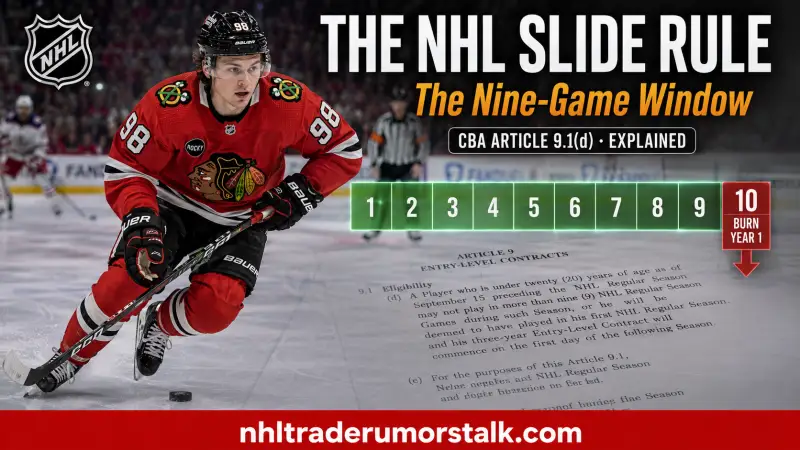
Nine games. That is how long a Connor Bedard or a Shane Wright can sit in an NHL lineup before a front office faces a cold choice: keep playing him and burn a year of his contract, or send him home and bank one for free. Chicago never hesitated with Bedard. He played 68 games, won the Calder, and Year 1 of his three-year, $950,000 deal was spent by April. Seattle played the angle with Wright: fewer than 10 games, back to junior, a full season saved. The rule that splits those two paths is four lines of the NHL Collective Bargaining Agreement. So what is the entry-level slide rule, why does everyone call it the nine-game rule when the CBA says ten, and how does a fall birthday quietly kill the whole option? Here is the rule through one idea: The Nine-Game Window.
The slide rule is one of the most important contract mechanisms in hockey and one of the least understood by fans. It exists because a teenage prospect cannot truly be evaluated in a handful of NHL nights, and a team should not be forced to burn a precious entry-level year proving that. Article 9.1(d) of the CBA gives the team a one-year reset, but only for the right age, and only inside a very specific window of games.
| Figure | What it represents |
|---|---|
| 10 NHL games | The exact CBA cutoff. An 18- or 19-year-old who plays fewer than 10 NHL games (regular season plus playoffs) sees his ELC slide one year; the 10th game burns Year 1 |
| $950,000 | The current maximum entry-level base AAV (Bedard's three-year deal). The base salary slides with the contract; the signing bonus does not |
One number is the legal cutoff buried in the CBA; the other shows what a young player actually earns under that ceiling.
Key Takeaways
- What it is: the ELC slide is a one-year reset for 18- or 19-year-olds who play fewer than 10 NHL games in their first season under contract.
- Playoffs count: "NHL Games" under CBA Article 9.1(d) means regular season AND playoff games combined; AHL, junior, international tournaments do not.
- The 20-year-old trap: a player who turns 20 between September 16 and December 31 of his signing year is not slide-eligible, regardless of games played.
- What slides: the term extends one year and the base salary slides; the signing bonus is still paid as scheduled.
- The Nine-Game Window: teams routinely cap a not-yet-ready prospect at exactly 9 games, then send him back to junior or Europe with Year 1 intact.
What the Entry-Level Slide Rule Actually Says
The slide is codified in NHL CBA Article 9.1, Section (d), in two short subsections. 9.1(d)(i) covers the first-year slide for any 18- or 19-year-old. 9.1(d)(ii) covers a secondary slide that only applies to players who first signed at 18. The legal trigger is simple: an 18- or 19-year-old who signs a Standard Player Contract but does not play at least ten NHL Games in his first season under that contract gets his ELC term extended by one year, and his place in the entry-level system extended by the same year.
The mechanism is the league's pressure valve for teenage prospects. Without it, a team would have to pick between two bad outcomes for a not-yet-ready 18-year-old: bury him on the bench in NHL games and burn a contract year, or shut him out entirely and risk slowing his development. The Nine-Game Window gives every club a legal, sanctioned third option.
Why 9 Games Slides and 10 Burns
The phrase "nine-game rule" only captures part of it. The CBA itself says "fewer than ten," so the legal trigger is the 10th game, and a player can dress for exactly 9 NHL games and still slide. The 10th game burns Year 1 of the ELC immediately, and the contract starts counting against the cap for that year and the next two. There is no soft landing on game 10.
Two other details routinely surprise fans. Playoff games count: dressing for 9 regular-season games AND a single playoff appearance crosses the line. And only NHL games count for this rule: AHL, junior CHL, World Juniors, and international play do not move the dial. That is why teams sometimes cycle a top prospect between the NHL and his junior club, holding the NHL total at 9 to preserve the year. Our draft explainer shows where these prospects come from in the first place, and our salary-cap guide covers how an ELC fits into a team's books.
Signing Connor is a huge step in building a new foundation for our organization. We're excited to see him grow and play a large role in pushing our team forward for many years to come.
— Kyle Davidson, Chicago Blackhawks General Manager, on Connor Bedard's three-year ELC signing, NHL.com
The September-to-December Age Trap
Age determination under the slide rule uses September 15 of the calendar year a player signs his first SPC. An 18- or 19-year-old on that date is eligible to slide. But there is a quirk that costs young players a year all the time: a player who turns 20 between September 16 and December 31 of his signing year is not slide-eligible. Even though he was 19 on the September 15 reference date, the CBA carves out that fall birthday window. His ELC burns Year 1 regardless of how few games he plays.
What slides, and what does not, also matters. Article 9.1(d) slides the term of the contract by one year and the player's base salary along with it. The signing bonus does not slide. Whatever bonus dollars were due that season are still paid on schedule. That distinction quietly shapes negotiations, because a young player who signs and then slides has effectively front-loaded part of his deal without losing a contract year. Our PIM guide shows the other end of the same paycheck: what penalties cost.
Two Cases: Bedard Burned Year 1, Wright Slid
Two recent first-overall picks show the rule in action. Connor Bedard signed with Chicago on July 17, 2023 and stepped immediately into a top-line NHL role. He played 68 games, won the Calder, and Year 1 of his three-year, $950,000-AAV ELC was over by April 2024. Shane Wright, taken fourth overall by Seattle in 2022, went the other way. The Kraken dressed him for fewer than 10 NHL games as an 18-year-old, leaning on conditioning stints and AHL time, and his three-year ELC slid one year forward, now running through 2025-26 instead of 2024-25.
Being drafted by an Original Six team has been such a surreal experience and I couldn't be more thrilled to be a part of this team's future.
— Connor Bedard, on signing his entry-level contract with the Chicago Blackhawks, NHL.com
One more wrinkle sits on the horizon. The new NHL-NHLPA CBA takes effect September 16, 2026 and runs through September 15, 2030. From the 2026-27 season, the maximum entry-level annual compensation is no longer pinned to the draft year; it is set at the league minimum salary plus $175,000. The Nine-Game Window itself does not change.
The ELC slide sits inside a much wider contract cluster worth understanding. The same CBA logic threads through how the salary cap works, how the draft feeds the pipeline, how standings decide the order, how long a hockey game runs, icing, and the recent offside and crease rule writeups for the on-ice side.
Written by Mike Johnson, NHL Senior Editor, with 15 years covering the league. The slide-rule mechanics, the CBA Article 9.1(d) wording, the playoff-games-count clarification, the September-15-to-December-31 age window, the Bedard and Wright case studies, and the 2026-30 CBA maximum-compensation change were checked against NHL.com, ESPN, Colligan Hockey's CBA primer, and Sound Of Hockey's Kraken-contracts breakdown. Both quotes were traced verbatim to NHL.com with inline links. The Nine-Game Window is the working name for the slide rule used throughout this guide. Published June 24, 2026. Editorial review and fact-check: Sarah Chen, Hockey Operations Editor. Corrections: editorial@nhltraderumorstalk.com.
Sources and Reporting
- NHL.com: Connor Bedard signs three-year ELC (Davidson + Bedard quotes, signing date, AAV)
- ESPN: new NHL-NHLPA CBA in force Sept 16 2026, ELC compensation formula change for 2026-27
- Colligan Hockey: CBA 101, how entry-level contracts slide (Article 9.1(d), secondary slide, signing-bonus carve-out)
- Sound Of Hockey: Shane Wright slide case study
The Verdict: The Nine-Game Window
Watch the ninth game closely every October. When a prized 18-year-old suddenly vanishes back to junior the night before his tenth, that is not a demotion. That is a front office choosing a free year of control, with playoffs counted, fall birthdays checked, and the math run to the decimal. The Nine-Game Window rewards the teams that treat a teenager's contract like the asset it is, and quietly punishes the ones that forget to count.
Frequently Asked Questions
What is the NHL entry-level slide rule?
The slide rule is a CBA provision (Article 9.1(d)) that lets an 18- or 19-year-old's entry-level contract extend by one year if he plays fewer than 10 NHL games in his first season under that contract. The team keeps the player on his existing deal but burns no contract year. The base salary slides with the term; the signing bonus is still paid as scheduled.
Is it really called the "nine-game rule"?
That is the shorthand most fans and reporters use, but the CBA wording is "does not play at least ten (10) NHL Games," so the legal trigger is the 10th game. A player can dress for exactly 9 NHL games and still slide; playing the 10th game burns Year 1 of the ELC immediately. There is no soft landing on game 10.
Do playoff games count toward the 10-game cutoff?
Yes. "NHL Games" under Article 9.1(d) means regular-season AND playoff games combined. AHL games, junior CHL games, World Juniors, and international tournaments do NOT count. A teenager who dresses for 9 regular-season games and a single playoff game has already crossed the line.
When does a player turning 20 still lose the slide?
Age is determined on September 15 of the calendar year a player signs his first SPC. A player who turns 20 between September 16 and December 31 of his signing year is not slide-eligible, even if he was 19 on September 15. The CBA carves out that fall birthday window, and his ELC burns Year 1 regardless of how few games he plays.
Did Connor Bedard's contract slide?
No. Bedard signed his three-year ELC with Chicago on his 18th birthday in July 2023, played 68 NHL games as a rookie, won the Calder Trophy, and burned Year 1 of the deal immediately. The contrast case is Shane Wright, the Kraken's 2022 fourth-overall pick, who played fewer than 10 NHL games as an 18-year-old and whose three-year ELC slid one year forward.
Related Stories
Gavin McKenna vs Connor Bedard
Gavin McKenna vs Connor Bedard: Bedard set the bar with 143 junior points and a Calder, but they are different players entirely. The honest...
By Mike Johnson · 7 min read
How Much Will Gavin McKenna Make?
How much will Gavin McKenna make? The projected No. 1 pick already earns a reported ~$700K in college NIL, but the NHL entry-level system ca...
By Mike Johnson · 8 min read
NHL Waivers Explained: The 24-Hour Window
NHL waivers explained: the 24-hour noon-to-noon ET claim window, why the worst team in the league claims first, the age-and-games exemption...
By Mike Johnson · 8 min read

What Does the C on a Hockey Jersey Mean?
What does the C on a hockey jersey mean? Plain-English guide to NHL Rule 6: the three-inch captain's letter, the alternate A, the one rulebo...
By Mike Johnson · 8 min read
Comments
Be the first to share your take.
Get NHL trade rumors in your inbox
One email per week, zero spam, verified rumors only.