How Much Will Gavin McKenna Make?
How much will Gavin McKenna make? The projected No. 1 pick already earns a reported ~$700K in college NIL, but the NHL entry-level system caps his base near $1M for three years; the real fortune waits until his 2029 second contract.
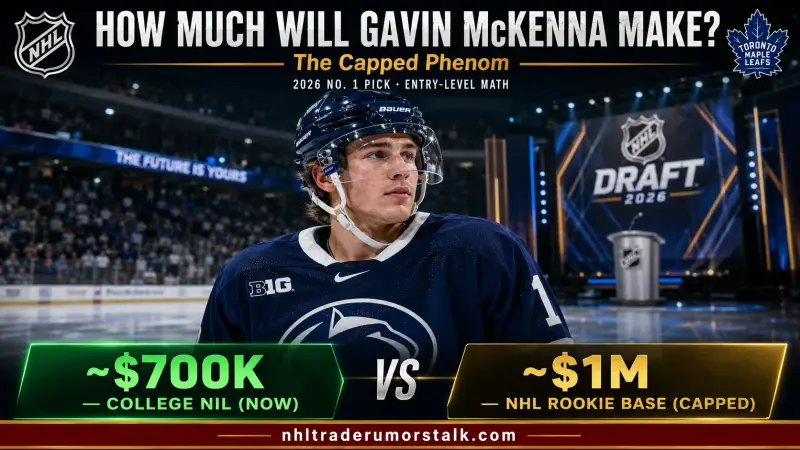
$700,000. That is roughly what an 18-year-old amateur named Gavin McKenna is reportedly earning this season, before he has played a single shift of professional hockey. ESPN's Greg Wyshynski put his Penn State name-image-likeness package "in the ballpark" of that figure, the richest NIL deal college hockey has ever seen. Here is the strange part: when McKenna turns pro, his NHL base salary is capped at around $1 million. The best teenager on the planet is about to take a job that pays barely more than the one he already has. That gap, between generational talent and a fixed rookie wage, is The Capped Phenom problem, and it explains why the real McKenna fortune is still years away.
| Figure | What it represents |
|---|---|
| ~$700,000 | McKenna's reported Penn State NIL money for 2025-26, as an amateur (ESPN, Greg Wyshynski) |
| ~$1,000,000 | The NHL entry-level maximum base salary a 2026 first-overall pick can sign for |
The best 18-year-old in the world earns a raise of roughly $300,000 to turn pro, because the entry-level system caps what any rookie can make no matter how dominant.
Key Takeaways
- Already paid like a pro: McKenna's reported ~$700,000 Penn State NIL deal is the largest in college hockey history, dwarfing Michigan State's reported $200,000-$300,000 offer.
- The Capped Phenom: his NHL entry-level base salary maxes out near $1 million for three years, regardless of how good he is, the same tier as every other rookie.
- Bonuses are the real money: a first-overall ELC can push past $4 million a season once Schedule A and B performance bonuses are added, the structure Macklin Celebrini signed.
- The fortune waits until 2029: McKenna's second contract, not his first, is where star money lives, projecting into the kind of AAV the league's top forwards earn.
- Not signed yet: the Toronto Maple Leafs hold the No. 1 pick on June 26 and are expected to take him; every NHL figure here is a projection until he signs.
Already Paid Like a Pro at 18
Start with what McKenna banks right now. He left the Western Hockey League's Medicine Hat Tigers, where he piled up 129 points and won the 2025 CHL and WHL Player of the Year awards, to play a single college season at Penn State. The reason was money the old amateur system never allowed. A new NCAA rule let major-junior players keep college eligibility, and revenue sharing let schools pay them directly. Penn State reportedly put roughly $700,000 on the table.
That is not a typo, because a freshman who turned 18 in December already earns within a whisker of the NHL's $775,000 league-minimum salary, and he did it before his draft. He rewarded the bet with 51 points in 35 games, a Penn State freshman record, and a near-lock on the No. 1 pick.
His camp insists the cash was not the driver. McKenna's agent, Pat Brisson, framed the college choice as a development call first.
"The NIL obviously comes into play, but it's not the primary decision of why he decided to go to college." — Pat Brisson, McKenna's agent, via ESPN (Greg Wyshynski)
Maybe so. But the number still reset the market, and it sets up the oddest contract conversation in hockey: a player who already earns pro money walking into a system designed to pay rookies as little as possible.
Why the NHL Caps Its Best Rookie at $1 Million
Every player drafted out of junior or college signs an entry-level contract, and the entry-level contract is a hard ceiling, not a negotiation. For a 2026 first-overall pick, the maximum base salary lands at about $1 million per season, the same cap that applies to the last forward taken in the seventh round. Talent does not move the number. The rulebook does.
If you want the deeper mechanics of how those deals lock in and slide, our breakdown of the entry-level slide rule walks through the games-and-years math, and the 2026 salary cap guide covers how it all fits under the cap. The short version for McKenna: he can sign for the $1 million base, add a signing bonus capped at 10 percent of the deal, and that is the floor of his earning power for three full years.
So McKenna's first NHL paycheck is a strange thing. It is a raise on paper, maybe $300,000 over his college money, and a cap on everything his ability should command. The weight of that expectation is something he has already talked about openly.
"I've almost got to be perfect at all times." — Gavin McKenna, on the pressure of being the consensus top pick, via ESPN
Where the Real Money Hides: Bonuses and the 2029 Wait
The $1 million base is only the start, because entry-level deals come with two layers of performance bonuses. Schedule A bonuses reward clean statistical thresholds, goals, assists, points, ice-time rank. Schedule B bonuses pay for the big-ticket items: a Calder Trophy, an All-Star nod, a top-10 league scoring finish. Stack them and a first-overall ELC can swell well past $4 million in a single season.
We have a real, recent template. When San Jose signed 2024 No. 1 pick Macklin Celebrini, his three-year entry deal carried a $975,000 cap hit plus up to $3.5 million in performance bonuses, a ceiling near $4.475 million a year if he hit everything. McKenna's deal will look almost identical in shape, just nudged up to the 2026 base maximum.
And yet none of that is the real windfall, which is contract number two. A player who delivers on McKenna's billing reaches restricted free agency in 2029 with every leverage chip in hand, and that is where the eight-figure AAV lives, the tier the league's elite forwards already occupy. The entry-level years are not McKenna's payday; they are the toll he pays to reach it.
(I went back and checked the bonus schedules twice, because the gap is almost hard to believe. The most valuable 18-year-old in a decade is legally locked into the cheapest contract class the league offers.)
What Bedard and Celebrini Already Proved
This is not theory: two recent first-overall picks ran the exact same gauntlet. Connor Bedard, the 2023 No. 1, signed a three-year ELC worth about $2.85 million total, a $950,000 cap hit, and is only now approaching the contract that pays him like a franchise center. Celebrini, a year later, edged up to that $975,000 number with the richer bonus package above it.
The pattern is iron-clad: the base creeps up a few thousand dollars per draft class as the cap rises, the bonus structure does the heavy lifting, and the superstar money does not arrive until the second deal. McKenna inherits that same staircase. You can dig into why he profiles this way in our full McKenna scouting profile and 2026 mock draft, and how his draft-class rival has shaped the conversation in the Sharks at No. 2 and the Team Canada Worlds piece.
For a sense of how rigid the rookie scale is across the board, even a depth prospect like the Islanders' signing covered in our Cole Eiserman ELC breakdown runs on the identical framework. The ceiling does not bend for stars, and it does not bend for role players, which is the whole point of it.
| Player (draft) | Base cap hit | Note |
|---|---|---|
| Connor Bedard (2023) | $950,000 | ~$2.85M total over three years |
| Macklin Celebrini (2024) | $975,000 | up to $3.5M in added performance bonuses |
| Gavin McKenna (2026, proj.) | ~$1,000,000 | 2026 entry-level base maximum |
Written by Mike Johnson, NHL Senior Editor, 15+ years covering hockey contracts and the cap. McKenna's ~$700,000 NIL figure is reported by ESPN's Greg Wyshynski and labeled a ballpark estimate, not a confirmed number, and is treated as such throughout. Every entry-level figure was checked against PuckPedia and Elite Prospects; the Bedard and Celebrini cap hits were confirmed at PuckPedia. McKenna has not signed an NHL contract as of June 25, 2026, so all professional salary figures are projections based on the 2026 entry-level maximum. Published June 25, 2026. Editorial review: Sarah Chen, Hockey Operations Editor. Corrections: editorial@nhltraderumorstalk.com.
Sources and Reporting
- ESPN: McKenna profile, expected No. 1 pick, the "perfect at all times" quote
- ESPN (Greg Wyshynski): the ~$700,000 NIL report and Brisson quote
- PuckPedia: entry-level maximum compensation and bonus structure
- Elite Prospects: how entry-level deals and the 10 percent signing-bonus cap work
- PuckPedia: Macklin Celebrini ELC cap hit and bonuses
- NHL.com: 2026 draft order, Toronto at No. 1
The Verdict: The Capped Phenom
Here is my read: McKenna signs a three-year entry-level deal within days of the June 26 draft, at the roughly $1 million base ceiling with the full Schedule A and B bonus package layered on top, a structure that can pay north of $4 million in a monster rookie year but locks his guaranteed base in place. The number that will actually define his wealth is the one nobody can sign yet: his 2029 second contract, where the eight-figure AAV waits. The Capped Phenom is hockey's quiet rule made loud by an extraordinary case, a teenager already earning pro money who still has to spend three years on the league's entry-level floor. Would you take the guaranteed cap-controlled path, or bet on yourself for the deal that comes after?
Frequently Asked Questions
How much money does Gavin McKenna make?
As of June 2026, McKenna earns a reported NIL package of roughly $700,000 from Penn State for the 2025-26 NCAA season, per ESPN. That figure is described as a ballpark estimate, not a confirmed number. He has not signed an NHL contract yet; the Toronto Maple Leafs hold the No. 1 pick on June 26 and are expected to draft him, after which he projects to sign an entry-level deal with a base salary near the $1 million maximum.
How much will Gavin McKenna's NHL contract be worth?
A 2026 first-overall pick signs a three-year entry-level contract with a base salary capped around $1 million per season. Add a signing bonus (limited to 10 percent of the deal) plus Schedule A and B performance bonuses, and a single season can exceed $4 million. For comparison, 2024 No. 1 pick Macklin Celebrini signed a $975,000 base with up to $3.5 million in performance bonuses.
Does Gavin McKenna make more than NHL players?
Not quite. His reported ~$700,000 NIL deal sits just below the NHL's current $775,000 minimum salary, so every NHL player technically out-earns him on base pay. What makes it remarkable is that McKenna banks that money as an 18-year-old amateur, before being drafted, the largest NIL package in college hockey history.
When will Gavin McKenna get a big NHL contract?
Not on his entry-level deal. The entry-level system caps a rookie's base near $1 million for three seasons regardless of production. The real money arrives on his second contract, when he reaches restricted free agency around 2029 with full leverage. If he delivers on his billing, that deal projects into the eight-figure annual range the league's elite forwards already earn.
Why did Gavin McKenna play at Penn State instead of junior?
A 2025 NCAA rule change let major-junior players keep college eligibility, and revenue sharing allowed schools to pay them directly. Penn State reportedly offered roughly $700,000, the richest NIL deal in college hockey. His agent, Pat Brisson, said the money was not the primary reason, framing the NCAA route as the better development path before the NHL.
Related Stories
Gavin McKenna vs Connor Bedard
Gavin McKenna vs Connor Bedard: Bedard set the bar with 143 junior points and a Calder, but they are different players entirely. The honest...
By Mike Johnson · 7 min read
NHL Waivers Explained: The 24-Hour Window
NHL waivers explained: the 24-hour noon-to-noon ET claim window, why the worst team in the league claims first, the age-and-games exemption...
By Mike Johnson · 8 min read

What Does the C on a Hockey Jersey Mean?
What does the C on a hockey jersey mean? Plain-English guide to NHL Rule 6: the three-inch captain's letter, the alternate A, the one rulebo...
By Mike Johnson · 8 min read
NHL Entry-Level Slide Rule: The 9-Game Window
NHL entry-level slide rule explained: CBA Article 9.1(d), the 10-game cutoff (playoffs included), the September-to-December age trap, what s...
By Mike Johnson · 8 min read
Comments
Be the first to share your take.
Get NHL trade rumors in your inbox
One email per week, zero spam, verified rumors only.