Sabres Tuch Squeeze: 3 Players Departing
Buffalo broke a 14-year drought, then lost Game 7 in OT to Montreal. Now the Tuch Squeeze forces out Stanley, Malenstyn, and Levi. Cap math + destinations inside.
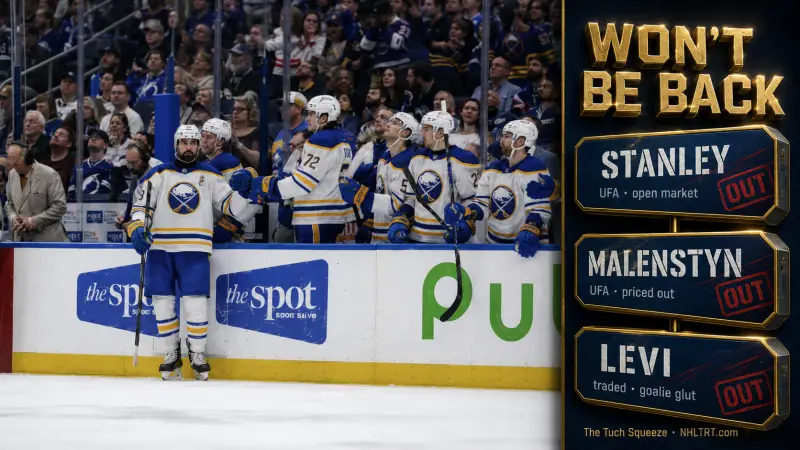
The Buffalo Sabres just broke a 14-year playoff drought, advanced to the Eastern Conference Second Round, and lost Game 7 in overtime to the Montreal Canadiens on May 18, 2026. The reward for that breakthrough season is an offseason of subtraction. New general manager Jarmo Kekäläinen, who replaced Kevyn Adams in mid-December, enters July 1 with roughly $12.9M in projected 2026-27 cap space, ranked 25th in the league. Pending UFA Alex Tuch reportedly wants $10.5M AAV on his next deal. That math forces three Sabres out the door. We call it The Tuch Squeeze.
The Post-Drought Context That Forces The Squeeze
The Sabres' 2025-26 season was, by any honest measure, the best in more than a decade of franchise history. They ended a playoff drought that traced back through 14 consecutive missed postseasons. They beat the Boston Bruins in the first round in a series that our earlier preview framed as a 5,458-day payoff. They pushed Montreal to a Game 7 overtime in the second round. They got Alex Newhook'd at 11:22 of overtime by Montreal in front of a sold-out KeyBank Center crowd on May 18.
That breakthrough is the context for every cap decision Kekäläinen now has to make. Adams, who built the playoff roster, was fired on December 15, 2025 when the team sat at 9-10-4 and missed his Thanksgiving benchmark for improvement. The new GM inherited the team's first deep run since 2011 and the bill that comes with it. Our 14-Year Exile breakdown from the regular season covered the cultural arc. The prior Adams-era Dark Cloud Unlock piece traced the operational reset that came before the firing. This piece covers the cap-driven cost of sustaining the playoff identity.
| Figure | What it represents |
|---|---|
| .9M | Buffalo cap room (25th in NHL) |
| .5M | Tuch's reported ask |
| 81% | Of the room one player eats |
The Sabres enter the 2026-27 offseason with the 25th-most cap space in the NHL and the league's most expensive UFA priority on a 26-year-old winger coming off his most productive season.
The Tuch Math: $10.5M Eats 81 Percent of the Room
The single largest cap commitment Kekäläinen faces is Alex Tuch. Tuch is a pending UFA whose reported asking price on a new contract is approximately $10.5M AAV, per Daily Faceoff's Sabres offseason breakdown. That figure was first cited at Daily Faceoff's elimination piece and re-reported by multiple Tier-1 outlets through the month of May. Buffalo enters the offseason with an estimated $12.9M of projected 2026-27 cap space, 25th in the league, per Spotrac.
| Cap component | 2026-27 figure | Notes |
|---|---|---|
| Projected available cap room | $12.9M | 25th-most in NHL, per Spotrac |
| Alex Tuch projected extension | $10.5M AAV | Per Daily Faceoff's reporting |
| Room remaining after Tuch | ~$2.4M | Must cover RFA raises + 3 UFA decisions + draft picks |
| RFA raises (Benson, Krebs, Kesselring) | ~$2.0-$3.5M combined | Three young pieces need new deals |
| Other UFAs in line | Pearson, Dunne, Schenn | League-minimum range; only veteran scraps left |
The arithmetic is the analysis. If Kekäläinen re-signs Tuch at anything close to the reported ask, every other roster decision tightens to the league-minimum range. The three players profiled below are the three most expensive cuts the new front office can make without touching the core. Each loss carries a different mechanism. Stanley walks for more money than Buffalo can pay. Malenstyn walks because the Sabres cannot price-match the offers he will get. Levi is traded because the goalie depth chart is full and his trade value is highest before he sees another AHL season.
Logan Stanley: The $25M Open-Market Casualty
Stanley was acquired at the 2026 trade deadline as cost-effective third-pair depth. Buffalo got 18 regular-season games and seven playoff games out of him before scratching him for two of the four games against Montreal. He played at his peak as a stay-at-home option behind the Sabres' top four, and he heads to July 1 as one of the most overlooked UFA defensemen on the board.
Chris Johnston of The Athletic ranks Stanley the 14th-best UFA on the open market this summer, projecting a multi-year contract worth $25M or more, per SabreNoise's free-agent roundup.
Buffalo cannot pay that price, even before the Tuch question is settled. The most credible destination, per Joseph Rexrode of The Athletic's Predators coverage, is Nashville. The Predators are searching for a general manager as Barry Trotz heads into retirement, per The Hockey Writers, and a $4.5M-$5M Stanley contract fits their cap situation and their need for stay-at-home presence on the back end.
The mechanism for Stanley is the simplest of the three. Open market gravity pulls him to the highest bidder. The Sabres are not in the bidding. The relevant Rangers Buffalo-pipeline coverage mentioned Stanley as a Rangers possibility earlier in the year. That Manhattan path has cooled since New York's own cap math tightened.
Beck Malenstyn: The Bidding-War Priced-Out
Malenstyn signed a two-year, $1.35M AAV deal with the Sabres in 2024 and now hits UFA status on July 1, 2026. He played a full fourth-line forechecking role with penalty-kill responsibility, and his combination of size, age, and term affordability makes him exactly the player every contender wants to sign for $1.5M-$1.8M.
The Sabres' actual public posture, per The Hockey Writers' player spotlight, has been that Malenstyn is a "priority retention." That phrase in NHL front-office speak typically translates to "we like him but we will not break the cap for him." The expected outcome is a $1.5M-$2.0M deal elsewhere that Buffalo could match in a vacuum but cannot afford alongside the Tuch retention.
For broader cap-context for teams Malenstyn might land with, see our piece on cap-floor teams forced to spend and the 2026 UFA position-by-position list. Malenstyn is the kind of name a cap-floor team uses to hit the spending requirement without committing to a star-tier contract.
Devon Levi: The Goalie Depth-Chart Trade
Levi is the most analytically interesting of the three departures because he leaves not via the open market but via trade. Per Pro Hockey Rumors, the Sabres are expected to listen to offers on Levi this summer, and Jeff Marek of Sportsnet (via Gino Hard syndication) has reported the relationship between team and player is "over."
Jeff Marek of Sportsnet 32 Thoughts: "Buffalo and Devon Levi are over." Per Gino Hard's reporting of his radio segment.
The math against keeping him is structural. Ukko-Pekka Luukkonen is the starter through next season. Alex Lyon signed a two-year, $3M total contract on July 1, 2025 ($1.5M AAV per PuckPedia) that puts him in the locked backup slot through 2026-27. Colten Ellis is the third-string emergency option. Levi, who played almost exclusively for the AHL Rochester Americans the past two seasons, has nowhere in the Buffalo organization to play next year.
His NHL numbers per Hockey-Reference are uneven: a 17-17-2 record across 39 games with a .894 save percentage and 3.29 GAA. His AHL record is far stronger, and Pro Hockey Rumors logs it at 64-39-22 across 120 games with a .914 SV% and 2.52 GAA. The trade value calculus rests on those AHL numbers and his age (24), which give a goalie-needy rebuilder a real second-window starter prospect at a discount.
The destinations most cited in reporting are the Ottawa Senators (backup behind Linus Ullmark), the Philadelphia Flyers (full rebuild on the back end), and the Edmonton Oilers (where Tristan Jarry has struggled and Connor Ingram is a pending UFA). Our prior piece on Devon Levi trade destinations laid out the three-team analysis in more detail. The new piece here is that Buffalo's trade urgency has hardened since that April reporting; Game 7 against Montreal was Levi's last realistic chance to break into the playoff rotation, and the Sabres went with the Luukkonen-Lyon tandem all the way through.
Kekäläinen's First Offseason: The Replacement Math
Subtraction is half the story of the Tuch Squeeze. The other half is what Kekäläinen does with the cap room these three departures free up, plus whatever he can negotiate down from Tuch's reported $10.5M ask.
Recent Josh Norris injury context matters here too. Buffalo's center depth chart looked thinner heading into the 2026 playoffs than the regular-season record suggested. The post-Tuch-Squeeze roster will inherit the same structural center vulnerability without three of the depth pieces that masked it during the first 82.
Here is the order we expect events to unfold, in chronological sequence:
- Late May: Tuch negotiations begin in earnest. Kekäläinen's pitch is term over AAV. An eight-year, $9M offer is more cap-friendly than a six-year, $10.5M deal. Tuch's camp publicly stays at $10.5M to anchor the open-market alternative.
- Early-to-mid June: the Levi trade. Best-case return is a 2027 second-round pick plus a B-tier prospect. Buffalo announces the move at the 2026 NHL Draft on June 26-27, freeing up roughly $0.875M in cap.
- June 23-28: the interview window opens for Stanley and Malenstyn. Sabres exit both conversations once the bidding crosses their internal valuations. Stanley signs Nashville inside the first 48 hours of July 1. Malenstyn signs a $1.6M-$1.8M deal elsewhere.
- July 1-3: Kekäläinen replaces departed depth with one mid-priced UFA forward (~$2.0M AAV), one cheap UFA defenseman (~$1.0M AAV), and rolls the remaining cap into the Benson, Krebs, and Kesselring RFA negotiations.
- Mid-July: the Tuch extension is announced at eight years and $9M AAV (~$72M total). Below his ask, but above the comparable cap-corridor for non-elite first-line wingers in 2026.
- August: final clean-up signings. With the squeeze resolved, Kekäläinen rolls into training camp with a roster structurally identical to the 2025-26 version minus the three departures profiled above, plus replacement-level adds.
The Verdict: Kekäläinen inherits a roster with a playoff identity and a cap structure that does not support the depth he inherited. The three departures here are the rational, predictable losses. The harder calls are the ones that will define his actual first offseason: what to do if Tuch refuses the $9M term ceiling, whether Benson's RFA conversation turns hostile, and whether the goalie depth chart needs Luukkonen-or-Lyon clarity.
Sources And Further Reading
- NHL.com, "Newhook scores in OT, Canadiens top Sabres in Game 7"
- Daily Faceoff, "The Sabres' magic run is over. How do they sustain it?"
- Spotrac, 2026-27 Buffalo Sabres cap tracker
- PuckPedia, Buffalo Sabres contracts + projected cap
- Pro Hockey Rumors, "Sabres Likely To Explore Moving Devon Levi"
- SabreNoise, Chris Johnston UFA ranking with $25M+ Stanley projection
- The Hockey News, Two off-season trade destinations for Levi
- The Hockey Writers, Beck Malenstyn player spotlight
Frequently Asked Questions
Which 3 Buffalo Sabres won't be back next season?
Per offseason reporting, Logan Stanley (pending UFA defenseman), Beck Malenstyn (pending UFA forward), and Devon Levi (goaltender expected to be traded) are the three most likely Sabres departures for 2026-27. Each leaves via a different mechanism: Stanley on the open market, Malenstyn priced out of a bidding war, and Levi by trade due to a full goalie depth chart behind Ukko-Pekka Luukkonen and Alex Lyon.
Why are the Sabres in a cap squeeze in 2026?
Buffalo enters the 2026-27 offseason with roughly $12.9M in projected cap space, 25th in the NHL per Spotrac. Pending UFA Alex Tuch reportedly seeks approximately $10.5M AAV, which would consume about 81 percent of the available room. RFA raises for Zach Benson, Peyton Krebs, and Michael Kesselring absorb most of what is left, leaving little for the team's other UFA decisions.
Did the Buffalo Sabres make the playoffs in 2026?
Yes. The Sabres ended a 14-year playoff drought in 2025-26, beat the Boston Bruins in the first round, and reached the Eastern Conference Second Round before losing Game 7 in overtime to the Montreal Canadiens on May 18, 2026, on an Alex Newhook goal at 11:22 of OT at KeyBank Center.
Who is the Buffalo Sabres GM now?
Jarmo Kekalainen. He was hired in December 2025 after Kevyn Adams was fired on December 15, 2025 with the team sitting at 9-10-4. Kekalainen, the former Columbus Blue Jackets GM, inherited the roster that went on to break the 14-year playoff drought and now faces the cap decisions of the 2026 offseason.
Where could Devon Levi be traded?
Per Pro Hockey Rumors and other outlets, the Ottawa Senators (backup behind Linus Ullmark), Philadelphia Flyers (rebuild), and Edmonton Oilers (where Tristan Jarry has struggled and Connor Ingram is a pending UFA) are the most-cited destinations. Levi, 24, posted a .914 SV% across 120 AHL games and is blocked in Buffalo by the Luukkonen-Lyon tandem already signed through next season.
How much will Logan Stanley get in free agency?
Chris Johnston of The Athletic ranked Stanley the 14th-best UFA on the 2026 market and projected a multi-year contract worth $25M or more. The Nashville Predators are a credible destination given their need for stay-at-home defense. Buffalo, facing the Tuch Squeeze, cannot match a $4.5M-$5M annual commitment to a third-pair defenseman.
Related Stories
NHL Buyout Candidates 2026
The NHL buyout window opens June 15. Rielly, Gallagher, Kotkaniemi, and Frederic are the names in play, but the Dead-Cap Tail means most buy...
By Mike Johnson · 10 min read

Darnell Nurse Trade: 4 Suitors
Edmonton wants Darnell Nurse's $9.25M off the books, but a buyout saves barely $1.53M and his no-move clause hands him the pen. The Bonus Sh...
By Mike Johnson · 12 min read

Alex Tuch Destinations: 4 Teams
Buffalo wants Alex Tuch back, but if the extension stalls, Columbus, Washington, Seattle, and Edmonton are circling. The cap math, the Kempe...
By Mike Johnson · 13 min read

Canucks Fire Foote: Malhotra Leading
Vancouver fired head coach Adam Foote on May 19, 2026 after a 25-49-8 season. Manny Malhotra leads the candidate list. The Voice Mandate exp...
By Mike Johnson · 9 min read
Get NHL trade rumors in your inbox
One email per week. Zero spam. Verified rumors only.