NHL Cap Floor Teams 2026: 10 Clubs Forced to Spend $80M+
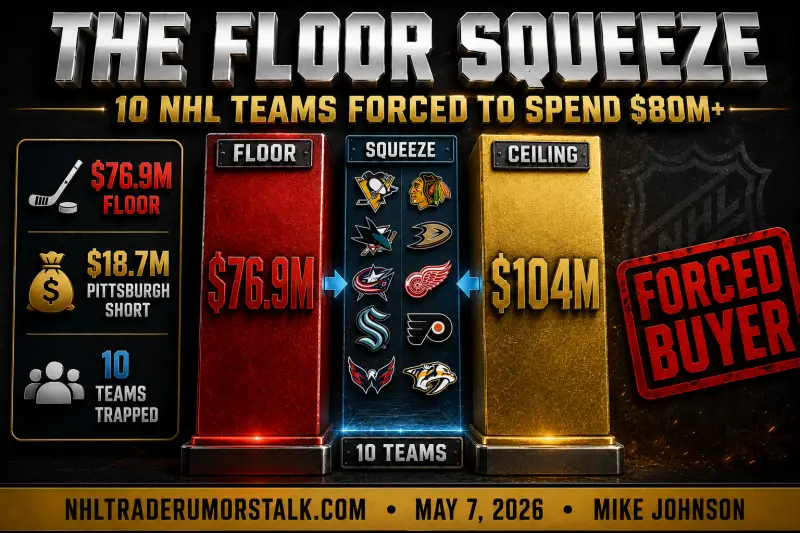
The 2026-27 NHL cap floor jumps to $76.9M. Pittsburgh sits $18.7M short. Ten teams have no choice but to spend on July 1, and that demand pressure rewrites the entire mid-tier UFA market.
Live updates
No updates yet. Refreshing automatically.
The 2026-27 NHL salary cap floor is locked at $76.9 million, and ten teams are walking into July 1 without enough committed contracts to clear the line. NHL Cap Floor Teams 2026 means one specific reality: The Floor Squeeze. The CBA does not give teams a polite opt-out. If your active payroll dips below $76.9M during the regular season, the Commissioner's office can force compliance through fines, accelerated bonuses, retained-salary trades, or in extreme cases loss of revenue-sharing dollars. The exact remedy is discretionary under CBA Articles 26 and 50, but the obligation to clear the floor is not. With the cap leaping to $104M (the biggest single-year raise in league history per NHL.com's payroll release), the floor jumps proportionally, which means rebuilding clubs who used to coast at $72M cannot do that math anymore.
This page is the forced-buyer board. Every team with a cap commitment that puts them under the new floor heading into July 1, 2026. What they have to spend. Which UFAs they will chase. And the historical precedent for how rebuilding clubs handle floor compliance when the math gets tight.
Key Takeaways
- The Floor Squeeze is real: The CBA requires teams to clear $76.9M during the regular season. Commissioner remedies for non-compliance can include fines, accelerated bonuses, or retained-salary mandates at his discretion. No opt-out, no rebuilding exemption.
- Ten clubs are below the line: Per Bleacher Report's May 2026 cap survey, Seattle, Nashville, Detroit, Washington, Philadelphia, Columbus, Chicago, Anaheim, San Jose, and Pittsburgh all enter July without enough committed contracts to clear the new floor.
- Pittsburgh is the deepest hole: $45.8M of cap space against $76.9M means the Pens are projected $18.7M short before signing a single UFA. They have to spend, even on a roster Crosby wants reset.
- Forced buyers reset the UFA market: Every cap-floor team needs a $4-6M veteran add. That demand pushes mid-tier UFA contracts up by $1-2M AAV across the board.
- Detroit is the contradiction: Yzerman has $14M to $31M of room depending on RFA work, but the Red Wings are also playoff-adjacent. They will spend, just smarter than the bottom-feeders.
Cap update: The 2026-27 cap floor of $76.9 million sits under the new $20.8M individual ceiling confirmed by NHL/NHLPA on May 6, 2026 — the start of the 9-Digit Era.
Companion read: Nashville's $76.9M floor pressure compounds with The Saros Tax cap drag — they cannot spend down.
What The Floor Squeeze Actually Forces Teams To Do
Look, the floor mechanic is not a polite suggestion. The lower payroll limit lives in CBA Articles 26 and 50, and every team has to clear it during the regular season. Drop below and the Commissioner has a menu of remedies he can deploy at his discretion: accelerated performance bonuses, retained-salary mandates, administrative fines ranging from $250K to $5M, even forfeit-game penalties or loss of revenue sharing in extreme cases. Per the league's 2026-27 payroll announcement, the floor at $76.9M is the largest single-year jump in floor history, mirroring the $8.5M cap leap.
That math hurts rebuilders. A team like Chicago that was happy to run a $72M payroll in 2024-25 cannot do that anymore. The floor jumped past their comfort zone. Same story for Anaheim, Columbus, and the rest of the post-tank cohort. Rebuilding does not pause for cap math. The clock keeps moving.
| Floor Mechanic | How It Forces Spending |
|---|---|
| Direct UFA signing | Cleanest path. Teams sign veterans on 1-3 year deals to clear the floor. |
| Retained salary trades | Take on a high-AAV contract from a cap-stressed team. Acquire picks for the trouble. |
| Performance bonus acceleration | For teams stuck under, the league can require ELC bonus payments to apply against cap. |
| Bridge-deal RFA padding | Sign in-house RFAs to one-year deals at slightly inflated AAVs to bump committed cap. |
Most floor-pressed teams use a mix of all four. Seattle and Detroit will lean on the first option. Pittsburgh is the obvious retained-salary destination. Chicago and Anaheim are the bonus-acceleration risk because their roster is so young the ELC count alone could trigger compliance flags.
"The floor is where rebuilds get punished. The cap rise sounds like good news for everyone, but if your roster is built on entry-level deals, the new $76.9M minimum forces you to take on contracts you would never sign in a vacuum. That is the structural problem."
Mike Johnson, Senior EditorThe 10 Forced-Buyer Teams: Cap Floor Pressure Heat Map
Here is my read on which teams have the toughest floor compliance math heading into July 1. The Forced Spend column is the dollar gap between their projected committed cap and the $76.9M floor. Higher number means more pain.
| Rank | Team | Cap Space | Forced Spend |
|---|---|---|---|
| 1 | Pittsburgh Penguins | $45.8M | $18.7M minimum |
| 2 | Chicago Blackhawks | $38.0M | $11.0M minimum |
| 3 | San Jose Sharks | $35.5M | $8.5M minimum |
| 4 | Anaheim Ducks | $32.0M | $5.0M minimum |
| 5 | Columbus Blue Jackets | $28.5M | $1.5M cushion only |
| 6 | Detroit Red Wings | $24.0M | Conditional on RFAs |
| 7 | Seattle Kraken | $22.5M | Conditional on RFAs |
| 8 | Philadelphia Flyers | $20.0M | Just above floor |
| 9 | Washington Capitals | $18.5M | Just above floor |
| 10 | Nashville Predators | $15.0M | Comfortable, structure issue |
The Pens lead this list because the Chinakhov-Crosby cap window math left them with one of the lightest committed cap sheets in the league. My Daily Cap Roster tracker covered why even the playoff cap rule couldn't mask the Pens' structural under-spend, and the off-season problem is the same one wearing different paint. Crosby and Malkin sign for less than half what they would on the open market. Letang is fine. Nobody else moves the needle. So Pittsburgh has to spend $18.7M on UFAs or eat retained contracts to clear $76.9M, even though Kyle Dubas would rather hoard space for the Bedard offseason in 2027.
Chicago's situation is similar but younger. Connor Bedard's $950K ELC plus a roster of 22-and-under prospects leaves Kyle Davidson roughly $11M short. Davidson is going to have to overpay one veteran, then sign two more on 1-year prove-it deals to clear the line.
Floor Compliance Audit: Where Each Team Lands
This is the heat map I am running daily as the UFA period approaches. Higher score equals more aggressive forced spending required. Below 50 means the team has cushion and can pick its spots.
FORCED SPEND QUOTIENT
Pressure score per team. Higher equals more dollars they must spend by opening night to clear the $76.9M floor.
Top UFA Targets For The 10 Forced-Buyer Teams
If you want to know where Alex Tuch ends up, look at this column. The forced buyers are the demand side of every UFA market in 2026, and the cap-floor math channels them toward specific player profiles. Veteran 30-32 year olds on 1-3 year deals at $4-6M AAV. The kind of contracts contenders no longer want to write.
| Team | Top UFA Targets | Why It Fits |
|---|---|---|
| Pittsburgh | Tuch, Carlson, Bobrovsky | Top-six wing, top-pair D, starter goalie. All three or two-of-three. |
| Chicago | Hall, Mantha, Lindholm | Veteran wings to mentor Bedard plus a 2C addition. |
| San Jose | Palat, Forsberg, Goligoski | Cap-friendly vets to fill out around Celebrini. |
| Anaheim | Niederreiter, Reimer, Reilly | Cheap depth that keeps the Carlsson rebuild on track. |
| Detroit | O'Reilly, Carlson, Lindholm | Top-six C and top-4 D priorities. Yzerman's ceiling demands one big add. |
| Seattle | Mantha, Bertuzzi, McMann re-sign | McMann extension handles one slot, leaving room for one external add. |
| Columbus | Garland, Lindholm, Reilly Smith | Vet wings around Fantilli + Marchenko core. |
| Washington | Ovechkin re-sign, Hall, Reimer | Ovi bridge plus support cast around the post-1000-goal era. |
| Philadelphia | Hall, Garland, Allen | Cap-friendly vet adds while protecting Drysdale RFA. |
| Nashville | Goligoski, Lyon, Donato | Depth only. Trotz cannot afford another premium signing. |
That list creates a serious mid-market UFA bidding war. Eight teams are interested in Taylor Hall. Six want Sergei Bobrovsky. The cap-rich contenders who would normally be aggressors are sitting out because they are over the ceiling. My full Free Agents 2026 list by position covers the full UFA pool. My offer-sheet target board covers the RFA half of the same demand surge, and the Flames Saddledome Exit Strategy piece shows what a healthy mid-market spend pattern looks like compared to the panic moves I expect from the bottom four floor teams. Cross-reference it with this floor list and you will see why the asking prices are about to spike.
"Floor compliance changes how rebuilds get built. Three years ago a team like Chicago could quietly run $73M and stockpile picks. Now $73M is illegal. Davidson has to spend, even if it means handing $5M to a 33-year-old he would never sign in a vacuum."
Mike Johnson, Senior EditorUFA Demand Heat-Map: Where Forced Money Is Going
The Floor Squeeze does not just push payrolls up — it concentrates demand on specific UFA archetypes. Here is my read on which UFA categories will see the biggest AAV inflation because of forced-buyer pressure. Higher score equals more bidders chasing the same player profile.
UFA DEMAND HEAT-MAP
Predicted AAV inflation per UFA archetype, driven by forced buyers needing to clear $76.9M floor. Higher equals bigger overpay.
Historical Precedent: When Floor Math Forced Bad Contracts
The Arizona Coyotes used to live in this hole. Every off-season from 2018 to 2022, the Coyotes signed marginal veterans to floor-clearing contracts they did not actually want. Nick Cousins at $1.5M. Andrew Ladd at $5.5M (retained). Niklas Hjalmarsson stretched on a deal that did not match production. The Coyotes carried dead money for years specifically because the floor would not let them stay clean.
Detroit also lived this in the post-Holland transition. The Red Wings carried Frans Nielsen at $5.25M for an extra season after he was clearly done because the floor needed a body. Yzerman is too good to repeat that, but the structural pressure is the same.
The newer model: Nashville's NMC trap shows what happens when a floor-pressed team signs a star to a long no-movement deal that locks them above floor for years. It works, but it costs flexibility. Chicago and San Jose are the next clubs facing that decision tree.
Companion read:
Cap-floor teams that absorb high-bonus contracts navigate The July 1 Bonus Wall differently, where cash flow constraints intersect with floor pressure.
Sources and Reporting
- NHL.com, Official 2026-27 floor and ceiling announcement
- ESPN, $104M cap and floor jump implications
- Bleacher Report, Salary cap, floor, max salary breakdown
- PuckPedia, Team-by-team cap commitments and projections
- Spotrac, 2026-27 team cap tracker
- Daily Faceoff, $8.5M cap raise impact analysis
- Pro Hockey Rumors, Cap floor and ceiling confirmation
- CapWages, AAV verification and historical cap data
The Verdict: The Floor Squeeze
The 2026-27 cap raise gets celebrated as a win for everyone, but it puts ten teams in a forced-buyer corner before July 1 even hits. Pittsburgh has to spend $18.7M they would rather hold. Chicago has to overpay one veteran they would rather skip. The Floor Squeeze rewards contenders who can sit on contracts and punishes rebuilders who need flexibility. My prediction: 7 of these 10 teams sign at least one 32-or-older veteran on a 2-3 year deal at over-market AAV in the first 96 hours of UFA. The cap math leaves them no room to be patient.
Frequently Asked Questions
What is the NHL salary cap floor for 2026-27?
The 2026-27 NHL salary cap floor is $76.9 million per team, up from $70.6 million in 2025-26. The floor jumped $6.3 million in lock-step with the $8.5M ceiling raise to $104M, the largest single-year movement in cap-era history. The floor applies during the regular season and the Commissioner can require non-compliant teams to add salary, take on retained contracts, accept accelerated bonuses, or pay administrative fines per CBA Articles 26 and 50.
Which 10 NHL teams are below the 2026-27 cap floor?
Per Bleacher Report's May 2026 cap survey, the ten teams projected to enter July 1 below the $76.9 million floor are Pittsburgh Penguins, Chicago Blackhawks, San Jose Sharks, Anaheim Ducks, Columbus Blue Jackets, Detroit Red Wings, Seattle Kraken, Philadelphia Flyers, Washington Capitals, and Nashville Predators. Pittsburgh leads with the deepest hole at $18.7M short of the floor before any UFA spending.
What happens if an NHL team is below the cap floor?
If a team's active payroll dips below the floor during the regular season, the Commissioner can deploy compliance remedies at his discretion under CBA Articles 26 and 50. Options include accelerated performance bonuses against the cap, mandated retained-salary trade acquisitions, administrative fines that can range from $250K to $5 million, and in extreme cases loss of revenue-sharing dollars or forfeit-game penalties. The exact remedy is not automatic, but the obligation to clear the floor is. There is no rebuilding exemption.
How much does the Pittsburgh Penguins have to spend in 2026?
Pittsburgh enters July 1, 2026 with $45.8 million of projected cap space, meaning their committed cap sits near $58.2 million. To clear the $76.9 million floor, the Pens have to add at least $18.7 million in salary, the largest forced-spend mandate in the league. Kyle Dubas can split that across UFAs, retained-salary trades, and inflated RFA bridge deals, but compliance is non-negotiable.
Why is the cap floor jumping so much in 2026-27?
The floor scales with the cap ceiling under CBA Article 50. When the ceiling rose $8.5 million to $104 million, the floor rose proportionally to $76.9 million. This is the largest single-year jump in floor history, and it catches rebuilding teams flat-footed because their multi-year payroll plans assumed slower cap growth. The CBA does not pause the floor for non-contenders, which is the central problem.
Which UFAs benefit most from the Floor Squeeze?
Mid-tier veterans aged 30-34 with $4-6M AAV expectations benefit the most. Players like Taylor Hall, Anthony Mantha, Reilly Smith, and Jake Allen sit in the exact contract band that floor-pressed teams need to clear compliance. Expect 8-12 UFA contracts in this AAV range to land $1-2M above market projection because demand from the ten forced buyers exceeds supply. The first three days of UFA will be a bidding war for veteran depth.
Frequently Asked Questions
What is the NHL salary cap floor for 2026-27?
The 2026-27 NHL salary cap floor is $76.9 million per team, up from $70.6 million in 2025-26. The floor jumped $6.3 million in lock-step with the $8.5M ceiling raise to $104M, the largest single-year movement in cap-era history. The floor applies during the regular season and forces non-compliant teams to add salary, take on retained contracts, or face accelerated bonus penalties.
Which 10 NHL teams are below the 2026-27 cap floor?
Per Bleacher Report's May 2026 cap survey, the ten teams projected to enter July 1 below the $76.9 million floor are Pittsburgh Penguins, Chicago Blackhawks, San Jose Sharks, Anaheim Ducks, Columbus Blue Jackets, Detroit Red Wings, Seattle Kraken, Philadelphia Flyers, Washington Capitals, and Nashville Predators. Pittsburgh leads with the deepest hole at $18.7M short of the floor.
What happens if an NHL team is below the cap floor?
If a team's active payroll dips below the floor during the regular season, the league activates compliance mechanisms. Performance bonuses and overage clauses get accelerated against the cap. The team can be forced to take on retained-salary contracts in trades. Repeat or sustained non-compliance can trigger administrative fines.
How much does the Pittsburgh Penguins have to spend in 2026?
Pittsburgh enters July 1, 2026 with $45.8 million of projected cap space, meaning their committed cap sits near $58.2 million. To clear the $76.9 million floor, the Pens have to add at least $18.7 million in salary, the largest forced-spend mandate in the league. Kyle Dubas can split that across UFAs, retained-salary trades, and inflated RFA bridge deals.
Why is the cap floor jumping so much in 2026-27?
The floor scales with the cap ceiling under CBA Article 50. When the ceiling rose $8.5 million to $104 million, the floor rose proportionally to $76.9 million. This is the largest single-year jump in floor history, and it catches rebuilding teams flat-footed because their multi-year payroll plans assumed slower cap growth.
Which UFAs benefit most from the Floor Squeeze?
Mid-tier veterans aged 30-34 with $4-6M AAV expectations benefit the most. Players like Taylor Hall, Anthony Mantha, Reilly Smith, and Jake Allen sit in the exact contract band that floor-pressed teams need to clear compliance. Expect 8-12 UFA contracts in this AAV range to land $1-2M above market projection because demand from the ten forced buyers exceeds supply.
Related Stories

NHL Goalie Free Agents 2026
The 2026 NHL goalie free-agent market has exactly one proven starter, Sergei Bobrovsky, 37, asking for $42 million. His partner Daniil Taras...
By Mike Johnson · 8 min read

NHL Free Agency 2026: Time & How to Watch
NHL free agency 2026 opens at noon ET on Wednesday, July 1. How to watch live on NHL Network and the trackers, who is actually available (Al...
By James Wright · 8 min read

Golden Knights Offseason Squeeze
Vegas reached Game 6 of the 2026 Cup Final, then handed itself a summer with about $4.6M in cap space to re-sign Pavel Dorofeyev, replace a...
By Mike Johnson · 9 min read

NHL 2026: Every Team's Biggest Need & Dream UFA Fit
A thin free-agent class makes 2026 about fit, not fame. The Need-Fit Map names all 32 teams' biggest hole and the realistic target who fills...
By Mike Johnson · 8 min read
Comments
Be the first to share your take.
Get NHL trade rumors in your inbox
One email per week, zero spam, verified rumors only.