Rangers Free Agency 2026: The Buffalo Pipeline (Tuch,
Two of Drury's three top Rangers free agency 2026 targets are Buffalo Sabres UFAs. Inside The Buffalo Pipeline, the post-Panarin retool, and the $30M cap math.

Live updates
No updates yet. Refreshing automatically.
Eighty-one days after Artemi Panarin's $11.6 million cap hit walked out of New York on a February 4 trade to the Los Angeles Kings, Chris Drury's Rangers free agency 2026 plan has taken shape around three names: Alex Tuch, Eeli Tolvanen, and Logan Stanley. Two of those three are Buffalo Sabres UFAs. That single fact, two of Drury's top three offseason targets coming from the same team, is the Rangers' summer playbook in one sentence. Call it The Buffalo Pipeline.
Panarin's exit cleared $11.6 million in old cap weight while Tuch's projected new AAV sits at roughly $9.5 million. The Buffalo Pipeline opens with a $2.1 million cap-saving swing on the very first signing, then folds in Tolvanen on the cheap and Stanley as a defensive insurance policy. It's a deliberate restructuring that bets on volume over a single elite signing.
According to Elliotte Friedman on the 32 Thoughts podcast, "Drury is telling teams he is ready for offers" and the Rangers are "prepared to be aggressive." That tone matches a GM who knows he's working with roughly $30 million in 2026-27 salary cap space and three legitimate UFA targets, two of whom report to the same Buffalo locker room.
Key Takeaways
- The Buffalo Pipeline: Two of Drury's three top targets (Tuch + Stanley) are Buffalo UFAs, an unusual single-team draw that reflects Sabres' cap squeeze plus Drury's post-Panarin urgency.
- Cap swing math: Panarin's $11.6M hit is gone; Tuch's projected $9.5M new AAV represents a $2.1M cap saving on the same top-six winger slot, freeing room for Tolvanen and Stanley as Layer 2 and 3 signings.
- Tuch is the prize, with caveats: 33 goals and 66 points in 79 games at age 29, but his Sabres camp is reportedly asking $10.6M, and an April 3 report (since muddied by GM uncertainty) tentatively had him signing 8×$8M to stay.
- Tolvanen is Drury's Layer 2: 31 points in 55 games at $3.475M current AAV, projects to $4-4.5M new deal. Right shot, plays both special teams, fits a retool timeline more cleanly than a star signing.
- Stanley is the cheap insurance: 6-foot-7, 21 points and 96 hits in 59 games at $1.25M current AAV. A bottom-pair defenseman who lets Drury redirect savings to forwards.
What the Panarin Trade Created
The Panarin trade was not an opportunistic move. It was a planned subtraction. Per Sportsnet's Friedman, Panarin had told the Rangers that Los Angeles was the only team he would waive his clause to join, and the January 28 healthy scratch was the front office signaling its acceptance of that constraint. By February 4, Panarin was a King for prospect Liam Greentree, a 2026 third, and a 2028 fourth.
What that move actually created was a $11.6 million cap line, half-retained by New York, plus a roster-construction void at top-six left wing. The Kings extended Panarin two years at $11 million AAV the same day. The Rangers walked away with a top-tier prospect, draft capital, and the open canvas Drury had been building toward since the spring of 2025.
That canvas now needs to be filled. The Rangers' 2026-27 cap space, projected near $30 million per Forever Blueshirts, has to absorb a Will Cuylle bridge deal, a Schneider raise, the Tuch-tier signing, and at least one defensive depth move. Drury is not running a cup window. He is running a controlled rebuild, and the kind of overcorrection cycle that consumed Toronto's GM search is exactly what Drury is engineering away from.
The Buffalo Pipeline: Why Two of Three Targets Wear Sabres Blue
Look closely at the target list and a pattern shows up that isn't obvious until you map the team affiliations: Tuch (Buffalo), Tolvanen (Seattle), Stanley (Buffalo). Two of three from the same team. That isn't coincidence. It's the product of Buffalo's specific cap pressure, an unsettled GM situation in Western New York, and the Sabres' post-Kekäläinen direction looking like a retool of its own.
The Buffalo Pipeline
A 2026 Rangers offseason pattern where two of three top free-agent targets, Alex Tuch and Logan Stanley, originate from a single team, Buffalo. The pipeline reflects parallel franchise calculus: Sabres can't keep both their breakout winger and their cheap mountain defenseman, and the Rangers, freshly liberated from Panarin's cap weight, can absorb both at market price.
The corridor matters because it removes guesswork. Drury's pro scouting team has been watching Tuch and Stanley share a Buffalo dressing room since the March 6 trade-deadline deal that brought Stanley over from Winnipeg. Per NHL.com, GM Jarmo Kekäläinen described Stanley as "a tree" upon arrival. By April, the Rangers had two months of in-conference film on both targets playing the same system. Buffalo's 14-Year Exile creates the seller dynamic; Drury's $30M cap space creates the buyer dynamic. Both sides need this market to clear.
"Drury is telling teams he is ready for offers. The Rangers are considering an awful lot of things. After the season they had last year, there are very few things that are off the table."
, Elliotte Friedman, Sportsnet (via Forever Blueshirts)Friedman's framing matters because it tells you Drury isn't waiting on July 1. The conversations are already happening, and the targets aren't in any single price tier. What stands out to me is that Drury is treating this as one coordinated sweep, not three independent decisions. The Buffalo Pipeline is the strategic shape of that sweep.
Tuch's Path to MSG (If He Hits the Market)
Tuch is the unrestricted free agent linchpin and the open question. His 2025-26 line reads 33 goals, 33 assists, 66 points in 79 games, a clean replacement-level top-six output at age 29 and a level of two-way play that Panarin never offered defensively. Buffalo's reported extension talks have moved between an $8 million AAV team offer and a $10.6 million player ask, per NHL Trade Talk.
An April 3 Buffalo Today report tentatively framed an 8-year, $64 million extension as "secured," but later coverage from mid-April suggested negotiations remained open after the Sabres GM transition. That uncertainty is what creates the Rangers window. If Tuch reaches July 1, his market opens at exactly the AAV Drury can pay without breaking the cap line for Schneider's next deal.
Buffalo's nine-year series-win drought removes any "win where you are" pitch. New York offers top-line minutes, Original Six market geometry, and a 24-month contender window. The Rangers' Shesterkin tandem stability gives any incoming top-six winger a high-floor playoff baseline. That's the package Drury sells when free agency opens.
Per advanced metrics, Tuch's 5-on-5 xGF% sat near 53.4% in his Buffalo peak (xGF% = share of scoring chances his team generates while he's on the ice; above 50% is positive). His 12.8% shooting on 257 shots holds across systems, so his goal output should not regress in New York.
Tolvanen and Stanley: The Cheaper Layers
Tuch is the centerpiece. Tolvanen and Stanley are the layers that make the cap math work. Tolvanen, 27, finished his 2025-26 Seattle Kraken regular season with 31 points across 55 games as Seattle managed his minutes through an inconsistent Kraken roster. His current $3.475 million cap hit projects to a $4 to $4.5 million new AAV, Layer 2 money, not headline money.
Where Tolvanen fits is exactly where Tuch wouldn't. He's a right-shot winger productive on both special teams with a physical layer Panarin's vacuum demands. His 5-on-5 shooting percentage during his last full Kraken season was 14.2% on 130 shots, suggesting a finisher's profile that scales when minutes scale. The Rangers wouldn't ask him to anchor a top-six; they'd ask him to multiply a top-nine that no longer has Panarin to absorb load.
Stanley is the structurally cheapest part of the Buffalo Pipeline. The 6-foot-7, 231-pound left-shot defenseman put up 9 goals, 12 assists, and 21 points across 59 games this season, career highs across the board, at $1.25 million AAV. His 96 hits ranked fifth on the Sabres after the March 6 trade. Buffalo cannot match a third-pair AAV bidding war, and Stanley fits a Rangers blue line that needs a replacement-level body next to Brandon Mednis on the third pair while Adam Fox and Jacob Trouba absorb the heavy minutes.
My read: Stanley's projected new AAV lands at $2 to $2.25 million. That's the cheapest defensive insurance Drury can buy. The kind of trade-route alternative that came up around Jordan Kyrou exists for Stanley too, but Buffalo would rather let him walk than retain salary on a defenseman whose shutdown role isn't worth a multi-year extension on their cap sheet. The Rangers benefit from that calculus.
Why Adrian Kempe Doesn't Fit (The Destination Rejection)
Friedman's reporting and various Rangers blogs have floated Kings winger Adrian Kempe as a younger Panarin replacement target. That target falls apart on closer inspection.
Kempe is 29, signed through 2026-27 at $5.5 million AAV, and the Kings just imported Panarin specifically to keep their core competitive for Anze Kopitar's final season, meaning Kempe isn't available in the trade market and won't be a UFA until 2027. Even if a path existed, the Rangers would be paying a Tuch-tier AAV for a player whose role overlaps with Will Cuylle's developmental track. There's no Buffalo Pipeline efficiency on Kempe. Just an expensive trade ask that would cost Drury his first-round pick and one of his top forward prospects, with no positional differentiation gained.
Compare that to Tuch, where the Rangers pay roughly the same AAV but acquire him through free agency for $0 in trade capital. The math isn't close. Kempe is the destination Drury rejects to make the Buffalo Pipeline work, and that rejection is the analytical honesty layer that separates a coherent retool from a fan-service signing spree.
Cap Math: How $30M Splits Across the Trinity
Here's how the projected cap deployment actually distributes across the three Buffalo Pipeline candidates against the Rangers' $30 million 2026-27 space:
| Target | Current AAV | Projected New AAV | Term Length |
|---|---|---|---|
| Alex Tuch (BUF) | $4.75M | $9.5M | 7 years |
| Eeli Tolvanen (SEA) | $3.475M | $4.25M | 3 years |
| Logan Stanley (BUF) | $1.25M | $2.0M | 2 years |
| Combined | $9.475M | $15.75M | , |
That $15.75 million combined cap leaves Drury about $14 million for Cuylle's RFA bridge (with offer sheet protection at $4.6M qualifying-offer territory), Schneider's raise, and a trade-deadline reinforcement next March. The Buffalo Pipeline isn't a max-out spend. It's a deliberate choice to keep operational room for in-season aggression.
"The Rangers don't have a ton of [salary] cap room yet, but they seem to want everyone to realize they're prepared to be aggressive."
, Elliotte Friedman, 32 Thoughts podcast (via Forever Blueshirts)Friedman's "prepared to be aggressive" framing applies precisely to this scenario. The $15.75 million spend leaves room for a fourth piece via trade if the Tuch signing clicks, exactly what the 2026 UFA scarcity is rewarding for cap-flexible buyers right now.
The 2014 Rangers Precedent
The Rangers have done this before. After the 2014 Marian Gaborik trade cleared $7.5 million in cap weight, Glen Sather replaced him with Martin St. Louis (the trade chip) plus Dan Boyle and Lee Stempniak in free agency. Three signings, one elite, two depth, all coordinated. New York reached a Conference Final the year after.
This 2026 version compresses that template into a single offseason. Tuch occupies the St. Louis slot. Tolvanen takes the Stempniak slot. Stanley fills the Boyle slot as a left-shot defensive complement rather than an offensive top-pair. The parallel suggests the Buffalo Pipeline can produce a Conference-Final-caliber roster, not a Cup-caliber one.
What Comes Next
The Tuch decision is the dam. If Buffalo finalizes that 8x$64M extension reportedly in motion since April 3, the Rangers' top option vanishes and the entire Buffalo Pipeline hypothesis collapses, Drury would pivot to Necas (Carolina) or trade-route alternatives like trading for a 600-Goal Exit Clause veteran that the market hasn't priced in yet.
If Tuch hits July 1 unsigned, the Rangers' bid is in by 12:01 p.m. ET. My projection: 7×$9.5M with a 12-team modified no-trade clause. Tolvanen follows within 72 hours at 3×$4.25M. Stanley signs around mid-July at 2×$2M.
The part that worries me is the Gavrikov question. Per NY Hockey Insider, Friedman has reported Gavrikov was "unhappy" after the Panarin trade and the Rangers "have to get clarity." If Gavrikov channels that frustration into a departure request, the Buffalo Pipeline plus Stanley alone won't backfill the defensive top-four hole. The cap sheet handles it; the roster needs everything else to break right.
The Buffalo Pipeline Audit
Composite grade for Drury's three-target plan against cap fit, on-ice value, and Tuch contract uncertainty.
Sources and Reporting
- NHL.com, Panarin trade announcement, 2-year extension, Trade specifics + cap retention
- LA Kings Insider, Trade pieces breakdown, Greentree + 2026 3rd + 2028 4th
- Puckpedia, Alex Tuch contract, $4.75M expiring 2025-26
- Puckpedia, Eeli Tolvanen contract, $3.475M expiring 2025-26
- Puckpedia, Logan Stanley contract, $1.25M expiring 2025-26
- Forever Blueshirts, Friedman 32 Thoughts on Drury's offseason, "Prepared to be aggressive" quote
- Forever Blueshirts, Rangers cap projection 2026-27, $30M projection
- NHL Trade Talk, Tuch extension ask, $8M offer vs $10.6M ask
- NHL.com Sabres, Stanley trade context, Kekäläinen "a tree" quote, Mar 6 deal
The Verdict: The Buffalo Pipeline
The Buffalo Pipeline is the most coherent post-Panarin plan Drury could build, and the math says it works at a $15.75 million combined cost while leaving $14 million for emergencies. My projection: Tuch signs in New York at 7×$9.5M on July 1, Tolvanen joins within 72 hours at 3×$4.25M, Stanley closes the offseason at 2×$2M, and the Rangers walk into 2026-27 with a top-six that is more balanced than the Panarin-era roster, even if it's less explosive at the top of the lineup. The Ovechkin-tier scoring ceiling isn't there. The Conference-Final ceiling is. And in a Metropolitan Division that's only getting tougher, Drury doesn't need a Cup-line, he needs the cap clarity to chase one.
Frequently Asked Questions
Why are the Rangers targeting Buffalo's free agents specifically?
Two of three top targets (Tuch + Stanley) are Sabres UFAs because Buffalo's cap structure can't match top-of-market AAVs for both. The Sabres are reportedly opening Tuch's extension at $8M while his camp asks $10.6M, a $2.6M gap that creates Drury's window. Stanley, acquired only six weeks before free agency, never had the bargaining position to demand a Sabres-matching deal. New York exploits that single-team pressure point with one coordinated bid sweep.
What is Alex Tuch's projected new contract?
Tuch's expected new AAV lands between $9.5M and $10M on a 7- or 8-year deal. His Sabres camp reportedly asked for $10.6M; a $9.5M middle-ground at 7 years ($66.5M total) is the projection if he hits open market. The 7-year preference comes from the Rangers' Schneider-extension timeline; an 8-year deal would compress their 2031-32 cap flexibility past Drury's risk tolerance.
How much cap space do the Rangers have for 2026-27?
Approximately $30 million per Forever Blueshirts' projections, accounting for the Panarin trade's 50% retention and Will Cuylle's pending bridge deal. After deploying the Buffalo Pipeline at a combined $15.75M, Drury retains $14M for Schneider's raise, RFA negotiations, and trade-deadline reinforcements. The reserve is the deliberate part of the plan.
Is the Panarin trade officially done?
Yes. The trade closed February 4, 2026, with Panarin signing a 2-year, $22 million extension with the Kings the same day. The Rangers retained 50% of Panarin's $11.6M old salary as part of the deal. Liam Greentree, a top Kings prospect, became the centerpiece return for New York. The conditional picks resolve based on Kings playoff performance.
Why doesn't Adrian Kempe fit the Rangers' plan?
Kempe is signed through 2026-27 at $5.5M AAV with the Kings, who just acquired Panarin to chase Anze Kopitar's final NHL season. He won't be a UFA until 2027 and isn't trade-available. A trade ask would cost the Rangers their first-round pick plus a top forward prospect, capital Drury wants for in-season needs.
What happens if Tuch signs his Buffalo extension before July 1?
The Buffalo Pipeline hypothesis collapses. Drury pivots to Carolina's Martin Necas or trades for a top-six winger like Jared McCann. Tolvanen and Stanley layers still happen, but the cap structure shifts to roughly $7M on Necas plus $4M on a fourth-line center upgrade. The Rangers' 2026-27 ceiling drops from Conference Final to second-round.
Frequently Asked Questions
Why are the Rangers targeting Buffalo's free agents specifically?
Two of three top targets (Tuch + Stanley) are Sabres UFAs because Buffalo's cap structure can't match top-of-market AAVs for both. The Sabres are reportedly opening Tuch's extension at $8M while his camp asks $10.6M, a $2.6M gap that creates Drury's window.
What is Alex Tuch's projected new contract?
Tuch's expected new AAV lands between $9.5M and $10M on a 7- or 8-year deal. His Sabres camp reportedly asked $10.6M; a $9.5M middle-ground at 7 years ($66.5M total) is the projection if he hits open market.
How much cap space do the Rangers have for 2026-27?
Approximately $30 million per Forever Blueshirts' projections, accounting for the Panarin trade's 50% retention and Will Cuylle's pending bridge deal. After deploying the Buffalo Pipeline at a combined $15.75M, Drury retains $14M.
Is the Panarin trade officially done?
Yes. The trade closed February 4, 2026, with Panarin signing a 2-year, $22 million extension with the Kings the same day. The Rangers retained 50% of Panarin's $11.6M old salary as part of the deal.
Why doesn't Adrian Kempe fit the Rangers' plan?
Kempe is signed through 2026-27 at $5.5M AAV with the Kings, who just acquired Panarin to chase Anze Kopitar's final NHL season. He won't be a UFA until 2027 and isn't trade-available.
What happens if Tuch signs his Buffalo extension before July 1?
The Buffalo Pipeline hypothesis collapses. Drury pivots to Carolina's Martin Necas or trades for a top-six winger like Jared McCann. The Rangers' 2026-27 ceiling drops from Conference Final to second-round.
Related Stories

How Do Line Changes Work in Hockey?
A line change is hockey's strangest routine: you swap players while the puck is live, but only inside a five-foot pocket beside your own ben...
By Mike Johnson · 10 min read

What Is the Long Change in Hockey?
The long change is not jargon, it is bench geography. Teams switch ends each period but keep the same bench, so in the second period a tired...
By Mike Johnson · 9 min read

What Is a Delayed Penalty in Hockey?
A delayed penalty is not a penalty yet. It is the referee holding the whistle after a foul until the penalized team touches the puck, which...
By Mike Johnson · 9 min read
What Is a One-Timer in Hockey?
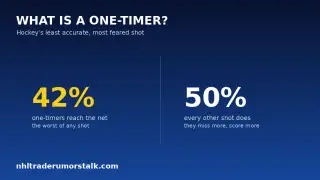
A one-timer reaches the net just 42% of the time, the worst of any shot, yet it is the most dangerous weapon in hockey and the shot Ovechkin...
By Mike Johnson · 11 min read
Comments
Be the first to share your take.
Get NHL trade rumors in your inbox
One email per week, zero spam, verified rumors only.